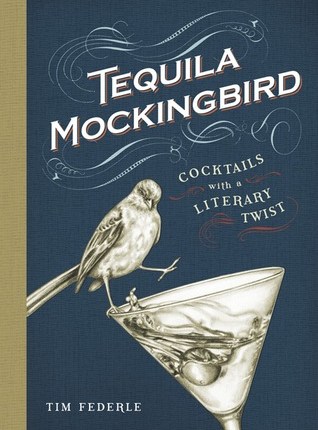
New life goals: buy this book. Read every classic mentioned within and try associated drink. (I was shocked by how few of these I’d read.)
I highly recommend this charming book of literary-themed drinks. For folks who are either underage or choose not to imbibe, there are a few non-alcoholic selections and snacks included.
The book summaries are hilarious and playfully presented. Some of my favorite drink titles: “Paradise Sauced”, “Are You There God? It’s Me, Margarita.”, and “Moby-Drink”.
This is a must-read for any bookworm or aspiring bartender. Five stars. Cheers!
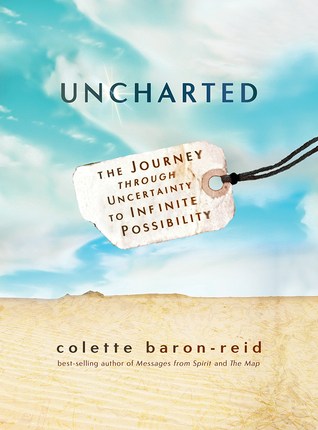
In Uncharted, Colette Baron-Reid guides the reader with journaling, visualization, personal stories, and meditation exercises through unexplored realms of the spirit as a method for greater self knowing and actualization.
I enjoyed this book, but it felt a bit all over the place. Let me explain what I mean by examining some of the many subjects discussed:
In the introduction, Colette begins by giving some background information into what’s been going on with her for the past couple of years.
One of those big changes is that she is now channeling an group of beings, whereas, prior to this, she wasn’t.
In this passage, she’s talking about the entity helping her to write Uncharted: “It’s like “they” had the puzzle pieces, and when I was ready for them, they dropped them down on the page for me to discover. I’m not realizing that this is, in essence, what channeling an “entity” is. It’s something I never quite understood, and I’m afraid I didn’t respect its power as I should have. So I hereby surrender my inner critical cynic who doubted others when they shared their channeling stories. I get it now.” loc 55, ebook.
She calls this/these entities, Fred. Throughout the book, Fred pops up and shares a message or clarifies something. I felt as if the channeled messages could have composed a whole other book in addition to this one.
Plus, it’s clear that she’s still honing her ability to talk and understand to this inner knowing. Anyway, it “muddied the waters,” so to speak, of Uncharted from nearly the first page.
Colette doesn’t think much of the ego or what she calls the “small self”:“When you view the world through the limits of your small self, you see only the separated parts of the material world. You are guided by your personal narratives that tell you who you are based on your past experience, ambitions, and goals that were set within the Realm of Form. You’re oblivious to being part of one big matrix of interconnectedness. You forget where home is, and you feel lost.” loc 634, ebook.
I’ve read all sorts of different teachings about the ego, but I’ve started to lean towards Abraham Hick’s thoughts on the matter. They teach that the ego is the lens through which the divine within you perceives reality and that our desires are breadcrumbs along the path to eternal joy if we allow ourselves to realize them.
Hicks also says that (paraphrasing): “If you only remembered how much you wanted to be in these bodies, you wouldn’t be so quick to fault yourself and your desires. You are the leading edge of thought- you take spirit beyond which it has ever been before.”
In my mind, that is the function of ego: to express our unique personality. Isn’t the desire to be free of ego also a desire driven by the ego?
I did like Colette’s definition of co-creation, which is one I’d never heard before: “Here’s how it works between you and Spirit. You, as an individual, are always cocreating. The divine creative force is always there with you, along with spirits and allies who enthusiastically join in as you co-create reality. And you are never alone.” loc 712, ebook. Encouraging, I think.
I also liked the lesson on fate, our internal “stories” and the subconscious mind: “Listen, it’s not fun to admit that while your story about yourself has been influenced by other people and things that just seemed to happen “to” you, it was also co-written by you personally to a large degree. Fate played a role, to be sure, but you can take much greater control over your “fate.” As Carl Jung is supposed to have said, “Whatever is not brought from the unconscious into the awareness seemingly comes to us as fate.” loc 1568, ebook.
The fact that shadow dwells hand in hand with light is something that I’ve learned through my own meditation practice.
Here’s what Colette has to say about it: “In the Realm of Light, we recognize that light always exists in duality with a shadow- there’s no avoiding it. There is always a dark side to everything, a contrast between what is nourishing and loving and what is draining and entangled in fear, anger, or hatred. Those emotions will always exist, but they don’t have to overwhelm you or scare you away from the process of co-creation and transformation.” loc 1892, ebook. I believe that is true.
As for the movement through Colette’s “realms”, it reminded me of shamanistic work by Robert Moss. I’m not sure about the order in which she explores things (seems like every teacher has a different way to do it), but I think that, if your intention is greater self knowledge and if you practice what Colette teaches, you will find it.
In fact, if you try just a fraction of what she suggests in Uncharted, you will learn something about yourself. She gives plenty of exercises to attempt in here if one particular method doesn’t speak to you.
Recommended mainly for the New Age enthusiasts because of the subject matter, methods, and channeled material, but also for anyone who is curious about finding and embodying one’s authentic power.
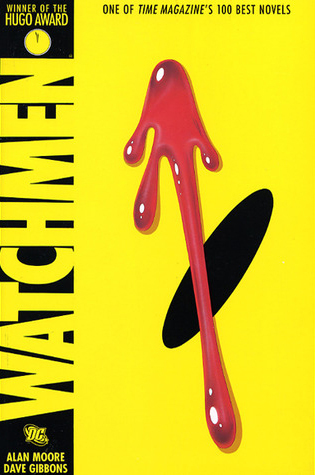
I can’t stop thinking about this graphic novel. It’s not something I’d usually like- ultra-violent with a very dark vision of humanity- but there is something incredibly compelling about it.
It starts with a murder. Watchmen is the story of a group of super heroes who don’t fight crime anymore because vigilantism was outlawed. Among the many costumed regular heroes (The Comedian, Rorschach, Nite Owl), there is an actual superhero, Dr. Manhattan, who suffered a freak radiation accident and was changed, permanently. He perceives time as happening all at once and can manipulate matter in multiple dimensions. Each of the heroes has a story, some are very sad, and all of them are upset as one of their own has just been killed. Can they figure out who the murderer is before he/she strikes again?
My favorite character out of the bunch is Dr. Manhattan. “We gaze continually at the world and it grows dull in our perceptions. Yet seen from another’s vantage point, as if new, it may still take the breath away.” pg 27, Chapter XI. He’s nearly godlike in his capabilities but that makes it practically impossible for anyone to understand him.
My husband’s favorite is Rorschach, which I could understand, but he was far too violent for me to truly appreciate the character. I feel like there’s an underlying importance to that character though, something that I couldn’t quite grasp…I tried thinking about Rorschach as a rorschach blot for the Watchmen and it nearly broke my brain.
And the comic within the comic? Fascinating.
The Watchmen is more than a superhero story: it’s an examination of power both physical and in the heart. It’s a criticism of government, the media, and art used to manipulate others. It looks at gender roles, rape, and sexual preferences and predilections. It asks: why would a person dress up and create an alter ego in the first place? And, beyond all that, it is a mystery and a love story. There’s a lot to enjoy in here if you can get past the blood, gore, and soul crushing darkness. Recommended for an adult audience only.
They’re trying to get to the coast and south to warmer climates, but many obstacles lie in their way. In addition to starvation because of the nuclear fallout, the duo face external threats like cannibalistic tribes of savage men and women.
But it’s not just a battle to save their bodies, the father must teach the son the proper way to live (like not eating other people) to save his spirit from the crushing darkness that has overtaken everything. It is a struggle to retain the internal spark that divides humanity from the animals.
This is a book about survival in a dystopian reality, but it is also about the sustaining and literally life preserving power of love.
My one complaint about this book is that the author didn’t clearly label who was speaking during the dialogue. He just went down a line to illustrate change of speaker. I had a really tough time keeping track of who was saying what.
Take this passage, for example: “Can I ask you something? he said. Yes. Of course. Are we going to die? Sometime. Not now. And we’re still going south. Yes. So we’ll be warm. Yes. Okay. Okay what? Nothing. Just okay. Go to sleep. Okay.” pg 9 The whole book is like that, anytime anyone is talking.
Otherwise though, this is an amazing, heart-pounding, thrill ride of a book.
I loved the father’s advice to the son throughout the journey: “A corpse in the doorway dried to leather. Grimacing at the day. He pulled the boy closer. Just remember that the things you put into your head are there forever, he said. You might want to think about that. You forget some things, don’t you? Yes. You forget what you want to remember and you remember what you want to forget.” pg 10
The father/son relationship described in here was fascinating to me. Generally, at least in my experience, the relationship between a mother and a child is the closer one in the family because of certain biological imperatives. McCarthy flips that whole paradigm on its head with this story. In here, it is the father who stands between the child and death. It is the father who finds meaning in a world gone mad through helping the child find food, stay clean, and stay protected from the elements.
“The boy sat tottering. The man watched him that he not topple into the flames. He kicked holes in the sand for the boy’s hips and shoulders where he would sleep and he sat holding him while he tousled his hair before the fire to dry it. All of this like some ancient anointing. So be it. Evoke the forms. Where you’ve nothing else construct ceremonies out of the air and breathe upon them.” pg 63.
I think one of the main lessons in here is that life holds the meaning that you assign to it. And, even if civilization falls apart, you can create your own mini-civilization through your actions and intentions.
“He’d had this feeling before, beyond the numbness and the dull despair. The world shrinking down about a raw core of parsible entities. The names of things slowly following those things into oblivion. Colors. The names of birds. Things to eat. Finally the names of things one believed to be true. More fragile than he would have thought. How much of it was gone already? The sacred idiom shorn of its referents and so of its reality. Drawing down like something trying to preserve heat. In time to wink out forever.” pg 75 Beautiful.
If civilization ever ends, look for me at the library. Probably will be reading this book. 🙂
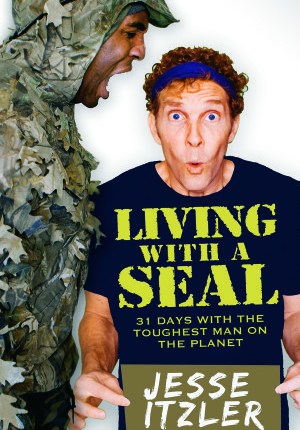
Jesse Itzler leads an interesting life. As a successful businessman and entrepreneur, his off-the-wall ideas for solving difficult situations and for stirring the pot have served him very well.
In this book, Living with a SEAL, he documents a month of training with a real life SEAL (who is called just “SEAL” throughout the book).
The workouts were insane, potentially life threatening, but Jesse achieved some astonishing results in a very short period of time. He also bonded with his trainer and learned, through daily interactions, that the sort of conditioning that it takes to make a killer like his SEAL, takes place mainly in the mind and such training can leave its marks on the psyche.
Jesse explains his motivation:“I don’t know if I was thinking about my mortality, or fretting over how many more peak years I had left, or anything like that. I think I was just thinking that now was as good a time as any to shake things up. You know, to break up that same routine.” loc 91, ebook.
SEAL thinks very carefully, bordering on obsessively, about safety and potential disaster scenarios for Jesse and his family. In this passage, he’s purchased an inflatable raft so that, if another 9/11 happens, that Jesse and crew could get out by taking the river.
Here’s what Jesse’s wife, Sara, thought of this: “I’m supposed to grab my son, strap a fifty-pound pack on my shoulders, carry four oars, walk a mile to the river, inflate this survival raft, and then paddle to New Jersey… in the middle of a national emergency?” There is dead silence in the room. … I think to myself, she has a point. Finally SEAL interjects. … “Sara, don’t EVER underestimate the power of adrenaline,” he says.” pg 961, ebook.
SEAL is a man who gets things done, sacrificing his own health to finish tasks that he’s started: “I found out SEAL once entered a race where you could either run for twenty-four or forty-eight hours. Shocker: SEAL signed up for the forty-eight-hour one. At around the twenty-three-hour mark, he’d run approximately 130 miles, but he’d also torn his quad. He asked the race officials if they could just clock him out at twenty-four hours. When he was told they couldn’t do that, he said, “ROGER THAT,” asked for a roll of tape, and wrapped his quad. He walked (limped) on a torn quad for the last twenty-four hours to finish the race and complete the entire forty-eight hours.” loc 1483, ebook.
Amazing what people can accomplish when they set their minds to it. Personally, I would have stopped when I broke myself, but then, I suppose I wouldn’t make a very good SEAL.
The extreme exercise that SEAL demanded of Jesse had some surprising mindfulness benefits:“…with SEAL around, I’m learning how to be more present. It’s primarily because I have to. If I don’t, there is no way I will be able to finish the tasks at hand. I just go one step at a time. One rep at a time. And when I’m done, I worry about the next step or rep.” loc 1909
I was continually impressed by the physical displays of power and endurance from SEAL. But then, he’d have an interaction with Jesse or his family and I’d question the man’s paranoia levels and ability to function in society.
In this passage, he’s encouraging Sara to mix up the times that she goes to get the mail: “Sara, you need to mix up your pattern.” “Pattern?” “Yeah, your pattern. … The time you get the mail. That’s your pattern. It’s the same every day. It’s predictable.” “I get the mail after lunch,” she says, “That’s the most convenient time.”… “Exactly. You know that. And I know that. The mailman most definitely knows that. So I bet EVERYONE knows that.”… “Just do me a favor. Change up the pick up time.” loc 2161, ebook.
Living with a SEAL is a lot of fun, but as I said, there are hints of a darker reality that SEAL has learned to endure. It is never graphic or spills over, but you can feel it boiling under the surface.
Incredibly scary and a perfect read for the month of October, Colin Dickey examines ghosts, haunted buildings, and other urban legends throughout the United States. But, it’s not just about ghost stories, he also delves into the true histories of everything from cemeteries to asylums.
When I picked up Ghostland I thought: how creepy can the US be, it hasn’t been around all that long, comparatively speaking. And I found out: really, really creepy.
You don’t have to believe in ghosts to enjoy this book. Here’s what the author had to say in the intro: “Even if you don’t believe in the paranormal, ghost stories and legends of haunted places are a vital, dynamic means of confronting the past and those who have gone before us. Ultimately, this book is about the relationship between place and story: how the two depend on each other and how they bring each other alive.” loc 23, ebook.
I learned a lot of quirky, historical details about the United States. For example, did you know that Spiritualists were a huge part of the suffrage movement?: “Early suffrage meetings were heavily populated with mediums and trance speakers; in some places it was difficult to find suffragists who weren’t also Spiritualists. Spiritualism had given many of these women practice and confidence in speaking to groups with authority; by allowing others (the dead) to speak through them, American women began to speak for themselves in greater numbers. Spiritualism was only one of many factors and social movements that drove women’s suffrage, but it was a vital and important one.” loc 961-978, ebook.
One night, my ride home from work was late and I found myself alone in the library with all of the lights off and it was so spooky. I felt like I was being watched and jumped at every little creak in the stacks.
In this passage, Dickey explains why: “Few things are more unsettling than being somewhere emptied out, after everyone else has left. If you’ve ever worked a closing shift, or as a security guard, you know the way a place can change after the doors are locked and the lights are dimmed, when the lighting so carefully designed to spotlight the latest gadgets goes slack, when the mood lighting gets moodier. It’s as though you don’t belong there.” loc 1250, ebook
The most disturbing moments, for me, were the true history portions of the narrative: “Early madhouses were often revealed to be nightmares of abuse and neglect. Reports of incontinent patients hosed down with icy water, naked women chained haphazardly to the walls, fleas and rats rampant, and other horrors gradually prompted a desire for something more sanitary and humane.”loc 2205, ebook. Eeeek. Is it any wonder that these places are haunted?
Dickey includes a poem by Goethe in his examination of the “ruins” of Detroit: “Goethe wrote in 1827: “America, you have it better Than our old continent, You have no ruined castles And no ancient basalt. Your inner life remains untroubled By useless memory And futile strife.” That was then. Now, almost two hundred years later, we’ve started to catch up to old Europe. We have plenty of ruined castles now, plenty of wasted strife to call our own.” loc 3217, ebook. I would have disagreed with that sentiment but then I readGhostland. Now, I know better.
I laughed, but I’m not proud of myself. This satire for fans or non-fans of the book, The Life-Changing Magic of Tidying Up: The Japanese Art of Decluttering and Organizing by Marie Kondō, takes no prisoners in its scathing examination of the minimalist movement. As it clearly states in the intro, this is not a self help book. As a librarian, I’d add that it is under the Dewey Decimal classification 818s (humor) rather than the 130s (self help), so that claim would be true.
First, let’s make one thing clear, I’ve loved ‘de-cluttering’ various rooms in my house and finding those objects that ‘spark joy.’ But, I couldn’t help but laugh at the process of it through the lens Jennifer McCartney provides.
Here’s what she has to say about ‘life changing magic’: There’s nothing wrong with wanting to improve your station in life or making changes to things you’re unhappy with. I guess. But be wary of neat slogans and books that promise life-changing magic. The only real magic in the world is from unicorns and the high you get from poppers. pg 19
I’ve never felt like a failure at the ‘tidying process’ but Jennifer’s book should appeal to those who do. Here’s her advice for how to ‘Be Free’: “Let go of caring, let go of guilt and feelings of failure. Breathe in good messy, breathe out boring tidy.” pg 28
In her book, Marie Kondo writes about thanking her small purse for its service at the end of every day. Jennifer has different ideas about the care and functionality of your handbag: “…you should always purchase the biggest purse you can carry. Here’s a good purse test: Can it fit a bottle of wine? No? Move on. Yes? Buy it.” pg 75
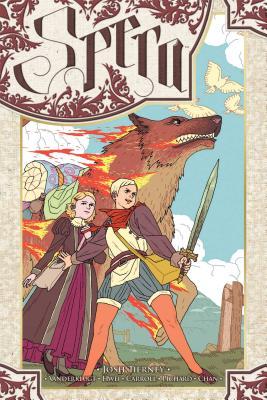
Spera is the story of two princesses, one who likes to sword fight and explore and another who likes to read and stay inside. One day, the tomboy princess, whose name is Pira, turns up in Lono’s (the reader) kingdom and says that her father the king is dead. They have to get away now to save Lono’s life. Where will two young princesses go to hide? A magical land called Spera. And so, the adventure begins.
I think that Spera tried to tell an engaging fairy tale with built in gender role options to educate impressionable young girls about who and what they can choose to be, but it didn’t quite work. Graphic novels need more than an interesting characterization idea- to engage reluctant readers, they need to tell a great story. Spera never gets there. The underlying message is sound- let children be who they are. Don’t point girls towards a book or boys towards a sword just because that’s their gender. But frankly, that’s it. The rest of the story, minus a run in with a creepy child, is kind of a non-starter.
Multiple authors contributed to this book so that’s a plus in my mind. Every chapter the reader gets a different artistic interpretation of Pira, Lono, and the fire spirit, Yonder. I gave Spera an extra star on Goodreads just for the artwork. As an adult, I found the variety enjoyable but I could see it being confusing for younger readers. They may not understand why the characters look so different every couple of pages.
If I was asked for a graphic novel recommendation for young girls that has fantasy elements, I’d skip Spera and point readers towards Princeless #1 by Jeremy Whitley.
I found this to be a fascinating study into the various forms of out of body experiences and the science behind them. Unfortunately, the second half of the book that deals with quantum mechanics and multiple dimensions went over my head.
So, The Out of Body Experience may lend itself more towards engineers and mechanical-minded types rather than artists, but that’s ok. Engineers need interesting books to read too. 🙂
Peake is very clear about the goals of this book: “In its pages I will review the evidence that such altered states of consciousness are subjectively real experiences; I will delve into the science by which consciousness can seemingly locate itself outside of the body and I will, finally, present my own hypotheses as to what may be happening when a person experiences such perceptions.” loc 98, ebook.
I felt like he accomplished all of that, but I was left with a sense of confusion/awe rather than clarity/awe. I had the same feeling when I tried to listen to a lecture by Amit Goswami. I knew enough to know that I had no idea what he was saying.
In this passage, he’s talking about shamanistic out of body experiences, something I do know a bit about: “Indeed, in my discussions with my shaman contacts, it became clear that what is encountered is a series of worlds full of archetypes pulled up from the deepest areas of the subconscious mind. However, what is of significance is that these beings seem to have motivations of their own, as if they have an existence independent of the shamanic traveller.” loc 261, ebook It is pretty trippy stuff.
Peake also tackled why remote viewers have trouble proving the validity of their experiences with verifiable facts in lab settings: “I am absolutely convinced that Ingo Swann believes he actually perceives information by remote viewing. In his books and articles he comes across as a genuine and honest individual, but the evidence seems to contradict this. … In my opinion he is remote reviewing, but not doing so in this dimension.” loc 1157, ebook.
Frankly, I always wondered about that too — why can’t remote viewers see whatever they want whenever they want or why are they sometimes completely wrong? The US military spent a pile of money developing a protocol that only works some of the time, but, the fact that it works at all blows my mind.
Peake presents the hypothesis that lucid dreaming and out of body experiences are two sides of the same coin: “The hypnagogic and hypnopompic states are really the same phenomenon that places consciousness in that liminal region between sleep and wakefulness. The only difference is in the circumstances. The hypnogogic state is experienced on going to sleep and the hypnopompic state is experienced on waking up. We define an OBE when a subject is unaware of their soma.” loc 1541-1558, ebook.
So, in layman’s terms I think he’s saying: out of body experiences happen when you’re awake, lucid dreaming happens when you’re asleep, but otherwise it is the same type of non-ordinary consciousness.
One more interesting fact, just one though, because otherwise my brain might explode:“Now, the fascinating thing about (the) electromagnetic spectrum is that the human eye can only see a very small section, the part we call ‘visible light’… If the electromagnetic spectrum were a roll of movie film that stretched for 2,500 miles (this is the distance between London and Jerusalem), the visible spectrum would be the size of one film frame, about three inches. This is just how little we human beings see of the real universe that is out there and yet most of us believe that ‘seeing is believing’! If we could see radio waves we would see a sky full of galaxies, not stars.” loc 2024, ebook.
Can you imagine — a sky full of galaxies? I can.
Recommended for the seriously scientific minded.
If you’re more into the history of the phenomena rather than the science, just stop reading before the second half of the book.