Much has been said over the past couple of months about the new film, The Odyssey, by master movie maker Christopher Nolan.

From the sets, costumes, and acting, extending even to the physiques of those involved in the film, no stone has been left unturned in the universal search for meaning from this ancient work of art, which was reimagined and introduced to the modern audience.

Even the translation and author (Emily Wilson) whom Nolan utilized to develop his script has been brought into the fray, with criticism lobbed at both Nolan’s unique vision for his masterpiece as well as the focus of his interpretation.

For, at its root, that is what everyone from Elon Musk and on is talking about, Nolan’s individual creation, how it fits into the universal narrative of story, and how their (the commentators) individual viewpoints differ from Nolan’s own.

I’d like to contribute my particular viewpoint of the film, which I’ve seen three times at this point (as of September 6, 2026). I will not highlight differences in Nolan’s interpretation versus my own for I think we’ve had that type of thing ad naseum.

Instead, I will apply symbols from the film to my work, the Light Congress, which is a narrative story about the soul’s journey, just as much as the Odyssey is the same. Perhaps, with a comparative analysis of a few similar symbols in both works, we can come to a new understanding of the spirit worlds, similarities between the paths of self knowledge from ancient times to today, and a new appreciation of the genius of Nolan, beyond a simplistic criticism of how he shot a scene or his use of modern language in a historical drama.

One more note, before we move on, my favorite element of Nolan’s film was the music. I watched a ‘making of’ documentary of the Odyssey on Disney+ and learned that Nolan hired musicians who utilized ancient instruments to make the haunting soundtrack for the film.

As the notes rose from the flute player’s mouth and fingers, it was like the sound drew me into the screen and I walked with the Greek hero as he faced the monsters, forces of nature, and his own countrymen in his epic journey home again. Thus is the magic of music, a universal language and bridge to the divine, and why it was my favorite element of the film.

Now, for a few similar symbols from my work and Nolan’s own, and what that might mean about the universal phenemonen which could be called the Hero’s Journey. As we say in the Light Congress, game on!

Giants in Armor, the Laestrygonians

In Nolan’s film, Odysseus (played by the incomparable Matt Damon) and his men are desperate for food and supplies as they make their way from Troy to Ithaca. On a random island, they enter an ancient forest and come upon a Child in the form of a giant in well-formed silver armor.

It is unclear if the Child speaks their language, for their request for help is met with a cry of fear and the Child runs from them, deeper into the woods, summoning his family who, to the detriment of Odysseus and his crew, turn out to be even larger, angrier giants, who are capable of defending themselves and their territory, which they do, to disasterous effect.

It must have been scary, in the time before translators, maps, what-have-you, to venture outside of the confines of your known world, by which I mean, the place of your birth and the tribe who taught you how to speak and move through the world. How would it be possible to trade or trust with another group who might not share your values beyond wanting to protect the resources that they have against your depredations?

Think of the scene prior to Odysseus and his men meeting the Laestrygonians. They are sacking a town, presumably on the coast of the Mediterranean, but it isn’t so distant or unknown from Ithaca because one of Odysseus’s men speaks the language of the townspeople and is able to translate when Odysseus asks why they burnt their town rather than give supplies to him and his men.

Think of the unfortunate villager’s response, “Because we thought you were the Sea People, coming to loot and burn.” Rather than giving their resources to the enemy, they razed the village.

I would posit that if the village had had the fighting power of the Laestrygonians, we would have seen a battle scene on the shore, similar to what happened next, rather than the destructive fires.

If you cannot defend what you have and you do not want to strengthen your enemies, you burn it to the ground. It isn’t an elegant solution, but what is one to do when faced by overwhelming forces outside of your control?

In the Light Congress, my version of the Laestrygonians arrive in Chapter 26 and I call them ‘the Blades of Eternity.’ Read it here: https://thelightcongress.com/2026/07/05/chapter-26-eirene-among-the-blades-of-eternity-and-formless-legions-of-mars/ (If you don’t want to donate to access the rest of the chapter, set your amount at $0 and it should let you through the gate. That being said, I would greatly appreciate anything you could spare to keep a roof over my head and food in my mouth.)

In my version of the soul’s journey, the Laestrygonians/Blades of Eternity sort or cull the unmanifested and embodied thoughts of a giant before they dance through the skies of the Inner Worlds to emerge into the Outer Worlds. These ‘thoughts’ could be Odysseus and his men, hungry warriors from another place who need resources to live as much as any in the territory in which they find themselves.

Rather than metaphorically burning themselves to the ground, the Blades of Eternity return the questing thoughts to their source so that they can emerge again at a more convenient time rather than taking up precious resources that could be used by someone else.

This is a more poetic way (or perhaps child-like viewpoint, which is something I embrace) of confronting the sad reality of the material world in which there are not always enough supplies for all and we prioritize our own tribe, whatever that may mean to you, over the needs of the Other or outsider to our home and hearth.

A militaristic response to the visitors to our shores is in direct opposition to the Golden Rule or ‘Law of Zeus’ as Nolan puts it so wonderfully in his film. How would you like to be treated if you were in need of food, shelter, and a friendly face, far from the home of your birth? I imagine you would like such things to be given to you without delay, preferably in a friendly and welcoming manner.

That is not what Odysseus and his men receive nor what the unmanifested thoughts of the giant from my story get either.

Let’s ask ourselves, what does this mean from a universal viewpoint? I would say, it means humanity has not changed very much, from ancient times to our own, presumably enlightened, era.

Scylla and Charybdis

Here be dragons. To digress a minute, I love how mapmakers from times past didn’t even attempt to hide their fear of the unknown and potentially dangerous places outside of the known world.

In an artistic representation of this fear, they created chimeric images as Carl Jung would call them, of monsters and creatures of legend, lurking at the edges of the map.

Jung believed the mind creates chimeric images when one has two or more opposing ideas and desires to integrate both ideas during the process of individuation. In the map metaphor, the dragon on the edge of the map stands for danger, certainly, but also opportunity.

Think about the legends of dragons, guardians of gold, maidens, wealth untold. There is danger in facing the unknown and you may lose parts of yourself that you didn’t even know you had, such as an innocence of spirit or unjaded heart. But, if you can face the unknown and return successfully to the lands you know, you could return with treasures beyond belief and the imaginations of those you left behind in your journey into the unknown.

That risk, the fight between your own spirit’s desire to experience something new or remain comfortable with the known, could be represented by the dragon or sea serpent.

Let’s take this metaphor back to the Odyssey. Odysseus and his men face two ancient monsters out of legend because they are at a critical juncture on the sea route home. One is a mysterious undersea creature at the center of an inescapable whirlpool; the other is a spider-like (in Nolan’s interpretation) mountain spirit.

One of the monsters, by their presence in the sea, represents the subconscious mind. That which we do not acknowledge can be far deadlier than that which we acknowledge for we can resist that which is known, like the monster hiding in the mountain heights. But that which we don’t know, we can’t even defend against.

Both monsters, like the blood-thirsty Laestrygonians, want to feast on the literal flesh of Odysseus’s men. The hero of our story is given a warning by a seer shortly before this moment. If he goes towards the whirlpool monster, everyone will die. If he heads past the mountain, only six men will be lost.

The pass must be faced, so what is to be done? The answer was obvious for Odysseus who, throughout the journey, consistently tries to minimize his losses in order to get everybody safely home. He chooses the mountain spirit, faces heavy criticism from his men for it and loses their trust, yet the men are safe until the next hurdle on the journey must be cleared.

Did he make the correct decision? I think so; his men disagreed. What is your opinion?

In the Light Congress, the choice between Scylla and Charybdis takes place in a world beyond death in a cave dominated by my personal shadow. Read it here: https://thelightcongress.com/2026/08/11/chapter-49-a-therapeutic-application-of-the-animus-of-dark-ivy-and-lighted-thorns/

Shadow tries to convince me to dive into the whirlpool to Scylla to “Let’s swim with the deep sea creatures as we were born to do” but instead I change the vision itself, revealing the monster beneath the waters to be nothing but foam and fast currents.

In the universal subconscious mind of humanity, there are scary shadows, chimeric spirits, and presences that mystics and seekers still do not yet comprehend. Does this mean we should leave the exploration of the Inner Worlds for another day? I say no. If we did that, we’d lose the metaphorical boat of mankind.

Instead, I, like Odysseus, say let’s brave the spiders in the mountains, take our losses (the number six is connected in the universal language of the qabalah to the world of the sacrificed gods or Christ for the Christians reading this blog post), and continue on for the good of all.

We will never get home if we can’t find the courage to venture beyond what we already know and understand.

The Siren’s Song or Song of the Undines

In Nolan’s movie, this was my favorite scene, the part where Odysseus asks his men to tie him to the mast of the ship so that he can hear the legendary song of the sirens and live to tell the tale.

The hero’s interpretation of their seductive pull hit a chord within me as something real and true. He described it in a couple of different ways: “all the things you wanted to be and then all the things you wish you never wished for.” “a delicious itch you want to scratch but you find it under the skin and can’t reach it.” “a song of all the promises I failed to keep.” “I don’t really want to go home.”

So what the heck does all that mean? Let’s start by thinking back to our conversation about Scylla, Charybdis, and the meaning of their chimeric appearance in Odysseus’s reality.

The sirens are beings of both the water and land. They have the tails of fish but the ability to breathe air like mortals. Thus, they are spirits of both the conscious and subconscious minds, and could potentially represent the dance of the individuated consciousness between those two mysterious polarities. (In the Light Congress, I call these ‘light’ and ‘shadow’ but I disgress.)

Why is Odysseus on his epic journey in the first place? He was called by the great warrior king Agememnon to honor his responsbilities as the leader of a Greek city state and to support the king of all in his quest to dominate the trade routes of the sea through their conquest of Troy.

Did he want to leave Penelope and Telemachus, his people, and homeland to fulfill his duty to the king? In the film, no. In the written version of the oral story, no.

But once he was out there, facing challenges, fighting against men of various nations, monsters of legend, and the world itself to find his way home again, it must have been quite a seductive adventure. I think we see the phenomenon in the thrill-seekers of today, the people who die on dangerous mountain slopes that didn’t really need to be climbed or others who die through accidents during other risky activities.

What calls us to put our lives in danger for the thrill of the moment?

Then, once we are there in that moment, fighting the battle for the kings of the earth, how on earth do we put that animalistic aspect of ourselves, the one that will literally kill the person next to us for whatever reason, back to sleep again?

The song of the sirens unmasked this primal urge in Odysseus, both its beginning and the place where the proud warrior found himself, on a journey to go back to the home that will never be the same because of what he did on the road to winning the Trojan war.

It is a very big question.

In the Light Congress, I am taught the song of the undines (my version of the siren’s song) by the elemental beings themselves. This takes place during a symbolic initiation into motherhood by one of the spirits of water. Read it here: https://thelightcongress.com/2026/05/20/chapter-13-a-near-escape-and-the-song-of-the-undines/

Through the subsequent chapters of my hero’s journey, I utilize the song of the undines to remind the spirits I meet about loves they have lost on their sojourn through time.

How could someone forget about a love so fierce that it once kept the stars in motion for them? Consider the timeless existence of the gods and goddesses. Consider the actions they’ve taken throughout time, just because they’ve existed for so long. Consider Odysseus’s predicament on returning home even in the course of a single, mortal lifespan.

In my tale, the itch that can’t be scratched is that experience of first love. The experience is so powerful because the first time a person experiences love, you can’t help but think that this feeling, this over-arching need to be in the presence of another person because they are your beloved, is somehow unique to only you. Only you, the person tells themselves, has ever felt this draw, this mysterious force that draws people together, creates families and friendships, and then departs again or morphs into something else, a familiarity that can quash erotic love if measures aren’t taken to prevent such things.

I would dare to say love is a creation of both the conscious and subconscious minds, just as the song of the sirens is. Once you know this and understand its magic, does that make it any less magical? No.

How about any less painful when it changes or ends?

I hope you get the chance to see Nolan’s masterpiece before it leaves theaters and enjoy it as much as I did.

Thanks for reading,

Heidi

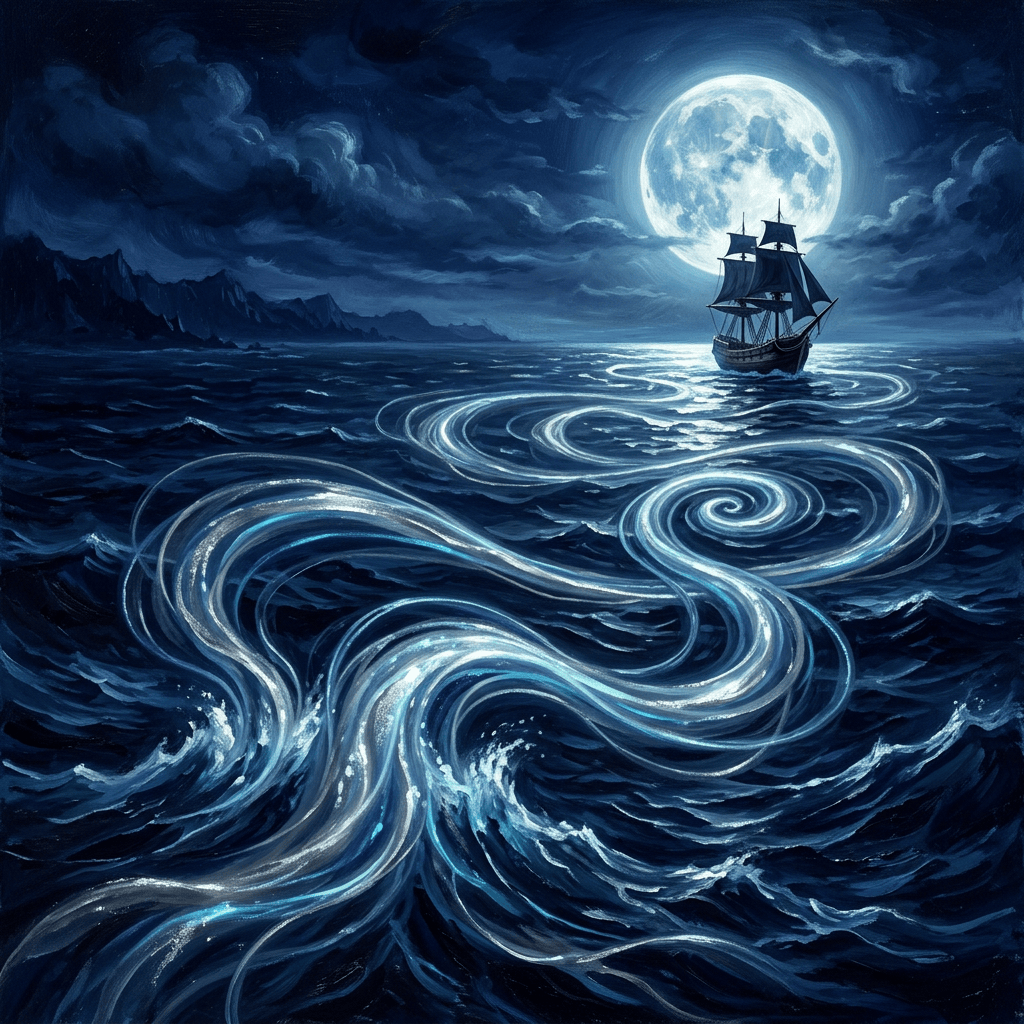
Sailing ship on a moonlit sea with glowing swirling waves
A sailing ship follows luminous, curling currents across a moonlit sea beneath dramatic clouds. Image created with WordPress AI.

Read more of the Light Congress at www.thelightcongress.com.


Leave a comment