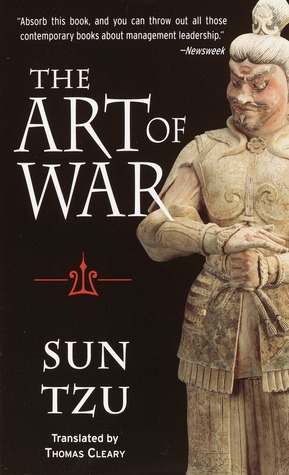
The Art of War by Sun Tzu

The Art of War by Sun Tzu
theartofwar

Frankly, I got tired of my husband quoting this and having no idea what he was talking about. So, Heidi-the-Hippie-Librarian picked up The Art of War. I must love him a great deal because this was so not my thing though I valiantly struggled my way through it. I’d say about three quarters of the book was commentary and translation quibbles on the text itself, which is really rather brief and kind of pretty in a “this is how you kill a bunch of people” sort of way.

My big take-aways from this were:
1 Pay attention to where you are and what’s going on around you all the time, especially in war. And also be super sneaky about what you’re going to do. “..concealing courage under a show of timidity presupposes a fund of latent energy; masking strength with weakness is to be effected by tactical dispositions. Thus one who is skillful at keeping the enemy on the move maintains deceitful appearances, according to which the enemy will act.” loc 1143

2 If you have to fight, do it fast because it’s too expensive to do for long.“There is no instance of a country having benefited from prolonged war.” loc 822, ebook.

3 Everybody uses spies and if you don’t, then you’re going to lose because the other guy is for sure using spies.

4 Be flexible and make the call as things happen. Don’t stick to orders from an emperor who’s really far away because he doesn’t know what the heck is going on like you do. “Water shapes its course according to the nature of the ground over which it flows; the soldier works out his victory in relation to the foe whom he is facing. Therefore, just as water retains no constant shape, so in warfare there are no constant conditions.” loc 1296, ebook.

Photo by Pixabay on Pexels.com

5 Know who you are and who you’re fighting. This knowledge makes you strong so other people can’t determine your future. Use it to win your war.“The art of war teaches us to rely not on the likelihood of the enemy’s not coming, but on our own readiness to receive him; not on the chance of his not attacking, but rather on the fact that we have made our position unassailable.” loc 1542, ebook.

6 Have a vision beyond what is right in front of you and guide yourself toward it, one good decision at a time. “To see victory only when it is within the ken of the common herd is not the acme of excellence. Neither is it the acme of excellence if you fight and conquer and the whole Empire says, “Well done!” To lift an autumn hair is no sign of great strength; to see the sun and moon is no sign of sharp sight; to hear the noise of thunder is no sign of a quick ear. What the ancients called a clever fighter is one who not only wins, but excels in winning with ease.”loc 1011-1030, ebook

7 The place that you fight is very important as well as the officer who is calling the shots and telling you which way to go. If either of these things suck, you’re in trouble. “The natural formation of the country is the soldier’s best ally; but a power of estimating the adversary, of controlling the forces of victory, and of shrewdly calculating difficulties, dangers and distances, constitutes the test of a great general.” loc 1886, ebook.

Photo by Pixabay on Pexels.com

8 Knowing small details about the enemy is very important. For example, if the dudes you’re going to war against put their pots and pans away, they’re planning on dying in battle. Who knew, right? “When an army feeds its horses with grain and kills its cattle for food, and when the men do not hang their cooking-pots over the campfires, showing that they will not return to their tents, you may know that they are determined to fight to the death.” loc 1752, ebook.

So, that’s The Art of War. Now back to my regularly scheduled reading. 🙂  And, thank you for reading.

How The Secret Changed My Life: Real People. Real Stories. by Rhonda Byrne

How The Secret Changed My Life: Real People. Real Stories. by Rhonda Byrne
secretchangemylife

How the Secret Changed My Life adds nothing new to the Secret franchise, but it’s still fun to read if you enjoy hearing success stories about people who utilized the Law of Attraction.

The criticisms of it have been voiced elsewhere and more eloquently: that it is predominantly focused on material things and that it stresses being happy at any cost.

That being said, I liked the stories.

I liked hearing about how people hit rock bottom and then changed their lives for the better. I really liked hearing that you can do or have or be anything that you want. Who wouldn’t?

Here’s Rhonda in the introduction: “I want you to know how easily you can change your life, and it’s not by running around trying to force it into the shape you want. You change your life in the only way you can ever change it: change your mind, and then your life will change.” loc 47, ebook.

All true change comes from within, I do believe that. Until I typed this out, I didn’t realize just how many times she used the word “change” in those two sentences. Counting back I see… five times? That’s a lot of change, people.

I feel like this book warns the reader away from negative emotions, but they serve a purpose too. It gives you a starting point- if you know what you don’t want, then you know what you do.

I’m not suggesting that you wallow in negative emotion, but feeling it, acknowledging it, then moving on isn’t as bad as this book makes it out to be.

Photo by Andre Furtado on Pexels.com

In this passage, Rhonda is suggesting the use of “Secret Shifters” to control your mood: “The Secret Shifters… are things you can focus on whenever you find yourself feeling angry, frustrated, or any other negative emotion, in order to change those negative feelings in an instant. They might be beautiful memories, future events, funny moments, nature, a person you love, or your favorite music.” loc 409, ebook.

I say: feel whatever you’re feeling and trust that your emotions will eventually rise again like a cork in water. Helping yourself along with “Secret Shifters” or gratitude lists or whatever is fine, but for goodness sake, don’t force it. “What you resist, persists.”

I really agreed with this next passage: “Most of us have the wrong idea about happiness. We believe that if we get everything we want, and if life continually goes our way, we will be happy. And from that belief, we create all the excuses in the world for why we can’t be happy right now. … It’s those very excuses that are preventing you from being happy now.” loc 457, ebook.

I used to do that- looking forward to circumstances or events and ignoring where I was. The journey really is the point, so why not be happy now?

Recommended for readers who are looking for a quick, uplifting read about the Law of Attraction or for those who are interested in getting started but don’t necessarily believe or know how it works. The latter, in particular, may find a great deal of worth in these pages.

As I said, I liked it, but I’d also recommend reading Abraham Hick’s books too: to learn the value of negative emotion, not be afraid of feeling your full emotions, and to learn not to practice affirmations unless you’re feeling “in the zone” so to speak.

Additional reading: The Vortex: Where the Law of Attraction Assembles All Cooperative Relationships and Co-creating at Its Best: A Conversation Between Master Teachers.

Thank you to NetGalley and Atria Books publishing for a free copy of this book!  And, thank you for reading.

Voracious: A Hungry Reader Cooks Her Way through Great Books by Cara Nicoletti

Voracious: A Hungry Reader Cooks Her Way through Great Books by Cara Nicoletti
voracious

Voracious is so much fun. It is a foodie’s honest and open-hearted memoir in which she weaves literary themed recipes each chapter and gives a brief summary of the novel that included it.

Pair this with Tequila Mockingbird: Cocktails with a Literary Twist and you’ve got the makings of a bookworm’s dream feast!

The chapters from Cara’s childhood were some of my favorites because they were so relatable. “I cooked and read my way through awkward middle school years, first love, devastating heartbreaks, loss, and change. As I grew older, though, reading and cooking became the forces that broke me out of my shell, allowing me to form strong relationships and connect to the world around me.” pg 5, ebook.

Or this part, when she and her friends find Grimm’s Fairy Tales in the attic: “We were heavily into mysteries and ghost stories at the time, and when we found the book we were certain that we had discovered some dark secret that my parents had tried to keep under lock and key.” pg 13, ebook.

I know that feeling- when I was ten or eleven, I found a copy of Alfred Hitchcock’s Mystery Magazine that Grandma had loaned to my mother and I had read half of it before Mom discovered me, contently turning pages in the summer sun.

She took it away saying, “This is too old for you.” Some humbug mothers, hmph. I learned to hide when I was reading anything that I thought she wouldn’t want me to. Can’t keep a bookworm down.

In this passage, Cara talks about the culinary conundrum of gingerbread houses: “You toil and sweat, smelling good smells and touching sticky dough and mixing sweet icing for hours and your only reward is visual. It seems so wrong.” pg 15, ebook. I’ve always thought that too!

Photo by EKATERINA BOLOVTSOVA on Pexels.com

If I try any of the recipes in here, it’s going to be: If You Give a Mouse a Cookie- Brown Butter Chocolate Chip Cookies (pg 34, ebook) or To Kill a Mockingbird: Biscuits with Molasses Butter (pg 93, book).

I think that some of the huge list of offerings in this book are only for “brave” kitchen people. Cara includes recipes for homemade doughnuts, ice cream, chocolate eclairs… things that I don’t think I’ll ever gear myself up to attempt. But, she makes me want to try and I suppose that is half of the battle.

Highly recommended for anybody who likes to eat, read, or do both at the same time. I would guess that’s pretty much everybody.

Thanks for reading!

This Trip Will Change Your Life: A Shaman’s Story of Spirit Evolution by Jennifer Monahan

This Trip Will Change Your Life: A Shaman’s Story of Spirit Evolution by Jennifer Monahan
tripwillchangeyourlife

This is a firsthand account of Jennifer Monahan’s discovery of her spiritual path and budding abilities as she becomes a modern day shaman.

From the introduction: “Let me start off by saying that I’m nobody special- or at least not any more special than every other person on the planet. But I do believe in magic. And the power of the universe in our lives. This is a story about magic- everyday magic that exists in everyone’s life but that for many goes unnoticed and unappreciated.” loc 26, ebook.

I think that everyone has potential, but sometimes they don’t tap into it because they can’t see how or don’t realize that they can. Jennifer Monahan empowers the reader through her example.

Shamanism, though ancient, feels New Age.

Take this teaching about the mind: “The purpose of the mind, Antonio said, is to train it so that it focuses on those things that make the spirit sing and bring it joy- and to let everything else just slip on by without letting it get caught in the mind… Doing this enables people to live in a state of happiness, peace, and self-love.” loc 153, ebook.

That’s the message of Thank & Grow Rich: A 30-Day Experiment in Shameless Gratitude and Unabashed Joy, Ask and It Is Given: Learning to Manifest Your Desires, The Secret… I could go on. Perhaps the New Age teachers are on to something :).

My favorite parts of This Trip Will Change Your Life were the messages that Jennifer received during meditation and what she experienced during her vision walks. It is always positive, loving, supportive or healing wisdom that is shared.

Photo by Tobi on Pexels.com

Here’s the universe speaking to her while she breathes: “You don’t have to do anything. Just be. Radiate love out from your core. Focus on that and on being present. Be accepting of people- that is the first step. You’re doing that now; keep it up. Share your joy- find it! Tap into your life.” loc 503, ebook.

I can see this book not appealing to everyone: Jennifer has a few moments of “far out” behavior like talking to her crystals and receiving their wisdom, but if you believe that everything contains a spirit (the philosophy in The Life-Changing Magic of Tidying Up: The Japanese Art of Decluttering and Organizing comes to mind) then it is not such a stretch to entertain the idea that one could communicate with inanimate objects.

Western Qabalists have taught for centuries that everything has a guiding intelligence and that to tap into it, you just have to clear your thoughts, ask, and be ready for the response. But, if you don’t have a fairly open mind about such things, this might not be the book for you.

Overall, I loved the message of this book and the approachable way that Jennifer explains shamanism. “The realization that I’ve come to is that the basic human need is to be loved. And that love needs to come from within. When we feel love for ourselves, we are happy and feel good. We can then send our love unconditionally out into the world.” loc 751.

Highly recommended for those who are curious about shamanism or finding one’s spiritual calling- whatever that may be.

Recommended read alikes: the books I linked above as well as The Flying Witches of Veracruz: A Shaman’s True Story of Indigenous Witchcraft, Devil’s Weed, and Trance Healing in Aztec Brujeria by James Endredy (another modern shaman), The Way of the Shaman by Michael Harner(classic text, gives plenty of general knowledge and practices) or Active Dreaming: Journeying Beyond Self-Limitation to a Life of Wild Freedom by Robert Moss (incorporates the shamanistic practices of the Aborigines for a modern audience).

Thank you to NetGalley and She Writes Press for a free digital copy of this book! And, thank you for reading.

Solomon’s Thieves, Book 1 by Jordan Mechner

Solomon’s Thieves, Book 1 by Jordan Mechner
solomons-thieves

I almost flipped out over this series today because I went to request the second book and found that it was never published. Not to be deterred, I used my mad librarian skillz and discovered that, after the release of Solomon’s Thieves, the publisher bound all of the issues together rather than releasing them one at a time.

The continuation to this story is found in the graphic novel: Templar. Crisis averted.

And what is this comic about?

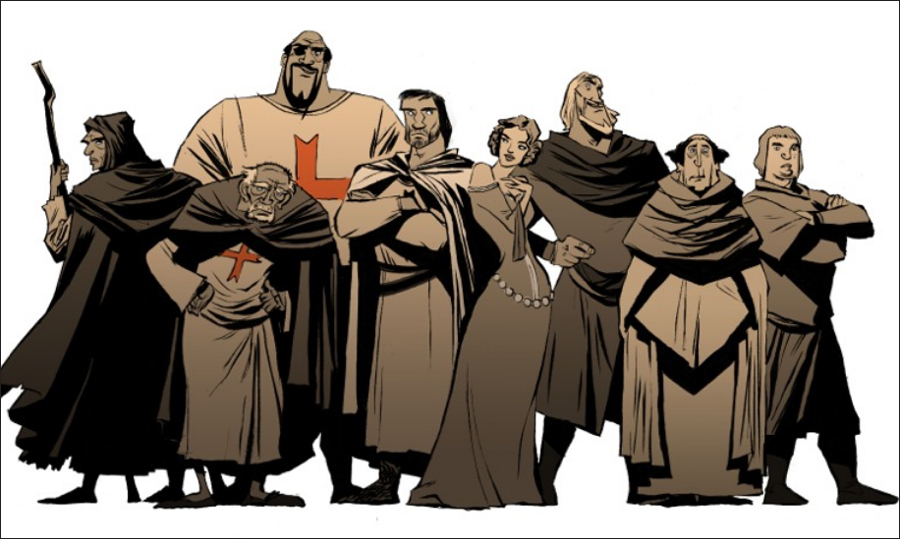
Solomon’s Thieves is a fun romp through 1300’s Paris at the time of the Templar’s disbanding and destruction.

The focus of the story is on a knight named Martin. He was unlucky in love and joined the order to change his life, which he manages to do. But, on the Templar’s return from an unsuccessful campaign in the Holy Land, after a wild night of drinking and some bad choice making in Paris, he ends up not being present when his brethren are arrested by the French king, Philip the Fair.

The adventure really starts when the king’s men discover that the fabled treasure of the Templars is not in their church/compound. Martin, after a series of misadventures and a chance meeting with some unsavory characters, decides to find out where that treasure is and steal it back.

Bit of trivia: the Paris Templars were arrested on Friday, October 13th, 1307. So, 709 years ago tomorrow (I wrote this review on October 12th, 2016). Now, you know.

templarcastFrom the introduction: “From humble beginnings the Knights Templar rose to become the most powerful military monastic order of the medieval world. Pledged to protect pilgrims during the Crusades, the Templars become heroes to Christians everywhere. Their fighting prowess was legendary. … But the Crusades were an expensive, blood-soaked failure. In 1291, after two centuries of warfare, the Muslims drove the Christian armies from the Holy Land once and for all. For the Templars, it was the beginning of the end…” Goosebumps!
I’d consider this a PG-13 level comic because of some rough language, non-graphic violence (dude sticks his sword through the chest of a guy in one of the panels, but there isn’t blood everywhere), and some, again non-graphic, torture scenes.

The afterward by Jordan Mechner is fantastic. Not only does he give the actual history that he based the comic on, but also the sources that he used to research it. Huge librarian thumbs up from me. 🙂

“Like Western gunslingers or Japanese samurai, their legend grew, and it attracted new recruits, donations, and privileges. By their peak in the thirteenth century, the Templars had grown into a religious, military, and banking organization whose assets, power, and reach rivaled any of the kings of Europe. They were the Jedi of their time. Their incredible downfall rocked the world. Its echoes reverberate to this day.” pg 135

If you enjoyed this comic, you may like: The Religion by Tim Willocks(regular book- not a graphic novel, very bloody, for adults only) or The Knights Templar: Discovering The Myth And Reality Of A Legendary Brotherhood by Susie Hodge (regular book also- non-fiction but in-depth examination of the templars).

Thanks for reading!

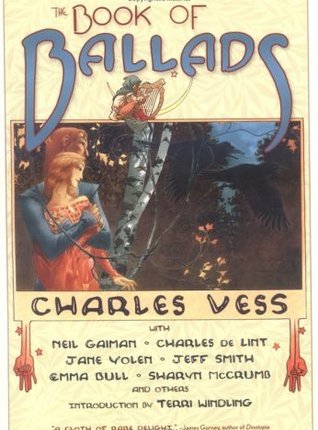
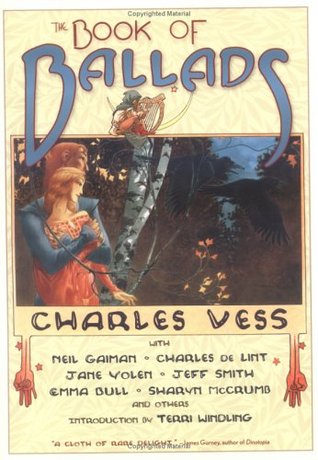
The Book of Ballads by Charles Vess, Introduction by Terri Windling

The Book of Ballads by Charles Vess, Introduction by Terri Windling
bookofballads

In this graphic novel, Charles Vess illustrates many traditional folk ballads that have been rewritten by some fairly popular fantasy artists like Neil Gaiman or Emma Bull.

I didn’t realize how many traditional ballads have negative interactions with strangers as their primary topic.

According to these stories, any stranger is either a fairy or the devil. If it is a male, he’ll either kill you or impregnate you and then come later to take your kid back to whatever magical land he came from.

If it is a female, she’ll either imprison you, change you into a snake, rape you, or take you away to fairyland.

An alternate title for this book could be: Strangers are Bad- Don’t Talk to Strangers or Let Them In Your House or Have Sex with Them Unless You Want to Die.

But all joking aside, there are very few ballads that end either happily or well. It is unsettling reading them altogether, like delving into a book of short horror stories.

From the introduction by Terri Windling: “Ballads, which are stories in narrative verse, are related to folktales, romances, and sagas, with which they sometimes share themes, plots, and characters (such as Robin Hood). No one knows how old the oldest are. It’s believed that they are ancient indeed…” pg 10

Which disturbs me even more when I consider that these stories were written for a reason. Can you imagine raising a kid in the dawn of time? ‘Don’t go talk to that stranger over there ’cause he might eat you. We don’t know about that exact dude, but seriously… it has happened. Remember how you used to have a sister?’

vess2

Take the ballad of Tam-Lin for instance: “O I forbid you, maidens a’, That wear gowd on your hair, To come or gae by Carterhaugh, For young Tam-Lin is there. There’s nane that gaes by Carterhaugh But they leave him a wad, Either their rings, or green mantles, Or else their maidenhead.” pg 92

In other words, don’t go over there or he’ll take your stuff or rape you.

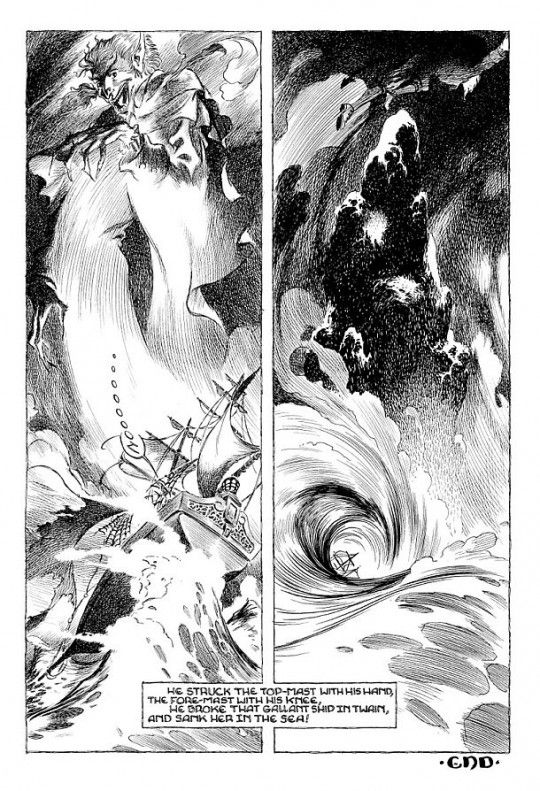
Despite the depressing nature of the stories, the artwork is very pretty and it’s all in black and white which makes the stories even starker. My favorite of the bunch is The Great Selchie of Sule Skerry which was re-written by Jane Yolen.

In it, a young maiden falls in love with a man from the sea. Guess how it ends?

Some read alike graphic novels: A Flight of Angels by Rebecca Guay, The Last Dragon by Jane Yolen, or The Sleeper and the Spindle by Neil Gaiman.

Thanks for reading!

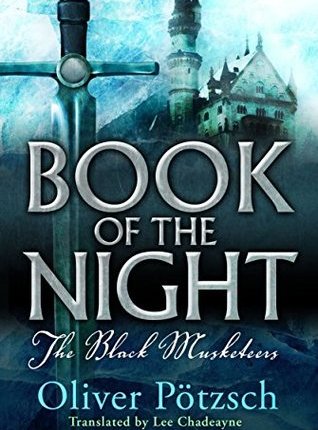
Book of the Night: the Black Musketeers by Oliver Pötzsch, translated by Lee Chadeayne

Book of the Night: the Black Musketeers by Oliver Pötzsch, translated by Lee Chadeayne

“Book of the Night” tells the story of Lukas Lohenfels, whose family is driven apart by an evil monk, intent upon finding a relic of power.

Along the path to revenge and redemption, Lukas makes some friends, some enemies, and discovers that magic may be more real than he ever imagined.

This is the 1600’s Germany, a land of princes and shifting alliances. A war has been going on for a very long time.

Photo by Kai Pilger on Pexels.com

Who are the Black Musketeers of the title?: “The Black Musketeers were the best fighters in the Reich,” he began, “trained in the use of all sorts of weapons and fear by everyone. They served as bodyguards to the Imperial General Wallenstein … We fought and shot like the devil, with swords, pikes, daggers, muskets, and pistols, and drove the Danes and their allies back across the Elbe River.” loc 129, ebook.

Lukas is forced to grow up quickly, not only because of what happens to his family, but also because of the unending war: “Lukas thought of the dreadful stories he’d heard about the war. Last year in Magedeburg, twenty thousand citizens had been slaughtered by mercenaries, who then completely destroyed the city.

Similar things had happened in other parts of the Reich. Whenever the troops passed by, no matter which side they were on, they left behind death, destruction, hunger, and disease. When he was young, Lukas had always imagined war as something heroic. … but for some time now, he had understood that war was not an adventure, but left horror and misery in its wake.” loc 1112, ebook.

Photo by Egor Kamelev on Pexels.com

Author Oliver Pötzsch is a master storyteller. His story flows smoothly and well.

I particularly enjoyed this homage to the classic, The Three Musketeers by Alexandre Dumas:

“If you have something to tell me or the others,” Gionvanni said softly, in order not to waken the other sleeping boys, “please don’t hesitate. We’re always here for you, do you understand?” He smiled. “One for all and all for one. I heard those words somewhere before, and they apply to us as well.” loc 1148, ebook.

I liked how Lukas and his friends were never entirely certain about the existence of magic until it entered their lives in a very real way: “Nonsense,” Paulus muttered. “Magic is humbug! I only believe things I can see and fight with my sword.” “It’s said there are certain vapors and gases that make people sick and can even cause the plague,” Giovanni replied matter-of-factly. “Can you see them, Paulus?

No. But still they’re there, invisible, all around us. Perhaps there’s lots more out there that we simpleminded little men can’t even imagine.” loc 1428, ebook.

Photo by Simon Berger on Pexels.com

When I saw the name, Oliver Pötzsch, and snapped up this book from NetGalley, not realizing that Book of the Night is intended for a young adult audience.

As I wrote earlier, it is very well-written and I had a lot of fun reading it. That being said, the Book of the Night isn’t very sophisticated nor are there any true surprises within its pages.

Book trailer for ‘Book of the Night’ in German.

However, it is a perfect pick for anyone in the 12 to 16 age group, or anyone who enjoys an adventure with some magical undertones.

If you’re looking for some more magical/coming-of-age young adult read-alikes try: Seraphina by Rachel Hartman, Archivist Wasp by Nicole Kornher-Stace, and Jackaby by William Ritter.

Thank you to NetGalley and Amazon Crossing Publishing for a free digital copy of this book!  And, thank you for reading.

Tequila Mockingbird: Cocktails with a Literary Twist by Tim Federle

Tequila Mockingbird: Cocktails with a Literary Twist by Tim Federle
tequila-mockingbird

New life goals: buy this book. Read every classic mentioned within and try associated drink. (I was shocked by how few of these I’d read.)

I highly recommend this charming book of literary-themed drinks. For folks who are either underage or choose not to imbibe, there are a few non-alcoholic selections and snacks included.

The book summaries are hilarious and playfully presented. Some of my favorite drink titles: “Paradise Sauced”, “Are You There God? It’s Me, Margarita.”, and “Moby-Drink”.

This is a must-read for any bookworm or aspiring bartender. Five stars. Cheers!

Thanks for reading.

Uncharted: The Journey through Uncertainty to Infinite Possibility by Colette Baron-Reid

Uncharted: The Journey through Uncertainty to Infinite Possibility by Colette Baron-Reid
uncharted

In Uncharted, Colette Baron-Reid guides the reader with journaling, visualization, personal stories, and meditation exercises through unexplored realms of the spirit as a method for greater self knowing and actualization.

I enjoyed this book, but it felt a bit all over the place. Let me explain what I mean by examining some of the many subjects discussed:

In the introduction, Colette begins by giving some background information into what’s been going on with her for the past couple of years.

One of those big changes is that she is now channeling an group of beings, whereas, prior to this, she wasn’t.

In this passage, she’s talking about the entity helping her to write Uncharted: “It’s like “they” had the puzzle pieces, and when I was ready for them, they dropped them down on the page for me to discover. I’m not realizing that this is, in essence, what channeling an “entity” is. It’s something I never quite understood, and I’m afraid I didn’t respect its power as I should have. So I hereby surrender my inner critical cynic who doubted others when they shared their channeling stories. I get it now.” loc 55, ebook.

She calls this/these entities, Fred. Throughout the book, Fred pops up and shares a message or clarifies something. I felt as if the channeled messages could have composed a whole other book in addition to this one.

Plus, it’s clear that she’s still honing her ability to talk and understand to this inner knowing. Anyway, it “muddied the waters,” so to speak, of Uncharted from nearly the first page.

Colette doesn’t think much of the ego or what she calls the “small self”:“When you view the world through the limits of your small self, you see only the separated parts of the material world. You are guided by your personal narratives that tell you who you are based on your past experience, ambitions, and goals that were set within the Realm of Form. You’re oblivious to being part of one big matrix of interconnectedness. You forget where home is, and you feel lost.” loc 634, ebook.

Photo by Sachin C Nair on Pexels.com

I’ve read all sorts of different teachings about the ego, but I’ve started to lean towards Abraham Hick’s thoughts on the matter. They teach that the ego is the lens through which the divine within you perceives reality and that our desires are breadcrumbs along the path to eternal joy if we allow ourselves to realize them.

Hicks also says that (paraphrasing): “If you only remembered how much you wanted to be in these bodies, you wouldn’t be so quick to fault yourself and your desires. You are the leading edge of thought- you take spirit beyond which it has ever been before.”

In my mind, that is the function of ego: to express our unique personality. Isn’t the desire to be free of ego also a desire driven by the ego?

I did like Colette’s definition of co-creation, which is one I’d never heard before: “Here’s how it works between you and Spirit. You, as an individual, are always cocreating. The divine creative force is always there with you, along with spirits and allies who enthusiastically join in as you co-create reality. And you are never alone.” loc 712, ebook. Encouraging, I think.

Photo by Mayu on Pexels.com

I also liked the lesson on fate, our internal “stories” and the subconscious mind: “Listen, it’s not fun to admit that while your story about yourself has been influenced by other people and things that just seemed to happen “to” you, it was also co-written by you personally to a large degree. Fate played a role, to be sure, but you can take much greater control over your “fate.” As Carl Jung is supposed to have said, “Whatever is not brought from the unconscious into the awareness seemingly comes to us as fate.” loc 1568, ebook.

The fact that shadow dwells hand in hand with light is something that I’ve learned through my own meditation practice.

Here’s what Colette has to say about it: “In the Realm of Light, we recognize that light always exists in duality with a shadow- there’s no avoiding it. There is always a dark side to everything, a contrast between what is nourishing and loving and what is draining and entangled in fear, anger, or hatred. Those emotions will always exist, but they don’t have to overwhelm you or scare you away from the process of co-creation and transformation.” loc 1892, ebook. I believe that is true.

As for the movement through Colette’s “realms”, it reminded me of shamanistic work by Robert Moss. I’m not sure about the order in which she explores things (seems like every teacher has a different way to do it), but I think that, if your intention is greater self knowledge and if you practice what Colette teaches, you will find it.

In fact, if you try just a fraction of what she suggests in Uncharted, you will learn something about yourself. She gives plenty of exercises to attempt in here if one particular method doesn’t speak to you.

Recommended mainly for the New Age enthusiasts because of the subject matter, methods, and channeled material, but also for anyone who is curious about finding and embodying one’s authentic power.

Some similar reads: Thank & Grow Rich: A 30-Day Experiment in Shameless Gratitude and Unabashed Joy by Pam Grout, Ask and It Is Given: Learning to Manifest Your Desires by Esther Hicks, and Active Dreaming: Journeying Beyond Self-Limitation to a Life of Wild Freedom by Robert Moss.

A big thank you to Hay House and NetGalley for a free digital copy of this book!  And thank you for reading.