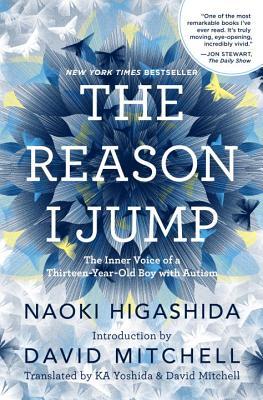
This is one of the first books I’ve ever read by someone with autism or who is neurodivergent.
Goodreads described it quite succinctly: “You’ve never read a book like The Reason I Jump. Written by Naoki Higashida, a very smart, very self-aware, and very charming thirteen-year-old boy with autism, it is a one-of-a-kind memoir that demonstrates how an autistic mind thinks, feels, perceives, and responds in ways few of us can imagine. Parents and family members who never thought they could get inside the head of their autistic loved one at last have a way to break through to the curious, subtle, and complex life within.”
The reviews on this one from my Goodreads friends are very mixed and I understand why. The Reason I Jump touches on a very emotional topic.
I’m not an expert on autism so I am completely unqualified to determine if Naoki wrote this book with or without help or the over arching truth of his experiences. However, as a reader, I thought that some of Naoki’s words were very beautiful.
Naoki talks about difficulties in communicating his feelings, the beauty of nature, the impossibility of controlling his emotions or repetitive actions- knowing that he’s not behaving “normally” but not able to do anything about it.
“Please don’t judge us from the outside only. I don’t know why we can’t talk properly. But it’s not that we won’t talk- it’s that we can’t talk and we’re suffering because of it.”pg 24, ebook.
It seems to me that everyone’s lens of perception is different and we can learn from each other if we share our own unique viewpoint. I certainly learned about Naoki’s inner world from this book.
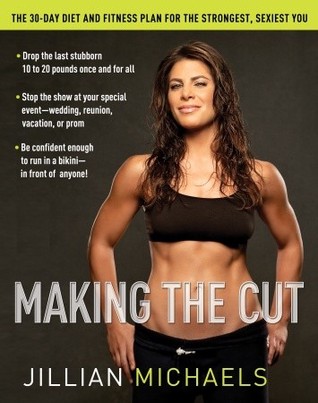
“Making the Cut” is a collection of recipes, workout tips, and insider training techniques from Jill Michaels, one of the trainers of the television program: The Biggest Loser. She’s hardcore and this book is a reflection of that.
Definitely not for everyone, myself included, I’d only recommend it to those who are already in very good shape. Let me make one thing clear, I’m not in “bad” shape, but I am not at the level required to complete these exercises.
So, I nearly killed myself trying to do Day 1 of the circuit training. I have a predictable cycle with fitness books. I read them, get all fired up about changing my diet and amping up my workouts, try it for awhile, then give up.
This one, at least, was so hard and I was hurting so bad that I gave it up right away rather than drawing it out to its inevitable conclusion. Her clean eating tips are solid and I’ve added a lot more fresh fruits and veg to my table, but, the workouts are just too hard.
I had my husband helping with the timer and figuring out what I was supposed to do at each step because her descriptions of the exercises are all gathered together in an index at the end. He was encouraging me to stop after the first two minutes, but I insisted on doing at least ten- silly me.
The weird frog push-ups were an impossibility from the start. I almost broke my nose when I tried to lower my face to the floor. I had to laugh, it was ridiculous.
My only saving grace was that I was using the equipment at my home rather than the gym. If I had humiliated myself like that in public, I might not have been able to give this book the “liked it” three stars.
There is a disclaimer written in the description of this book on Goodreads that states it is not for everyone, but it was awesome in my opinion. I am going to admit that I am incredibly biased.
However, I couldn’t convince my public library to buy them because, I was told, they are “too fringe”.
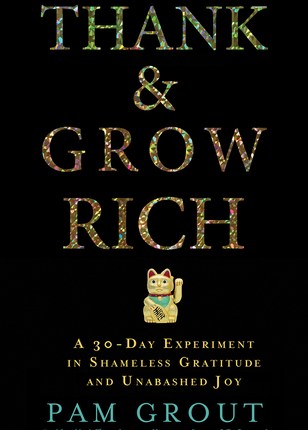
Perhaps this book, which focuses on adopting an attitude of gratitude to improve your life, will be mainstream enough to make the cut.
Pam addresses the metaphorical elephant contained in her title early in the book: “No offense to Napoleon Hill, the author of the self help classic on which my title riffs, but the real power is in not thinking. If you want to override your brain’s unfortunate habit of leafing through your past and creating a present hologram to match, forget thinking. And start thanking.” Loc 108, ebook.
I read Think and Grow Rich last year and I could see how other people have beef with the classic. Napoleon Hill focuses on money, making connections, and doing the internal work to shoot yourself into the stratosphere of life success.
There’s very little in there about feeling your way to the same place.
Pam takes a different approach: “I should get this out on the table right now. This book won’t do a thing for your 401(k) or help you secure the McMansion you pasted onto your vision board. It’s not about getting rich in the traditional sense. … There’s nothing wrong with financial capital, but let me be very clear. It’s incapable of bringing any measure of real happiness.” Locs 324-337 ebook.
She gets to the heart of why seekers chase anything- because we believe that it will bring happiness. Pam suggests getting happy and then the success will come.
And, how does she say that we should “get happy”? By being thankful for what we already have.
“Be astonished by useless things. It’s easy to be thankful for the obvious- healthy kids, public libraries, strong marriages. But in this game we’re going to take it a step further. We’re going to build our gratitude muscle by also appreciating the insignificant and impractical…” Loc 856 ebook.
I had to include that passage for the library mention. Yay libraries!
Pam backs up her claims with scientific studies such as: “According to Richard Wiseman, psychology professor at the University of Hertfordshire in England and creator of Luck School, people who think they’re lucky actually are. After eight years of studying hundreds of self-identified exceptionally lucky and exceptionally unlucky people, he concluded that getting good breaks has nothing to do with karma or kismet and everything to do with how we see ourselves.” Loc 991 ebook.
I would like to state for the record that I am one of the luckiest people that I know. 🙂
She also includes a bunch of information from happiness researchers: “When it comes to success, research shows that while IQ, education, and training play cameo roles, the starring role, the headliner on the success stage, is “Do you have a vision? Do you believe it’s possible?” Shawn Achor, author of The Happiness Advantage: The Seven Principles of Positive Psychology That Fuel Success and Performance at Work… claims that predicting success using any other factor (say, your IQ or number of degrees) is about as effective as flipping a coin. What is effective, Achor and Frederickson and other happiness researchers have proven, is creating a happy brain that anticipates accomplishment, that knows success is just a matter of time.” Loc 1876 ebook.
I know that I have a pretty open mind when it comes to these types of books, but my thought is, what’s the harm in it? If it works for you, great! You’ve just discovered a new tool to use for living the best life for you.
If it doesn’t work, no harm done. At the very least, you would know for yourself.
The opinions contained within this review are entirely my own. Thank you to NetGalley and Hay House for a free advance reader’s copy of this book for review purposes! And, thank you for reading.
The Andy Cohen Diaries is the type of book that you have to be in the mood to read. It is basically like a book length gossip column, which can sometimes be exactly the kind of fluff that I want to read. Other times though… it is more annoying than amusing.
Andy writes it in a stream of consciousness style- event, event, feeling, event, aside, event, personal thoughts, inside joke, repeat. So, jump into this one if you want a bunch of gossip about the New York scene and Watch What Happens Live.
I thought Andy’s description of his book was spot on:“Sometimes-like life itself-these chronicles are funny, sometimes dishy, and sometimes even a little sad. And sometimes they are really, really shallow. Because sometimes life is shallow. I understand that and have accepted it. I hope you will too.” pgs 7-8 ebook
Andy’s life is filled with drama, divas, and emotion laden moments both on and off the screen. I enjoyed watching him juggle it all. He offers this advice for handling the more challenging people in your life: “…I told her I was sorry if I offended her. Sometimes, the only option is to say you’re sorry, even if you have no idea what someone is talking about.” pg 11 ebook.
I’ve never watched any of the Real Housewives of (fill in the blank city). So, those gossip bits didn’t mean all that much to me.
However, the parts about Lady Gaga were a different story! : “Then the weirdest cake arrived from Lady Gaga, red velvet cheesecake with white chocolate on top with Lady Gaga Art Pop written on it… the note said “Love, Gaga” in teeny little capitals. It looked like-I don’t know what actually-robot writing?”pg 18 ebook
Andy is from St. Louis, the closest city to my small hometown. So, we had that in common.
Any time he was taking about the weird things that people from St. Louis do, I was nodding my head in sympathy: “Everybody in St. Louis, all they talk about is how great St. Louis is. The hostess lady in the suite asked me if I lived in LA and I said no, I live in New York, and she said to me very earnestly, “Why, may I ask, would you ever leave St. Louis?” pg 38 ebook. Yeah, they do that.
I could go on and on. The Andy Cohen Diaries is just so quotable. Some read alikes: Amish Confidential by “Lebanon” Levi Stoltzfus (tell-all about the Amish Cofidential show and the Amish community) or My Horizontal Life by Chelsea Handler (hilarious recounting of Chelsea’s various escapades). Thanks for reading!
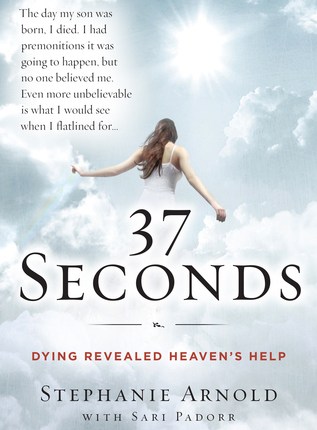
37 Seconds is a fascinating account of Stephanie Arnold’s near death experience. She had a premonition that she was going to die having her second child.
Stephanie did die for 37 seconds and had an amazing spiritual experience. Her religious upbringing is in Judaism which makes for a totally different lens of perception than other NDEs (near death experiences) that I have studied.
I like reading books about near death experiences and examinations of consciousness. So far, I’ve read twenty one books by folks from different religions and parts of the world about their NDE and what they’ve brought back with them to their normal, every day lives.
I found it interesting that the focus of Stephanie’s consciousness during the event was on her deceased relatives and their support of the physical world rather than on a location on a higher level where people go to hang out around their G-d for the rest of eternity.
Another portion of the account that made it different than others that I’ve read on the topic is that Stephanie accessed her memories of the time during her 37 second death through hypnosis.
Other NDE writers (Piper, Moorjani, Burpo, et al) came out of their NDEs with memories of what went down. Stephanie, because of the extreme trauma and the premonitions about her death that haunted her for months before the actual event, repressed her NDE.
Isn’t it fascinating? The study of consciousness never ceases to surprise me. It seems that not only do our lenses of perception create what we see in other modes of existence, but we can choose whether to access those perceptions or not.
I also liked Stephanie’s repeated message through 37 Seconds of trusting your own intuitions and believing in that inner voice. I feel that in modern society, we’ve advanced in so many ways both scientifically and technologically, that we discount simpler modes of understanding and knowledge.
Why try learning about why your body is presenting symptoms of anxiety and stress when we can just medicate it away? Why believe in your dreams and intuitions when educated doctors and scans show that nothing is wrong?
If Stephanie had listened to the experts, she would be dead. She is a great role model for a return to trusting ourselves. Doctors, medicine, and therapy have their place but so do dreams, intuitions, and the inner voice.
If you enjoyed 37 Seconds, try Wisdom of Near-Death Experiences: How Understanding NDEs Can Help Us Live More Fully by Penny Satori or Journey of Souls: Case Studies of Life Between Lives by Michael Newton.
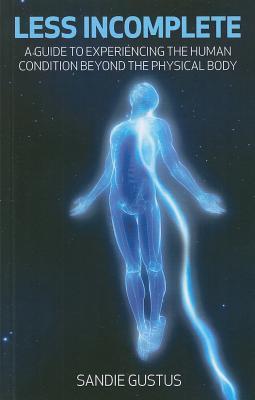
Like Journeys Out of the Body by Robert Monroe, Less Incomplete is about out-of-body experiences and how to have them.
Unlike Monroe’s book, there’s less personal narrative in this one and more about ethics and practical exercises for the out-of-body state.
So, in that way, it wasn’t as fun to read, but for people who are just starting out, I could see this book being an excellent place to start. I had never heard of Dr. Vieira and his work with the IAC (International Academy of Consciousness), so now, I have another resource to investigate too. Hooray!
Sandie’s reasons for writing the book: “…Vieira’s own books are notoriously sophisticated, technical and intellectual in style… My endeavor, with this book, is to make his work available to a wider nonacademic audience by presenting it in a language and format that everyone can understand follow, without compromising the integrity of his ideas in any way.” pgs 14-15
A simple explanation of other dimensions: “… when thinking about where the extraphysical dimensions are, we can say that many of them coexist and share space with the physical dimension. They are all around us. They are right here, right now. This fact is much easier to understand when we remember that we are also sharing space with innumerable invisible artificial electromagnetic waves, such as those used to broadcast television and radio and to transmit data across mobile phone networks and between aircraft and military installations.” pg 39
Other dimensions sound so normal when she puts it that way.
Sandie stresses the importance of exploring consciousness for evolutionary reasons: “If we take into account the broader, more detailed picture of what it means to be a consciousness… it is clear that physical life, rather than being meaningless or arbitrary, provides us with a sophisticated, challenging environment that is rich in opportunities to better ourselves and to mature- in other words, to evolve.” pg 162
I think it’s fun too.
Consciousness exploration is a chance to evolve, certainly, but it’s also a way to play, explore, and simply exist in a way that is entirely different from regular reality. That’s my only criticism of this book, I feel like it takes itself too seriously at times.
I was having trouble fitting my visions/meditations into the paradigm provided by this book until the chapter on Lucid Projection Techniques, section Projection through the Mental Body Technique: “Targets for a projection in the mental body are notional concepts that are outside the boundaries of ordinary life. The point of them is to break out of the boundaries of what’s known. The experience is epitomized by having an epiphany- suddenly you consider the concept of infinity or spirituality or oneness and you have an expansion of consciousness in which you grasp the whole idea. pg 254 Bingo.
Vieira doesn’t seem to have a high opinion of remote viewing: “Vieira describes it in Projectiology as “a daydream with some flashes of awareness or clairvoyance at a distance.” pg 270
I was surprised by that. It seems like, in this sort of research, one would want to consider all modalities for their possible contributions to the topic.
If you’re looking for more books on how to do out-of-body experiences, you may want to consider Soul Flight: Astral Projection & the Magical Universe by Donald Tyson, Soul Traveler: A Guide to Out-of-Body Experiences and the Wonders Beyond by Albert Taylor, and, one of my favorites, Otherwhere: A Field Guide to Nonphysical Reality for the Out-of-Body Traveler by Kurt Leland.
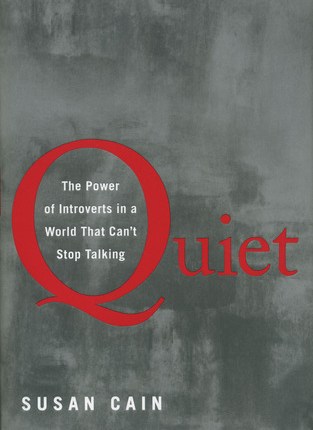
Quiet: The Power of Introverts in a World That Can’t Stop Talking entered my life at a particularly low moment.
Allow me to set the scene: I had been on vacation for a week and a half. We were in Colorado, visiting my husband’s family, some of whom I had met before, others whom I had not. I knew I wasn’t going to be entirely comfortable being around people the whole trip- I’m a huge introvert and I’m self aware enough to know that I need downtime, and quite a bit of it, to feel as if I’m functioning normally.
But I didn’t realize that my husband, who is just as introverted as I am and who I was counting on to help me through all of the introductions, dinners, conversations, etc, was going to immerse himself in Pokemon Go a majority of the time and essentially leave me to my own devices.
As Susan Cain would say, he found a “restorative niche” for himself in a digital world. It was hard on me as I didn’t have that escape.
So, here we are, visiting a friend’s home and my daughter, who strangely enough is a huge extrovert (the exact opposite of her parents), is struggling. She’s tired, out-of-sorts, and throwing a sulk every ten minutes.
I’m meeting yet more people, trying to hold trite conversations, and steer my child, all the while just wanting to retreat into a cave and not talk to anyone for a very long time. Honestly, I felt that way before we reached the party, but things seemed to get much, much worse the moment we arrived.
It had been building over the course of the vacation, but that day, my internal clamor reached a boiling point. My husband was oblivious to my growing discomfort as he’s catching Pokemon, again. (I don’t mean to sound bitter here, but I suppose that I am.)
I had forced myself for ten days to be social, keep the smile on my face, keep everything flowing smoothly. To my horror, I realize that I am about to have a panic attack in the middle of this crowd of people, more than half of whom I don’t even know. I grab my keys and leave.
I drive a couple blocks away, castigating myself for not being able to handle it and just pissed because, once again, like many times in my childhood, adolescence, and adulthood, I feel like I’m failing at life because I’m not a social butterfly.
I can’t stand to be around strangers for extended periods of time. I’ve always been this way- overly sensitive to others, noise, motion, events. I really dislike groups, parties, places where I have to circulate with a bunch of people who don’t know me or care about anything that I have to say.
The tears fell down my cheeks as I opened up my tablet and began reading this book. And I discovered that about half of all people are just like me.
Thank you, Susan Cain. Your book gave me the courage to drive back to my friend’s house and face the rest of the evening. I am not a pariah. I am an introvert and perhaps I can do a better job figuring out when I’ve reached my socializing limits before I meltdown.
Many of the positive attributes of introverts which Susan describes, I have, I’ve just never considered them as worth the trade-off of the extroverted personality.
I notice small details, have a great memory for conversations and events, long past the time when others forget such things. I think carefully about problems and people, devoting time to taking apart small nuances of books and movies, that other people don’t even consider, which makes me a good reviewer of media- perfect for my job as a librarian.
Susan nailed my general feeling about myself in the introduction: “Introverts living under the Extrovert Ideal are like women in a man’s world, discounted because of a trait that goes to the core of who they are. Extroversion is an enormously appealing personality style, but we’ve turned it into an oppressive standard to which most of us feel we must conform.” pg 34 ebook. Yes!
My role at the reference desk calls for an extroverted personality but I muddle through it, because I care about the job and helping others. Usually, I come home from work, totally worn out and in need of quiet time to unwind.
Susan helped me understand that sometimes “faking it” is worth it, if it for a cause that means something to you and that others do the exact same thing that I do.
Pull out the mask for the job, but then allow yourself the freedom to be who you really are at home: “According to Free Trait Theory, we are born and culturally endowed with certain personality traits- introversion, for example- but we can and do act out of character in the service of “core personal projects.” In other words, introverts are capable of acting like extroverts for the sake of work they consider important, people they love, or anything they value highly.” pg 391 ebook.
My favorite parts of the book were about sensitivity and social situations. Take this passage: “…maybe we didn’t choose … social accessories at random. Maybe we’ve adopted dark glasses, relaxed body language, and alcohol as signifiers precisely because they camouflage signs of a nervous system on overdrive. Sunglasses prevent others from seeing our eyes dilate with surprise or fear; we know from Kagan’s work that a relaxed torso is a hallmark of low reactivity; and alcohol removes our inhibitions and lowers our arousal levels. When you go to a football game and someone offers you a beer, says the personality psychologist Brian Little, “they’re really saying hi, have a glass of extroversion.” pg 277 ebook.
I may use that in my life. “Please hand me that glass of extroversion.”
I also really enjoyed learning the differences in thinking: “Introverts and extroverts also direct their attention differently: if you leave them to their own devices, the introverts tend to sit around wondering about things, imagining things, recalling events from their past, and making plans for the future. The extroverts are more likely to focus on what’s happening around them. It’s as if extroverts are seeing “what is” while their introverted peers are asking “what if.”pg 323 ebook. Yeah, I do that too.
I can’t recommend this book highly enough. It saved an evening for me, but more importantly, it changed the way that I view myself. There is power in knowing that you’re not alone. Again, thank you, Susan Cain. Some read-alikes: The Introvert’s Way: Living a Quiet Life in a Noisy World by Sophia Dembling (for introversion) or Furiously Happy: A Funny Book About Horrible Things by Jenny Lawson (for more instances of social anxiety).
“You’re Never Weird on the Internet (Almost)” is an excruciatingly honest memoir from Felicia Day about her quirky childhood, gaming addiction, cultural attitudes online, and life long struggle with anxiety and other mental health issues.
She reminded me a great deal of Jenny Lawson in her straight forward presentation of difficult topics and also in her exuberant storytelling style. And, in many other ways, she reminded me of myself.
Being a female gamer is hard. There, I’ve said it. Not only do your female friends not want to play video games with you, but your male friends never really accept you as a legitimate gamer. You’re kind of stuck in this twilight space of “this is what I love to do” but society doesn’t agree that it is appropriate for you to do.
Now, unlike the early days of MMORPGs, many more women play video games, and I’m sure that I’d make more female friends if I tried. But, back then in the fall of 2000, when I first got into EverQuest (one of the predecessors of WoW, the game that Felicia played), many more men played female avatars than actual women played. That’s just how it went.
I loved that Felicia addressed this female gamer white elephant, so to speak. There are few people who really talk about it, but it’s something that I’ve been dealing with for a long time.
I loved her cheerful attitude, even when things got tough: “My story demonstrates that there’s no better time in history to have a dream and be able to reach an audience with your art. Or just be as weird as you want to be and not have to be ashamed.” pg 19 ebook. That’s a pretty powerful lesson and one which artists and dreamers everywhere should know.
Felicia admits that she has very few hands-on skills, something which I also have in common with her. In this passage, she’s joking about ordering coffee: “…I’m determined to enjoy the liquid indulgences of modern life. Might as well take advantage of it all before the zombie apocalypse. I have no practical skills; I’m fully aware that I’ll be one of the first ones “turned.” Instead of learning motorcycle repair or something else disaster-scenario useful, I’ll order the drink I want until I become a shambling corpse.” pg 17 ebook.
I’ve thought about my librarianship skills and book reviewing abilities in that same light. If something catastrophic happens, I’m kind of screwed.
I mean, yes, there have been favorable depictions of librarians after the apocalypse (Station Eleven comes to mind) but really, what good could I do for people struggling to survive or myself? While we’re on the topic of librarians, I also enjoyed that Felicia’s first “job” was working for her aunt, a librarian. She said about it: “No job since has left me feeling so well rewarded.” pg 67 ebook. Aww….
Chapter Five: Quirky Addiction = Still an Addiction (How my obsessive personality steered me into a twelve-hour-a-day gaming addiction and an alt-life as a level 60 warlock named Codex) pg 85 ebook, was my favorite.
Gaming addiction is an actual thing. I’ve known multiple people who dropped out of college or lost their jobs because they couldn’t stop playing video games. I’ve also known people whose relationships started or ended because of it too. It seems silly for people who don’t have any interest in video games, but it can be as destructive an addiction and as real as anything else- drugs, sex, whatever.
Felicia nails the siren call of video games in this passage: “When we graduate from childhood into adulthood, we’re thrown into this confusing, Cthulhu-like miasma of life, filled with social and career problems, all with branching choices and no correct answers. Sometimes gaming feels like going back to that simple kid world. pg 93 ebook.
That’s it, really. Do the quest, get the reward, and repeat. Real life is never that simple or straight forward.
Though she felt like she wasted a lot of time, Felicia managed to break free of her addiction and channel her passion into the hugely successfully series: The Guild. I had never watched it, but after reading this book, I binge-watched every episode. She managed to take the culture, friendships, and craziness that is online gaming and turned it into a compulsively view-able series. I loved it.
If you haven’t had a chance to watch it yourself, I highly recommend it. One of the overarching points of this book, and the television show, is that not only can you overcome hurdles that held you back from the life of your dreams, but you can use the very thing that was the stumbling block to move onwards. Well done, Felicia, very well done.
One last little bit that I wanted to include in this review, because it rang so true for me, was Felicia’s thoughts about her struggles with mental illness. She says: “I couldn’t trust my own mind anymore, which was the scariest thing I’ve ever experienced. pg 170 ebook.
When your own internal filter, your brain, is compromised, you feel like you can’t trust yourself ever again. It’s as simple and as terrifying as that and, unless you go through it yourself, there’s not really any good way to explain what’s happened to you or why you’re so afraid.
If you’ve ever had any struggles with anxiety or mental health issues, you may really enjoy this memoir. Also, if you enjoy online gaming or want to understand one of your loved ones who does, you may like this book. Some read-alikes: Nerd Do Well by Simon Pegg, Fantasy Freaks and Gaming Geeks: An Epic Quest for Reality Among Role Players, Online Gamers, and Other Dwellers of Imaginary Realms by Ethan Gilsdorf, or Just a Geek: Unflinchingly honest tales of the search for life, love, and fulfillment beyond the Starship Enterprise by Wil Wheaton.
Part art appreciation and part homage to the female reader, Women Who Read Are Dangerous is probably the the most aptly titled book that I’ve ever read.
In addition to the beautiful images (my favorites pages 73 & 89), this book educates the reader about the politics, historical trends, and gender inequality tied to reading. Who knew that simply picking up a book could be such a subversive act?
Women Who Read are Dangerous sums up years of strange thinking about women and books with a dose of humor that I appreciated.
Take these historical opinions for example: “Women are too literal-minded for reading. Women are too sentimental, too empathetic, too distractable for reading. Women are passive, practically somnolent, consumers of popular culture, never realizing how, with the very books they choose, they participate in their own subordination.” pg 16
Or this: “The lack of all physical movement while reading, combined with the forcible alternation of imagination and emotion,” said the teacher Karl G. Bauer in 1791, would lead to “slackness, mucous congestion, flatulence, and constipation of the inner organs, which, as is well known, particularly in the female sex, actually affects the sexual parts”- so anyone who read a great deal and whose powers of imagination were stimulated by reading would also be inclined to masturbation, as indeed we can already observe in Baudouin’s painting. But such moralizing could not hold up the triumphal march of reading, including- and specifically- female reading.” pg 23
Can’t hold us back, right readers? I’m actually feeling pretty well for all the reading that I do.
Reading is power, I’ve always known that: “With the ability to read, however, there developed new patterns of private behavior that were to threaten the legitimacy of both the Church and secular authorities on a permanent basis. Women who learned to read at that time were considered dangerous. For the woman who reads acquires a space to which she and no one else has access, and together with this she develops an independent sense of self-esteem; furthermore, she creates her own view of the world that does not necessarily correspond with that conveyed by tradition, or with that of men.” pg 26
An introvert’s paradise, the keys to your freedom, the way to stick it to the “man”… as if I needed more reasons to read.
I also liked this description of reading: “Reading is an act of friendly isolation. When we are reading, we make ourselves unapproachable in a tactful way.” pg 34 I never really considered it that way before, but it is a method in which you remove yourself from the world for a time, even from those sitting in the same room.
Seems obvious, when I consider it, but I had never taken the time to do so.
Finally, I learned about how “silent reading” is a recent trend. Did you know?: “An illiterate today is not only someone who cannot read (or write), but also anyone who cannot understand a text unless he or she reads it aloud. Yet there must have been a time when the opposite was the case- when reading aloud was the norm, as silent reading is today. … Until well into the Middle Ages and in some cases well into modern times, reading consisted of both thinking and speaking, and was above all an act that took place not in separation from the outside world, but at its center, within the social group and under its surveillance.” pg 25
Ugh. “Under its surveillance”?
That brings to mind the quotation, “Let others praise ancient times; I am glad I was born in these.” -Ovid.
Highly recommended for art enthusiasts and anyone who loves to read, Women Who Read are Dangerous is a lot of fun and a walk on the wild side… if one believes in such things.
If you’re looking for more non-fiction information about reading, try “Wild Things! Acts of Mischief in Children’s Literature” by Betsy Bird. It doesn’t have the beautiful artwork of this book, but it does contain a lot of information about the history and, sometimes scandalous, back story of children’s books and authors.
A big thank you to the Goodreads First Reads Program for a finished copy of this book for review purposes. And, thank you for reading!