This unique book is a series of pictures of dogs in a ‘zen’ state. Even though I’m more of a cat than a dog person (gasp, I know!), I found it completely charming.
As I enjoyed the pictures, I found myself becoming more relaxed. Cearns reminds us in the introduction: “Like the dogs in these photos and the canine companion on your couch, we all need to stop, take a break, relax, and unwind- to breathe it all in and be fully present in each and every experience.” Preach.
The best part of the collection is comparing the ‘zen’ photos to the regular photos of each pooch. I couldn’t believe the difference that eyes opened vs eyes closed made. Check this book out and see for yourself! Recommended for everyone with two legs or four.
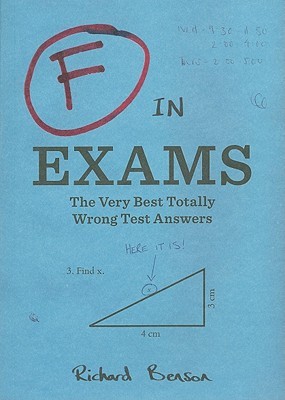
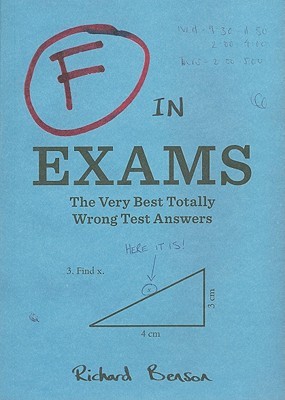
Necessity is the mother of invention. When these students didn’t know the answers, they pulled out all the stops to come up with something- sometimes with hilarious results.
At other times though, I despaired for the future…
I think that F in Exams would be enjoyed the most by current or former educators.
I read some of these aloud to my husband who used to be a college professor and he laughed so hard that he had tears in his eyes. Then, it led to a conversation about not knowing the answers on tests and making stuff up to fill in the blanks.
He admitted that he had done so once in a marketing class and the prof had given him points for his creativity.
Honestly, I don’t think I’ve ever attempted joking my way into a better grade. This book makes me wish that I had, just once.
His favorite: Question: “What was Sir Francis Drake known for? Answer: Sir Francis Drake circumsized the world with a 100 foot clipper.”
My favorite: Question: “Clair was well prepared for her interview. Explain how Claire may have prepared herself for the interview. Answer: Had a bath and put on her lucky pants.” There’s a lot to be said for a pair of lucky pants.
F in Exams would make excellent reading material for a doctor’s office or any other place where you need to spend a few moments relaxing (ahem, powder room?), in which case, you should buy your own copy. Otherwise, I’d recommend borrowing this short little book from your local library as I’m sure that I’m not going to feel the need to pick it up again.
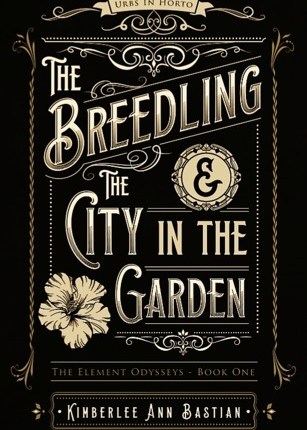
Bartholomew is a Breedling- an immortal spirit that guides the souls of the mortal dead to their eternal homes. He is tasked by his masters, the Fates, to find the Creators of the world, who have gone missing. Bartholomew finds the ones he’s seeking, but then refuses to reveal their location and as punishment, he is sealed in a prison until he changes his mind or the end of time, whichever comes first. But, magically, Bartholomew escapes and finds himself in 19th century Chicago in the company of two boys who are named Charlie and Jimmy. Bartholomew must find a certain mortal to bind his spirit to this world or he will end up back in his timeless prison. He also must complete his original quest- to find the Eden Wanderer. But, he must accomplish all of this without the mortals knowing who he really is or what he is really seeking. Will he succeed?
I have some serious reservations about this book. First of all, the plot isn’t nearly as straight forward as my description. The mythology of Bastian’s world is very complex and I felt like I wasn’t given enough background before I was thrown into the thick of it. Multiple characters are mentioned, but never make an appearance and, there was so much implied but not stated, that at times I felt as if I was reading the second book in the series instead of the first. Fantasy is a tricky genre because there’s a fine line between mysteriousness and utter confusion and, unfortunately, I spent much of my time in The Breedling and the City in the Garden trying to understand how everyone was connected.
On the other hand, there is much to enjoy in this debut novel beyond the complex/confusing world building. The young man, Charlie, has a big heart and spends much of his time trying to keep his cousin, Jimmy, safe from the gangs that rove the streets. He was my favorite character: “Are you prepared for the meeting tomorrow?”he asked, referring to the gang dispute Charlie had been asked to mediate, which was a nicer way of saying he was forced. “As ready as I can be, I suppose,” said Charlie. “It’s not as though they gave me a say in the matter.” loc 159, ebook.
Bastian paints a pretty picture of Chicago: “For miles, rooftops stretched in every direction. Smokestacks stood proudly as a testament to the modern age of industry. The calls of trains answered each other from east to west. To the north, the distant shrills of tugboats and barges floating along the river thundered through the air. The dark sky above blanketed every inch as far as the eye could see, the city lights hiding the stars.” loc 476, ebook
There is certainly a feeling of danger throughout the story- both for the success of the Breedling’s quest but also for the souls of the mortals who travel with him:“If Charlie were to uncover his secret, it would lift the veil of ignorance that blinded him to the truth about the supernatural elements in Eden (Earth). And for enlightened mortals, it never ended well. Their souls earmarked in the afterlife by the Mistress of Heaven or the Master of Hell.” loc 1321, ebook. “The Mistress of Heaven” is a tantalizing name for a character but Bastian never really gives the backstory for her- I wish she had.
I also liked the personal responsibility theme that cropped up again and again in this story: “…a man who runs has no life at all. He merely survives on the fringes and finds only regret. You leave here, now, like this, I swear to you there will be nowhere far enough for you to run. You will become miserable and reckless and in the end you’ll die alone, a world away, wishing you could take this moment back.” loc 3069. I’m a big believer in taking responsibility for one’s life rather than blaming it on fate or destiny. It seems like Bastian is too.
Recommended for readers who can tolerate a lot of unknown elements in the story and for people who enjoy urban fantasy. I think that Bastian shows a lot of promise and this series is only going to improve as she reveals more of the complex world she has created. Other fantasy debut recommendations: The Interminables, Funeral Games, or Chasing Embers.
Thank you to NetGalley and Wise Ink Creative Publishing for a free digital copy of this book. And, thank you for reading!
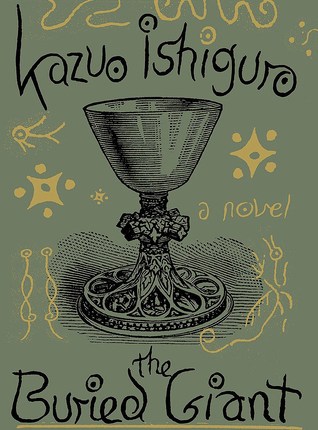
Axl and Beatrice are an aging married couple in the time of King Arthur. They’re on a quest to visit their son and face otherworldly threats like ogres and pixies as well as more regular dangers like Saxons on the road. They meet a boy named Edwin, who has a secret, and a warrior named Wistan, who is on a quest of his own.
Making matters even more difficult, there’s a mind-fogging mist covering the land that makes people forget things that just happened to them moments ago and the past is a puzzling blank. Axl and Beatrice would also like to solve the mystery of this mist, but first, they need to remember where their son lives.
This fantasy novel tackles the themes of love, forgiveness, and war- but, be warned, this is a ‘love it or hate it’ kind of read and will not appeal to everyone.
This is the first book I’ve read by Ishiguro and my feelings about it are complicated.
At first, I hated it because of the plodding pace and the fact that, although the author hinted at plenty of magical creatures and cryptic places, he didn’t do anything with them. But then, Ishiguro layered the themes on each other and brought the novel to a conclusion that I can’t stop thinking about… so I’m torn.
Depending on where I was in the book, this was either a one star or a five star- so I’m going to come down right in the middle with three.
The mist is so pervasive throughout this story that it almost a character all of its own: “It’s queer the way the world’s forgetting people and things from only yesterday and the day before that. Like a sickness come over us all.” … She had said this while looking away into the mist-layered distance, but now she looked straight at him and he could see her eyes were filled with sadness and yearning.”pg 21, ebook.
A life lived without memories makes day-to-day living more simple, but remembering and appreciating the good times, almost impossible.
Throughout this story, I was cheering for Axl and Beatrice to remember their shared past. They’re my favorite characters in this tale.
“Yet are you so certain, good mistress, you wish to be free of this mist? Is it not better some things remain hidden from our minds?” “It may be so for some, father, but not for us. Axl and I wish to have again the happy moments we shared together. To be robbed of them is as if a thief came in the night and took what’s most precious from us.” pg 113, ebook
Wistan is a Saxon warrior beyond compare, but he does not love Britons: “It was Britons under Arthur slaughtered our kind. … We’ve a duty to hate every man, woman and child of their blood. So promise me this. Should I fall before I pass to you my skills, promise me you’ll tend well this hatred in your heart. And should it ever flicker or threaten to die, shield it with care till the flame takes hold again.”pg 172, ebook.
Despite his efforts to remain detached, he develops a soft spot for Axl and Beatrice (Britons). Perhaps if he didn’t label people under blanket terms like “Britons” then he’d feel more kindly disposed towards them. Blind hate softens when you get to know someone and understand who they are. I think that is part of Ishiguro’s point… maybe.
There were plenty of confusing moments in The Buried Giant for me.
What’s with the old lady slaughtering small animals in that ruin? What’s with the island where people go to live entirely by themselves? (Metaphor for death or a trip to fairyland?) What’s with Edwin’s memories? Or the priests who feed themselves to the vicious birds for things they can’t remember?
Or that ending? (Geez, that ending!)
I can see how this would make an excellent book club choice because there is so much that can be interpreted different ways and discussed.
Picking read alikes for this novel was tricky because the tone, pacing, and complexity of this book is so unique.
The Last Unicorn is a fairy tale with layers, like this read, but for young adults. Mythago Wood might be another solid choice, but it takes place in the modern era rather than the distant past. Or you could try: Suldrun’s Garden. I read that a long time ago and didn’t like it much, but it is a classic fantasy book set close to the same time as The Buried Giant.
Rajiv Parti was living a materialistic dream with the house, car, and beautiful wife to prove it. But, the many things in his life didn’t bring him comfort when he developed prostate cancer and a bunch of unfortunate side effects from the surgery to remove it.
Addicted to pain pills and disconnected from the people around him, Dr. Parti underwent emergency surgery and experienced something so incredible, that when he woke up, he completely changed his life, developed a new form of holistic health treatment, and gave up many of the possessions that were weighing him down.
This is the memoir about that experience and Dr. Parti shares it in the hopes that it will change the reader’s life or at least bring comfort to those who are struggling in their current life experience.
Like many of the other memoirs I’ve read by medical professionals, Dr. Parti talks about the completely scientific view he had of the soul, which is to say, if you couldn’t see it and measure it, then it doesn’t exist.
Also, working on the technological edge of medical breakthroughs in the treatment of various diseases, had given him an invincible feeling.
This experience blew that attitude away: “Feeling like a master of the universe is easy in the world of modern medicine. … Maybe it’s a sense of cheating death for others that gives us cardiac surgical teams the vague feeling that we can overcome our own death. Of course that isn’t true. … Reality popped that myth for me.” pg 10
In his near death experience, Dr. Parti not only encountered his father, but also a huge crowd of his ancestors.
They shared messages of forgiveness and love: “Love is the most important thing there is, my grandfather communicated to me. I am glad to let you know that simple truth while you can still make change in your earthly life.” pg 44
But his time on the other side wasn’t all light and love, Dr. Parti also had the (fairly rare) experience of seeing hell and the suffering souls within it.
This is entirely my opinion, but I think that the detached manner in which Dr. Parti was living his life brought forth a major wake-up call from the spirit world. He saw hell first and then heaven and, in a way, that could be a metaphor for his life experience.
I don’t believe in “hell” myself other than the nightmare that people can create in their own minds and lives, but, I didn’t experience it like Dr. Parti did. This memoir does not focus on the hell portion of the narrative, but, with the rarity of that experience, it could have. That, in itself, says something.
When Dr. Parti “comes back”, he knows that he wants to start a new life and a new focus, but he doesn’t know how.
The information for developing a new type of medicine comes to him slowly during meditation: “What is (the new mode of healing) anyway?” “…It is how nonpharmacological treatments in combination with drugs can heal things like depression and addiction and other diseases. It’s about searching one’s own soul to fight back against the hollowness that pharmaceuticals alone or alcohol and illegal drugs create or don’t really fill.”pg 91.
He eventually develops meditations and lifestyle changes as well as a manifesto for treatment.
To me, the most fascinating part of this memoir was the communication between himself and the spirit world once he was back.
For readers who are unfamiliar with near death experiences, Dr. Parti provides a broad background with some of the major historical figures who went through it.
Like Jung: “(Carl) Jung’s NDE led to a split with Sigmund Freud, who believed that spiritual experiences were fantasies. Jung, however, considered spirituality an important part of our well-being saying that life has purpose beyond material goals and that our main task, the path we should all be on, is the one that leads to our own connection with the universe.” pg 124
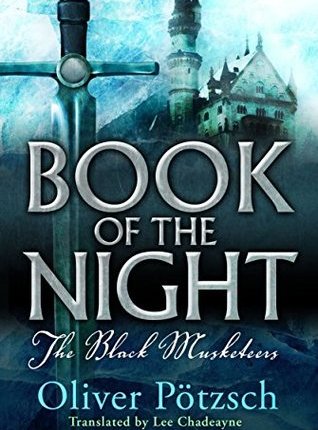
Who are the Black Musketeers of the title?: “The Black Musketeers were the best fighters in the Reich,” he began, “trained in the use of all sorts of weapons and fear by everyone. They served as bodyguards to the Imperial General Wallenstein … We fought and shot like the devil, with swords, pikes, daggers, muskets, and pistols, and drove the Danes and their allies back across the Elbe River.” loc 129, ebook.
Lukas is forced to grow up quickly, not only because of what happens to his family, but also because of the unending war: “Lukas thought of the dreadful stories he’d heard about the war. Last year in Magedeburg, twenty thousand citizens had been slaughtered by mercenaries, who then completely destroyed the city.
Similar things had happened in other parts of the Reich. Whenever the troops passed by, no matter which side they were on, they left behind death, destruction, hunger, and disease. When he was young, Lukas had always imagined war as something heroic. … but for some time now, he had understood that war was not an adventure, but left horror and misery in its wake.” loc 1112, ebook.
“If you have something to tell me or the others,” Gionvanni said softly, in order not to waken the other sleeping boys, “please don’t hesitate. We’re always here for you, do you understand?” He smiled. “One for all and all for one. I heard those words somewhere before, and they apply to us as well.” loc 1148, ebook.
I liked how Lukas and his friends were never entirely certain about the existence of magic until it entered their lives in a very real way: “Nonsense,” Paulus muttered. “Magic is humbug! I only believe things I can see and fight with my sword.” “It’s said there are certain vapors and gases that make people sick and can even cause the plague,” Giovanni replied matter-of-factly. “Can you see them, Paulus?
No. But still they’re there, invisible, all around us. Perhaps there’s lots more out there that we simpleminded little men can’t even imagine.” loc 1428, ebook.
When I saw the name, Oliver Pötzsch, and snapped up this book from NetGalley, not realizing that Book of the Night is intended for a young adult audience.
As I wrote earlier, it is very well-written and I had a lot of fun reading it. That being said, the Book of the Night isn’t very sophisticated nor are there any true surprises within its pages.
Book trailer for ‘Book of the Night’ in German.
However, it is a perfect pick for anyone in the 12 to 16 age group, or anyone who enjoys an adventure with some magical undertones.
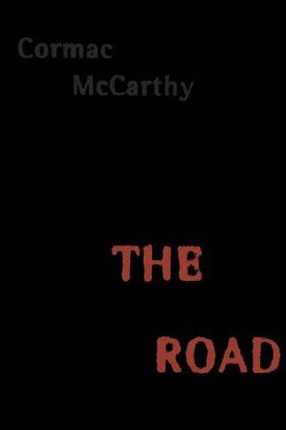
Dark but powerful, The Road is a dystopian novel, a modern classic really, about a father and son who are navigating a destroyed world. They fight to stay alive but also to hold onto their humanity in a new existence where your neighbors are now your enemies, and there is no one who cares if you live or die.
In this nightmare realm, at least they have each other.
The story opens with the duo trying to get to the coast and south to warmer climates, but many obstacles lie in their way. In addition to imminent starvation because of the nuclear fallout, the father and son face external threats like cannibalistic tribes of savage men and women. (Similar to themes found in the Walking Dead, both books and television.)
But it’s not just a battle to save their bodies, the father must teach the son the proper way to live (like not eating other people) to save his spirit from the crushing darkness that has overtaken everything. It is a struggle to retain the internal spark that divides humanity from the animals.
This is a story about survival in a dystopian reality, but it is also about the sustaining and literally life preserving power of love. (Similar to the Room by Emma Donoghue.)
My one complaint about this book is that the author didn’t clearly label who was speaking during the dialogue. He just went down a line to illustrate change of speaker. I had a really tough time keeping track of who was saying what.
Take this passage, for example: “Can I ask you something? he said. Yes. Of course. Are we going to die? Sometime. Not now. And we’re still going south. Yes. So we’ll be warm. Yes. Okay. Okay what? Nothing. Just okay. Go to sleep. Okay.” pg 9 The whole book is like that, anytime anyone is talking.
Otherwise though, this is an amazing, heart-pounding, thrill ride of a book.
I loved the father’s advice to the son throughout the journey: “A corpse in the doorway dried to leather. Grimacing at the day. He pulled the boy closer. Just remember that the things you put into your head are there forever, he said. You might want to think about that. You forget some things, don’t you? Yes. You forget what you want to remember and you remember what you want to forget.” pg 10
The father/son relationship described in here was fascinating to me. Generally, at least in my experience, the relationship between a mother and a child is the closer one in the family because of certain biological imperatives. McCarthy flips that whole paradigm on its head with this story. In here, it is the father who stands between the child and death. It is the father who finds meaning in a world gone mad through helping the child find food, stay clean, and stay protected from the elements.
“The boy sat tottering. The man watched him that he not topple into the flames. He kicked holes in the sand for the boy’s hips and shoulders where he would sleep and he sat holding him while he tousled his hair before the fire to dry it. All of this like some ancient anointing. So be it. Evoke the forms. Where you’ve nothing else construct ceremonies out of the air and breathe upon them.” pg 63.
I think one of the main lessons in here is that life holds the meaning that you assign to it. And, even if civilization falls apart, you can create your own mini-civilization through your actions and intentions.
“He’d had this feeling before, beyond the numbness and the dull despair. The world shrinking down about a raw core of parsible entities. The names of things slowly following those things into oblivion. Colors. The names of birds. Things to eat. Finally the names of things one believed to be true. More fragile than he would have thought. How much of it was gone already? The sacred idiom shorn of its referents and so of its reality. Drawing down like something trying to preserve heat. In time to wink out forever.” pg 75 Beautiful.
If civilization ever ends, look for me at the library. Probably will be reading this book. 🙂
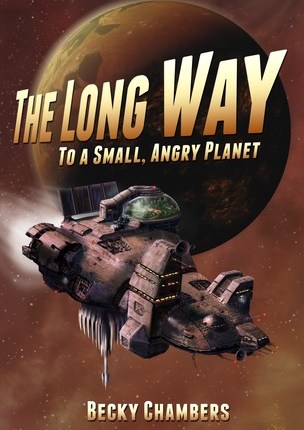
I recently finished The Long Way to a Small, Angry Planet for a second time and was again impressed by the author’s character building.
A small criticism I have is the lack of adventure in the tale. Becky Chambers does such a great job creating characters the reader cares about, but then does so little with them.
Still recommended for readers who enjoy light-hearted science fiction.
Review from first read-through: This is a charming, character driven, space opera-ish, science fiction novel about a crew, made of a bunch of different species, who man a ship that drills holes in space.
The focus of this story is on the relationships of the crew, their histories, and a big job that is going to take them to a distant part of space where very few have gone.
At first, I was concerned this book was going to be too heavy on the technology or psychics, but, have no fear readers, very little technical thinking is required in The Long Way to a Small, Angry Planet, which, after a few I’ve read lately, was just what I was looking for.
I loved the different species that Chambers imagined for this universe. From lizard-type aliens to a giant caterpillar with an otter head to a simian creature who shaves his blue fur into concentric shapes, there’s a lot of characters to keep track of but they’re so different that it’s not confusing. It is just plain fun.
Even the AI of the ship, the Wayfarer, is a character named Lovelace: “There were other Lovelaces out there, of course. Her core software platform could be purchased through any AI dealer. There were probably dozens of versions of her traveling through the galaxy- maybe hundreds, who knew. But they weren’t her.” pg 58. Indeed.
The reader gets to learn about space travel and the various ports of call through the eyes of Rosemary, the newest member of the crew, who is carrying a dark secret about her past:
“Rosemary hurried after her crewmates, anxious to not get lost. … Getting lost wasn’t what scared her, exactly. It was more the prospect of getting mugged. Or harassed. Or stabbed. She’d seen a few people that definitely looked stabby.” pgs 109-110. “Looked stabby” made me giggle.
This bit had me laughing too. I had never taken the time to consider what might happen if a cold-blooded creature ate something that was freezing cold: “We’re grown-ups, we can have ice cream for lunch if we want.” “Let’s not,” Sissix said. “Right. I forgot,” Kizzy said, and laughed. “Ice cream makes her mouth go slack.” pg 140
There are a few bits of life advice hidden in this story: “All you can do, Rosemary- all any of us can do- is work to be something positive instead. That is a choice that every sapient must make every day of their life. The universe is what we make of it. It’s up to you to decide what part you will play.” pg 232.
This last section contains my favorite line from the entire book: “She lived up there, in that vast expanse of color. Every day, she saw planets and comets and stellar nurseries right up close, plain as weather. Yes, there was something about being planetside that made it feel different. Perhaps stars were supposed to be viewed from the ground. pg 291-292.
“Perhaps stars were supposed to be viewed from the ground” is it. I have never traveled in space and may never get the chance to, but The Long Way to a Small, Angry Planet transports you, if just for a short time, into worlds far beyond ours.
I highly recommend it for folks who enjoy light, character-driven science fiction as there is nothing too heavy or disturbing to be found here.
When Breath Becomes Air is Paul Kalanithi’s life story. He relates how he got into neuroscience, his exhausting and life consuming training, his illness, and his eventual transition out of this world into the next.
At first, Paul didn’t even want to become a surgeon because his own father was one and he saw how hard it was to balance work and family: “When we did see him, late at night or on weekends, he was an amalgam of sweet affections and austere diktats, hugs and kisses mixed with stony pronouncements … He had reached some compromise in his mind that fatherhood could be distilled; short, concentrated (but sincere) bursts of high intensity could equal.. whatever it was that other fathers did. All I knew was, if that was the price of medicine, it was simply too high.” pgs 24-25, ebook.
Even though he started out as an English major, Paul’s own interests led him toward the medical profession anyway. Similarly, I started out as a music major in college but switched to political science my sophomore year.
Why? I knew, somehow, that governmental systems were where my academic interest lived and I haven’t regretted that decision for a moment. Isn’t it funny how life leads us down paths we may never have envisioned for ourselves?
Back to When Breath Becomes Air– I was glad that Paul made the decision to follow a different life path because it seemed to be the perfect fit for him. In this book, Paul’s stories reveal his passion about the field of medicine and commitment to making the best decisions for the patients in his care. He was interested in what makes life worth living and how the brain’s functions effect quality of life.
I was particularly interested in that last bit. Sometimes, and I’m not going to point any fingers here, doctors and professionals of all stripes get caught up in the power, prestige, and monetary rewards that come with a position, forgetting the reason why they started in their field in the first place- to help people.




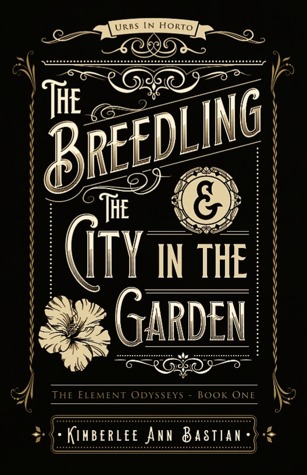 Bartholomew is a Breedling- an immortal spirit that guides the souls of the mortal dead to their eternal homes. He is tasked by his masters, the Fates, to find the Creators of the world, who have gone missing. Bartholomew finds the ones he’s seeking, but then refuses to reveal their location and as punishment, he is sealed in a prison until he changes his mind or the end of time, whichever comes first. But, magically, Bartholomew escapes and finds himself in 19th century Chicago in the company of two boys who are named Charlie and Jimmy. Bartholomew must find a certain mortal to bind his spirit to this world or he will end up back in his timeless prison. He also must complete his original quest- to find the Eden Wanderer. But, he must accomplish all of this without the mortals knowing who he really is or what he is really seeking. Will he succeed?