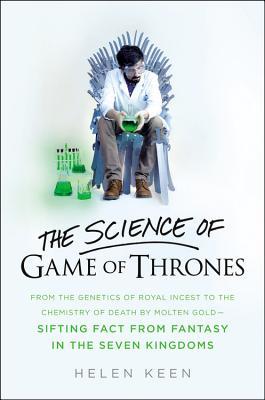
The Science of Game of Thrones: From the genetics of royal incest to the chemistry of death by molten gold – sifting fact from fantasy in the Seven Kingdoms by Helen Keen

The Science of Game of Thrones: From the genetics of royal incest to the chemistry of death by molten gold – sifting fact from fantasy in the Seven Kingdoms by Helen Keen
thescienceofgameofthrones

Readers beware: there are major spoilers contained within the pages of The Science of Game of Thrones. Do not read it (or this review) unless you’ve read all of the books that are currently out or have watched all of the seasons of the HBO show!

That being said: if you are a fan of the Game of Thrones, in any format, you simply must read this book.

From dragons to the effectiveness of female body armor, poisoning to the real possibilities of our world ending in ice or fire, Keen takes us on a scientific examination of all things related to George R.R. Martin’s epic series and what a trip it is.

My favorite part was a discussion about how dragons would breathe fire in real life and how that relates to the explosive capabilities of cows: “A cow can produce between 250 and 500 litres of highly flammable methane a day… In 2013 it was reported that a build-up of methane from a particularly afflicted dairy herd, coupled with an accidental spark of static electricity, ‘nearly blew the roof off [the] barn’ in Rasdorf, Germany… After a lot of genetic tinkering, a Danearys Targaryen in our world will be able to ride valiantly into battle to claim what’s hers on the back of a genetically modified fire-breathing heifer.” loc 235, ebook.

Can you picture it? I can!

Photo by Pixabay on Pexels.com

The potential positive effects of inbreeding: “… there’s evidence that, over time, inbreeding can actually purge a population of the effects of harmful recessive gene variants. These ‘bad’ genes are way more likely to show their effects, so, ultimately, the lines of the carriers are more likely to die off. Thus while the results of successive generations inbreeding is generally bad for the particular individual, it’s often good for the population as a whole.” loc 328, ebook.

So, the Lannisters can continue paying their debts as long as they’re not carrying harmful recessive gene variants. Good to know.

The Hodor question: “For a long time we were wondering what happened to Wyllis to cause his ‘hodoring’ behaviour. Perhaps he suffered a stroke or a tumour, or even a blow to the head. … Extensive damage to Broca’s area is also sometimes caused by malnutrition, but that seems unlikely in Wyllis’s case, given his enormous girth. Whatever the story, one thing is clear: Wyllis is clearly exhibiting a severe type of ‘expressive aphasia’. He can understand what other people are saying and respond, but he struggles to produce more than a single word.” loc 882-895, ebook. Hodor, hodor… hodor! Hodor.

Prior to a wonderful examination of the actual existence of dire wolves, Keen has this to say about the Starks and their pets: “The Stark children.. find a litter of orphaned dire wolf puppies and are desperate to keep them- like all children everywhere when confronted with the cute, mewling faces of slavering ferocious death beasts in their juvenile form. Their father Ned gives them a lecture worthy of any parent in Pets R Us along the lines of ‘Ok then but you’ll have to walk them yourselves even if it’s raining’.” loc 1160, ebook. Ha!

Photo by Brenda Timmermans on Pexels.com

And, finally, I enjoyed learning about crows. Apparently, they’re actually extremely smart and have very good memories: “Previous research has shown that crows not only remember a threatening face, they share that knowledge within their community, so that the individual is remembered and scolded by the crows, even after a gap of several years. Young crows, it seems, are even taught to recognise and scold the ‘villain’ by their parents.” loc 1357, ebook. Yikes. Don’t bully crows, friends.

There’s a bit of language in The Science of Game of Thrones and some juvenile humor, but, overall, it is much tamer than the source material. Recommended for ages 14+. Some further reading: What If?: Serious Scientific Answers to Absurd Hypothetical Questions by Randall Munroe or Loch Ness Monsters and Raining Frogs: The World’s Most Puzzling Mysteries Solved by Albert Jack.

Thank you to NetGalley and Little, Brown and Company for a free digital copy of this book! And, thank you for reading.

Medicine, Miracles, and Manifestations: A Doctor’s Journey Through the Worlds of Divine Intervention, Near-death Experiences, and Universal Energy by John L. Turner

Medicine, Miracles, and Manifestations: A Doctor’s Journey Through the Worlds of Divine Intervention, Near-death Experiences, and Universal Energy by John L. Turner
johnturner

I felt like this memoir was all over the place- from remote viewing to Johrei, prophetic dreams to explanations of brain functions.

Dr. John Turner has an incredibly open mind when it comes to integrating traditional Western and holistic medicinal techniques. That was refreshing, but, because he was covering so much material, I felt like he didn’t spend enough time going into detail about the different modalities.

I wanted more depth and less breadth.

There were some interesting bits in here though.

Dr. Turner experienced, first hand, a case of spontaneous healing. His patient had a large brain tumor and, through the intercession of some monks and some radiation therapy, her tumor completely disappeared: “Here was a case of emotional disarray that when corrected, allowed healing to take place. Was it the patient’s realization or belief in karmic cause of her disease that allowed her brain to join with radiation to expel the foreign invader?… Were surgery and radiation necessary at all? I paced back and forth in my office, pondering the matter.” pg 60

Photo by Oles kanebckuu on Pexels.com

Dr. Turner practiced daimoku (intense chanting of a certain set of words, like a prayer) for two hours a day for a year.

Here is what he had to say of the experience: “I believe that chanting sets up resonant circuits in the brain that activate usually quiescent neural pathways. I came to know this feeling of attonement quite well, and after the promised 12 months I discarded the incense sticks, the gong, and the chanting. I could recreate the feeling through meditation… However, I saw no practical way in which to use this complex and time-consuming process for the benefit of my patients.” pg 89-90

Dr. Turner practicing Johrei (a light healing technique) in his surgery: “After placing the last suture, I gave him 20 minutes of intraoperative Johrei, letting Okada’s light flow through a spiritual cord to me, and then to the patient. This was a first for Hawaii and perhaps for any medical center (and surely for any neurosurgical operating room) outside of Japan. (My patient’s) recovery was spectacular…” pg 134

Photo by Pixabay on Pexels.com

The technique seems strange to me, but if it works, I say use it!

One of the first accounts I have read of remote viewing being used for medical diagnosis and treatment: “…it occurred to me that I should run the cause of this patient’s pain as a remote viewing target and see what Ed Dames could do to arrive at the answer. Not only would this be a confirmation of the power of remote viewing as a method of medical diagnosis, I would also have a chance to witness an expert at work. The results, as you will see, were everything I had hoped for; the patient fared well, much better than if I had tried to wait for the condition to become obvious on examination.” pg 194

If you are looking for more books about neurosurgeons who are considering non-traditional therapies in their practice, try Into the Magic Shop: A Neurosurgeon’s Quest to Discover the Mysteries of the Brain and the Secrets of the Heart by James Doty or Proof of Heaven: A Neurosurgeon’s Journey into the Afterlife by Eben Alexander.

Thanks for reading!

Templar by Jordan Mechner

Templar by Jordan Mechner

templarTemplar: a graphic novel about the dissolution of that famous order and the struggle for the legendary treasure that they left behind. A couple of weeks ago, I read the first book in this series and I enjoyed it more than this complete volume. It was the ending that diminished my enjoyment of it the most, which I won’t get into because I don’t want to ruin it for anyone, but that was really my issue. Mechner ties up the major plot points, but I didn’t like how he did it- at all.
Like the other book, this contains adventure, daring rescues, and amusing “heist movie” type moments. We’ve also got a strong female lead in Madame De Chalancon (love interest) who is actually very hard core for a 12th century woman. She’s sneaking out at night and running around with the guys, stealing horses, manipulating the powerful men around her, kissing people- I mean, that kind of stuff could have gotten her burned as a heretic or witch back then. So, that was good and the other characterizations are solid. The illustrations aren’t gorgeous (compared to Monstress #1 or Saga, Volume 1) but those are considered adult graphic novels while this one is marketed for the teen set.

Which reminds me, there’s a whole scene that takes place in a Turkish steam bath that some parents may find objectionable. I’d let my kid read it, but she’s a girl and has the parts that are revealed through the steam and also, I’m a librarian, and I don’t censor stuff. But yeah, there’s some (very tasteful) nude females, torture scenes, hand to hand combat, men being burned at the stake, arrows through limbs… I honestly think that this may have been better as a mature book than a watered down PG13, but it is what it is.

Still, it is a fun story and semi-educational in that some of the people featured in this book were actual historical figures. Mechner includes his sources in the back and also some recommended reading. I think I’m going to look into Foucault’s Pendulum, which I’ve never read, but Mechner gives high praise.

Some more graphic novels that teens may enjoy are The Guild (ties in to the show of the same name) or the surprisingly fun, Nimona.

Thanks for reading!

How to Be Dull: Standing Out Next to Genius by Basil Morley, Esq.

How to Be Dull: Standing Out Next to Genius by Basil Morley, Esq.
howtobedull

How to Be Dull: Standing Out Next to Genius is one of the funniest books I’ve read this year.

I read a lot of self help, self improvement, self actualization books and How to Be Dull shines a hilariously dark spotlight on the myriad benefits of staying just as you are. The humor is dry and the delivery is completely serious and matter-of-fact, rather like a Monty Python classroom sketch.

It is also surprisingly educational.

Do you know why we remember Chaucer’s name but so very few of his contemporaries? : “…Chaucer succeeded by adapting Italian masters, appropriating a wide range of old folk tales, mixing them with Greek myth, writing in the vernacular rather than hoity-toity Latin or snooty French, and adding a wide range of characters to represent the whole of modern 14th century life from the top to the bottom… He was a true original, though one must admit his originality was made of things familiar mixed up, changed, innovated and slapped together in wholly unexpected ways.” loc 68, ebook.

It’s so true! People don’t want new stuff- they want old stuff repackaged to look new. How dull is that. Chaucer knew what was up.

This whole dull thing is very appealing to introverts: “Be dull. Be boring. Make no splash. Make no waves. Put your head down and do the work you wish to do and present such a bland face to the world that they leave you in peace to get on with it. Do not make the mistake of seeing this as some kind of capitulation. You are not defeated if you are dull. You merely refuse, wisely, to spend your precious time convincing others of your originality.” loc 105.

Photo by Pixabay on Pexels.com

Being left in peace to do what I want to do- now there’s a philosophy I can get behind.

If you were curious as to the enduring popularity of socialites who don’t seem to contribute in any meaningful way to society, Morley suggests that it is because of dull people just like you and me.

Imagine our importance! : “Be below notice. For you will find it easy to make your way unseen into important places, for the truth is the appeal of these ‘personalities’ is their true blandness. They are screens upon which we project our home movies of illusion. And they need dull people to make them sparkle.” loc 168, ebook.

I do enjoy an author who isn’t afraid to put in a good word for themselves: “How to explain this conundrum without falling into dullness myself and losing your attention? I do wish to teach you to be dull, but you must attend to my brief lesson long enough to say, ‘Yes I read that book and I rather liked it’ so you can recommend it on ReadGood or whatever those places are before you go back to sipping your own martini and forget all about my delicious tome.” loc 796, ebook.

Photo by MART PRODUCTION on Pexels.com

Ah, self promotion, the height of dullness. Now, back to my martini…

Let’s end with Morley’s exhortation to be a “shining example” to those who try to stand out from the crowd: “It helps one to know that whilst one appears to be useless and idle, one can congratulate him or herself on being a shining example to those who would wish to be extraordinary. It is the normal thing, or should I say the usual thing.” loc 923, ebook.

Know anybody who forgets to laugh about the silliness that is the self improvement rat-race? I have just found the perfect Christmas present for them. You’re welcome. 🙂

Photo by mentatdgt on Pexels.com

Some more humorous books about popular culture: The Joy of Leaving Your Sh*t All Over the Place: The Art of Being Messy or The Life-Changing Magic of Not Giving a F*ck: How to Stop Spending Time You Don’t Have with People You Don’t Like Doing Things You Don’t Want to Do. But, How to Be Dull is superior to either of those books because the author never wavers from his/her beautifully worded, high brow observations or resorts to vulgarity to make a point.

Thank you to NetGalley and Women’s League of Ale Drinkers Publishing for a free digital copy of this book. (What a great name for a publishing firm, by the way.) And, thank you for reading!

Some Kind of Fairy Tale by Graham Joyce

Some Kind of Fairy Tale by Graham Joyce

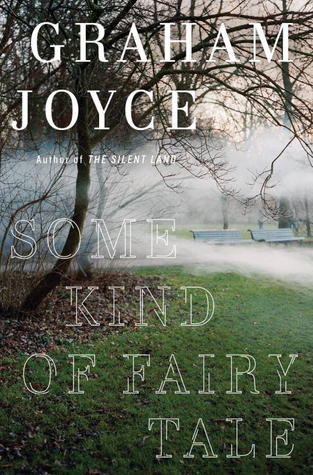
somekindoffairytaleSome Kind of Fairy Tale is a fantasy set in modern times. Peter is a farrier (shoes horses and fixes small, metallic things). He has a lovely wife and four beautiful children. He also has a sister whom he hasn’t seen for nearly twenty years, presumed dead. Imagine his surprise, when she shows up at their parent’s home on Christmas Day. Where has she been? Where indeed…

The magic in this book isn’t in your face, it’s hidden in the shadows and rocks of the woods and glens- very much like I imagine magic really is: “The Outwoods was one of the last remaining pockets of ancient forest… It was an eerie place, swinging between sunlight and damp, flaring light and shadow; a venue of twisted trees, its volcanic slopes of ash and granite ruptured by mysterious outcropping crags of the very oldest rocks in Britain.” pg 14, ebook.

I loved the twists and turns of the story and it had me questioning myself the entire time. Is Tara bonkers, injured in some way, or did something outside of her power actually spirit her away? “There is a veil to this world, thin as smoke, and it draws back occasionally and when it does we can see incredible things.” pg 142, ebook.

I also loved how Joyce used quotations from poetry, books, and an actual trial where a man was convicted of killing his wife because he thought she was a changeling (can you imagine?!) to introduce a few of the chapters. It was chilling- the deadly combination of superstition and violence and the trial in question happened, not in the dark ages, but 1895. Here’s Joseph Campbell’s thoughts that preface Chapter Twenty-Six: “Nevertheless- and here is a great key to the understanding of myth and symbol- the two kingdoms are actually one. The realm of the gods is a forgotten dimension of the world we know.” pg 169, ebook.

I did not like the surprising vulgarity of this tale, the few violent moments it contains, or when something terrible happens to a neighborhood cat but, if such things don’t bother you, you really must give Some Kind of Fairy Talea try. If you don’t already, it makes you believe in the possibility of other worlds and every day magic.

Some books with similar themes: Meeting the Other Crowd (non-fiction, but reads like fiction), Fairies: Real Encounters With Little People (non-fiction, again, reads like fiction) or Passport to Magonia: On UFOs, Folklore, and Parallel Worlds (classic work on real people and actual encounters with other worlds).

Thanks for reading!

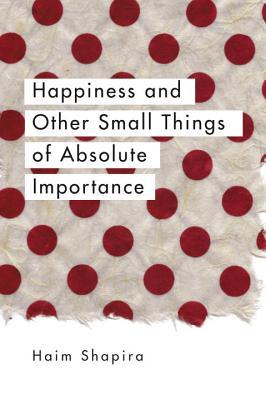
Happiness and Other Small Things of Absolute Importance by Haim Shapira

Happiness and Other Small Things of Absolute Importance by Haim Shapira
haimshapira

Happiness and Other Small Things of Absolute Importance does not resemble a self help book as much as it does a long, meandering lecture by your favorite professor.

Shapira talks about happiness, the passage of time, love, death, money, and so much more by tying it to classic literature and his own musings. I loved it.

There is little that Shapira doesn’t cover in these pages and, when you’re done, you feel as if you’ve just had a long discussion with a very dear friend.

“This little book is meant to change your perspective on almost everything in your life- and primarily the concept of happiness. … As serious and life-changing as the voyage to the land of the Things That Matter may be, it’s no less important to enjoy the ride.” loc 27, ebook. Shapira succeeds with flying colors.

His humor shines through his words. There aren’t any laugh-out-loud moments, but I found myself grinning throughout: “There’s empirical proof that How-To-Be-Happy Books are useless. If just a shred of the promises made in many of those books came true, the world would be knee-deep in incomprehensible quantities of bliss. We all know that this is not the case.” loc 73, ebook. True story.

My favorite parts were about the importance of a positive mind-set and love.

Photo by Sharon McCutcheon on Pexels.com

This passage is about being positive: “Anyone who has lived on this planet long enough knows that pessimism is the natural way to think. It requires no effort, like a rock rolling downhill. It’s much harder to push the rock up the hill, to think positively. Just see the effort it takes to think like (Winnie the) Pooh, to find a bit of magic and grace in everything. That is a mission worthy of the wise.” loc 387 I agree.

I also found the sections on anger and forgiveness to be very meaningful.

Here, Shapira is talking about the futility of being angry and how we can learn to control our tempers, rather than have them control us: “My wife, a chemical engineer by profession, has reached an important understanding. In nature, she told me, each substance has a typical, unique and fixed boiling point. We can artificially change it, however, by using other substances that act as inhibitors, thereby raising the boiling point. For example, anyone who cooks knows that salted water takes longer to boil than water alone. The same applies to people. Their boiling points can be raised. Wisdom can be salt for our water…” loc 610, ebook.

Recommended for spiritual seekers, happiness chasers, and anyone who wants to learn more about themselves. This book is a gem.

Some similar reading, if you liked this: How to Talk About Places You’ve Never Been: On the Importance of Armchair Travel, The End of Self-Help: Discovering Peace and Happiness Right at the Heart of Your Messy, Scary, Brilliant Life, or The Power of the Heart: Finding Your True Purpose in Life.

Thank you to NetGalley and Watkins Publishing for a free digital copy of this book.  And, thank you for reading!

The Sound of Gravel by Ruth Wariner

The Sound of Gravel by Ruth Wariner

The Sound of Gravel is in the running for my favorite book club read this year! (Bull Mountain is the other pick I really enjoyed.)

It is Ruth Warnier’s memoir about her poverty-stricken childhood in a polygamist cult in Mexico, her dysfunctional mother, abusive step-father, and struggle for survival along with her many siblings.

Photo by Belle Co on Pexels.com

She pulls you in, first line: “I am my mother’s fourth child and my father’s thirty-ninth.” pg 10, ebook. I read that sentence to my husband and his reaction was, “Are you reading a book about royalty?” Unfortunately, no.

Ruthie’s father was a founding member of the “Firstborns”, a polygamist group that broke away from the Mormon church. He believed that, in order to live in the manner that God intended, men are supposed to have multiple wives and as many children as possible, to become like gods in the next life. He lived what he preached.

But, unlike members of royal families, Ruthie’s father, and later her stepfather, did not have the resources available to allow his wives to live in houses with running water or electricity. It is a hard existence but Ruth’s parents live it because of their faith.

Photo by Hank Nielsen on Pexels.com

“After all,” she said, “it is better to have ten percent of one good man than to have one hundred percent of a bad one.” The women of LeBaron (the colony in Mexico) were always saying that…” pg 12, ebook. But what about ten percent of a bad man…

At first, Ruth’s stepfather seems almost normal: “Everyone in the colony was always saying how Lane had a strong work ethic. He spent every day milking cows, planting and baling hay, fixing tractors, trucks, and other equipment- all of which broke down regularly. But in spite of all his hard work, he never made enough money to provide for his eleven kids and stepchildren.” pg 21, ebook.

And his family grew larger than that quite quickly. But, after a short time, he begins to show his true self.

It’s hard to imagine the level of poverty that Ruth and her family endured. Every month, her mother and all of her brothers and sisters made their way by bus from Mexico to the US to collect government assistance. The trip took all day and when they got back, if stepfather Lane did not show up at the bus stop to pick them up, they had to walk a mile home.

Photo by Spencer Davis on Pexels.com

“The rest of us followed silently, watching and listening as Mom took a wide step over the highway shoulder and onto the dirt road, the gravel crunching beneath her footsteps, the sound of home.” pg 29, ebook.

Ruth’s mother tries to do what she can for her children but there’s only so much a perpetually pregnant, struggling mother of five (or more) can do. Some of Ruth’s siblings suffer from disabilities that make it dangerous for them to be left alone with any of the younger ones. After reading what her childhood was like, I am simply amazed that Ruth survived to write this book.

Major trigger warnings for sensitive readers: there are some seriously disturbing scenes of child abuse and domestic violence. But, it is worth the read.

The Sound of Gravel is ultimately uplifting, inspiring, and I highly recommend it. A few similar memoirs: Hillbilly Elegy: A Memoir of a Family and Culture in Crisis , Pigs Can’t Swim, or A Girl Named Zippy.

Thanks for reading!

Funeral Games by Colin Heintze

Funeral Games by Colin Heintze

funeralgamesFuneral Games is a unique, fantastical romp through a medieval world. Syphax is a prince, but an unimportant one, being the younger son of one of his father’s many wives. He doesn’t excel in much of anything, other than reading and daydreams of greatness (reminds me of myself in some ways… I jest… but really). Syphax is a member of the nobility who are called the Undying because, when they shuffle off this mortal coil, they rise again as tangible ghosts called ancestors. These ancestors help govern the living and form another spooky faction in the sprawling complex of the capital city that is Ingerval Palace. The walls of the palace are filled with dead and living nobility who are divided into many different houses with a tangled history of treaties and backstabbing, all with the goal of more power for the members of their clan. The future looks, if not bright, then at least rosy, for our hero, Syphax, until, at one very memorable funeral celebration, something completely unexpected happens. And then, all hell breaks loose inside and outside the walls of Ingerval.

I loved the juxtaposition of the living and the dead in Funeral Games. It added a whole other level of political machinations to the usual struggles of a monarchy and its nobility. Here is the scene at one of the funerals: “The crowd roared with laughter- at least the Living among them. The Dead sat at their assigned places. They didn’t eat or drink, and weren’t the least bit amused by the antics of their descendants. There must have been two hundred ghosts and at least as many Living in attendance. Normally, the Dead kept their own company, but the day was a special one.” loc 56, ebook. I also loved how, in the course of the story, Heintze dealt with the ghost’s eternal nature, limitations, and struggle for recognition beyond the grave. It really is unlike anything else I’ve ever read.

There is a love interest in this but it doesn’t dominate the storyline or descend into the ridiculous. In fact, the girl/heroine, though she doesn’t play a huge part, is kind of hard core, which is a refreshing change of pace for the genre. In this passage, she’s talking to Syphax about one of the ancestors: “I feel like he watches me, Syphax.” “You’re in a palace full of ghosts. It’s natural to feel that way.” “Sometimes I have these dreams. And when I wake up, he’s always nearby…” … “It will be fine,” I said. “He’s harmless. All ghosts are.” loc 136, ebook. (suspenseful music building…)

My favorite part of Ingerval is, of course, the Library! “Ingerval Palace had many wonders. None were as great, nor so underappreciated, as the Library. Books were one of the few pleasures afforded to ghosts, and the Dead’s demand for the written word made Ingerval the world’s leader in the production, purchase, and dissemination of books.” loc 367, ebook. I would fit in well with the Undying, I think.

There is some rough language in this, some tense moments, and a small, if not too graphic, torture scene, so I’d suggest a reading audience of 14/15+ depending on the maturity level of the reader. I’d recommend Funeral Games for not-too-serious fantasy fans as it lacks the complexity of, say, the Malazan books, but for some folks (myself included), that may be considered a plus. Some similar reading: The Interminables by Paige Orwin (a ghost plays a large part in this story too), Ink Mage by Victor Gischler (fantasy world, lots of adventure), or The Quick by Lauren Owen (different time period, but also a fantasy).

Thank you to NetGalley and Curiosity Quills Press for a free digital copy of this book.  And, thank you for reading!

Snow White, Blood Red by Ellen Datlow

Snow White, Blood Red by Ellen Datlow

snowwhitebloodredFull credits for Snow White, Blood Red by Ellen Datlow (Editor), Terri Windling (Editor), Elizabeth A. Lynn (Contributor), Harvey Jacobs (Contributor), Steve Rasnic Tem (Contributor), Melanie Tem (Contributor), Caroline Stevermer (Contributor), Ryan Edmonds (Contributor) , Neil Gaiman (Contributor), Leonard Rysdyk (Contributor), Esther M. Friesner (Contributor)

This is a very adult collection of fairy tale re-tellings. From Little Red Riding Hood to Snow White, these are not stories that I’d share with my child or any impressionable young mind.

Fairy tales haven’t always been exclusively for children as Terri Windling explains in the introduction: “..most fairy tales were never initially intended for nursery duty. They have been put there, as J.R.R. Tolkien so evocatively expressed it, like old furniture fallen out of fashion that grown-ups no longer want. And like furniture vanished to the children’s playroom, the tales that have been banished from the mainstream of modern adult literature have suffered misuse as well as neglect.” pg 2

But fairy tales are important because they touch on dreams, archetypes, and the psyche. However, these re-workings were far more bleak than I expected. “The fairy tale journey may look like an outward trek across plains and mountains, through castles and forests, but the actual movement is inward, into the lands of the soul.” pg 10. And personally, I think that the soul is a rather light place.

The most disturbing of the bunch, in my mind was, Little Redby Wendy Wheeler, which told a tale of sexual relations between a mother/wolfish boyfriend/daughter. (A warning for any sensitive readers, triggers abound in these stories from rape to physical/sexual/emotional abuse towards adults as well as children.) “Before she climbed in, Helen looked in my face as though something in my smile disturbed her. “I’ve never noticed before what white teeth you have, Josef,” she murmured. “So large and white.” pg 140 The only saving grace for the darkness of these tales are that they’re short and you’re soon on to the next one.

My favorite was Puss by Esther M. Friesner: an excellent but nightmarish re-imaging of Puss-n-Boots. “Help! Help, ho!” My paws flailed the air; I brandished my plumed hat to make the coachmen see so small a creature as a cat before the horses trampled me. “Robbers, thieves, rascals and hounds! They have despoiled my good master, the Marquis of Carrabas!” pg 319

A close second was Troll Bridge by Neil Gaiman, based on The Three Billy Goats Gruff. His depiction of a troll was creepy but magical, that curious blend of two unrelated traits that Gaiman crafts so well. “Trolls can small the rainbows, trolls can smell the stars,” it whispered, sadly. “Trolls can smell the dreams you dreamed before you were ever born. Come close to me and I’ll eat your life.” pg 286

Recommended for ages 18+ and the brave at heart. Some read-alikes, if you dare: The Book of Ballads by Charles Vess, Alice by Christina Henry or The Library at Mount Char by Scott Hawkins.

Thanks for reading!