Unmistakable: Why Only is Better than Best by Srinivas Rao

Unmistakable: Why Only is Better than Best by Srinivas Rao
unmistakable

A call-to-action for artists and business people of all types to create the work that only they can create which makes them irreplaceable and also Unmistakable.

“When you’re the only person who could have created a work of art, the competition and standard metrics by which things are measured become irrelevant because nothing can replace you. The factors that distinguish you are so personal that nobody can replicate them.” pg 2.

That makes sense to me. You’re essentially writing the book so no one can tell you how it’s supposed to go.

The theory of becoming Unmistakable is fairly simple but the journey to that place is not. There are no maps to this realm because it is different for everyone and the paths to that place vary as widely as the talents that people bring with them.

As Srinivas reminds us: “Unmistakable work is a process of self-discovery. We start our ride not knowing what it is that makes us unmistakable, and a thread reveals itself through the creation of a body of work. Dots connect, patterns emerge, and our unmistakable gift is revealed. Time is the critical ingredient required for this to take place, hence the role of longevity and commitment in the quest to become unmistakable.” pgs 56-57

So, you can’t give up. Create and fail and try again. That is as hard and as easy as it is.

“…creating unmistakable work might be one of the hardest things to do: you have to look into the depths of who you are, explore what matters to you, and infuse that into every element of your work until it can’t possibly be mistaken for something anybody could have done but you.” pg 68.

The messages contained within Unmistakable become repetitive after a few chapters, but Srinivas threads some of the stories and artists from his podcast to break up the material as well as his personal testimony.

Unmistakable encourages creation even in areas that you may have no prior experience: “Lack of formal instruction might keep us from attempting some sort of creative pursuit or starting anything in which we don’t have experience. … When we lack experience, we also have the advantage of lacking preconceived notions of what’s possible.” pg 113.

And, you don’t know what you’re capable of until you get started. So, what are we waiting for!

As Srinivas writes from an interview with Seth Godin: “The enemy of creativity is fear; that seems pretty clear. The enemy of fear is creativity; that doesn’t seem that obvious.” The antidote to our fear is to put our heads down, do our work, and make something each day.”pg 189.

Let’s all become Unmistakable.

Some further reading: Creativity: The Perfect Crime, Do the Work, and How to Fly a Horse: The Secret History of Creation, Invention, and Discovery.

Thanks for reading!

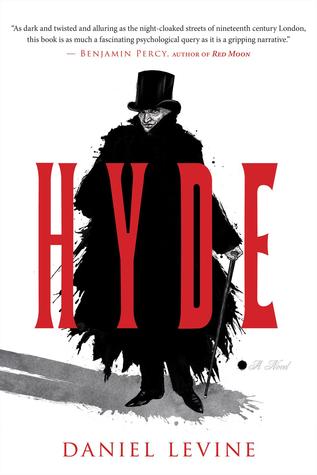
Hyde by Daniel Levine

Hyde by Daniel Levine

hyde**Please do not read this review if you intend to read this book and haven’t yet. I discuss a major plot twist and don’t want to spoil it for anyone.**

Hyde is the story of Jekyll and Hyde from the villain’s point of view and what a story it is. The visceral and sense obsessed descriptions are just what one would expect from a character that is made almost completely of someone’s baser nature, but if you have a weak stomach, you may want to steer clear of this disturbing tale.

The story is told in flashbacks from Hyde’s final days as he’s holed up in Dr. Jekyll’s lab: “I don’t want to die at all, but if there’s no escaping it, then at the very least I want to remember everything properly first, the way it truly happened. The truth is inside this head. I simply must extract it. In the end no one will know it but me, but that will be enough.” pg 10, ebook. I never considered it before, but how would it feel to be shut away inside someone’s mind in a type of half life, always looking out from someone’s eyes, then to be suddenly thrust into a body, given complete control, and then blamed for everything that inevitably goes wrong.

Levine’s darkly imaginative reasons why Jekyll would have “created” Hyde in the first place were chilling. I found myself pitying Hyde rather than fearing him: “It was a frustrating, blinding feeling, my ignorance. I wanted to know what my purpose was, what Jekyll needed me for.” pg 36, ebook. I always wondered that too. After the first failed experiment, Jekyll summons Hyde forth again and again with increasingly awful results. He could have just stopped after the first time and been like, “whoa, THAT was a bad idea” and chucked the rest of his solution into the river. Hyde examines the twisted motivations behind the repeated transformations.

It also looks into the infinite nature of the human psyche. The rest of this review is going to have a major spoiler in it, but I have to talk about it to truly discuss this story because this twist is what elevated Hyde in my mind from a horror story with cheap thrills to a spine tingling look into the darkness of the abyss that could exist in the soul.

How about the idea that Mr. Hyde could have a dark side of his own? That, within a damaged and fractured mind, there’s no end to the shadows that could emerge. The worst of the actions recorded in Jekyll and Hyde were not done consciously by either man, but by a monster that was created by the rage that Jekyll suppressed in his childhood. I thought that was genius. I only wish Mr. Seek had a bigger part in this tale! Because, beyond that huge twist, this story felt repetitive.
Recommended for readers who enjoy dark, violent re-tellings and can tolerate a slower paced read. Some similar, grisly tales: The Last Werewolf or Black Moon.

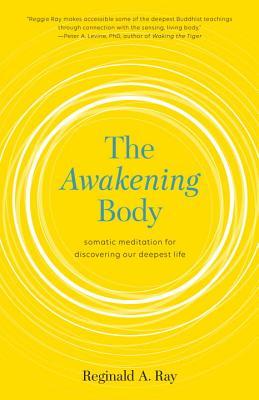
The Awakening Body: Somatic Meditation for Discovering Our Deepest Life by Reginald Ray

The Awakening Body: Somatic Meditation for Discovering Our Deepest Life by Reginald Ray
theawakeningbody

I picked up The Awakening Body because of a conversation I had with a friend last week. He said that when he sits down to meditate, that his mind won’t shut off, and it ruins the experience for him.

I gave him a technique about focusing on the space between thoughts, but decided that I needed something more concrete to give him. This book is perfect for anyone who feels like they can’t escape from his or her own mind.

The Awakening Body is a series of progressive meditations that take the practitioner out of “thinking” and into “experiencing”.

It’s as easy as focusing on your own toes: “In contrast to contrived conventional approaches that emphasize entry into the meditative state through the intentional thinking of the conscious mind… Somatic Meditation develops a meditative consciousness that is accessed through the spontaneous feelings, sensations, visceral intuitions, and felt senses of the body itself. … Put in the language of Buddhism, the human body, as such, is already and always abiding in the meditative state, the domain of awakening- and we are just trying to gain entry into that.” loc 110, ebook.

The teachings themselves are Buddhist in origin but you don’t have to be a practicing Buddhist to receive benefit from them. If you have a body, you can successfully do these meditations.

And the benefits from them could be enormous: “It is as if we are waking up, within our Soma (body consciousness), and we suddenly find ourselves in a new world. … We begin to see that what we formerly took to be our body was just a made-up version with little correspondence to anything real. We find in our body previously unimaginable vistas of spaciousness, experience arising that is ever surprising and fresh, an endless world of possibilities for ourselves and our lives.” loc 329, ebook.

Photo by Pixabay on Pexels.com

This book includes a link to access the guided meditations online so that you can completely focus on the practice as it unfolds. I am just beginning to work with these, but I am encouraged by my progress so far.

When I started, I couldn’t sense my big toes at all, which kind of freaked me out. Logically, I knew they was there, but I couldn’t feel them.

Ray says that this isn’t uncommon: “When we arrive at the first instruction, “pay attention to your big toe on each foot,” at first, practitioners may not be able to do this because, they often report, they have no feeling not only of their toes, but often of their feet, their legs, or even the lower half of their body. … “Keep trying,” I tell them. For even directing our attention to the vicinity of where we think the toes should or might be is already transforming our neurological wiring.” loc 1215, ebook.

That was a big wake up call for me. I’m so glad I picked this book up.

The last part of the book was the most challenging for me to understand because Ray begins to speak directly to those who have had experience with Somatic meditation. I read the words, but I can’t say that I grasped their meaning… yet. With time, perhaps I will.

I recommend The Awakening Body to anyone who is looking for a slightly different technique to begin or improve his or her meditation practice. Beginners to advanced practitioners will find this book useful.

Some further books to explore if you are interested in using/sensing the body in meditation: Ecstatic Body Postures: An Alternate Reality Workbook or Meditations for Breaking the Habit of Being Yourself.

Thank you to NetGalley and Shambhala Publications for a free digital copy of this book! And, thank you for reading!

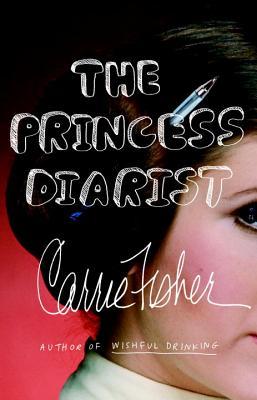
The Princess Diarist by Carrie Fisher

The Princess Diarist by Carrie Fisher
diarist

Take a highly intelligent, anxiety prone girl, mix in the life changing, world wide phenomena that is Star Wars, and add a dash of handsome, introverted, and married leading man and you have: The Princess Diarist.

This is not really about Star Wars as much as it is about obsession and Carrie trying to figure out who she is.

Though there are some tidbits sprinkled throughout: “And as much as I may have joked about Star Wars over the years, I liked that I was in those films. Particularly as the only girl in an all-boy fantasy. They were fun to make. It was an anecdote of unimaginable standing.” pg 5.

Or the moment Carrie found out that she got the part: “…I laughed and dropped the phone and ran out into the front yard and into the street. … It was raining in L.A. and I was Princess Leia. I had never been Princess Leia before and now I would be her forever. I would never not be Princess Leia. I had no idea how profoundly true that was and how long forever was.” pg 31

Carrie’s not afraid to make fun of herself: “When you watch the movie, it turns out that the voice I used when I was upset was vaguely British, and my not-upset voice is less British.” pg 44.

Or confess her hopeless awkwardness around her co-star: “But one thing I knew was that Harrison made me feel very nervous. I got tongue-tied in his company, and clumsy. It was uncomfortable in the extreme, and not in any way I could over come with a few well-chosen witticisms. We met, hit a wall, and stayed there. pg 61.

I’ve known someone who had that kind of effect on me. Poor Carrie.. poor me. 🙂

Here’s an actual entry from her diary that includes a mention of George Lucas: “George says that if you look at the person someone chooses to have “a relationship” with, you’ll see what they think of themselves. So Harrison is what I think of myself. It’s hardly a relationship, but nevertheless he is a choice. … I can’t think about it anymore. It makes my head hurt.” pg 114.

The older journal entries were my favorite part, but I can see how some readers may not enjoy them. They’re written in stream of consciousness and, at one point, I think Carrie flirts with a full on psychotic break- there’s a particularly disturbing entry about a rainbow colored talking fish that you can’t miss!

After the “Carrison” portion of the book, there’s some cringe worthy moments revealed between Carrie and mega Star Wars fans. Yes, she may have become a household name, but it doesn’t seem like it was worth the price.. or was it?

All of this just makes me want to watch Episode IV again! Read The Princess Diarist if you want to touch the depths of despair in a decades old love affair or if you want some quirky details about one of the most beloved science fiction films of all time. Also recommended: Fisher’s Shockaholic in which she details her struggles with bipolar disorder.

Thanks for reading!

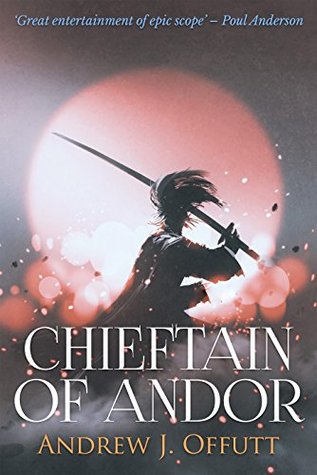
Chieftain of Andor by Andrew Offutt

Chieftain of Andor by Andrew Offutt

I thought I would enjoy Chieftain of Andor but this reprint of a 1976 classic wasn’t to my liking. Unfortunately, the anachronistic treatment of a majority of the women in the writing of the story, as either sex object or victim, ruined any possible enjoyment that I might have had in the adventure.

As for the story itself, it’s straight forward and may appeal to true fans of pulp science fiction. Robert Cleve is seeking an adventure. A shadowy company on Earth offers to transfer his consciousness to a man on a hugely distant planet where magic is real: “You will have adventures, Mr. Cleve- yes, plural, and in abundance. The opportunity for greatness- although your friends will never know of your achievements. And the opportunity to die. In which case your friends will never be certain. For once you agree, Robert Cleve- … you vanish from this world.” loc 27, ebook.

The women are the ones who are able to do magic on the planet, Andor. In this aspect, it was vaguely reminiscent of Dchieftainofandorune: “..she was Starpowered, and of Starinor, oldest of families. Down to her had come centuries of generations of Andorite witchery.” loc, 289, ebook. But, even with these magical powers, the females are never able to secure power, which I found puzzling. They act primarily as a sort of supporting role for the chieftains because… that’s how it’s done, I suppose. Offutt tries to dissect gender roles a little bit in Chieftain of Andor but I never found it satisfying.

Robert Cleve doesn’t believe in magic and so, his troubles begin from almost the first moment that he arrives in his new body: “…Robert Cleve was of Earth. Worse, he was of America, where belief in magic is laughed at and sneered at, save only in church and on Wall Street. …despite all he had seen and heard here, despite the beliefs of his peers and of the memories he now possessed… Cleve found it most difficult to accept witches and witchery. loc 419, ebook. Of course, the sorceress does not care if he believes in her or not…

As I mentioned before, readers who loved Dune may eat this up with a spoon as it has some similar themes. Unfortunately, I can’t recommend it for the modern female reader.

Thank you to NetGalley and Endeavor Publishing for the opportunity to read this book.

And, thanks for reading!

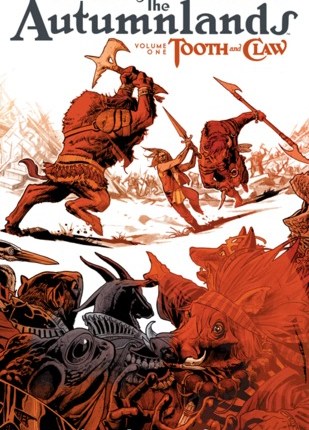
The Autumnlands V. 1: Tooth & Claw by Kurt Busiek

The Autumnlands V. 1: Tooth & Claw by Kurt Busiek
autumnlands

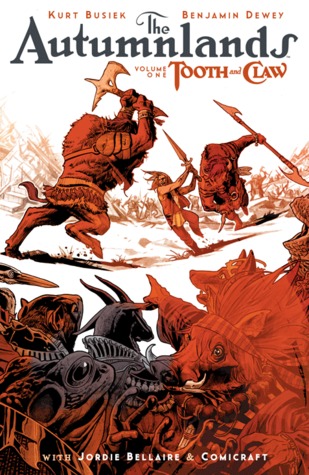
Excellent introduction to a world where anthropomorphized animals live on cities that float in the sky with the help of a magic that is fading from existence.

To combat this magic shortage, a talented magic user gathers a coalition of wizards to bring a great warrior from the past to the present in order to reawaken the powers.

The warrior is surprising, his summoning has unintended consequences, and the reader, after just a few pages, finds herself quickly caught up in a strange new world.

Highly recommended for adult readers who enjoy fantasy graphic novels.

There is a bunch of graphic violence and full frontal male nudity in here so, head’s up librarians. Make sure to shelve The Autumnlands in the appropriate section.

Some similar graphic novels, though I didn’t enjoy them nearly as much as this book: Monstress, Volume 1: Awakening or Wild’s End, Vol. 1: First Light.

Thanks for reading!

Running with a Police Escort: Tales from the Back of the Pack by Jill Grunenwald

Running with a Police Escort: Tales from the Back of the Pack by Jill Grunenwald
runningwithapoliceescort

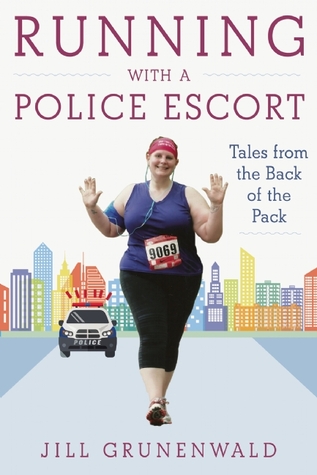
A Cleveland librarian chronicles the emergence of her inner road warrior. Jill was very unhealthy- tipping the scales at nearly 300 pounds when an email from her younger sister convinced her that she needs to change her ways.

Self described “slow runner”, Jill often finds herself at the end of races with organizers closing the course behind her. Thus the title of her eventual podcast and this book: Running with a Police Escort.

Jill reminded me of my younger sister, another “slow runner” who took up running for health reasons.

I have a great deal of respect for people who have the courage to make major life changes- be that taking up a sport, counting calories, or giving up meat products.

It is so easy to let life determine who you are becoming instead of taking full responsibility for your choices. Jill’s point in this memoir is that it doesn’t matter how fast or slow you go, you win if you’re making even the smallest steps towards your goals.

In this passage, she’s closing down the race, like usual: “…I happened to see one of the policemen on the street gesture to get my attention and point to the car following me. I pulled out my earbuds and from the sidewalk he called out with a supportive smile, “You must be a very important person to have a police escort!” loc 72, ebook.

Jill relates her unathletic/uncoordinated childhood and I felt a lot of sympathy for her bookworm tendencies: “While (my classmates) ran wild, I’d find a quiet corner along the brick wall of the building and bury myself in a book. My favorites were the Scary Stories to Tell in the Dark series, the macabre illustrations haunting my dreams.” loc 162, ebook.

Photo by Ricardo Esquivel on Pexels.com

That probably would have been one of my favorites too, but my school library’s copy was always checked out. Not that I’m bitter or anything.

Jill reminds the reader that people don’t get to nearly 300 pounds without a reason why- an underlying pain that they’re insulating themselves from. For Jill, it seems that she was chronically lacking in self esteem and self love.

I loved reading about her getting her mojo back: Truthfully, I didn’t even know how much I weighed because the analog scale that I owned didn’t go up that high. … I don’t know if I can verbally express what it means to be so heavy that you literally outweigh your scale’s capabilities. Like, seriously. Just think about that for a second, okay? A scale has a pretty basic function… and I had gotten so big, I put my scale out of work.” loc 312, ebook.

Running with a Police Escort is a great book for those who are struggling with their weight or the decision to become more healthy.

Jill isn’t afraid to laugh at herself and there is quite a lot of wisdom in these pages: “…it’s these simple decisions that compound as we make them every single second of every single moment of every single day. It is not the Friday nights or Saturday evenings that determine who we are and where we go: it is the Thursday afternoons or Monday mornings that mentor and counsel our being into a full-fledged sense of self.” loc 818, ebook.

Beware, there’s a bunch of swearing too. If you don’t appreciate that, you may have to find another book.

I also found it to be repetitive after the first couple of races, but it’s clear that Jill is writing from the heart and has been changed by every single mile that she’s undertaken. Share this book with others who may need encouragement because Jill is a natural cheerleader for the novice runner or athlete of any type.

Some further reading: Confessions of an Unlikely Runner: A Guide to Racing and Obstacle Courses for the Averagely Fit and Halfway Dedicated, Running Like a Girl, and Down Size: 12 Truths for Turning Pants-Splitting Frustration into Pants-Fitting Success.

Thank you to NetGalley and Skyhorse Publishing for a free advance reading copy of this book!

Thanks for reading!

Splintered by A.G. Howard

Splintered by A.G. Howard

splinteredAlyssa is a descendant of Alice Liddell- the Alice who inspired Carroll to write his tale of white rabbits and fantastical creatures. But, Alyssa has a family secret: the women of her bloodline go insane when they come of age.

She tries to look on the positive side of this: At least one good thing has come out of my inherited insanity. Without the delusions, I might never have found my artistic medium.” pg 10, ebook.

Alyssa is in love with Jeb, a dark and brooding young man with a penchant for grunge clothing and a lip piercing (that she talks about all the time). But, he is dating the most popular girl in Alyssa’s high school class, Taelor (of course).

Things get really exciting when Alyssa starts to hear voices coming from the bugs and plants.

After a brief introduction where the reader learns that Jeb is freakishly controlling and Alyssa’s mother is in an insane asylum, she falls through a mirror and after some trials, finds her way into Wonderland.

I thought this could have been a potentially interesting re-telling of the classic Alice in Wonderland story, but Splintered‘s uniqueness is stifled under a bunch of teen angst and a love triangle.

Granted, I’m not the target audience for this book, but I’d been on a roll lately with awesome fairy tale re-tellings and I thought I’d give it a shot. Oh well.

I actually enjoyed A.G. Howard’s interpretation of Wonderland itself. The characters were familiar but twisted slightly.

Here’s a passage from the tea party- my favorite part: “Now we need to get back to our world. Like yesterday.” “Yesterday, you say?” the hatmaker warbles in his bouncing timbre. “Yesterday is doable.” Guffawing, the hare slaps a knee and adds, “Although two yesterdays would be impossible.” The Door Mouse snickers, slipping back into his uniform. “No, no! You can retrogress as many yesterdays as you please. Simply walk backward the rest of your life.” pg 187, ebook.

See? Howard nailed the classic characterizations, but Carroll’s original creations were far superior to Alyssa, Jeb, and Morpheus, who were her main contributions to the story.

Disregard my opinions on this book if you simply must read any and all fairy tale re-tellings because, at the very least, it is that.

Just be aware what you’re picking up- a young adult romance/coming of age- and if that’s what you’re in the mood for, you may really enjoy it.

I find that my expectations shape my opinion of a book almost as much as the text itself. For example, I think if I had been warned that Alice in Zombieland had really very little to do with the Wonderland story, I may not have disliked it as much as I did.

Splintered actually has a lot of the original Wonderland in it and, if I had to choose between Alice in Zombieland or Splintered, I’d pick this in a heartbeat.

Some highly recommended horror/fairy tale re-tellings (for adults): Alice or All Darling Children.

Thanks for reading!

After a While You Just Get Used to It: A Tale of Family Clutter by Gwendolyn Knapp

After a While You Just Get Used to It: A Tale of Family Clutter by Gwendolyn Knapp
afterawhile

Sometimes poignant, other times appalling memoir by Gwendolyn (Wendy) Knapp that describes her dysfunctional family, drama filled relationships, and quest to find a job as a struggling writer in New Orleans.

The poverty level and drug addicted aunt described in After a While You Just Get Used to Itreally reminded me of Hillbilly Elegy: A Memoir of a Family and Culture in Crisis except that instead of in Appalachia, Gwendolyn describes a childhood in Florida. I suppose that some struggles are universal.

Although I enjoyed the stories, I wanted to read more about how the family dealt with Gwendolyn’s mother’s hoarding. Anybody else binge watch episodes of A&E’s Hoarders? It’s strangely compelling.

One lady collected every single flower bouquet message card that she had ever received- a leaning tower of Pisa in miniature, just perpetually collecting dust on one of her many side tables.

Anyway, the hoarding angle isn’t what this book is really about. The focus is mainly on Gwendolyn’s coming of age and early adulthood.

Gwendolyn is slightly older than me, but I enjoyed hearing about specific details from her childhood because I remembered some of those things in mine, like: “I applied my Dr Pepper lip gloss and pulled on my deflated Nike Airs, watching Mom give John a hug before saying her world-famous line, “Well, excuse our junk.” pg 6.

Photo by Rodolfo Clix on Pexels.com

Not to brag, but I think I had a Dr Pepper lip gloss and a Mint Chocolate Chip chapstick. Those were the days…

I knew that hoarders were emotionally attached to their belongings, but what I didn’t realize is that they’re also connected to their relatives through their stuff, though it makes sense when you think about it.

This is what happened when Gwendolyn’s grandpa died: “When an old relative dies, pack rats usually take in all they can from the person’s home as if they’re adopting abandoned children. It’s their duty. Since Grandma kept all his things, her kids had to find new ways to fill their void. Pack rats build up the world around them, separating themselves with a cloak of comfort from the outside world…” pg 16

Gwendolyn’s large, extended family has a passive aggressive, sometimes overtly aggressive love/hate thing going for it.

She describes her holidays as: “It was cacophonous, ear piercing, and annoying. Don’t worry, you might warn a newcomer, some bewildered boyfriend or classmate you’d invited and would never hear from again, after a while you just get used to it. Once the first jug of wine was finished, the racist diatribes and Burl Ives impersonations reared their ugly heads like gophers in need of malleting. … It wasn’t a holiday until my mother, and everybody else for that matter, had left Grandma’s feeling victimized by their loved ones.” pgs 54-55.

Photo by Christian Diokno on Pexels.com

Reading scads of memoirs has made me truly appreciate my own family and our very low levels of dysfunction, especially considering how large we are.

Here was the moment when I thought that we were going to deal with the hoarder thing for good, but Gwendolyn records this realization and time just marches on: “Imagine your mother burying herself alive. Imagine knowing there’s nothing you can do to help her. Imagine this every day of your life.” pg 85

Recommended for readers who grew up during the late 70’s/early 80’s or for people who like to read about dysfunctional families. Some further suggestions: Hillbilly Elegy: A Memoir of a Family and Culture in Crisis (similar themes like poverty and drug addiction), Not That Kind of Girl: A Young Woman Tells You What She’s “Learned” (struggling writer comes of age, details failed relationships), The Opposite of Loneliness: Essays and Stories (coming of age theme, but far more serious treatment than this book).

Thanks for reading!