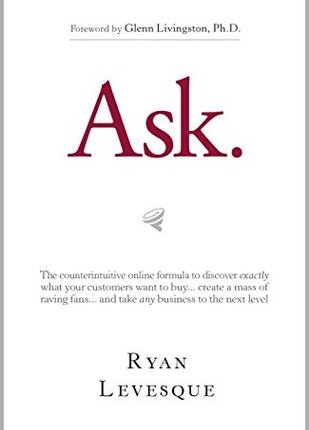
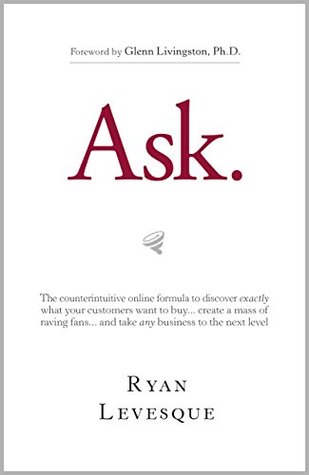
Quite the title, isn’t it?
I picked this up a few months ago because I was looking for some pointers on creating online surveys for the public library. It has some excellent ideas, but they’re buried beneath the coils of a very aggressive marketing formula.
Levesque coaches businesses to send twelve follow up emails to customers, whether they purchase the product or not. Can you imagine?
It’s no wonder that people don’t like giving their emails out, if that is the manner in which they will be used. I have to give it to Levesque- the man certainly doesn’t take no for an answer.
He describes the unique circumstances that gave him this fierce business drive and, unlike other reviewers on this book, I actually liked the autobiographical portion of Ask.
It made me view Levesque as a regular guy before he presented his over-the-top marketing strategies. I mean, perhaps if you were running your own business and needed absolutely every customer who strayed to your webpage, Ask would be invaluable to you. As it is, if the library were to employ this system, I think it would just seriously piss everybody off.
So, anyway, the some gems I pulled out of the mess:
“…people essentially are only good at answering two basic types of questions when they don’t know what they want: what it is they don’t want and what they’ve done in the past.” pg 10
Bring clarity to your business through stat analysis: “We discovered that by paying attention to the right information (provided by the market), you could not only identify what sub-segments exist in your market, but you can also identify which ones are worth focusing on.” pg 53
Put the important questions first: “Generally speaking, you should expect to see a degradation in response the deeper you get into your survey. So, for this reason, it’s essential to prioritize the importance of your questions beyond the initial questions in your survey.” pg 87
When evaluating survey responses: “The reason why response length is vitally important is because it’s an indication of hyper-responsiveness, which is a leading indicator of how likely someone is to purchase a paid solution for the problem or challenge about which we’re asking.” pg 92
Why to use an “open-ended Single Most Important Question”: “To determine what buckets naturally emerge in your market. To identify what people’s hot buttons are. To identify what their objections are. To identify what their biggest challenges are. To use in concert with their demographic information. pg 97
So anyway, to get all of these tidbits in context, pick up Ask and dig through it. But please, if I ever, for whatever reason, give you my email, do not send me 12 follow up emails. Please. And thanks for reading.
- Steve Cox and Matthew Walker’s Shaun the Sheep: The Beast of Mossy Bottom, a review
- Christopher Nolan’s The Odyssey, a review
- Edward Berger’s The Ballad of a Small Player, a review
- Otherwhere: A Field Guide to Nonphysical Reality for the Out-Of-Body Traveler by Kurt Leland
- Psychic Dreamwalking: Explorations at the Edge of Self by Michelle Belanger









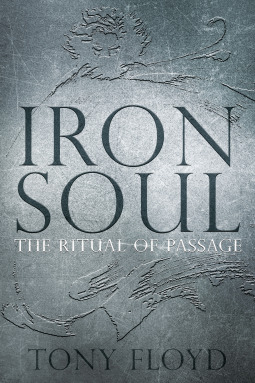 An ambitious book with complex world building, I nearly gave up on Iron Soul because I felt like it was too much for one story. But, I stuck with it and really enjoyed the ending. Here’s just a taste of this book: there’s multiple worlds in which the dead spend their after lives that all have their own sets of immortal (sort of) warriors each with their own unique magic system, the struggles of the dead stuck on Earth, the plight of the dead who don’t know that they’re dead, the living who have no faith and no where to go after they die, the spaces between the worlds that are filled with monsters, a sophisticated system of hierarchy and trade among souls, a process of augmentation of powers among the dead, souls trapped in dolls, animal spirits and soul bonding…