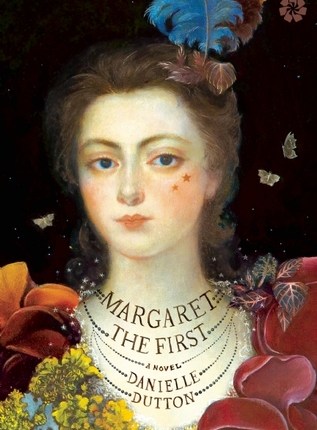
Margaret the First by Danielle Dutton

Margaret the First by Danielle Dutton

This book is life story of Margaret Cavendish, a duchess and one of the first popular female writers in England.
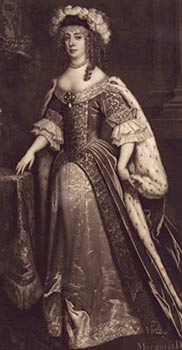
cavendish

Nice hat, right?  Digital image from nottingham.ac.uk

Margaret the First is written like a dream- the scenes come and go with little or no explanation in them and years pass in the blink or an eye or turning of the page.

Usually, I read historical fiction to immerse myself in the details of a time period, but this book doesn’t really cater to that. It’s a bubble in the wind or a glimpse from the windows of a fast moving car. It hints at depth more than delivers it.

Photo by Lucas F. on Pexels.com

But still, despite this strangeness, I was mainly captivated.

Margaret describing her mother: “As for our mother, she was beautiful beyond the ruins of time. None of her children would be crooked, of course, nor in any ways deformed. Neither were we dwarfish, or of a giantlike stature, but proportional, with brown hair, sound teeth, sweet breath, and tunable voices- not given to wharling in the throat, I mean, or speaking through the nose, unless we had a cold- yet we were none so prone to beauty as she, and I perhaps the least of them all.” pg 14, ebook. Beautiful.

Margaret describing the difference between her childhood education and her brother’s: “You must wear chicken-skin gloves on your hands all night,” my mother began… “When inside the house,” my mother went on, “you must not spend all your time writing little books.” Yet out the window, as she spoke, under a net of branches, my youngest brother, Charlie, arrived on the lawn with a hawk. … It is nobler to be a boy, I thought- and looked back with nostalgia, as if I just had been.” pg 18, ebook
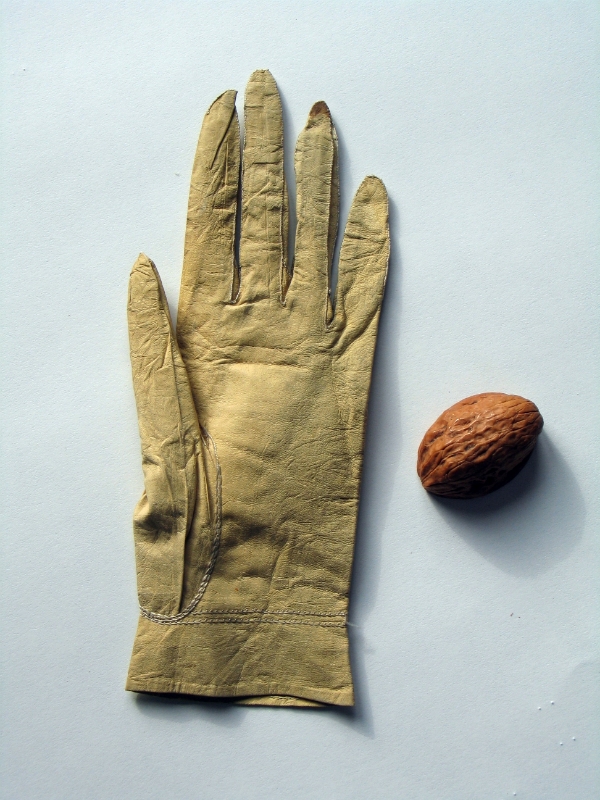
chicken-skin-gloves-0031

Actual chicken skin glove. Image from www.museumofleathercraft.org

The first time Margaret speaks out in a group of intellectuals: “A second man then sportingly suggested they debate the nature of woman. “You will find, sir,” I abruptly spoke, “women as difficult to be known and understood as the universe.” The room fell silent. I was surprised as any man.” pg 43, ebook.

This may be a work of fiction, but I feel like that’s something that Margaret would have actually said. Don’t you?
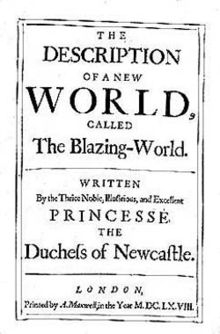
theblazingworld

Cover of one of Margaret’s books.  Photo from wikipedia.org.

The attitudes of that time period were astonishing: “Unlike Mr. Hobbes in his Leviathan, then under production in Paris, William thought that common man should be kept illiterate and happy, with sport and common prayer. “Too much reading,” he said, “has made the mob defiant.” I chewed my mutton and considered.” pg 56 (ebook)

Margaret undergoes a lot of unfortunate medical treatment in this book.

I thought that this passage was charming and really showed the time period rather than purely grotesque, bodily manipulations like some of the other doctor visits: “He (the doctor) tapped and patted, then scribbled in a book: how clear, how pale, how pink. I looked, he assured me, ten years younger than my age, in blossom, in perfect health, and prescribed only a new herb from China called tea. “The decoction of it drunk warm doth marvels,” he told Charles. “Very comforting, abates fumes.” To me he spoke nonsense, as he would to any child, suggesting candy or gossip, or candy with gossip, to lift my mood.” pg 64 (ebook)
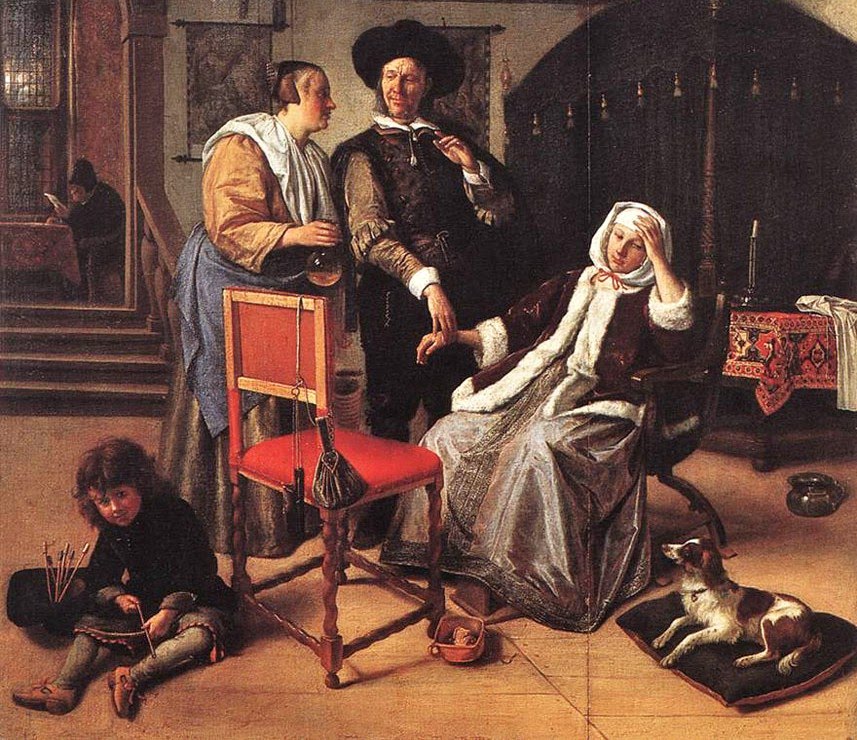
thedoctorsvisit

Painting: The Doctor’s Visit by Jan Steen.

Digital image from b-womeninamericanhistory17.blogspot.com

The science of the 1600’s was so off from reality as to seem absurd now in retrospect.

Take this scene where Margaret and an intellectual friend are viewing a map of the North Pole:“Here,” he said, “lies the very pole of the pole of the Earth, where all the oceans’ waters circle round and fall, just as if you’d poured them down a funnel in your head, only to see them come back out the southern end. And in the middle of the middle sits a large black rock, the very pole of the pole of the pole of the Earth, wholly magnetic, possibly magic, and thirty-three miles across!” “Where is the ice?” she wanted to know.” pg 100, ebook.
Photo by Ylanite Koppens on Pexels.com

In this passage, Margaret’s husband asks her what she wants in life and I thought that Dutton captured the (occasionally) unsettled attitude of every woman who has ever lived nearly perfectly:“But Margaret wanted the whole house to move three feet to the left. It was indescribable what she wanted. She was restless. She wanted to work. She wanted to be thirty people. She wanted to wear a cap of pearls and a coat of bright blue diamonds. To live as nature does, in many ages, in many brains.” pg 102, ebook. I’ve been there.

If the reader is looking for a historical fiction with more umph to it, she may want to consider The Dream Lover: A Novel of George Sand by Elizabeth Berg.

But, if she wants a frothy, fun, and fantastical journey into what might have been, look no further than Margaret the First.

Thanks for reading!

This review also appeared on O’Fallon Public Library’s blog.

Finding Jake by Bryan Reardon

Finding Jake by Bryan Reardon

A heart-wrenching yet ultimately uplifting story of psychological suspense in which a parent is forced to confront what he does—and does not—know about his teenage son, in the vein of Reconstructing Amelia, Defending Jacob, and We Need to Talk about Kevin.

While his successful wife goes off to her law office each day, Simon Connolly takes care of their kids, Jake and Laney. Now that they are in high school, the angst-ridden father should feel more relaxed, but he doesn’t. He’s seen the statistics, read the headlines. And now, his darkest fear is coming true. There has been a shooting at school. -Goodreads

I wouldn’t have touched this title without the encouragement of the library book club. Books and Brew challenges me to read different books, which I like, but I don’t always enjoy the topics that are discussed.

At first, I did not like Finding Jake. I thought that Reardon was presenting the glaring differences between introverts and extroverts as traditional gender role difficulties. I didn’t think that Simon was avoiding playdates because he was a “guy” but because he was an introvert. But, I suppose, being a guy didn’t help him build any common ground with the stay-at-home moms, which Reardon discusses in depth.


Also, I never liked the way that Simon and Rachel treated each other. I think that all too often, marriages tank because of the careless way that couples stomp on each other’s emotions. Yes, it’s a legitimate topic to discuss, but I don’t like reading that kind of thing for fun. Because, it’s not really fun at all, is it?

I empathized with Simon’s feelings about staying home and taking care of Jake and, later, his daughter, Laney. I never planned on having a kid, so the assumption that I was going to stay home and care for her really blind sided me. It was never even discussed in any serious way just presented like- so this is your life now, full time caregiver. That part of the book was hard for me to get through, in addition to all of the obvious school shooting horror emotions, because it brought up a lot of old angst that I would have rather had stayed buried at the bottom of my subconscious: “I never realized how much I’d miss seeing the cast of characters that make up an office. I also did not realize how much I identified with my job, or how much my job identified me.” pg 15 Yeah, either did I.

Here’s part where I just wish Simon had admitted to himself that he was an introvert: “I, for one, could go days (maybe weeks) without talking to the neighbors. Not that I disliked them. There were days I could go without talking to anyone, a new trait that expressed itself since I’d left the office. Conversations at work, whether about the job or not, had been simple. In the suburbs, though, the same exchanges left me either confused or apologetic.” pg 19 Classic introvert. Business is one thing, but personal relationships are a whole other can of worms.

The mother in this story, Rachel, asks Simon to stay home and raise the children, but they never seem to make peace with that decision and it seriously bugged me: “The rest I (Simon) left unsaid. It presented itself like a hippo in my kitchen, though. She should have stayed home with the kids. I don’t think Rachel picked up on it, thankfully, or the rest of the conversation would have progressed very differently. pg 47 Tons of exchanges like that, peppered throughout the book. Not fun.

And why do teachers make parents sit on those child sized chairs at parent teacher conferences? I’ve always wondered: “Ms. Jenkins motioned toward a low, round table. One full-size chair rested on her side. An array of three miniaturized versions lined our side. … I tried to fit my rear on the tiny seat, teetering back and forth until I found a semblance of comfort. When I turned to Ms. Jenkins, I realized I had to look up at her. I instantly felt like a child, folding my hands in my lap and waiting to get in trouble.” pg 101 It’s ridiculous.

Simon was far too hard on himself for about the whole book: “The past hours lost all clarity. Inexcusably, I think about the movies. Those parents, caught up in some awful tragedy paralleling our own, act the heroes, persevere against all odds, track down the clues and find the answers, gun in hand, nursing a nonfatal wound to the shoulder. For me, it is nothing of the sort. Instead the tsunami of reality pushes me, all of us, along, forcing us down this path of inactivity, bureaucracy, and flashbulbs. It is a wave of staggering weight that holds us captive to the nothingness.” pg 113 He should have given himself some credit. Who among us could have done any differently in the same situation?

What I loved about Finding Jake is that it is so relatable. At almost any point in the story, I could put myself in Simon’s shoes: “Maybe life is just a series of banal moments punctuated by tragedy. … Rachel and Laney sat in the living room, both reading. Laney flipped through a People magazine while my wife read a brief on her iPad. A familiar yet diaphanous annoyance colored my vision of what could have been a nice family moment. Instead, I blamed my wife for being a workaholic and at the same time wondered why Laney wasn’t reading her assignment from school instead of a glossy periodical.” pg 221

In conclusion, Finding Jake wasn’t a walk in the park, but I’m glad I read it, because now I’ll have plenty to say tomorrow night at book club. And, I’m glad that we meet at a bar, because I’m going to want that drink in my hand to soften and fuzz the lines of the less palatable emotions that will inevitably arise while we talk about school shootings, raising kids, gender roles, and life.

Thanks for reading!

The Secret of the Soul: Using Out-of-Body Experiences to Understand Our True Nature by William Buhlman

The Secret of the Soul: Using Out-of-Body Experiences to Understand Our True Nature by William Buhlman

The Secret of the Soul is a great title for beginners who are looking to understand this, sometimes confusing, other times frightening, skill that we all seem to possess — the ability to exit our bodies in a kind of vision or trance.

Some call this the “out of body experience” or OBE.

Photo by Joshua Abner on Pexels.com

The first half of the book, Buhlman discusses OBEs, why they are important, and gives countless examples of actual OBEs that folks have had. The second part of the book gives concrete techniques and problem solving tips to assist readers in having their own OBEs.

One of my friends is a long distance runner who has had some OBEs during his ultra marathons. I thought of him in the section entitled “Combat and Trauma-Induced Experiences”: “It was while I was running in a marathon last year that I had a very strange experience. I was at about the eighteen-mile marker when I looked beside me and saw myself running. At first I thought it was someone who was my build and wearing the same shoes, but then I realized it was me!” pg 55

Buhlman has story after story like that.

Photo by anouar olh on Pexels.com

If you’ve never had an out of body experience of your own, the sheer variety and number of people who have fills you with confidence that you can.

I also liked Chapter 4, “Transformational Experiences”: For thousands of years spiritual masters have taught that the act of withdrawing from the senses is essential in order to consciously experience our spiritual self. pg 61

And the testimony from that chapter: “This is bigger then anything I can imagine; how can I tell people without sounding like a nutcase? This changes everything I ever thought I knew or thought was true.” pg 68

That’s the thing about powerful transformational experiences. Until someone has one him or herself, there’s not really anyway to explain it.

Chapter 6, “Extraterrestrial Contact and Abduction,” was the first time that I’ve read about aliens alongside traditional OBEs. Buhlman writes: “After reading more than two hundred such letters (from his OBE survey), I noticed a startling similarity: The letters describing extraterrestrial contacts and abductions were almost identical to the thousands of letters I have received describing out of body experiences. In fact, I often could not distinguish between letters.” pg 89

Photo by Francesco Ungaro on Pexels.com

In Chapter 7, A Brief History of Out-of-Body Experiences, the reader is given cultures from different time periods, all over the planet, that support and confirm the existence of out of body experiences.

These seem to suggest that OBEs are a “human” experience rather than a culturally specific one.

Take Emanuel Swedenborg’s words: “It has pleased the Lord to… open the interiors of my mind or spirit, whereby I have been permitted to be in the spiritual world with angels, and at the same time in the natural world with people, and this now (has happened for) twenty-seven years.” pg 113

I was surprised at how many of the historical figures presented here as having OBEs were scientists… I guess in my mind I’ve always drawn a line between the artsy/mystic types and the scientists. Line erased. 🙂

I’ll conclude with a few statements from the Appendix of the book, which was compiled from Buhlman’s extensive survey of people who had had OBE’s: “Self-initiated out-of-body exploration is a direct and powerful method to experience our true spiritual essence. It is an effective method to accelerate our personal growth and evolution. … This is achieved by personal spiritual experience and exploration beyond the physical limits.” Appendix pg 253.

Photo by Enrique Hoyos on Pexels.com

Couldn’t have said it better myself.

If you’re looking for more books on the topic of out-of-body experiences, check out Otherwhere by Kurt Leland, Journeys Out of the Body by Robert Monroe, or Multidimensional Man by Jurgen Ziewe.

Thank you for reading!

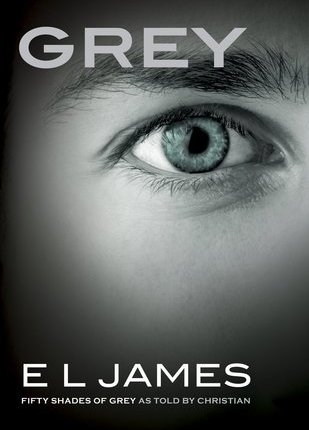
Grey by E.L. James

Grey by E.L. James

We all know what this book is about and why I didn’t like it. If you don’t have any idea what it is, here’s the Goodreads link.  Instead of writing a negative review about that, let me tell you a story about Fifty Shades of Grey and my first days as a librarian.

It was March of 2012. After being unemployed for four years to be a stay-at-home mom, I was hired to work behind the circulation desk at the public library in town. That particular day, a line formed at the front desk, which, as I would discover, happens all the time- but it’s stressful to have people waiting while you’re learning the ropes.

At the front of the line, a sweet, little elderly lady asked me, “Honey, do you have that book about the color grey?” I looked at my manager in confusion and he immediately answered, “Yes, ma’am, we do, but all SIX of our copies are currently checked out. Would you like me to put you on hold for it?” He walked me through the process of doing a hold request and then we were on to the next person in line. This time, a teenage girl giggled behind her hand as she asked me about, “That Fifty Shades book, do you have it?” I gave her the answer that we just gave the little old lady, and I put the girl on hold for it too.

All day long, for my first two weeks on the job, women, old/young and from all walks of life, asked me to get the book, Fifty Shades of Grey, for them. I still had no idea what this series was about… remember, this was before E.L. James did the talk show circuit in the states. After she made her appearances on Rachel Ray and, I can’t remember where else- was it Ellen?-, all hell broke lose. We couldn’t keep the books on the shelves and irate patrons were calling and storming the circ desk, wanting to know why the second book in the series arrived on their hold shelf before the first book did. (Short answer-the first book had four times as many holds on it as the others in the series.) To accommodate the demand, the library bought another six copies of the regular print books, bringing our own total copies to a dozen, not counting the audiobooks and large print versions. The library system that we take part in, owned nearly 500 copies of Fifty Shades of Grey, altogether. It was a literary phenomenon.

I decided, that even though it wasn’t my thing, I was going to read this trilogy that was blowing up the library world. So, I did. I wasn’t floored by it, but I could see how it appealed to a certain crowd. Erotica is very popular at the library, after all. Conscientiously, I read all three of the books, because that’s just the kind of professional reader that I am. :p After awhile, I started skipping the sex stuff because, frankly, it became repetitive and boring. I soldiered on because I wanted to know what happened to Ana. And, I found out.

In this book, on the other hand, I knew what was going to happen before I even picked it up so I didn’t bother to finish it when I discovered that it had nothing really new to offer. Grey is just for the true fans of the series and, unfortunately, I am not a true fan. I’ll always equate Fifty Shades with my first days on the job and my whirlwind introduction to the world of public libraries. I believe that it is a cultural touchstone for me in that regard. But, that doesn’t mean that I think it’s worth the ridiculous hype that it has garnered. Pick up Grey if you truly loved the original trilogy and wanted it to go on and on. I’d advise all other readers to steer clear.

Thanks for reading!

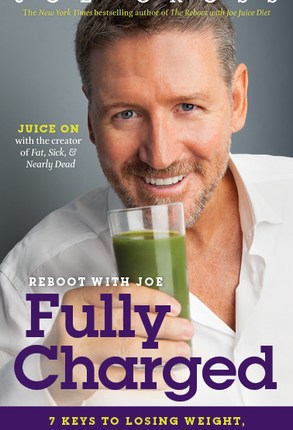
Reboot with Joe: Fully Charged: 7 Keys to Losing Weight, Staying Healthy and Thriving by Joe Cross

Reboot with Joe: Fully Charged: 7 Keys to Losing Weight, Staying Healthy and Thriving by Joe Cross

Fat, Sick, and Nearly Dead is one of the main reasons why I bought a juicer and have attempted to incorporate more plants into my diet. I’m not hardcore about it, but I try.

I didn’t know that Joe from that documentary is named Joe Cross and that he’s written multiple companion books for that film. This one, Reboot with Joe: Fully Charged, is excellent.

What I love about Joe is that he’s realistic. He doesn’t expect that he will eat perfectly for the rest of his life- he just wants to do the best that he can today then repeat the process tomorrow.

Photo by Wendy Wei on Pexels.com

He pushes the big lifestyle changers: diet, exercise, and rest but not in an extreme, unobtainable manner. In addition to common sense ideas about health and diet, Joe has spent years building an online community to support those who are working on major life changes. http://www.rebootwithjoe.com/weight-loss/

When you read this book, you also read examples of people who have turned their lives around with juicing and exercise. It’s inspiring and could be life changing for many people.

I also like that Joe included some of his go-to juicing recipes towards the back of the book. I’ve tried quite a few different juices, but I haven’t found any that I particularly liked. It’s always nice to have some new options that have appealed to other people in the past.

If you enjoyed Reboot with Joe: Fully Charged, I highly recommend his two documentaries: Fat, Sick, and Nearly Dead & Fat, Sick, and Nearly Dead 2. Also, I’d recommend the documentary Forks Over Knives which has a couple companion cookbooks out now.

A big thank you to the Goodreads First Reads program and NetGalley for free copies of this book.  And, thank you for reading!

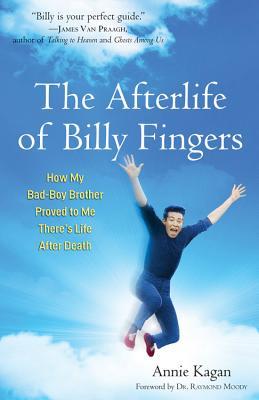
The Afterlife of Billy Fingers: How My Bad-Boy Brother Proved to Me There’s Life After Death by Annie Kagan

The Afterlife of Billy Fingers: How My Bad-Boy Brother Proved to Me There’s Life After Death by Annie Kagan

I think anyone who has lost a loved one wishes to talk to them again. Annie Kagan was granted that wish. She wasn’t a practicing channeler, so it came as a huge surprise to her when she heard her dead brother’s voice speaking to her from a spot above her head.

At the time that this happened, Annie was living a hermit’s life in New England only venturing out to kick ideas around at her writer’s group. So, that gave her the space and time to explore these communications rather than running to the doctor to have the voice medicated away.

Photo by William Alexander on Pexels.com

At first, she was reluctant to share what she was hearing, afraid that Billy’s voice was her mind’s way of holding the grief away or that other people would think she was going insane, but the information imparted became more and more specific until she couldn’t explain it away.

Through the experience and sharing it, Annie came to believe without a doubt that the spirit continues on after death. She took comfort from it and hopes, with this book, to share that comfort with others who may be grieving or afraid of death itself.

The Afterlife of Billy Fingers isn’t going to appeal to everyone. If you don’t believe that communications from beyond the grave are possible, I’d suggest passing on this book. And, towards the end of Billy’s travels into the afterlife, things get really far out as he lets go of his previous self and becomes the universe, embodying the entirety of reality.

Photo by Designecologist on Pexels.com

It reminded me of Be Here Now by Ram Dass, hippie to the extreme. But, that’s the type of spirituality I’m into, so I loved it.

The introduction by Raymond Moody describes Billy as a modern psychopomp, someone who guides the spirits of others through the afterlife: “The experiences Dr. Kagan relates are completely consistent with the kind of role walkers between the worlds played in antiquity. And that is no surprise to me. I think that such experiences are part of the collective psychological heritage of humankind- not artifacts of any one culture.” pg 11, ebook.

Billy was a drug addict and led a very hard life.

This is what he had to say about it: “How do I know my life wasn’t some punishment for my past transgressions? Well, because there’s no such thing. You’re not on earth to be punished. … That’s a human concept. Something man made up. Humans make up stuff and then they believe it”. pg 24, ebook.

A continuation along that line of thinking later in the book: “Beliefs are big on earth. People collect them. Some of these beliefs are helpful, but others just keep you running around trying to follow rules that others have laid down. They don’t have a lot of personal meaning. It’s a good idea to sort through your beliefs now and then and throw out the ones that don’t serve you.” pg 85, ebook

Photo by Pixabay on Pexels.com

Annie dealt with a bunch of her own issues in this book, like the fact that by writing this book, people were going to think she was “flaky”. At one point in the narrative, she has a toothache and starts to believe that she’s being punished for revealing universal truths that should be kept secret.

She eventually gets past that attitude, but, when it comes to the unknown, I think fear can be a major hurdle: “After my toothache and the painful root canal and awful infection that followed, I was scared. … who was I to be the one to prove there’s life after death? Maybe some secrets shouldn’t be revealed. Maybe I was breaking a sacred taboo, dabbling in a cosmic Pandora’s box.” pg 41, ebook.

Another of the Be Here Now moments: “In your world, as the earth moves around the sun, there’s nothing but shadow for a good part of the time. The mystery of life on earth cannot exist without the shadow element. You cannot have the sea without storms, the earth without quakes, the wind without tornados. … And sometimes- sometimes darkness is okay too. Don’t overlook the riches contained in the darkness. Life’s very temporary, so don’t let time just pass. Let the moments fill you- the ones you judge to be good as well as bad.” pg 77, ebook. Solid advice.

Let’s end with one more bit of wisdom: “People spend lots of time on things that make them unhappy- too much focus on the sand in the oyster. To cultivate joy, pay attention to what you like.” pg 116

Recommended for spiritual seekers and people who enjoy reading about near death experiences/channeled wisdom.

Some read alikes: Conversations with God: An Uncommon Dialogue, Vol. 1 by Neale Donald Walsch, My Son and the Afterlife: Conversations from the Other Side byElisa Medhus, Ask and It Is Given: Learning to Manifest Your Desires byEsther Hicks or, if you’re looking to introduce more joy into your life:Thank & Grow Rich: A 30-Day Experiment in Shameless Gratitude and Unabashed Joy by Pam Grout.

Thanks for reading!

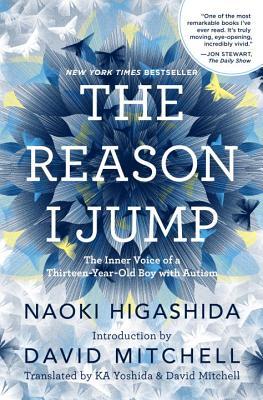
The Reason I Jump: The Inner Voice of a Thirteen-Year-Old Boy with Autism by Naoki Higashida

The Reason I Jump: The Inner Voice of a Thirteen-Year-Old Boy with Autism by Naoki Higashida

This is one of the first books I’ve ever read by someone with autism or who is neurodivergent.

Goodreads described it quite succinctly: “You’ve never read a book like The Reason I Jump. Written by Naoki Higashida, a very smart, very self-aware, and very charming thirteen-year-old boy with autism, it is a one-of-a-kind memoir that demonstrates how an autistic mind thinks, feels, perceives, and responds in ways few of us can imagine. Parents and family members who never thought they could get inside the head of their autistic loved one at last have a way to break through to the curious, subtle, and complex life within.”

The reviews on this one from my Goodreads friends are very mixed and I understand why. The Reason I Jump touches on a very emotional topic.

I’m not an expert on autism so I am completely unqualified to determine if Naoki wrote this book with or without help or the over arching truth of his experiences. However, as a reader, I thought that some of Naoki’s words were very beautiful.

Naoki talks about difficulties in communicating his feelings, the beauty of nature, the impossibility of controlling his emotions or repetitive actions- knowing that he’s not behaving “normally” but not able to do anything about it.

“Please don’t judge us from the outside only. I don’t know why we can’t talk properly. But it’s not that we won’t talk- it’s that we can’t talk and we’re suffering because of it.”pg 24, ebook.

It seems to me that everyone’s lens of perception is different and we can learn from each other if we share our own unique viewpoint. I certainly learned about Naoki’s inner world from this book.

Thank you for reading!

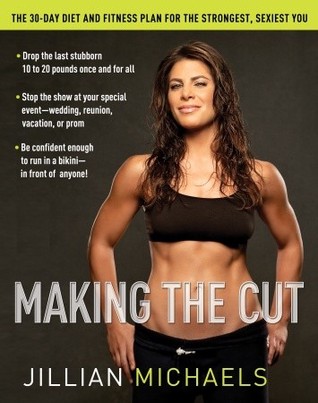
Making the Cut: The 30-Day Diet and Fitness Plan for the Strongest, Sexiest You by Jillian Michaels

Making the Cut: The 30-Day Diet and Fitness Plan for the Strongest, Sexiest You by Jillian Michaels

“Making the Cut” is a collection of recipes, workout tips, and insider training techniques from Jill Michaels, one of the trainers of the television program: The Biggest Loser. She’s hardcore and this book is a reflection of that.

Definitely not for everyone, myself included, I’d only recommend it to those who are already in very good shape. Let me make one thing clear, I’m not in “bad” shape, but I am not at the level required to complete these exercises.

Photo by Pixabay on Pexels.com

So, I nearly killed myself trying to do Day 1 of the circuit training. I have a predictable cycle with fitness books. I read them, get all fired up about changing my diet and amping up my workouts, try it for awhile, then give up.

This one, at least, was so hard and I was hurting so bad that I gave it up right away rather than drawing it out to its inevitable conclusion. Her clean eating tips are solid and I’ve added a lot more fresh fruits and veg to my table, but, the workouts are just too hard.

I had my husband helping with the timer and figuring out what I was supposed to do at each step because her descriptions of the exercises are all gathered together in an index at the end. He was encouraging me to stop after the first two minutes, but I insisted on doing at least ten- silly me.

The weird frog push-ups were an impossibility from the start. I almost broke my nose when I tried to lower my face to the floor. I had to laugh, it was ridiculous.

My only saving grace was that I was using the equipment at my home rather than the gym. If I had humiliated myself like that in public, I might not have been able to give this book the “liked it” three stars.

Some read alikes, for those fitness buffs who just can’t get enough! : This Is Why You’re Sick and Tired: by Jackie Warner, Get Me Skinny by Tony Arreola or, if you’re tired of the exercise and diet merry-go-round: Down Size: 12 Truths for Turning Pants-Splitting Frustration into Pants-Fitting Success by Ted Spiker or Confessions of an Unlikely Runner: A Guide to Racing and Obstacle Courses for the Averagely Fit and Halfway Dedicated by Dana L. Ayers.

Thanks for reading!

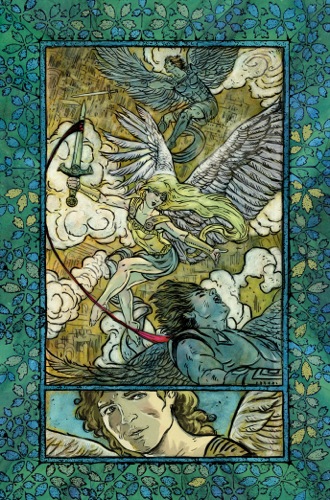
A Flight of Angels, Illustrated by Rebecca Guay

A Flight of Angels, Illustrated by Rebecca Guay

A Flight of Angels includes stories by Holly Black, Louise Hawes, Todd Mitchell, Alisa Kwitney, Bill Willingham.

Lovely art elevates a so-so collection of short stories about angels. Rebecca Guay, in my opinion, is one of the most talented illustrators I’ve ever seen. The artwork is classic but ephemeral with tasteful nudes and multi-layered backgrounds. In a word: gorgeous.

flightofangels

I picked this one up because of The Last Dragon by Jane Yolen. In that book, as in this, I loved the art but thought that the story was predictable. I feel like the authors that Guay has partnered with, at least so far, don’t measure up to the masterworks she produces.

flightofangels2

Borrow this one from your nearest library so that you can see how beautiful it is.

Read alikes: some of the Fables, Vol. 1: Legends in Exile series has art on this level but they’re kind of hit or miss. Saga, Volume 1 is beautiful but the story has some very vulgar moments popped in there. If you can handle that, and I know that some people are huge fans of Saga, then that series might be a good fit. Or, of course, you may want to pick up The Last Dragon as that is done by the same illustrator.

Thanks for reading!