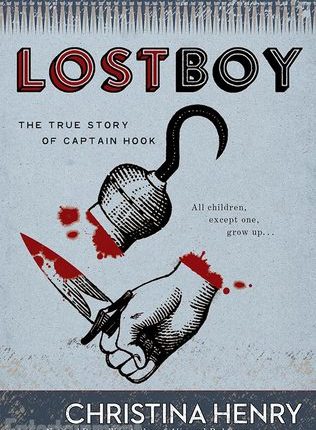
Christina Henry, author of the chilling Alice, which is a brilliant re-telling of Alice in Wonderland, has shifted focus to a new fairytale. In Lost Boy, readers get to experience the story of the boy-who-never-grew-up through the origin story of his arch-nemesis. And what a story it is.
“Peter will say I’m a villain, that I wronged him, that I never was his friend. But I told you already. Peter lies. This is what really happened.” loc 85, ebook. Goosebumps? Yeah.
Fans of the original tale will need to prepare themselves for having beloved characters shown in a new and sinister light. Think Longbourn, but worse, much worse. “I had been with Peter longer than I’d been in the Other Place, longer than I could count, anyway. The seasons did not pass here and the days had no meaning. I would be here forever. I would never grow up.” loc 146, ebook. The others in Peter’s group call the narrator, Jamie.
He is a fierce fighter- the best. And he protects the younger and weaker members of those lucky few that Peter brings back from the real world or in this tale, the Other Place. This protective instinct is sneered at by Peter who accuses Jamie of “babying” or “mothering” the boys. In truth, there is no worse insult in Peter’s arsenal. Grown ups either abuse you or take your stuff or both. They’re pirates.
“(Peter) had invited us there, had promised us we would be young and happy forever. So we were. Unless we got sick, or died, or were taken by the pirates.” loc 257, ebook. So, Neverland is not the paradise that it is portrayed as in the original tale. There are also monsters called Many-Eyed that eat the boys alive, if they catch them.
“Was this, I wondered, what it felt like to be a grown-up? Did you always feel the weight of things on you, your cares pressing you down like a burden you could never shake? No wonder Peter could fly. He had no worries to weight him to the earth.” loc 1971, ebook.
The stage is set. Love and hate intertwine with magic, blood and, of course, a little bit of fairy dust.
If you enjoyed this tale, you may also want to explore some other Peter Pan re-tellings like Tiger Lily by Jodi Lynn Anderson or All Darling Children by Katrina Monroe. The last, a horror-filled offering, may really appeal to those who want to delve more into the potential shadows of Neverland. There’s a price to pay for never growing up. In that tale, as in this, Peter pays it without a qualm.
Thank you to NetGalley and Berkley Publishing for a free advance reader’s copy of this book. Reminder: the short quotations I cited in this review may vary in the final published version.
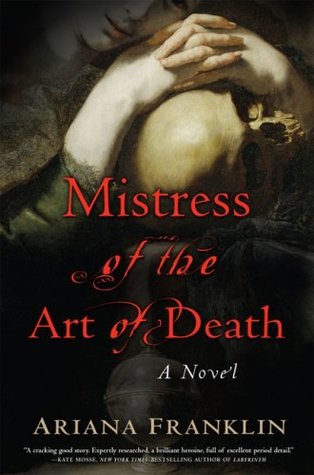
A medieval mystery in which Simon of Naples, a eunuch and a unique woman with the ability to decipher the wounds inflicted on bodies, race to discover the identity of a violent killer of children before he strikes again.
From its opening lines, The Mistress of the Art of Death had me in its thrall. “Here they come. From down the road we can hear harnesses jingling and see dust rising into the warm spring sky. Pilgrims returning after Easter in Canterbury. Tokens of the mitered, martyred Saint Thomas are pinned to cloaks and hats- the Canterbury monks must be raking it in. They’re a pleasant interruption in the traffic of carts whose drivers and oxen are surly with fatigue from plowing and sowing. These people are well fed, noisy, exultant with the grace their journey has gained them. But one of them, as exuberant as the rest, is a murderer of children.” pg 1.
I have been to Canterbury and viewed the spot where Thomas Becket was cut down by the knights of Henry II. It is an amazing place. Even more so when you consider that it has been standing for so long. I loved going back there, if only in a story.
The Mistress of the Art of Death herself, Adelia, is a brilliant and headstrong heroine. She embodies what I imagine women to have been in the time before we were allowed the same privileges as men. “She sighed with impatience. “I see you are regretting that the woman, like the doctor, is unadorned. It always happens.” She glared at him. … “Turn over that stone”- she pointed to a flint nearby-“and you will find a charlatan who will dazzle you with the favorable conjunction of Mercury and Venus, flatter your future, and sell you colored water for a gold piece. I can’t be bothered with it. From me you get the actuality.” He was taken aback. Here was the confidence, even arrogance, of a skilled artisan.” pg 52.
The reality that Adelia has been taught to see is not pretty. She learns all about the horrors that mankind inflicts on one another through her schooling. It has hardened her, but she seeks, beyond all else, to give voice and justice to the murdered. “Man hovers between Paradise and the Pit… Sometimes rising to one, sometimes swooping to the other. To ignore his capacity for evil is as obtuse as blinding oneself to the heights to which he can soar.” pg 77.
And yet, Adelia is still sassy. I loved her attitude. “He found her modest- a description, Adelia had long decided, that was applied to women who gave men no trouble.” pg 88. Though this novel could have dragged the reader through the stultifying reality of medieval attitudes and prejudices, instead Ariana Franklin takes us on a sparkling adventure filled with just enough detail to give the flavor of the time.
Recommended for those who like mysteries, historical fiction, strong heroines and perhaps some romance on the side. The Mistress of the Art of Death, though it touches on dark themes, was a welcome respite for me from a world that so often shows its shadows. I hope that it is an escape for you too.
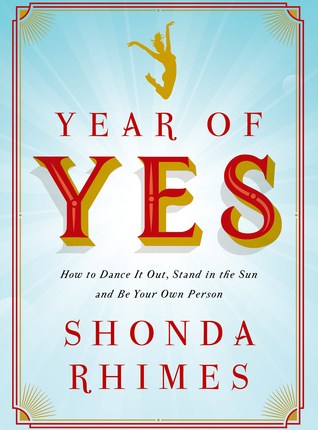
Shonda Rhimes’ heartfelt memoir about the power of embracing who you are and having the courage to set aside what you are not.
Though outwardly successful, Shonda was miserable. Between over-working and her introverted tendencies, she turned down every invitation and social event. The ones that she was forced to accept were anxiety inducing trials or complete blanks because of panic attacks.
Shonda didn’t even realize she was unhappy until, one Thanksgiving, her sister tells her that she doesn’t say yes to anything. Something clicks and Shonda embarks on a Year of Yes. Her results are astonishing and so is this memoir.
I have never watched a single episode of Grey’s Anatomy. I didn’t even realize that that was her show. You don’t need to be an aficionado to appreciate this book.
Shonda begins with some crushingly honest passages about her discomfort at sharing her life and her passion for writing. “Making stuff up is responsible for everything-everything I’ve done, everything I am, everything i have. Without the tales, the fiction, the stories I’ve spun, it is highly likely that right now, today, I’d be a very quiet librarian in Ohio.” pg 6, ebook. Not that there’s anything wrong with that. 🙂
The first part of this book was actually hard for me to get through because she was so obviously uncomfortable at creating a window into her heart and mind. She gets over it and so did I. “When it was first suggested to me that I write about this year, my first instinct was to say no. Writing about myself feels a lot like I have just decided to stand up on a table in a very proper restaurant, raise my dress and show everyone that I’m not wearing panties. That is to say, it feels shocking.” pg 12, ebook.
Shonda is just so relatable. Take this confession about motherhood: “I don’t know about you, but the mistakes and missteps I have made since becoming a mother… before kids, my confidence could not be dented. Now it’s shattered on a daily basis. I don’t know what I am doing.” pg 63, ebook. I know, right! Nobody knows what they’re doing. I take comfort in that.
Throughout her year of challenging herself, Shonda discovers that she’s uncomfortable in her own skin because of her weight. This next passage is for anyone out there who has body image issues: “I believe everyone’s body is theirs and everyone has a right to love their body in whatever size and shape and package it comes in. I will fight for anyone’s right to do so. I will kick ass and take names if I have to. Your body is yours. My body is mine. No one’s body is up for comment. No matter how small, how large, how curvy, how flat. If you love you, then I love you.” pg 85, ebook. End of story.
I also liked how she came to a new understanding about how life works: “I’ve started to think we are like mirrors. What you are gets reflected back to you. What you see in yourself, you may see in others, and what others see in you, they may see in themselves.” pg 120, ebook. I’ve started to think that too.
The Year of Yes is recommended for readers who enjoy memoirs or for those folks out there whose lives are in need of an awakening- a shaking of the snow globe of your reality, if you will. Shonda said yes to things that scared her and discovered, on the other side of fear, a life truly worth living. I hope that we can all be as fortunate and as brave on our journeys.
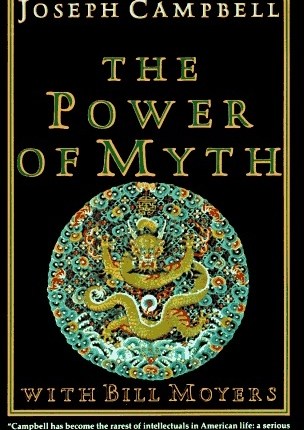
Though a bit rambling at times, The Power of Myth is a great introductory text on archetypes found within all world mythologies from almost every time period.
In it, Joseph Campbell explains why the underlying stories are the same from all over the world and what they mean in both cultural, personal, and world contexts.
He breaks down some of the major archetypes like the sacrificed god and resurrection, virgin births, goddesses, trees, snakes, and more. As someone who has studied tarot and The Tree of Life extensively, I found it to be an illumination.
I particularly liked learning about the mythology of Star Wars. With the release of the new film, that particular series is back in the top of the pop culture charts. I think that The Power of Myth explains why it has such enduring appeal.
Or pick up any of the many books about mythology from any country you’d like. If you immerse yourself in enough of the stories, you will pick up on the reoccurring patterns yourself.
I believe that one of the many purposes of mythology, beyond its entertainment value, is to teach us about what we have in common with each other, and also, the hidden dimensions of ourselves.
As the doorway to the Delphic Oracle said, “Know Thyself.” And, really, that is the greatest power there is. Mythology helps you do that.
I have decided to partner up with another blogger to expand the content of The Help Desk.
I will continue to post the book reviews that The Help Desk is known for, but this blogging partnership will take some of the pressure off of my frantic reading schedule. It takes time to read and review books properly. With my new 40 hour a week job, I don’t have the time to devote to it as I used to.
The History Guy is a dear friend of mine who makes five minute videos about history.
His educational videos are well-researched and fun: a perfect fit for The Help Desk. If you’ve been following my blog, you’ll notice that I love quirky non-fiction. These are right up my alley.
I’ve learned a lot from this YouTuber and I hope that you do too.
My first pick from his lengthy catalog of videos is about Mary Edwards Walker, the only woman to receive the Medal of Honor. She was an abolitionist, surgeon and truly ahead of her time.
Without further ado, I present, “Five Minutes of History: Mary Edwards Walker,” by the History Guy.
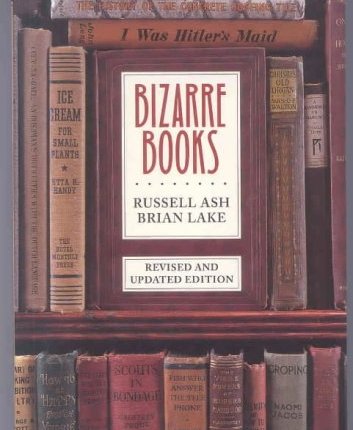
Though it relies too heavily on puns and doubles ententes, Bizarre Books is a humorous look at titles, subjects and author names in published materials. It is a must-read for any book lover or professional who deals with the printed word on a daily basis. *cough* Librarians. *cough*
“All the books recorded are real titles, with real authors. All of them were published with the serious intention of informing, not amusing. In this, they have signally failed.” introduction, pg 7.
I don’t think that ALL of them were meant to be informative. Take this entry from one of my favorite genres, science fiction: Planet of the Knob Heads. Stanton A. Coblentz. Science Fiction, Atlas Publishing, 1939. “Jack and Marjorie are brought to the distant world of their captors. In far Andromeda, they struggle against “favors” of the knob-heads – but hope fades as they face the High Knobule!” pg 40. Almost irresistible, isn’t it?
If science fiction isn’t your thing, how about this (I’m guessing) thriller: What Farrar Saw. James Hanley. Nicholson & Watson, 1946. “No story by Mr. Hanley is without its moral implications; here we have a glimpse of nightmare horror and chaos in a monstrous machine ridden world. It starts simply enough as chaos does. A young couple set off for a holiday in Scotland.” pg 44. Sounds at least as promising as The Girl on the Train, wouldn’t you say?
Those were some of the fictional books that caught my eye. On to the non-fiction. If it was on a shelf in front of me, I’d pick up Carnivorous Butterflies by Austin Hobart Clark, pg 62.
In the most ineffective category, the prize goes to: Atomic Bombing: How to Protect Yourself. Watson Davis, et al. New York: William H. Wise & Co. 1950. One of its suggestions was: “Curl up in a ball as you hit the ground.” pg 166.
By far, my most favorite selection is: The New Guide of the Conversation in Portuguese and English in Two Parts. Pedro Carolino.
Familiar phrases: Let us go on ours feet. At what o’clock is to get up? At which is this hat. Have him some children? pg 54. And so on. The authors dedicated another three pages to this gem alone.
Highly recommended from this bookworm. It made me laugh a lot and that is not easy to do.
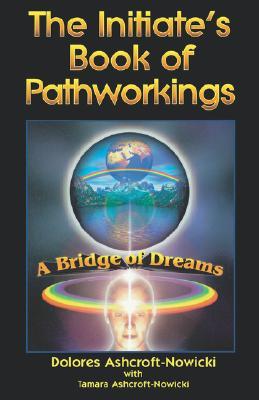
Dolores Ashcroft-Nowicki shares meditations which she calls pathworkings as a method of self actualization.
I understand that directed pathworkings are an actual technique that has been used by mystery schools for centuries to explore consciousness. I just don’t see its usefulness beyond a sort of tourist trip through what “may” be in your mind rather than what “is”.
Let’s compare it to riding a bike. Directed pathworkings are like watching a video of someone riding a bike. Passive pathworkings are like hopping on that bike and riding it all over your neighborhood. You get the visceral experience of being there.
If you’ve never ridden a bike before, watching the video might be safer, but it certainly isn’t more fun.
If we look at the Initiate’s Book of Pathworking as a journal of an adept’s inner work, it feels rather rehearsed and stilted as opposed to the out of body work that was chronicled in Multidimensional Man by Jurgen Ziewe.
If we consider the different approaches between Ashcroft-Nowicki and Ziewe, it also makes more sense that these pathworkings have a clear beginning, middle, and end as opposed to Ziewe’s offerings which are more like real life: random and, at times, nonsensical.
Because (I’m assuming) an adept from The Servants of Light School created these pathworkings through actual experiences on the inner planes, it has the curious side effect of unfolding like a structured lesson plan.
In Nick Ferrell’s book, Magical Pathworking, he discusses the importance of writing pathworkings like a story with a beginning, middle, and end for its consciousness shaping potential, but he never talks about how naturally occurring pathworkings or passive pathworkings, present themselves in that manner, organically. At least, that has been my experience.
I suspect that mystery schools experienced some pathworkings through their consciousness research, recorded the patterns that occur, and then sought to imitate that inner perfection by scripting pathworkings like the ones found in this book.
There is value to be found in this book as it provides a nice introduction to pathworking in general: “What is a pathworking? It is similar to a virtual reality trip. Pathworkings are perfectly natural and can occur spontaneously in the form of daydreams. Used as a structured series of visualizations, they hold many possibilities for the student.” Introduction, pg x
I found some of this book silly like the Healing Spring (Women only) pathworking on page 61. Women only? We’re dealing with consciousness here which is neither male or female, but pure being. If a guy wants to run the Healing Spring pathworking, I’m not going to be the one to say no.
Some of the poetry in the pathworkings is very beautiful and felt authentic, which again made me wonder who wrote these for the SOL. W.E. Butler? Dion Fortune? So curious:
“Forest Lord, with twelve-tined crown, Now we come to bed thee down. Rest content when sleeping deep, Leave the Summer Queen to weep.
Rest thee well till comes the Spring When harebells in the wood do ring; Then rouse thee up the maid to wed And seek the joy of the greenwood bed.
Hunter, blessed be thy sleep; Choose a maid thy bed to keep. Dreams of silver, dreams of gold Will guard against the winter’s cold.” pg 190
To give you a comparison, here is a chant from some pixies in a passive pathworking that I experienced a couple of months ago:
“Awake the trees, awake the night, awake the shining moon. Feed the plants, free the life that dwells within the bloom. To keep the forest growing tall, the pixie people sing, We bring the song and dance the call to wake the Forest King.
Awake the night, awake the moon, awake the powers old, We’re the ones that call upon the Spirit of the fold. Dance the dance, sing the songs, make the forest wake, In our stead, these plants have fed the thirst that never slakes.
Feels very similar, yes? That’s the fascinating thing about consciousness research to me. It feels so familiar but, at the same time, infinitely unknown.
It’s just my opinion but, I think, in addition to space, our own minds are the next frontier of human exploration.
“These “serial” workings will grow with you as you explore them, and can bring about many strange events, both in your astral life and in your physical existence. They are more potent than they seem, so take them slowly.” pg 214. One a week has worked pretty well for me. I feel like I’m learning and growing but not being overwhelmed by the changes.
A dated portion of this book that I found rather amusing, especially since the recent kerfluffle over the year 2012: “As the year 2000 comes ever closer, speculation as to the future of the world gets wilder. Exactly the same kind of hysteria hit the known world in the year 1000… The year 2000 will usher in a time of adventure, opportunity, and yes, a lot of changes. But we will survive. Things may be very different a hundred years from now, but we have survived big changes before and will do so again.” pg 231 Amen.
“One of the things an initiate learns is that every man and woman is essentially a “multi-versal” being. That is, we exist simultaneously in many dimensions and parallel universes. We have a consciousness in each one, a life in each one, a purpose and destiny in each one. But each is minutely different. With every passing moment in time, we change our future in each universe by constantly making decisions that affect the course of that future.” pg 240. I don’t know that I agree with everything in that passage, but isn’t it a beautiful view of reality? Layers within layers of truth, all interacting and changing each other, eternally.
If you liked the guided pathworkings in this book, you may want to read: Magical Pathworking: Techniques of Active Imagination by Nick Farrell, Pathworking and the Tree of Life: A Qabala Guide to Empowerment & Initiation by Ted Andrews, or the second half of A Garden of Pomegranates: Skrying on the Tree of Life by Israel Regardie. If you want examples of (mostly) passive, out of body experiences, read: Multidimensional Man by Jurgen Ziewe or Psychic Warrior: The True Story of America’s Foremost Psychic Spy and the Cover-Up of the CIA’s Top-Secret Stargate Program by David Morehouse.
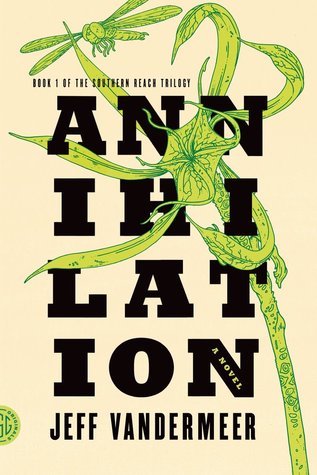
A group of female scientists and professionals are sent to explore a region that is not like the world they know. Annihilation is a hypnotic science fiction/thriller that weaves its spell slowly. Then, all at once, it has your complete attention and you find yourself hanging on every word. I loved it.
Isolation from the modern world and technology places this tale in an anachronistic bubble: “One rule for an expedition into Area X was that we were to attempt no outside contact, for fear of some irrevocable contamination.” pg 7, ebook. It harkens back to the idea that, “In space, no one can hear you scream.”
They’re far from home in a surprisingly deadly world. It has already claimed eleven groups of explorers. But, we don’t know what killed most of them: “We were scientists, trained to observe natural phenomena and the results of human activity. We had not been trained to encounter what appeared to be the uncanny.” pg 46, ebook. Extraordinary things begin to happen, almost from the moment the team sets foot in Area X.
“When Area X first appeared, there was vagueness and confusion, and it is still true that out in the world not many people know that is exists. The government’s version of events emphasized a localized environmental catastrophe stemming from experimental military research.” pg 61, ebook. The government has reasons to cover this place up. But why? What is it really and what does it contain?
Creepy and enthralling, Annihilation is a treat. It is easy to see why this won the Nebula Award for Best Novel. I highly recommend it for science fiction lovers and those who enjoy experiencing a world that doesn’t behave by the usual rules.
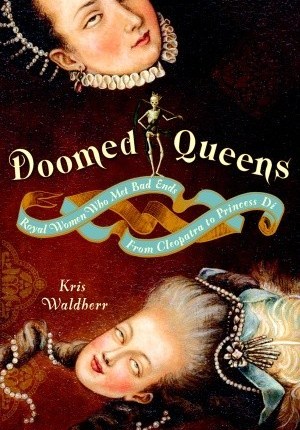
A quirky yet educational list of Doomed Queens that is organized by time period. I learned a lot and was entertained- everything that I look for in a non-fiction book.
“While kings were also vulnerable to political upheaval… for the most part men pulled the strings at court. Therefore any woman blocking the way to power was a threat to be eliminated. Common ways to bump off an inconvenient consort included beheading, burning, drowning, poison, stabbing, strangling, starving, and forcing suicide.” pg 8, ebook. Shocking, isn’t it. One would think that a queen’s power would afford her a measure of protection, but it didn’t.
Here’s one of the facts I learned: “Arsinoe’s story has been overlooked in the face of her more successful older sister, Cleopatra… But in death, Arsinoe was buried with the queenly honors that had been denied her in life. Her remains were interred in a tomb in the Temple of Artemis, one of the seven wonders of the ancient world.” pg 31, ebook. If you’d like a historical fiction book about Arsinoe, may I suggest The Drowning King.
I also learned the Roman viewpoint of the fury of Boudicca, queen of the Iceni: “Dio Cassius later wrote, “All this ruin was brought upon the Romans by a woman, a fact which in itself caused them the greatest shame.”pg 37, ebook. Silly Romans. Here’s a historical fiction about Boudicca if you’re interested: The Eagle and the Raven.
Doomed Queens includes plenty of puns and amusing witticisms. Take this passage from the chapter about Brunhilde: “… the queen of Austrasia incited a forty-year war between her realm and Neustria that made the Hatfields and the McCoys seem downright Merchant-Ivory. “ pg 44-45, ebook.
Or in Sibyl of Jerusalem’s entry: “Sibyl’s marital history took on Liv Taylor proportions as she became engaged, married, widowed, and annulled in varying combinations. pg 53, book. Burn.
Recommended for readers interested in royal stories and unfortunate yet powerful females. Reluctant readers may enjoy Doomed Queens because of the short chapters and light-hearted delivery of some seriously sad history.









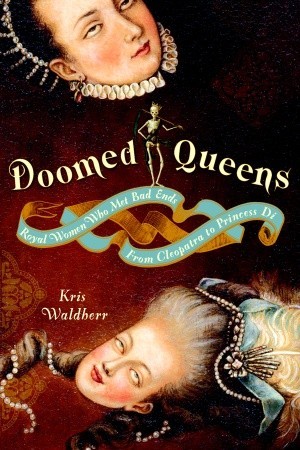 A quirky yet educational list of Doomed Queens that is organized by time period. I learned a lot and was entertained- everything that I look for in a non-fiction book.
