As You Wish: Inconceivable Tales from the Making of The Princess Bride by Cary Elwes

As You Wish: Inconceivable Tales from the Making of The Princess Bride by Cary Elwes

Before I start my review, I want to mention that As You Wish is the perfect audiobook for a road trip between St. Louis, Missouri and Kansas City, Kansas. I was traveling with my daughter and husband, and we were all entertained by Elwes’ memories of the making of the film.

It’s really not that easy to find a book that works for all three of us, but this was an absolute hit. I can’t recommend it enough and if you’re already a fan of the movie, I’m sure that you’ll love it even more.

Though it starts out a bit self-congratulatory in tone, throwing around words like “timeless”, “modern classic”, and “once-in-a-lifetime experience”, As You Wish is ultimately, like The Princess Bride, a very sweet and and enjoyable memoir about the events behind the making of the film.

At first, as I said, I was afraid that I was going to be bored to tears. Rob Reiner wrote and narrated the foreward and it is sugary sweet in its praise of the author, the movie, and everything to do with either. This high praise, some may argue, is well deserved, but I thought that it might have fit better in the flow of the tale as an afterword. First, the play then the applause, but, that’s just my opinion.

Some of the best parts of the memoir, not surprisingly, centered around Elwes’ interactions with his colorful co-stars. Andre the Giant figures largely into this tale, as he did in life, not only because of the enormous size of his body but also his heart.

The brightest among us always seem to burn too quickly.

Another of my favorite parts is the description of Elwes’ and Patinkin’s struggle to film the “greatest sword fight in modern times.” I had no idea of the amount of backbreaking work that went into the acquisition of the skills to run the scene. From day one of filming, Elwes and Patinkin were schooled by some of the best sword fighters in the movie business. Now that I know, I’m going to have to re-watch the film. I had always assumed that the fight was done by stuntmen. How wrong I was…

If you enjoy the film, The Princess Bride, you must listen to this audiobook. It is a real treat and you’ll appreciate some hidden gems revealed by Elwes’ narration. To borrow some descriptors from the book, it was a magical, “once-in-a-lifetime” moment when talent and story mixed together to create a “timeless, modern classic”. If you’re looking for some film related read-alikes (for movies other than the Princess Bride), try Nerd Do Well by Simon Pegg or A Funny Thing Happened on the Way to the Future…: Twists and Turns and Lessons Learned by Michael J. Fox.

Thanks for reading! -Heidi

Waking the Spirit: A Musician’s Journey Healing Body, Mind, and Soul by Andrew Schulman

Waking the Spirit: A Musician’s Journey Healing Body, Mind, and Soul by Andrew Schulman
wakingspirit

Waking the Spirit is an educational and uplifting look at music therapy from a world class musician who, not only plays for a critical care unit at a hospital, but was also saved by music himself.

I’ve always known about the healing power of music for the spirit, but I didn’t realize that it had such marked effects on the body itself. When I’m having a bad day or just need to relax, I plop down in front of the piano and play the stress out.

What I did not know, and that Andrew discusses at length in this book, is that music has been used throughout history to treat sick people and the astonishingly positive effects that it has on the critically ill.

The idea behind music therapy in the ancient world is that everything is vibration.

If you play harmonious and balanced music, the human body will, in turn, put itself into harmony and alignment. Sickness was viewed as a simple imbalance: “Early records have been discovered from ancient Egyptian medicine, Babylonian medicine, Arurvedic (Indian subcontinent) medicine, and classical Chinese medicine that incorporated musical healing. The ancient Greeks valued the relationship between music and medicine in the god Apollo, whose gifts included both the musical and healing arts, and the first use of the term “musical medicine” began with Pythagoras, the fifth-century philosopher-mathematician. The Romans are said to have used musicians in their battlefield hospitals as a form of anesthesia.”

Before I read this book, I didn’t realize that music therapy was even a “thing” in hospitals.

It seems like, at least here in the U.S., and this is entirely my opinion, that medicine has moved ever so much farther away from holistic treatments. The preference is for high cost drugs and highly educated doctors to perform surgery… something concrete that people can hold in their hands and say, “Look! This is what I paid for. This thing right here.”

If something, like music therapy, works, but we can’t explain why it works, then people don’t value it as much. That’s where Waking the Spirit comes in.

Andrew provides tons of examples of beneficial music therapy treatments as well as studies to back up his real life experiences. I think this book could be helpful to doctors, nurses, or anyone who is looking to try something inexpensive to make the environment within their institution more appealing.

Take this experience: the patient was in pain and talking to herself (a side effect of the brain surgery she had just undergone). Then, Andrew shows up with his guitar: “At the sound of the first note she turned her head toward me, looking at my face and then at my right hand as it plucked the strings of the guitar. Gone was the scattered expression from her face as her eyes gained focus. She stopped talking, her mouth half-open in surprise, silent. Her face and shoulders relaxed, and she smiled. Not the plastered grin of before but a real smile of pleasure. She was here now, in this room, and not wherever she’d been for the past few hours. Something was connecting. We were just ten seconds into the music.” Powerful.

“Over the years, I’ve witnessed the most remarkable ways in which music can help the healing process, the ways it can calm a patient or lift their spirits, or reach them when they seem locked in a place that no one else can access. It can soothe a staff member’s exhaustion or anxiety and let them refocus on helping a patient, and it can provide a connection for a patient’s family, perhaps bring back old memories and open pleasant topics of conversation.”

Bringing beauty and dignity back to medicine with music.

In this passage, Schulman is talking to Dr. Richard Kogan, a professor of psychiatry, about how just the act of composing music has soothed individuals who are suffering from mental illness and then, their masterworks have gone on to help others: “While it’s important not to overromanticize mental illness- most depressed individuals are too paralyzed to write a symphony and most psychotic individuals are too disorganized to produce a work of art that is coherent- the suffering associated with mental illness can led to bursts of creative inspiration that are less likely to come from an individual that is emotionally content. For many of the greatest composers, music has been profoundly therapeutic.” In other words, artists who used their music to alleviate their own suffering composed some of the greatest music ever written, which in turn as the effect of ameliorating the suffering of others.” It’s a circle of healing.

You don’t have to be a musician to fully enjoy Waking the Spirit. I recommend it for anyone who’s interested in non-traditional treatments for pain and suffering. Thank you to NetGalley and Picador for a free digital ARC of this book.

Thanks for reading!

Realizing Soul — From Intuition to an Inspired Life by Paul Brunton

Realizing Soul — From Intuition to an Inspired Life by Paul Brunton

Paul Brunton was an English philosopher who dedicated his life to the spiritual journey.

Photo by Jonas Ferlin on Pexels.com

I had never read the teachings of Brunton before Realizing Soul and I found him to be very similar to Eckhart Tolle or, interestingly enough, Abraham Hicks.

He was like Eckhart Tolle in that he stressed the importance of the Now moment.

Brunton was like Abraham Hicks in that his description of the “Oversoul” could walk hand in hand with Hick’s “Vortex of Creation”. In fact, in my mind when I was reading this, I just substituted Oversoul for Vortex because I was more familiar with Hick’s thoughts on the matter than Brunton’s.

There is quite a lot of information in Realizing Soul, though it isn’t very long. In fact, I wish that some of the passages had been longer. This book was mainly a compilation of ideas from many of Brunton’s different writings.

I suppose that it gives the reader a great overview of the various works but I felt that it lacked some depth because of the shortened sections which were each generally only a couple of sentences long.

Photo by ArtHouse Studio on Pexels.com

Some parts I want to remember:
“…That which he has been seeking so ardently has been within himself all the time. For there at the core of his being, hidden away underneath all the weakness, passion, pettiness, fear, and ignorance, dwells light, love, peace, and truth. The windows of his heart open on eternity, only he has kept them closed! He is as near the sacred spirit of God as he ever shall be, but he must open his eyes to see it. Man’s divine estate is there deep within himself. But he must claim it.”pg 18

“The personal ego of man forms itself out of the impersonal life of the universe like a wave forming itself out of the ocean. It constricts, confines, restricts, and limits that infinite life to a small finite area. The wave does just the same to the water of the ocean. The ego shuts out so much of the power and intelligence contained in the universal being that it seems to belong to an entirely different and utterly inferior order of existence. The wave, too, since it forms itself only on the surface of the water gives no indication in its tiny stature of the tremendous depth and breadth and volume of water beneath it…” pg 27

“What can I do to break this barren, monotonous, dreary, and sterile spiritual desert of my existence? The answer is if you cannot meditate successfully go to nature, where she is quiet or beautiful; go to art where it is majestic, exalting; go to hear some great soul speak, whether in private talk or public address; go to literature, find a great inspired book written by someone who has had the glimpses (of the divine within life).” pg 78

Photo by Dina Nasyrova on Pexels.com

“Man as scientist has put under observation countless objects on earth, in sea and sky. He has thoroughly examined them. But man as man has put himself under a shallower observation. He has limited his scrutiny first to the body, second to what thinking can find. Yet a deeper level exists, where a deeper hidden self can be found.” pg 96

For the most part, I found Realizing Soul to be very beautiful and rich in meaning. There were some bits on karma and ego illusion that didn’t really resonate with me, but that doesn’t mean that it won’t speak to others.  If you want more of Brunton’s writings, they can be found online for free at this website: http://www.paulbruntondailynote.se/

If you enjoyed this book, you may want to listen to some of Eckhart Tolle’s lectures like Even the Sun will Die, Gateways to Now, or pick up the book, Stillness Speaks. Readers may also enjoy The Art of Living and Dying: Celebrating Life and Celebrating Death by Osho.

Thanks to the Goodreads First Reads program for a free copy of this book.  And, thank you for reading!

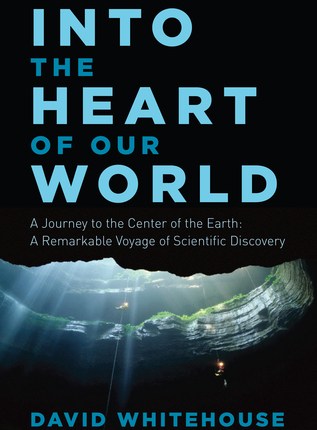
Into the Heart of Our World — A Journey to the Center of the Earth: A Remarkable Voyage of Scientific Discovery by David Whitehouse

Into the Heart of Our World — A Journey to the Center of the Earth: A Remarkable Voyage of Scientific Discovery by David Whitehouse

Into the Heart of Our World-A Journey to the Center of the Earth: A Remarkable Voyage of Scientific Discovery is a mind boggling, hypothetical journey into the world beneath our feet. Whitehouse, an astronomer, has bottled the wonder that he feels for the stars and channeled it into exploring the depths below. Though the science in this book went above my head at times, I enjoyed learning about Earth and its secrets. Into the Heart of Our World would make a great documentary.

Here are the parts that I loved the most:
Whitehouse was discussing the chemical composition and age of some of the oldest rocks on earth: “If the life of the Earth was represented by a day then mankind appeared just twenty seconds before midnight. These rocks have been waiting since about 1 a.m.” pg 52, advance reading copy

On a discussion of plumes beneath the Earth’s surface: “The big question is: can we see mass extinction events on the way up? Some scientists believe we can by looking for the plumes. Such a thing is seen in the south-west Pacific near the Fiji Tonga subduction zone. It’s 700 km deep, has a structure consistent with a massive temperature anomaly and may be rising. It could render the Earth uninhabitable for humans and it will reach the surface in an estimated 200 million years.(!!!!!?!????!!)” pg 146, advance reading copy, emphasis mine

About the core of the Earth: “”The core…is larger than the planet Mars and far more alien. It has one-sixth of the volume of the Earth yet one-third of its mass, and it is liquid, dense yet not thick. If you donned super-protective gloves you could run your hands through it like water. It is this liquid- molten iron, nickel, and a few other elements- that profoundly affects the nature of our planet and protects us from the harshness of the cosmos. In the mantle we suspect that there may be aspects of the subduction cycle that are important for life on the surface. But in the liquid core we have no such doubts. We are certain that life on our planet could not have survived without it, for out of its liquid motions emerges our great protector- the Earth’s magnetic field.” pg2 158-159, advance reading copy.  Who knew?

In a discussion of the magnetic field, some medieval beliefs about magnets:“In the thirteenth century Bartholomew the Englishman (c. 1203-72), author of the book On the Properties of Things, said that ‘This kind of stone restores husbands to wives and increases elegance and charm in speech. Moreover, along with honey, it cures dropsy, spleen, fox mange, and burns… when placed on the head of a chaste woman causes its poison to surround her but if she is an adulteress she will instantly remove herself from bed for fear of an apparition.” pg 167, advance reading copy. Behold the power of magnets.

One last bit of Into the Heart of Our World that was special to me on a personal level: “The oldest working seismograph, over a hundred years old but still fully operational, can be found at the university of Gottingen. It is the work of Emil Wiechert (1861-1928) who was the world’s second professor of geophysics.”pg 80-81, advance reading copy. My husband, a Geiger, is related to the man who created the Geiger counter. I’ve always felt that my family was a bit lacking when it came to scientific contributions. But now, I find out, there’s a geophysicist in the family! In your face, Geigers! :p

If you enjoyed Into the Heart of Our World, you may want to read What If by Randall Munroe or Rust: The Longest War by Jonathon Waldman.  A big thank you to Goodreads First Reads program for a free advance reading copy of this book.  And, thank you for reading!

Confessions of an Unlikely Runner by Dana Ayers

Confessions of an Unlikely Runner by Dana Ayers

Confessions of an Unlikely Runner filled me with hope. Hope that one day, I too with my sporadic training style and bookworm tendencies, could stumble my way through a race longer than a 10k at, if not respectable pace, then at least a step above sedate. Ayers is funny, candid, and self effacing in Confessions, her sports memoir.

She gives tips and tricks from her many years of race running as well as humorous stories to comfort and amuse struggling athletes. I liked her writing style immediately. It’s down to earth and genuine. This book is appropriate everyone but I think that the beginner to intermediate runners will enjoy her humor the most.

Ayers’ thoughts about running: “Running as helped me deal with coworkers and break-ups, has taught me what I’m capable of physically and emotionally, has introduced me to some fascinating people, and has taught me how to accept support. Of course, it’s also gotten me electrocuted…” pg 3

How she stumbled into marathon running: “I honestly don’t remember how I decided on a marathon as my weight-loss enabler. I searched through old emails and found one I’d written on November 15, 2009, to my friend Kami. The subject line just said, “Marathon,” and the email started with, “I may want to do one. Haha.” pg 17

On running at the back of the pack: “But being slow has its perks. Races are like mullets: business in the front, party in the back.” pg 28 Cracked me up.

On cross-training, here Ayers describes her first CrossFit class: “At some point during my last rep, my contact lens slipped off my eye. Even my eyeballs are working in this class. I had to walk back out past the MMA testosterone ring to get to the ladies’ room to fix it, and that’s when I realized I could no longer straighten my arms. I was walking like a T-Rex and couldn’t help it. I won’t be joining a CrossFit gym anytime soon.” pg 91

I’m seriously considering purchasing one of my sisters this book- it’s hilarious and uplifting. If you enjoyed Confessions of an Unlikely Runner, you may also like Down Size: 12 Truths for Turning Pants-Splitting Frustration into Pants-Fitting Success by Ted Spiker or Running Like a Girl by Alexandra Heminsly.  Thanks for reading!

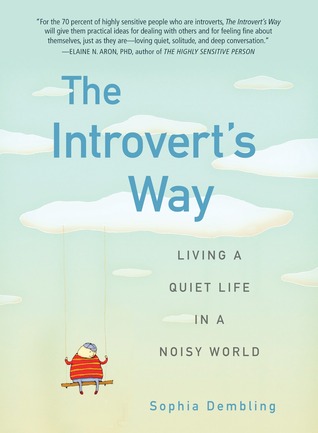
The Introvert’s Way by Sophia Dembling

introvertThe Introvert’s Way: Living a Quiet Life in a Noisy World is a collection of Dembling’s blog posts about introversion. She talks about how introverts are different from extroverts, how we rub each other the wrong way, and how, with some understanding on both sides, we can all get along and thrive.  It’s engaging, but she writes as the royal “we” which I found distracting. No one has the authority to speak for introverts as a group. Right, introverts? *crickets*


I loved how she cleared up some rather major misunderstandings that I’ve been running into my entire adult life, like this one: “When we want to, not-shy introverts can nut up to the task of being charming and witty. We can meet new people. We can start conversations and keep them rolling, and even draw shy people out, since we’re good at not getting up in anyone’s face and we’re patient listeners… Introverts who are not shy are used to being told that they could not possibly be introverts. This can be irritating, but think of it as a teachable moment.” pg 16-17

Dembling gives some concrete ways in which introverts can improve their social skills: “If you’re misinterpreted more often than not, you might need to give some thought to what your quiet is telling people. When you are sitting quietly, try to parse what kind of quiet you’re feeling. “Leave me alone” quiet is different from “thinking hard” quiet, which is different from “enjoying watching the scene” quiet, which is different from “I’m totally overwhelmed, get me out of here” quiet. Once you have a sense of what you want to project, consider your body language. pg 37 My husband has expressed to me, many times, that he can’t read my “quiet”. This can be problematic because when I’m upset, I withdraw completely and, if he’s not paying attention, he misses the whole thing. Maybe I should make some signs…

“…with our deep listening habits and our hyperawareness and sensitivity, introverts are particularly susceptible to being sucked into the vortex of other people’s demands and expectations, which can cause us to keep going long after we are completely drained of energy.” pg 55 This is a legit problem. I’m from a large family of extroverts and I’ve learned that I have to draw very clear boundaries to preserve my space. There’s an assumption that if I’m home that I’m not doing anything “important” and I should be willing to go out and do whatever it is that they’re doing. Annoying. I know that they do it out of love and the desire to make me feel included, but sometimes, most times really, I just want to be left alone.

This, just this: “Nine out of ten introverts agree: the telephone is the tool of the devil.” pg 64 End of story. I can never think of anything to say while I’m on the phone, but after I hang up, I think of ten million things I could have said. It’s a vicious cycle of terror and then regret. I’m over it.

Dembling’s “Affirmations for Introverts” are excellent. Here’s my favorite: “I know what I need better than anyone else.” pg 179

It was encouraging to read about how some of my major personality quirks, which I have always viewed as flaws, are not really stumbling blocks at all. It’s just how I interact with the world. I’m very fortunate in that my friends and family have accepted me for who I am, for the most part, and not pushed me to be someone that I’m not. I just wish that I had been more aware of what makes me happy and not been so hard on myself for so many years because I wasn’t an extrovert. I wish I was good at parties, made small talk with ease, or lit up a room with my mere presence, but I don’t. And, at long last I realize: that’s ok.

If you’re looking for more books on this topic, try The Power of Personality: How Introverts and Extroverts Can Combine to Amazing Effect by Sylvia Loehken or The Life-Changing Magic of Not Giving a F*ck: How to Stop Spending Time You Don’t Have with People You Don’t Like Doing Things You Don’t Want to Do by Sarah Knight (not necessarily a book on personalities, but I found it useful as a technique to manage my energy).

Thanks for reading!

The Light: A Modern-Day Journey for Peace by Judith Lambert

The Light: A Modern-Day Journey for Peace by Judith Lambert

In The Light, Judy, the author, chronicles her dreams and her search through various countries and cultures for their ultimate meaning. She calls this book, a memoir, with some pieces changed to protect the privacy of the people involved.

I found it to be an engaging look into the life of a spiritual seeker and a fascinating comparative study of all religions, their symbols, and common meanings.

Judy talks to a librarian named Bill about symbols: “I’ve been having some dreams with symbols that seem to be very powerful and consistent, and I’m wondering whether these symbols have a history or a larger meaning…” “Oh, yes, absolutely,” he broke in. “All symbols have a history and a commonality. There’s no question about that… Images are the means people must employ to understand ideas and feelings. Without them, we cannot reason… but, you see, we often don’t know where these symbols and images come from, do we? We forget their origin and the long history of their use, until we end by thinking that the symbol is the thing itself!”

I’ve heard it said that all symbols are mere pointers. It is like a man trying to draw our attention to the moon by pointing at it, but we mistake the moon for the finger doing the pointing.

Photo by Aron Visuals on Pexels.com

A beautiful description of the chaos at the river, Ganges: “Over the course of the day, blessed pilgrims gathered at Mother Ganga to wash away their sins. Motionless holy men sat absorbed in rumination, their faces turned toward the sun in celebration of the endless cycle of mornings like this. The striking of wet clothing against the steps was accompanied by the distant ringing of temple bells, whose pitch and resonance varied with the preciousness of the material from which they were made- bronze, brass, or iron. And over it all hung a fetid haze smelling of smoke and of- well, I didn’t want to think what else.”

I enjoyedThe Light because Lambert made me feel as if I was there beside her in her spiritual wanderings. I enjoyed the travel parts of this book very much.

The City of Light: “…The Gita,” now he looked out at the Ganges, “speaks of a radiant river of light. Westerners.. well, they often see a surface, and then they have no idea how to look beyond that surface.” He gestured as if to indicate the whole city. “This is the City of Light. Is this not what you were looking for? I do not mean any disrespect, madam,” he hurried on before I could react, “but if one cannot see the Light here, then one has not looked long enough.”

A description of inner illumination: “Nothing changed. Or everything did, for though monk, mandala, walls, cushions, and robes all seemed to remain the same, I felt at last- and only for an instant- the sense of peace that had eluded me since my dreams began.”

Photo by Pixabay on Pexels.com

The author changes immensely over the course of her journey: “I feel a reassuring contentment from all I’ve discovered and all that I’ve been privileged to learn. I am a Jew, a Christian, a Hindu, a Muslim, a Buddhist, everything else, and nothing, all at once. I am…whole… And I believe that all religions possess and have knowledge of the Light. By claiming the Light myself, I can also retain my own personal stories, my own place, and time, and history…” An empowering message and a timely one.

If you enjoyed The Light, you may want to pick up The Realization of Being by Eckhart Tolle (a lecture, any of his talks are along this subject line) or The Invisible Hand: Business, Success & Spirituality by David Green (a memoir about another spiritual seeker and how he found the “Light”).

Thank you to NetGalley and Ann Duran Productions for the opportunity to read and review a digital ARC of this book!  And, thank you for reading.

The New Science of the Paranormal: From the Research Lab to Real Life by Carl Llewellyn Weschcke & Joe H Slate, PhD.

The New Science of the Paranormal: From the Research Lab to Real Life by Carl Llewellyn Weschcke & Joe H Slate, PhD.

Carl Llewellyn Weschcke died last year- may he rest in peace. I eagerly looked forward to reading The New Science of the Paranormal, one of his last (I’m guessing) books that we will ever see from him.

The primary message in here is one of self empowerment and the potential for anyone to develop powers that could be considered “paranormal”. What an appropriate departing lesson from a man who ran a publishing firm dedicated to bringing the occult and mysterious to light.

Photo by Rafael Guajardo on Pexels.com

The New Science of the Paranormal isn’t an “easy” read in that it includes a lot of tables and metaphysical philosophizing about the new age and levels of spiritual evolution.

To me, the most engaging bits were the accounts of students and researchers trying to swing a pendulum with their minds or use dowsing rods to predict the gender of unborn babies.  The scientific experiments that were included are fascinating in their implications.

Also, many of the techniques like water gazing and hand prints in the sand are not ones that I had been exposed to. I’ll definitely be trying some of this out on my own.

“The objective study of paranormal power can dispel many of the myths and “stories” surrounding the topic, including the belief that very few individuals possess paranormal powers. Although certain individuals, often called “advanced beings” or “gifted psychics”, may appear to be extraordinarily empowered, everyone to some degree possesses paranormal potential. Not unlike intelligence, the distribution of paranormal potential within the general population seems to occur in a so-called “normal curve”…

Photo by Lucas Pezeta on Pexels.com

Empowerment: “We are more than we think we are, but we don’t know we are until we develop that level of awareness and related sense of perception. We must grow to become more than we are and all we can be.”

Water gazing, who knew? : “Validated in the lab setting and successfully applied beyond the lab, water gazing is among the most effective self-empowerment techniques known. Whether to increase creativity in writing and art, activate telepathic sending and receiving, facilitating clairvoyance, improve memory, promote successful goal attainment, or generate a state of mental, physical, and spiritual attunement, the powers of water gazing appear to be without limits.”

Photo by Anastasia Shuraeva on Pexels.com

The Crumpled Paper technique was also surprising in its incredible amount of potential uses. Actually, this whole book kind of blew my mind. Perhaps I was dreaming too small.

A bit reminiscent of Abraham Hicks: “…one simple self-administered procedure is: Pay Attention to Your ‘Feelings.’ By that, we don’t mean to get all emotional when ‘feeling’ an idea, concept, event, situation, person, etc., but rather to analyze: what your feelings are telling you, what is it you are sensing, what is the basis for your emotional reaction, etc. And then let yourself explore the ‘answers’ to those questions.”

Know thyself. A message as old as the Delphic oracles.

I’ll close with a quotation included in Chapter Twelve: “Not in the clamor of the crowded street, Not in the shouts and plaudits of the throng, But in ourselves are triumph and defeat.” Henry Wadsworth Longfellow, “The Poets” (1876)

Thank you to NetGalley and Llewellyn Publishing for a free digital ARC of this book!  And, thank you for reading!

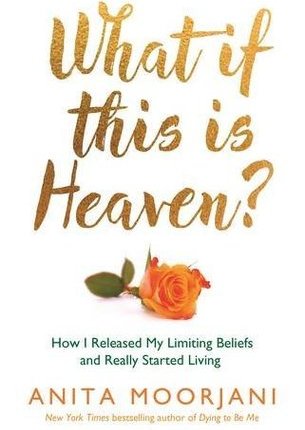
What if This is Heaven?: How I Released My Limiting Beliefs and Really Started Living by Anita Moorjani

What if This is Heaven?: How I Released My Limiting Beliefs and Really Started Living by Anita Moorjani

I was so excited to read What If This Is Heaven?: How I Released My Limiting Beliefs and Really Started Living. Moorjani’s first book, Dying to Be Me, was one of the first accounts of near death experience that I read. In it, she details how she was on her death bed, experienced the world beyond, and then came back to fulfill her life’s purpose.

When she came back, the tumors in her body disappeared and she’s been fine ever since.

It’s an astonishing and uplifting reminder of who we are as eternal beings and why we’re all here. What If This is Heaven is a continuation of this message in that, now, Moorjani is a teacher and lecturer on the topics of spirituality, healing, and self actualization. It’s wonderful.

And, it’s different enough from the first book that readers don’t feel like they’re re-reading the same messages. Moorjani has evolved and I’m very interested to see where life takes her from here.

Here are some passages that I loved:
“A major reason why I chose to return to this life during my NDE (near death experience) was because I understood that heaven is a state and not a place, and I wanted to experience, firsthand, the heaven that this life could actually be.”

“Remember, your only work is to love yourself, value yourself, and embody this truth of self-worth and self-love so that you can be love in action. That is true service, to yourself and those who surround you.”

“On the physical plane, we see love as an emotion, something we have for some people and not others. But the truth is that unconditional love is a state of being, and it’s our birthright. Once we begin to tap into that, we realize is has the power to transform all of our relationships simultaneously- including our relationship with ourselves- for the better.”

“… illness is our body’s way of communicating with us and showing us a better path. Yes, we may die from cancer- or from countless other things- and each of us will die from something at some point. But death is not the enemy. What often is the enemy is the way we view illness…”

Some fascinating teachings about the positive aspects of the ego are included in here: “The ego gives us our sense of identity, our individuality. It’s what allows us to know who we are as individuals and to express our uniqueness. If our ego weren’t necessary, we wouldn’t have been born with it.”

There’s so much more to enjoy in What if This is Heaven beyond these small bits. I highly recommend this read for spiritual seekers and those who are interested in self actualization.  If you enjoyed this book, you may want to read Moorjani’s other book, Dying to Be Me or Co-creating at Its Best: A Conversation Between Master Teachers by Wayne Dyer and Abraham Hicks.

A big thank you to NetGalley and Hay House for the opportunity to review this book!  They sent me a free digital ARC for review purposes. And thank you for reading!