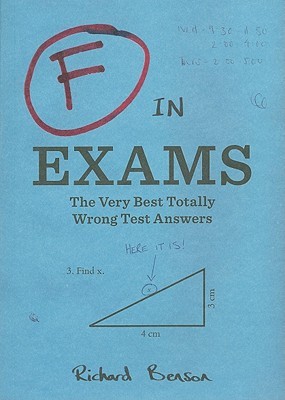
Necessity is the mother of invention. When these students didn’t know the answers, they pulled out all the stops to come up with something- sometimes with hilarious results.
At other times though, I despaired for the future…
I think that F in Exams would be enjoyed the most by current or former educators.
I read some of these aloud to my husband who used to be a college professor and he laughed so hard that he had tears in his eyes. Then, it led to a conversation about not knowing the answers on tests and making stuff up to fill in the blanks.
He admitted that he had done so once in a marketing class and the prof had given him points for his creativity.
Honestly, I don’t think I’ve ever attempted joking my way into a better grade. This book makes me wish that I had, just once.
His favorite: Question: “What was Sir Francis Drake known for? Answer: Sir Francis Drake circumsized the world with a 100 foot clipper.”
My favorite: Question: “Clair was well prepared for her interview. Explain how Claire may have prepared herself for the interview. Answer: Had a bath and put on her lucky pants.” There’s a lot to be said for a pair of lucky pants.
F in Exams would make excellent reading material for a doctor’s office or any other place where you need to spend a few moments relaxing (ahem, powder room?), in which case, you should buy your own copy. Otherwise, I’d recommend borrowing this short little book from your local library as I’m sure that I’m not going to feel the need to pick it up again.
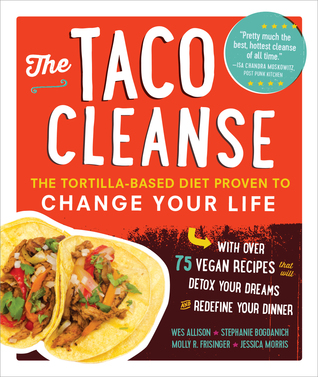
Deciding what to eat for dinner was becoming a drag, but luckily for me, the library has an enormous foodie section. I dug through the cookbook collection and discovered this gem- The Taco Cleanse.
Part satire, part traditional recipes, The Taco Cleanse makes you laugh while you prepare delicious, vegan eats.
From the copyright page: “This book contains the opinions and ideas of its authors, plus large quantities of total BS. Although the recipes are intended to be accurate and tasty, all other content is solely intended to be hilarious.” And it is.
This book isn’t just about the food: “Now, we want to be clear that supplementing- that is, drinking beverages that traditionally accompany tacos- is acceptable as long as you are getting all of your tacos in. Margaritas should be added on an as-needed basis for the top levels of the cleanse, but at Fuego (the highest cleanse level) you should be adding them at least a couple of times a week, working up to every day.” pg 4.
To your health. 🙂
My favorite part was the author’s insistence on Taco Journaling: “One of the most powerful things you can do in your taco journey is taco journaling. Writing down your thoughts during your Taco Cleanse now will be like having a time machine for your future. Future You can go back and see how you’ve changed over time, where you had taco successes and taco failures. … Every time you open your journal, you will feel peace in your heart.” pg 26.
They really nailed the self help tone that is prevalent in most “dietary” cookbooks. It is really very clever and worth the read, even if you’re not planning on trying the recipes.
Speaking of which, I personally plan on trying Minimalist Nacho Cheese pg 128, Infinite Fish Tacos pg 145, Smoked Brisket and Jalapeno Mac and Cheese Tacos pg 149, and the Frito Pie Tacos pg 152. Decadent.
Recommended for people who are experiencing a dinner idea slump or anybody looking for an excuse to drink a margarita (or two).
I read The Golem and the Jinni a few months ago and realized that I knew next to nothing about the mythology of the Jinn. Not that I’m an expert on golems either, but I had at least been exposed to the idea.
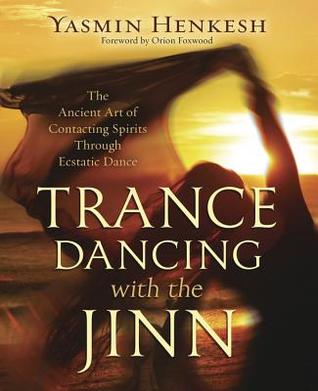
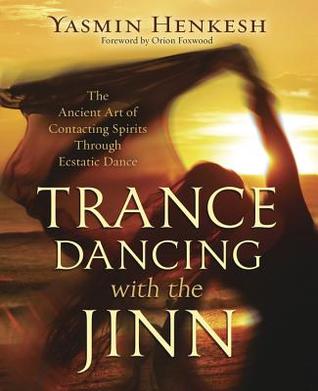
Trance Dancing with the Jinn is a book about kinetic meditation (trance dancing) but it also documents the history of the Jinn as written in the Quran and other sources as well as the biological and historical reasons that humans go into trance.
In addition to the mythology and biology, I learned about how trance dancing at meetings called “zars” is an outlet for women who have very little control over any other aspect their lives in Northern Africa.
The author is clearly a believer in the existence of “the Invisibles” but, if you don’t share the same beliefs, this book still has plenty of fascinating information for those interested in cultural, religious, or feminist studies and ritual dance.
The author asks the reader to have an open mind: “Do you believe in Invisibles or do you consider them an outdated tradition from an ignorant past? What if you had a safe, drug-free way to see for yourself? Would you be curious enough to try it- even though the method takes practice and you probably won’t succeed on your first attempt?” loc 200.
Yeah, I’m down for that.
I don’t think it is that difficult to entertain the idea that there may be intelligences that exist that can’t be perceived in normal states of consciousness.
As Henkesh reminds us: “According to NASA’s website, “Everything on Earth, everything ever observed by all our instruments, all normal matter- adds up to less than 5% of the Universe… The rest is a complete mystery, but an important one. Roughly 68% of the Universe is dark energy, while dark matter makes up about 27%.” This energy and matter are called “dark” because they do not reflect light… or interact with electromagnetic forces. We only know they are there by their effects on gravity…” loc 233, ebook.
Only 5% has been observed- that leaves a whole lot that we haven’t even looked at yet.
Western researchers are still discovering how and why trance works, but they at least acknowledge that it exists: “Neurologist Oliver Sacks once wrote, “Normal waking consciousness, rational consciousness as we call it, is but one special type of consciousness, whilst all about it, parted from it by the flimsiest of screens, live entirely different potential forms of consciousness.” loc 267.
The most fascinating part of this book was the emotional outlet that trance dancing has allowed women for hundreds of years: “… thousands of women in Egypt still turn to the zar when modern medicine fails them. If doctors cannot find the cause of their physical or mental ailments, they assume supernatural forces are involved. … Diagnostic zars can last anywhere from a day in Egypt to a week in Sudan and Ethiopia.” loc 2530-2548
I had never heard of this and looked up some examples of zar/trance dancing on YouTube. Go ahead, take a look:
I can see how such flowing, uninhibited movements would feel therapeutic now, so I can’t imagine the relief I’d feel if I was not allowed to have a job or leave the house without a male by my side. I’d probably be trance dancing non-stop.
Rajiv Parti was living a materialistic dream with the house, car, and beautiful wife to prove it. But, the many things in his life didn’t bring him comfort when he developed prostate cancer and a bunch of unfortunate side effects from the surgery to remove it.
Addicted to pain pills and disconnected from the people around him, Dr. Parti underwent emergency surgery and experienced something so incredible, that when he woke up, he completely changed his life, developed a new form of holistic health treatment, and gave up many of the possessions that were weighing him down.
This is the memoir about that experience and Dr. Parti shares it in the hopes that it will change the reader’s life or at least bring comfort to those who are struggling in their current life experience.
Like many of the other memoirs I’ve read by medical professionals, Dr. Parti talks about the completely scientific view he had of the soul, which is to say, if you couldn’t see it and measure it, then it doesn’t exist.
Also, working on the technological edge of medical breakthroughs in the treatment of various diseases, had given him an invincible feeling.
This experience blew that attitude away: “Feeling like a master of the universe is easy in the world of modern medicine. … Maybe it’s a sense of cheating death for others that gives us cardiac surgical teams the vague feeling that we can overcome our own death. Of course that isn’t true. … Reality popped that myth for me.” pg 10
In his near death experience, Dr. Parti not only encountered his father, but also a huge crowd of his ancestors.
They shared messages of forgiveness and love: “Love is the most important thing there is, my grandfather communicated to me. I am glad to let you know that simple truth while you can still make change in your earthly life.” pg 44
But his time on the other side wasn’t all light and love, Dr. Parti also had the (fairly rare) experience of seeing hell and the suffering souls within it.
This is entirely my opinion, but I think that the detached manner in which Dr. Parti was living his life brought forth a major wake-up call from the spirit world. He saw hell first and then heaven and, in a way, that could be a metaphor for his life experience.
I don’t believe in “hell” myself other than the nightmare that people can create in their own minds and lives, but, I didn’t experience it like Dr. Parti did. This memoir does not focus on the hell portion of the narrative, but, with the rarity of that experience, it could have. That, in itself, says something.
When Dr. Parti “comes back”, he knows that he wants to start a new life and a new focus, but he doesn’t know how.
The information for developing a new type of medicine comes to him slowly during meditation: “What is (the new mode of healing) anyway?” “…It is how nonpharmacological treatments in combination with drugs can heal things like depression and addiction and other diseases. It’s about searching one’s own soul to fight back against the hollowness that pharmaceuticals alone or alcohol and illegal drugs create or don’t really fill.”pg 91.
He eventually develops meditations and lifestyle changes as well as a manifesto for treatment.
To me, the most fascinating part of this memoir was the communication between himself and the spirit world once he was back.
For readers who are unfamiliar with near death experiences, Dr. Parti provides a broad background with some of the major historical figures who went through it.
Like Jung: “(Carl) Jung’s NDE led to a split with Sigmund Freud, who believed that spiritual experiences were fantasies. Jung, however, considered spirituality an important part of our well-being saying that life has purpose beyond material goals and that our main task, the path we should all be on, is the one that leads to our own connection with the universe.” pg 124
No matter how many books I read on meditation, I always seem to learn something new when I pick another one up.
The Space Within is one of the more excellent books that I’ve discovered- not pushing any particular way of being, just quietly encouraging the reader to go within and embrace what’s there.
On separating our consciousness from the universal energy that surrounds it, Neill compares the mind to a book and I’m sure most Goodreads users, like me, could easily connect with the metaphor:“Think of ‘quiet’ not as an absence of thought but as the space inside which the noise of your thinking arises. What makes this tricky, at least to begin with, is that at first glimpse the noise is more interesting than the quiet …look at the white background of this page. Chances are you can still see the words, and even read them, but without noticing it, at some point you will once again become absorbed in the words and stop seeing the white of the page.” loc 192, ebook.
Why bother to meditate? : “There is a space within you where you are already perfect, whole, and complete. It is a space of pure Consciousness- the space inside which all thoughts come and go. When you rest in the feeling of this space, the warmth of it heals your mind and body. When you operate from the infinite creative potential of this space, you produce high levels of performance and creative flow.” loc 207
And more, promises Neill. I’ve meditated for many years and I’ve experienced some extraordinary things. It wasn’t always easy and it didn’t happen all at once, but I can say, from personal experience, that this particular claim is absolutely true.
Photo by Samuel Theo Manat Silitonga on Pexels.com
Thoughts are incredibly powerful things. I think we forget just how life changing your personal perspective can be: “… we live in a world of unrecognized thought. Thought is the architect of both hope and despair, the source of every color in the emotional rainbow. … But unrecognized thought demands our attention and fills our consciousness. And when we get caught up in thought, we lose our way.” loc 324, ebook.
And also: “We live in a world of thought, but we think we live in a world of external experience. The mind is not a camera, it’s a projector. We can’t tell the difference between an imagined experience ‘in here’ and what’s going on ‘out there’- and that confusion creates a lot of confusion.” loc 375, ebook.
You create your own reality- but it’s easy to forget that and blame other people for your circumstances.
When I read this next passage, I thought of How The Secret Changed My Life and the incredible importance that people placed on feeling good.
Neill points out that it isn’t anything to get wound up about: “There’s no such thing as a solution to a feeling. Because we don’t recognize this fact, we spend huge chunks of our time and energy trying to ‘solve’ our feelings by changing them to ‘better’ ones or eliminating them altogether. … When it’s okay to feel good when you feel good and bad when you feel bad, recognizing that as thoughts change, the feelings change with them, there’s no need to prefer one feeling over another, let alone attempt to fix it. And when you really see that for yourself, you being to experience more of the deeper feelings that make life worth living.” loc 457, ebook.
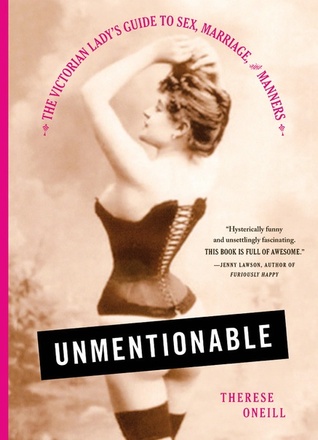
Unmentionable made me truly appreciate how good I have it compared to my female ancestors.
This clever little book examines the gross, disturbing, and, at times, hilarious “unmentionable” facets of a Victorian woman’s life and also, their powerlessness in society when compared to their male counterparts.
The women’s rights portion sounds grim, but Oneill’s writing keeps it light. I learned so much and was entertained too.
For example, I don’t consider modern cities to be very clean, but Oneill explains in her book, that they are shining examples of cleanliness compared to what came before: Some would argue that the nineteenth century was one of the filthiest times in all of Western history, particularly in any urban, developed area. … Ankle deep in filth, I said, but forgive me, I was inaccurate. You will wish the filth terminated at your ankles. Foulness is everywhere. Grime and rot cling to the very air, the buildings, the people; even the soap is made out of lard and poison.” pg 20, ebook.
All that dirt, but bathing was considered bad for your health and even, depending upon your religious upbringing, immoral! I’ve never read a historical fiction that describes the foul stench of the streets or the crowd upon it… now, I know better. Thanks Unmentionable!
Make up and other personal care products used to be either oily goop or filled with poisonous substances that could kill you or permanently wreck your face.
With this in mind, Oneill gives us a new take on the story of Jezebel: “She painted her face, and tired her head [fixed her hair], and looked out at a window.” “Some think this means Jezebel planned to seduce her way out of this problem; others think she was facing death with composure and dignity. At any rate, her eunuchs saw that they were on the wrong team and shoved her out the aforementioned window, and dogs ate her face. Which reinforces the assumption that her face was coated in sinfully delicious animal fat.” pgs 67-68, ebook.
Because women really had no other choice, being the ideal wife and mother was no laughing matter: “Your only job now that you are a nineteenth-century wife is to do everything within your power during every waking moment to make his life so sweet and full that he will literally dread the glory of Christ’s return, if only because it will mean parting from your secret strudel recipe and the unmatched craftsmanship of your trouser hemstitch.” pg 130, ebook.
So, unreasonable expectations of perfection abounded at home.
Women, especially single, unmarried ones, weren’t supposed to go anywhere alone: “Etiquette for Ladies reminds us that no woman has any business being alone in a museum, a library, or any other such den of unwholesomeness. Wherever you are going, your behavior once you arrive should remain every bit as self-aware-but-pretending-not-to-be as when you were in transit.”pg 165, ebook.
The library is a “den of unwholesomeness”… ha!
But the worst of the era, in my opinion, was the medical community’s attitude towards women. At that time, we hadn’t figured out how the female body worked and didn’t connect the idea that people need intellectual stimulation and purpose for a life well lived.
That lead to the lumping of every female complaint under the title, “Hysteria”: “First I would like to tell you what hysteria actually was. Which is incredibly difficult. Because the only honest definition I can give you is “a misdiagnosis.” Epilepsy, diabetic shock, neural disorders, post-traumatic stress disorder, postpartum depression, and bipolar disorders do not necessarily cause similar symptoms, but they were all commonly diagnosed as hysteria.” pg 173, ebook. So, pretty much, everything then.
Oneill reminds the reader that many of the rights, and indoor plumbing, and personal care products that we enjoy today are because of the demands for a better life by women who lived during the Victorian era.
Things have been stressful in my neck of the woods, so I picked up Five Good Minutes to help me cope.
I’m in the fourth month of having my house on the market and my husband has been looking for employment for over a year. Yeah, I’m feeling it…
Five Good Minutes is simple enough for beginners to the mindfulness/meditation practice and filled to the brim with suggestions for ways to focus in the morning and get your day off on the right foot.
The best part of this book is that there is something for everyone- it is that broad. The techniques that it uses varies from visualizations to mindfully drinking your morning cuppa.
The worst part of the book is that, because it covers so much, that it doesn’t really talk about anything in depth. If you’re looking for detailed methods of meditation and relaxation, this is not the book for you.
Why the focus on early in the day?: “The morning is the best time to break away from old habits of thinking and feeling and to set a new direction for yourself and how you will be in your day. Any exercise in this book- done in the morning- has the power to impact greatly on your experience throughout the day, if you allow it!“
Personally, I’ve found that I’m at my best in the mornings- well, once I blink the sleep out of my eyes. My mind is clearer and I can focus for longer periods of time.
But, if you’re more an afternoon/evening type person, don’t let the title of this book stop you. I think that these practices could be beneficial at any time of the day.
My favorites were- the Five-Fingered Peace pg 32: In which you use your hands almost as a rosary and remember awesome things that have happened to you.
Freedom from Tension pg 58: In which you scan your body and focus your relaxation on the stressed out bits.
Your First Sip of Tea pg 94: or coffee, for me. Take your time and mindfully drink your morning pick-me-up.
A Shot of Faith pg 186: You use visualization to picture a problem turning out perfectly.
And finally, Cultivate Gratitude pg 206: “This practice invites you to turn toward the good in your life and to express gratitude as recognition grows.”.
If none of those spoke to you, there are 95 others for you to choose from.
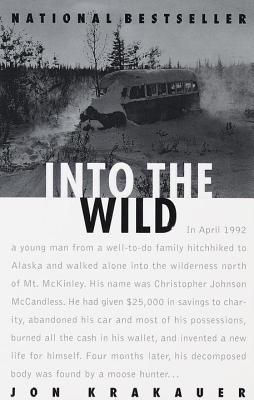
“Not all those who wander are lost” seems to be the focus of this non-fiction biography by Krakauer about a young man named Chris McCandless who went into the Alaskan wilderness, but never came out again.
Jon Krakauer examines McCandless’ history, friendships, and probable motivations while also comparing his case to other young men who died or disappeared in the wilderness.
He also gets very personal and recounts a solo mountain climbing adventure of his own that nearly went south, but didn’t- crediting his survival to luck rather than skill.
Into the Wild paints McCandless as a man with a brilliant mind and the soul of an artist, who didn’t fit in to the modern world’s or his family’s view of how he was supposed to be.
“In April 1992, a young man from a well-to-do East Coast family hitchhiked to Alaska and walked alone into the wilderness north of Mt. McKinley. Four months later his decomposed body was found by a party of moose hunters.” pg 10, ebook.
For much of the book, Krakauer tries to figure out what ultimately ended McCandless’s life. In the edition I read, he had a new afterword that he penned in April 2015, talking about his definitive theory for why McCandless died.
If you haven’t read the book since it was published, I really recommend picking up a new edition if only to read that.
Krakauer includes actual journal entries from McCandless’s wanderings, which I thought gave us a pretty clear window into the man’s mind: “It is the experiences, the memories, the great triumphant joy of living to the fullest extent in which real meaning is found. God it’s great to be alive! Thank you. Thank you.” pg 37, ebook.
We saw a man who cared about life, about the way he was living, and about the way he interacted with others.
It is curious to me that his relationship with his parents wasn’t better, but I’ll let Krakauer tell you all about it: “McCandless’s personality was puzzling in its complexity. He was intensely private but could be convivial and gregarious in the extreme. And despite his overdeveloped social conscience, he was no tight-lipped, perpetually grim do-gooder who frowned on fun. To the contrary, he enjoyed tipping a glass now and then and was an incorrigible ham.” pg 95
As interesting as McCandless’s story is, my favorite part of this book was Krakauer’s experience solo climbing the Devil’s Thumb in Alaska.
“By and by your attention becomes so intensely focused that you no longer notice the raw knuckles, the cramping thighs, the strain of maintaining nonstop concentration. A trancelike state settles over your efforts; the climb becomes a clear-eyed dream. Hours slide by like minutes. The accumulated clutter of day-to-day existence- the lapses of conscience, the unpaid bills, the bungled opportunities, the dust under the couch, the inescapable prison of your genes- all of it is temporarily forgotten, crowded from your thoughts by an overpowering clarity of purpose and by the seriousness of the task at hand.” pg 115, ebook.
That passage made me wonder- what sorts of things do I like to do in my life as much as Krakauer loves climbing? It seems to me, that the state of flow he’s describing there, would be a place that I would like to dwell in as much as possible.
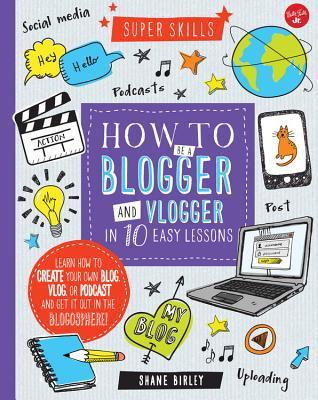
This is a good resource for kids who are looking to start their own online presence on a variety of platforms.
From podcasts to video blogs, Birley gives basic to expert tips and safety suggestions.
As a parent, I was particularly interested in his Super Skill Section 8 (begins on page 50) in which he talks about online etiquette and how to appropriately handle unruly website visitors.
(Getting on my soapbox) I think that there aren’t enough books that teach kids how to behave online.
With episodes of cyber bullying and trolling on the increase, as a professional educator, I am always on the lookout for books that give effective coping mechanisms for dealing with the issues that arise.
How to Be a Blogger and Vlogger in 10 Easy Lessons is a great place to start and we need more books just like it. (Getting off soapbox)
My only complaint is that this doesn’t include “Parent Tips” or any sections about how the adults in the kids’ lives can support the effort.
Birley doesn’t leave parents entirely out of the loop: “Speak to a trusted adult about any comments on your blog that make you feel uncomfortable or upset.” pg 53. But, I wish that there had been more.
The recommendation on the cover of this book is for ages 12+ but my 9-year-old devoured this text. So, I’d give this to any child who is interested in digital media, no matter their age.