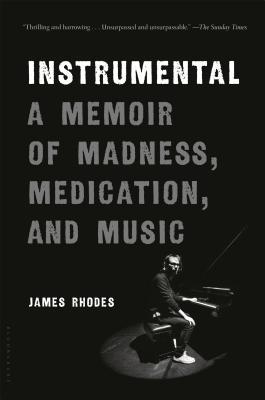
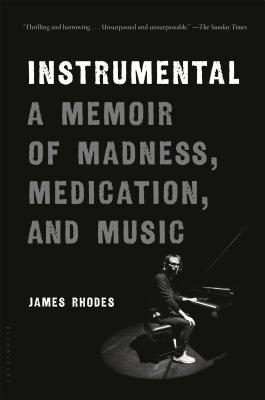
This is a shocking memoir about the horrific sexual abuse that James suffered as a child and how music saved him. It is raw, ragged and real.
The author is frank about describing what happened, how his life fell apart, and how he was able to finally begin putting it back together.
Not a book for the faint of heart, Instrumental makes the reader wonder why we’re all here and what might the purpose of suffering serve in the grand scheme of things. I don’t pretend to know the answers to these questions, but James has given us a powerhouse of a book and a place to start.
I am also a classically trained pianist but you don’t have to be one to appreciate Instrumental: “… the unassailable fact is that music has, quite literally, saved my life and, I believe, the lives of countless others. It provides company when there is none, understanding where there is confusion, comfort where there is distress, and sheer, unpolluted energy where there is a hollow shell of brokenness and fatigue.” loc 51, ebook.
James gives a poignant warning to readers: “…this book is likely to trigger you hugely if you’ve experienced sexual abuse, self-harm, psychiatric institutionalisation, getting high or suicidal ideation.” loc 112. So, friends, be aware before you pick this one up.
James has a child with his first wife and he adores the boy, only asking him to do what makes him happy.
Though James thinks he’s a poor father, he’s offering the child more than some people are able to manage, even coming from a stable and emotionally healthy place: “I want him to know the secret of happiness. It is so simple that it seems to have eluded many people. The trick is to do whatever you want to do that makes you happy, as long as you’re not hurting those around you. Not to do what you think you should be doing. Nor what you think other people believe you should be doing. But simply to act in a way that brings you immense joy.” loc 986.
James introduces each chapter with a suggested classical music track to listen to as you read as well as some juicy tidbits about the musicians who wrote the pieces: “Beethoven… was clumsy, badly coordinated, couldn’t dance, cut himself while shaving. … Schubert, nicknamed ‘Little Mushroom’ on account of his being 5 foot nothing and violently ugly, was spectacularly unsuccessful with girls and, on one of the very rare occasions he did manage to score, he caught syphilis. … From Schumann (who died alone and miserable in a mental asylum) to Ravel (whose experiences driving trucks and ambulances in the First World War changed him forever), the great composers were basket-case geniuses…” locs 2040-2058, ebook.
He reminds us that these men we’ve set on a pedestal because of the art they produced were nothing but human with all of the failings that people have today. James makes classical music and musicians interesting to the average person. It’s a gift and one that the genre really needed to bring a new generation into the fold. This book really made me wish that I could see James Rhodes in concert. I think I would love it.
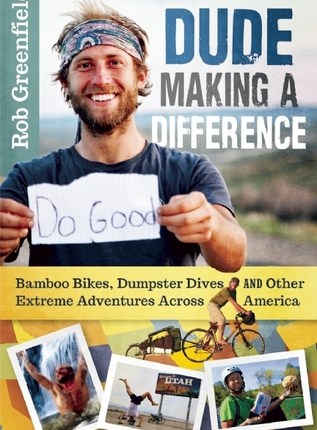
In Dude Making a Difference, Rob Greenfield has some interesting ideas about how to conserve resources, promote sustainability, and how to educate others on natural resources, transportation, personal hygiene, and more.
I don’t think that many of the methods that Rob uses will work for everyone, but they seem to make him feel better about his lifestyle.
In his quest to save the planet, Rob fights with the photographer who comes along on the 4,000+ mile bike ride (though he omits the details of these misunderstandings). I found that small detail to be ironic. It seems as if Rob cares more about the planet than he does about getting along with the people on it.
I think that if he embraced working within the system rather than getting under other folk’s skin and bucking the system, then he might make more headway with convincing others to his point of view.
As it is, Rob runs afoul of multiple municipalities on his trip because of his dumpster diving and naked hi-jinks. I’m not saying that the system is perfect or that one shouldn’t question authority if you believe that the status quo is bogus — what I am saying is that I feel as if Rob pushes the issue just to see what he can get away with and to tell the story afterwards.
I learned quite a lot about small changes that I can make to my current lifestyle to save resources like changing out my faucets or utilizing a PowerPot (that particular product seemed exceptionally cool). But, the majority of this book felt repetitive and somewhat preachy.
Rob gets up from wherever he crashed for the night (rarely from a real bed, of course), he either feels energized or not, he scavenges for food from local dumpsters, gets yelled at for that or not, gets on the road where he either feels energized or not, promotes his sustainability initiative for the day- be that biking barefooted, or going without the seat on his bike, or using only leaky faucets to get drinking water- then he rides for awhile, finds somewhere to sleep, pops on social media while either plugging his computer into the grid or not- but justifying it either way- and then goes to sleep either energized by his day or not.
Repeat, repeat, repeat. For 104 days.
It’s interesting how Rob relies on waste to get by for much of the time because, if he succeeds in his quest to lower waste, he wouldn’t be able to live the lifestyle that he’s promoting anymore.
The cognitive dissonance in such a position would drive me bonkers, but Rob seems ok with it. I admire what he’s doing, but I just don’t believe in his methods.
If you enjoyed Dude Making a Different, you may want to read Outsmart Waste: The Modern Idea of Garbage and How to Think Our Way Out of It by Tom Szaky or The Art of Non-Conformity: Set Your Own Rules, Live the Life You Want, and Change the World by Chris Guillebeau.
I received a free copy of this book from the GoodReads First Reads Giveaway program. Thanks for reading!
The Office Sutras sums itself up in the first couple of pages: “The basic premise of this book is that we’re on a spiritual journey every second of our lives, not just during those times we set aside to contemplate the cosmos. The job you have right now, no matter how frustrating, no matter how screamingly imperfect, is part of your spiritual path.”pg 3
Every page there after pretty much repeats the same theme.
This book just wasn’t for me. Every chapter presents a common problem that one can encounter at work and then gives exercises that you can use to come to an understanding about it.
I realized that I was never going to do any of the exercises and I didn’t regret that in any way. Big fail.
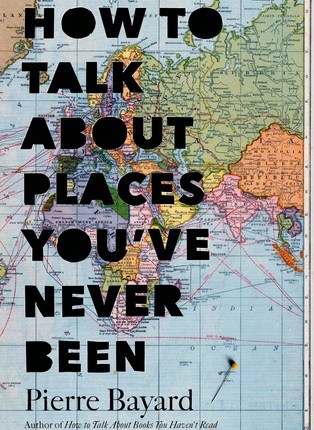
How to Talk About Places You’ve Never Been is a funny little non-fiction book about the skill of conversing about places you’ve never actually been.
At first, I couldn’t figure out what tone the author was wanting to convey because he, quite seriously, discusses why and how to describe places that the reader has never been- a topic that I, before I read this, didn’t take seriously at all.
I eventually settled my inner dialogue’s tone to “slightly grizzled professor who is smiling while lecturing” and that seemed to fit the bill.
There’s a lot to enjoy in here like Marco Polo’s hilarious description of unicorns.
Polo is presented as an armchair traveler because he left out so many important details about the area he was describing (like the Great Wall) and, quite brazenly, made other stuff up: “They have great numbers of elephants and also great numbers of unicorns, which are not smaller than the elephants. Here is what they look like: they have the same hide as a buffalo, feet like an elephant, and they have very thick, black horns in the middle of their foreheads.” pg 9
Oddly enough, that sounds rather like the Siberian unicorn, doesn’t it? Only problem is- they became extinct so long ago, that Polo would have never seen one.
The character Phileas Fogg from Around the World in Eighty Days by Jules Verne, goes around the world and never leaves his cabin to see the sights.
Bayard thinks this is an excellent strategy: “The idea of staying in your cabin for the entire journey highlights the importance of the imagination and reflection in our approach to place. These are activities that Fogg is able to commit himself to completely vis-a-vis the places passed through, with all the more energy because he doesn’t waste precious time visiting them.” pg 29
Chateaubriand went beyond simply trying to describe his travels in Ohio, he put an island into the middle of it in his “memoir.”
Bayard applauds his imaginative creation as precise accuracy of physical locations is not what is necessarily important to an armchair traveler:“As Jean-Claude Berchet recalls, (the island) was first situated in what is now Florida at the time of Travels in America. Migrating, it then made a foray into the Mississippi at the time of an 1834 manuscript, before, following its movement northward, it found itself here in Ohio, several thousand kilometers away, clearly justifying the epithet of “a floating island.” pg 57
Bayard’s reasons why the reader may, one day, have to convince someone that they had been somewhere that they actually had not been: “The first is adultery. … The second, murder, is fortunately less common, but any one of us might become confronted with the necessity of having to take this route to ensure our peace and quiet one day. pg 103
How exciting and dramatic! And here I thought this book was just about sitting in your chair and day dreaming. 🙂
“It is impossible to hope to speak with any conviction of places you haven’t been to without a vivid imagination. The capacity to dream and to make others dream is essential to anyone wanting to describe an unknown place and hoping to capture the imagination of their readers and listeners.” pg 123
Dream on, readers, dream on!
If you enjoyed How to Talk About Places You’ve Never Been, you may want to pick up The Art of Travel by Alain de Botton or The Art of Non-Conformity: Set Your Own Rules, Live the Life You Want, and Change the World by Chris Guillebeau but, keep in mind, these books recommend that you actually go to the places, not just dream it.
I received this book through the Good Reads First Reads program. Thanks for reading!
Sometimes life kills you before you die. It’s not a death of the body but a slow wearing away of the spirit that you carried from your birth through your childhood until wherever it is that time finds you now. That flickering flame of beliefs and dreams that you somehow knew was a true vision of reality but you had no real reason to believe so, except that inner feeling in your chest that would incline its head in quiet acknowledgment when you consult it. I thought that life had devoured my romantic streak but then this little book of poetry made me cry and I realized that my flame still burns. Some things can never be lost. That’s what this collection made me feel. I suppose all good poetry should make you feel like that.
One little gripe before I get into my favorite bits, the author has a habit of using parenthesis ( ) to accentuate meanings and voices in his poems. I sort of felt like the regular writing was his talking voice and the writing in parenthesis was his inner mind’s voice or whispers. I got what he was trying to do, but it became annoying because it sort of felt like a crutch or an excuse to not put down exactly what was in his head- a flavor of the truth but not the truth, if that makes sense. Say what you’re going to say, don’t ( ) your way through it. We can take it and so can you. Now, on to the good stuff.
What gets me about Josh’s poetry are the one liners in the middle of an innocuous poem about whatever, the weather or some chick’s eyes, and it’s like that one little bit reaches out and punches you in the gut.
Take this example- Complete pg 19:
“Sometimes it seems as if my life all happened years ago and now we’re all just waiting here to die.
and rainbows, they might promise me a break but the pouring rain isn’t flooding yet, the floors still reach my feet.
the cloud and bolts still keep me quiet this silence is complete.”
I think that the first three lines are just genius. “Sometimes it seems as if my life all happened years ago and now we’re all just waiting here to die.” He sets this tone of utter despair, then brings in the rainbow to crack the door open for some light to come in to his inner space, and finally ties it to the ending where you feel a bit of hope in the silence. Gorgeous, just gorgeous.
Or this one, the Sunrise pg 69 (“and sometimes, love” she says, between gasps for air “your mouth spends too much time on the sunrise and not enough time on mine.”)
There we get to see the use of the parenthesis ( ). Blah. But, the sentiment just bowls you over. What passion, what fire. Keep writing, Josh. The world needs to hear more from you.
If you enjoy the poetry of Joshua C. Geiger, I’d recommend picking up a book of Pablo Neruda or David Whyte.
I enjoyed the examples that the authors cite for simple rules helping to solve complex problems, but the manner in which to create your own ‘simple rules’ wasn’t really that simple.
I thought that in a book with the title, Simple Rules, that they’d give me a checklist of how to do it: Step 1, 2, 3, you know. The simple rules for how to make simple rules.
But, that wasn’t the case.
Since each problem, situation, business, and life is different, the authors essentially told the readers to use their discernment in the creation of the rules. Pick a ‘bottleneck’ and solve it. I found the suggestion too vague to be very helpful.
Despite these complaints, I did find a gem or two:
“Decisions that require coordination across different departments or teams are another good place to look for bottlenecks.” pg 135
“Better rules are better, and even apparently irrelevant rules can be reasonably effective if they happen to encourage helpful behavior.” pgs 172-173
If you enjoyed Simple Rules, I’d suggest The Checklist Manifesto by Atul Gawande (ways to simplify your work processes) or Yes, And: How Improvisation Reverses “No, But” Thinking and Improves Creativity and Collaboration—Lessons from The Second City by Kelly Leonard (for more simple rules on collaborations).
I picked this up a few months ago because I was looking for some pointers on creating online surveys for the public library. It has some excellent ideas, but they’re buried beneath the coils of a very aggressive marketing formula.
Levesque coaches businesses to send twelve follow up emails to customers, whether they purchase the product or not. Can you imagine?
It’s no wonder that people don’t like giving their emails out, if that is the manner in which they will be used. I have to give it to Levesque- the man certainly doesn’t take no for an answer.
He describes the unique circumstances that gave him this fierce business drive and, unlike other reviewers on this book, I actually liked the autobiographical portion of Ask.
It made me view Levesque as a regular guy before he presented his over-the-top marketing strategies. I mean, perhaps if you were running your own business and needed absolutely every customer who strayed to your webpage, Ask would be invaluable to you. As it is, if the library were to employ this system, I think it would just seriously piss everybody off.
So, anyway, the some gems I pulled out of the mess: “…people essentially are only good at answering two basic types of questions when they don’t know what they want: what it is they don’t want and what they’ve done in the past.” pg 10
Bring clarity to your business through stat analysis: “We discovered that by paying attention to the right information (provided by the market), you could not only identify what sub-segments exist in your market, but you can also identify which ones are worth focusing on.” pg 53
Put the important questions first: “Generally speaking, you should expect to see a degradation in response the deeper you get into your survey. So, for this reason, it’s essential to prioritize the importance of your questions beyond the initial questions in your survey.” pg 87
When evaluating survey responses: “The reason why response length is vitally important is because it’s an indication of hyper-responsiveness, which is a leading indicator of how likely someone is to purchase a paid solution for the problem or challenge about which we’re asking.” pg 92
Why to use an “open-ended Single Most Important Question”: “To determine what buckets naturally emerge in your market. To identify what people’s hot buttons are. To identify what their objections are. To identify what their biggest challenges are. To use in concert with their demographic information. pg 97
So anyway, to get all of these tidbits in context, pick up Ask and dig through it. But please, if I ever, for whatever reason, give you my email, do not send me 12 follow up emails. Please. And thanks for reading.
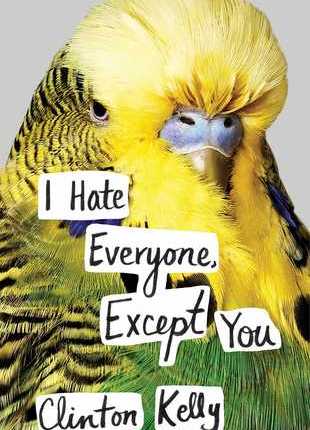
I Hate Everyone, Except You entered my life at the perfect time. I listened to a David Sedaris book last week and was unimpressed with some of his more edgy material. Clinton Kelly has the snark and sass of Sedaris, but, in my opinion, more heart and empathy.
Let’s just say, if Sedaris’ book was a hard drug, the Kelly book equivalent would be “a little fresca on a panty shield” loc 1784, ebook. Perhaps uncensored, he’s more honest and vulgar than what his fans usually see, but he’s real.
I really enjoyed this one, but don’t go into it expecting Kelly to parade himself around as the fashionista from What Not to Wear the whole time. It is definitely not that.
Kelly’s dialogue (inner and outer) is hilarious. Take this moment, he’s psyched himself up and gone on an interview for an editorial position at a fashion mag and he’s asked to wait: “I’ll hang out here in the lobby,” I said. Yep, I’ll just sit in that plastic chair facing the door, watching my dreams rot like a bowl of fruit on time-lapse video. Thanks so much. Employees began to arrive, coffees in hand, and quite frankly, I had expected them to be better looking. … Sure, some of them were so skinny you could see through them, but they didn’t look happy about it. I had been expecting to work among anorexic women who radiated inner strength, not soul-crushing hunger. And what was with all the joyless denim? loc 375, ebook.
It makes me wonder what he would say if he saw my office crowd. Maybe I wouldn’t want to know.
Kelly isn’t religious but he seems to be spiritual in that he believes people should live authentically every moment for as long as they can.
Here’s what he has to say about it: “… the older I get…, the less Destiny and Fate-and their cousin, Faith, for that matter-concern me. For some, the opposite is true. Men and women on their deathbeds, old as the Appalachaians, wondering what it was “all about”. So foolish. I must admit, perhaps to the detriment of your esteem for me, that my sympathy for such wonderers is minimal. Imagine being given a life and not understanding until its ugly end that the point was to live it.” loc 494, ebook.
I can see how that attitude could offend some people, so, here’s your warning. He’s not anti-religion necessarily. He’s pro- figuring out what works for you.
How he found his way onto “What Not to Wear” was New Age in the extreme and I’m so glad he recorded it here for us.
He didn’t like his current job and wasn’t sure what to do, so he talked to his friend: “She suggested that I ask the Universe for guidance. I wasn’t quite sure how to do that until I read a couple of books by Caroline Myss, in which she explained that if you ask the Universe for help, it will provide help.” loc 512.
Not to spoil the story, but guess what he did? I’ve read a bunch of New Age stuff and, honestly, Caroline Myss is hard core, sometimes angry even, and unapologetic about it. If I was asked to recommend a Law of Attraction author to a complete new comer to the topic, I’d pick Abraham Hicks, but whatever works.
Kelly found what he needed when he needed it and he didn’t even know it was missing- the very essence of New Age teachings.
My favorite part of the whole book: “When What Not to Wear ended a few years ago, many reporters asked me about my favorite and least favorite makeovers and the worst fashion faux pas I had ever witnessed. But not a single one asked me what I had learned about women over ten years of listening to their concerns about their bodies and their clothes. … Women want to feel beautiful. I’ve never met one who said she didn’t, and believe me, I’ve asked around.” loc 602, ebook.
Yes! And why would women want to feel beautiful? Because they would think they were worthy of love then. So, at the end of the day, what does every woman, man, child on earth want? Love.
Kelly talks about his failed and successful relationships in an honest manner, never denying that his own foibles could be why things tanked:“What probably kept us together was Rick’s ability to produce a level of rage in me so profound it actually inspired out-of-body experiences.” loc 2097, ebook. Funny, no?







 Sometimes life kills you before you die. It’s not a death of the body but a slow wearing away of the spirit that you carried from your birth through your childhood until wherever it is that time finds you now. That flickering flame of beliefs and dreams that you somehow knew was a true vision of reality but you had no real reason to believe so, except that inner feeling in your chest that would incline its head in quiet acknowledgment when you consult it. I thought that life had devoured my romantic streak but then this little book of poetry made me cry and I realized that my flame still burns. Some things can never be lost. That’s what this collection made me feel. I suppose all good poetry should make you feel like that.