The Joy of Leaving Your Sh*t All Over the Place: The Art of Being Messy by Jennifer McCartney

The Joy of Leaving Your Sh*t All Over the Place: The Art of Being Messy by Jennifer McCartney

I laughed, but I’m not proud of myself. This satire for fans or non-fans of the book, The Life-Changing Magic of Tidying Up: The Japanese Art of Decluttering and Organizing by Marie Kondō, takes no prisoners in its scathing examination of the minimalist movement. As it clearly states in the intro, this is not a self help book. As a librarian, I’d add that it is under the Dewey Decimal classification 818s (humor) rather than the 130s (self help), so that claim would be true.

First, let’s make one thing clear, I’ve loved ‘de-cluttering’ various rooms in my house and finding those objects that ‘spark joy.’ But, I couldn’t help but laugh at the process of it through the lens Jennifer McCartney provides.

Here’s what she has to say about ‘life changing magic’: There’s nothing wrong with wanting to improve your station in life or making changes to things you’re unhappy with. I guess. But be wary of neat slogans and books that promise life-changing magic. The only real magic in the world is from unicorns and the high you get from poppers. pg 19

Photo by mark glancy on Pexels.com

I’ve never felt like a failure at the ‘tidying process’ but Jennifer’s book should appeal to those who do. Here’s her advice for how to ‘Be Free’: “Let go of caring, let go of guilt and feelings of failure. Breathe in good messy, breathe out boring tidy.” pg 28

In her book, Marie Kondo writes about thanking her small purse for its service at the end of every day. Jennifer has different ideas about the care and functionality of your handbag: “…you should always purchase the biggest purse you can carry. Here’s a good purse test: Can it fit a bottle of wine? No? Move on. Yes? Buy it.” pg 75

At times, Jennifer is downright dismissive of The Life-Changing Magic of Tidying Up: The Japanese Art of Decluttering and Organizing‘s teachings about every object having a “spirit” and she’s particularly vitriolic about the way Kondo rolls her socks. If that is going to bother you, you may want to skip this one.

Photo by Pixabay on Pexels.com

A humorous read alike: The Life-Changing Magic of Not Giving a F*ck: How to Stop Spending Time You Don’t Have with People You Don’t Like Doing Things You Don’t Want to Do by Sarah Knight. Warning: contains approximately a billion f-words.

Thanks for reading!

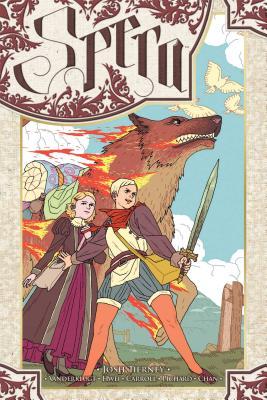
Spera, Volume 1 by Josh Tierney, Illustrated by Kyla Vanderklugt, Hwei Lin Lim, Emily Carroll, Olivier Pichard, Afu Chan, Rebecca Taylor

Spera, Volume 1 by Josh Tierney, Illustrated by Kyla Vanderklugt, Hwei Lin Lim, Emily Carroll, Olivier Pichard, Afu Chan, Rebecca Taylor

Spera is the story of two princesses, one who likes to sword fight and explore and another who likes to read and stay inside. One day, the tomboy princess, whose name is Pira, turns up in Lono’s (the reader) kingdom and says that her father the king is dead. They have to get away now to save Lono’s life. Where will two young princesses go to hide? A magical land called Spera. And so, the adventure begins.

I think that Spera tried to tell an engaging fairy tale with built in gender role options to educate impressionable young girls about who and what they can choose to be, but it didn’t quite work. Graphic novels need more than an interesting characterization idea- to engage reluctant readers, they need to tell a great story. Spera never gets there. The underlying message is sound- let children be who they are. Don’t point girls towards a book or boys towards a sword just because that’s their gender. But frankly, that’s it. The rest of the story, minus a run in with a creepy child, is kind of a non-starter.

Multiple authors contributed to this book so that’s a plus in my mind. Every chapter the reader gets a different artistic interpretation of Pira, Lono, and the fire spirit, Yonder. I gave Spera an extra star on Goodreads just for the artwork. As an adult, I found the variety enjoyable but I could see it being confusing for younger readers. They may not understand why the characters look so different every couple of pages.

If I was asked for a graphic novel recommendation for young girls that has fantasy elements, I’d skip Spera and point readers towards Princeless #1 by Jeremy Whitley.

Thanks for reading!

The Out of Body Experience: The History and Science of Astral Travel by Anthony Peake

The Out of Body Experience: The History and Science of Astral Travel by Anthony Peake

I found this to be a fascinating study into the various forms of out of body experiences and the science behind them. Unfortunately, the second half of the book that deals with quantum mechanics and multiple dimensions went over my head.

So, The Out of Body Experience may lend itself more towards engineers and mechanical-minded types rather than artists, but that’s ok. Engineers need interesting books to read too. 🙂

Photo by eberhard grossgasteiger on Pexels.com

Peake is very clear about the goals of this book: “In its pages I will review the evidence that such altered states of consciousness are subjectively real experiences; I will delve into the science by which consciousness can seemingly locate itself outside of the body and I will, finally, present my own hypotheses as to what may be happening when a person experiences such perceptions.” loc 98, ebook.

I felt like he accomplished all of that, but I was left with a sense of confusion/awe rather than clarity/awe. I had the same feeling when I tried to listen to a lecture by Amit Goswami. I knew enough to know that I had no idea what he was saying.

In this passage, he’s talking about shamanistic out of body experiences, something I do know a bit about: “Indeed, in my discussions with my shaman contacts, it became clear that what is encountered is a series of worlds full of archetypes pulled up from the deepest areas of the subconscious mind. However, what is of significance is that these beings seem to have motivations of their own, as if they have an existence independent of the shamanic traveller.” loc 261, ebook It is pretty trippy stuff.

Peake also tackled why remote viewers have trouble proving the validity of their experiences with verifiable facts in lab settings: “I am absolutely convinced that Ingo Swann believes he actually perceives information by remote viewing. In his books and articles he comes across as a genuine and honest individual, but the evidence seems to contradict this. … In my opinion he is remote reviewing, but not doing so in this dimension.” loc 1157, ebook.

Photo by Pixabay on Pexels.com

Frankly, I always wondered about that too — why can’t remote viewers see whatever they want whenever they want or why are they sometimes completely wrong? The US military spent a pile of money developing a protocol that only works some of the time, but, the fact that it works at all blows my mind.

Peake presents the hypothesis that lucid dreaming and out of body experiences are two sides of the same coin: “The hypnagogic and hypnopompic states are really the same phenomenon that places consciousness in that liminal region between sleep and wakefulness. The only difference is in the circumstances. The hypnogogic state is experienced on going to sleep and the hypnopompic state is experienced on waking up. We define an OBE when a subject is unaware of their soma.” loc 1541-1558, ebook.

So, in layman’s terms I think he’s saying: out of body experiences happen when you’re awake, lucid dreaming happens when you’re asleep, but otherwise it is the same type of non-ordinary consciousness.

One more interesting fact, just one though, because otherwise my brain might explode:“Now, the fascinating thing about (the) electromagnetic spectrum is that the human eye can only see a very small section, the part we call ‘visible light’… If the electromagnetic spectrum were a roll of movie film that stretched for 2,500 miles (this is the distance between London and Jerusalem), the visible spectrum would be the size of one film frame, about three inches. This is just how little we human beings see of the real universe that is out there and yet most of us believe that ‘seeing is believing’! If we could see radio waves we would see a sky full of galaxies, not stars.” loc 2024, ebook.

Can you imagine — a sky full of galaxies? I can.

Recommended for the seriously scientific minded.

If you’re more into the history of the phenomena rather than the science, just stop reading before the second half of the book.

Some of the reads mentioned in here that you may want to pick up: Journeys Out of the Body by Robert A. Monroe,Wisdom of Near-Death Experiences by Penny Sartori, or for some general remote reviewing information: The Seventh Sense: The Secrets of Remote Viewing as Told by a “Psychic Spy” for the U.S. Military by Lyn Buchanan.

Thank you to NetGalley and Watkins Publishing for a free digital copy of this book for review purposes!  And, thank you for reading.

The Long Way to a Small, Angry Planet by Becky Chambers

The Long Way to a Small, Angry Planet by Becky Chambers

I recently finished The Long Way to a Small, Angry Planet for a second time and was again impressed by the author’s character building.

A small criticism I have is the lack of adventure in the tale. Becky Chambers does such a great job creating characters the reader cares about, but then does so little with them.

Still recommended for readers who enjoy light-hearted science fiction.

Photo by Pixabay on Pexels.com

Review from first read-through:
This is a charming, character driven, space opera-ish, science fiction novel about a crew, made of a bunch of different species, who man a ship that drills holes in space.

The focus of this story is on the relationships of the crew, their histories, and a big job that is going to take them to a distant part of space where very few have gone.

At first, I was concerned this book was going to be too heavy on the technology or psychics, but, have no fear readers, very little technical thinking is required in The Long Way to a Small, Angry Planet, which, after a few I’ve read lately, was just what I was looking for.

I loved the different species that Chambers imagined for this universe. From lizard-type aliens to a giant caterpillar with an otter head to a simian creature who shaves his blue fur into concentric shapes, there’s a lot of characters to keep track of but they’re so different that it’s not confusing. It is just plain fun.

Photo by David Selbert on Pexels.com

Even the AI of the ship, the Wayfarer, is a character named Lovelace: “There were other Lovelaces out there, of course. Her core software platform could be purchased through any AI dealer. There were probably dozens of versions of her traveling through the galaxy- maybe hundreds, who knew. But they weren’t her.” pg 58. Indeed.

The reader gets to learn about space travel and the various ports of call through the eyes of Rosemary, the newest member of the crew, who is carrying a dark secret about her past:

“Rosemary hurried after her crewmates, anxious to not get lost. … Getting lost wasn’t what scared her, exactly. It was more the prospect of getting mugged. Or harassed. Or stabbed. She’d seen a few people that definitely looked stabby.” pgs 109-110. “Looked stabby” made me giggle.

This bit had me laughing too. I had never taken the time to consider what might happen if a cold-blooded creature ate something that was freezing cold: “We’re grown-ups, we can have ice cream for lunch if we want.” “Let’s not,” Sissix said. “Right. I forgot,” Kizzy said, and laughed. “Ice cream makes her mouth go slack.” pg 140

Photo by Somben Chea on Pexels.com

There are a few bits of life advice hidden in this story: “All you can do, Rosemary- all any of us can do- is work to be something positive instead. That is a choice that every sapient must make every day of their life. The universe is what we make of it. It’s up to you to decide what part you will play.” pg 232.

This last section contains my favorite line from the entire book: “She lived up there, in that vast expanse of color. Every day, she saw planets and comets and stellar nurseries right up close, plain as weather. Yes, there was something about being planetside that made it feel different. Perhaps stars were supposed to be viewed from the ground. pg 291-292.

“Perhaps stars were supposed to be viewed from the ground” is it. I have never traveled in space and may never get the chance to, but The Long Way to a Small, Angry Planet transports you, if just for a short time, into worlds far beyond ours.

I highly recommend it for folks who enjoy light, character-driven science fiction as there is nothing too heavy or disturbing to be found here.

Thanks for reading!

Monstress by Marjorie Liu

Monstress by Marjorie Liu

I wasn’t impressed by the graphic novel, Monstress. The story is downright confusing until the end of each issue when the reader is given a history lesson (info dump) by a talking cat with multiple tails. Let me attempt a summary of just the beginning (it gets really complicated after that):

There’s a teen. There’s something special about her but we’re not sure what. She’s purchased by a religious cult with others of her kind. They’re shipped to a prison fortress and tortured- for what, who knows? Maika (the girl) knows that she has to get out of this horrible place, but her “power” is unreliable. There are a bunch of flashbacks to explain where Maika came from and it seems to be as awful as where she is now. Will she survive? Will she figure out what her power is and learn to control it? Will anybody tell me what the heck is going on? Who are these witch/nuns? And why does the fox girl have such big eyes?

I managed to get into the story towards the end, but I was completely turned off by the F-bombs peppered throughout the text. I mean, there’s a whole language to choose from, and that’s the best you can do? I’m not opposed to a few well-timed ones, but it turned into the go-to exclamation. Also, what’s up with the females who are drawn so un-lifelike that it looks like their balloon filled chests are going to float away at any moment? Now, to be fair, they weren’t ALL ridiculously drawn, but some were. I understand that this kind of depiction is a stylistic choice, but it’s not my cup of tea. In addition, there is some seriously disturbing and graphic violence in this. With the popularity of various Tarantino films, I know that this type of art has its audience. But, again, I am not in the audience.

The bad guys in this are really, really bad, like unbelievably so. I think graphic novels are more fun when there are grey areas. Torturing children doesn’t leave a whole lot of room for sympathy.

I wanted to like Monstress as it has a lot of things that I do enjoy: magic, steampunk, gods, fairy-type creatures. But, there was just so much more that I didn’t like, that it soured the experience for me. I understand that I’m in the minority here so if you’re a graphic novel aficionado you may want to give Monstress a read through anyway as many of my friends seemed to enjoy it.

Thanks for reading!

How to Relax by Thich Nhat Hanh

How to Relax by Thich Nhat Hanh

There are very few spiritual leaders who can communicate with the simplicity and succinctness of Thich Nhat Hanh.

As wise as the Dalai Lama is, I’ve only been able to really understand one of the books he’s written and I think that was because he had a co-author. It seems like he contemplates this stuff so much, you know, like it’s his job, that when he’s just trying to talk to a regular person about it, there’s a gap that can’t be crossed.

Photo by Mikhail Nilov on Pexels.com

That isn’t a problem in Thich’s Mindfulness Series.

Thich encourages the reader to find the quiet within. He says: “We already have calmness in us; we just need to know how to make it manifest.” pg 14, ebook.

How do we do this? Through focus, breathing, mindfulness, and relaxation.

One of Thich’s methods for connecting with inner peace that really resonated with me was that we should take “lazy days”: “A lazy day is a day for us to be without any scheduled activities. We just let the day unfold naturally, timelessly. … When we have unscheduled time, we tend to get bored, seek entertainment, or cast about for something to do. A lazy day is a chance to train ourselves not to be afraid of doing nothing. You might think that not doing anything is a waste of time. But that’s not true.” pg 32, ebook.

Not to brag, but I rather excel at “lazy days”.

Photo by Rachel Claire on Pexels.com

Anyone out there have a partner who snores? I do. Thich invites us to incorporate the snores into our relaxation practice.

“Sometimes you have to share a room with someone who snores. You may get irritated. But with mindfulness you can bring about compassion. You can lean on the sound of snoring in order to go to sleep. Listen and say that this brings you home to the here and now.” pg 42, ebook.

I think this could be a difficult exercise, but I’m willing to give it a try. 🙂

Ever tell yourself that relaxation/meditation is too hard? Thich addresses that concern too: “When you sit and watch television, you don’t make any effort. That’s why you can sit there for a long time. When you sit in meditation, if you struggle, you won’t be able to sit for very long. Please imitate the way you sit in your living room. Effortlessness is the key to success. pg 76 ebook.

If you can watch tv, you can meditate. It’s silly but it reminds me of that line from Dodgeball: “if you can dodge a wrench, you can dodge a ball”.

Highly recommended for anyone looking to introduce more relaxation into their lives and isn’t that everybody?

Some read alikes: Relax RX: A Self-Hypnosis Program for Health and Well-Being by Steven Gurgevich (very relaxing, all you have to do is listen), Guided Mindfulness Meditation by Jon Kabat-Zinn (simple and relaxing), or 10% Happier: How I Tamed the Voice in My Head, Reduced Stress Without Losing My Edge, and Found Self-Help That Actually Works by Dan Harris (a regular guy teaches himself to meditate- a light hearted memoir).

Thanks for reading!

The Queen of the Night by Alexander Chee

The Queen of the Night by Alexander Chee

Lilliet Berne has secrets, many secrets hidden in her past and layered upon each other through time and circumstance. Now, she is a successful opera singer but, during a ball one night, a man brings a libretto to her attention that seems to be based on her life. Only a few people know the truth behind the secrets, which one would have made that truth public? Lilliet is going to find out and, along the way, the reader gets to experience the 18th century world from the American Midwest to the Paris Opera to Napoleon’s Imperial Court and beyond.

The Queen of the Night is a glittering, epic historical fiction, reminiscent of Margaret George’s style in that Chee weaves actual historical figures throughout his story. So, you’re learning as you’re entertaining yourself- two birds with one stone. I absolutely loved it.

Who is Lilliet? According to rumor: “I was innocent or I was the devil unleashed, I had nearly caused wars, I had kept them from happening. I was never in love, I had never loved, I was always in love. Each performance could be my last, each performance had been my last, the voice was true, the voice was a fraud. The voice, at least, was true.” pg 7, ebook.

Though true, the voice was not free from rumor either: “There’s a story told of my voice that says it was bought from a witch, the result of an occult surgery. … I never corrected this. … The real answer to where my voice came from is as ordinary as all of life. … I wanted to eat so I learned to sing.” pgs 65-66, ebook. But, as a public figure, Lilliet profited from being a spectacle on and off the stage. She encourages the stories because her notoriety brought her opera parts, connections, and money. Her true background, on the other hand, could ruin her.

The complexity of life in Paris: “Paris, which, when I looked close, was a vast 0péra-bouffe-féerie (opera with elements of comedy and magic in it)- and you did not know your role, I think, until it was too late, and the crowd was laughing at the joke you had uttered in all innocence.” pg 99, ebook. Chee explores many closed societies and the unwritten rules that are followed by them in The Queen of the Night. Among the many scenes examined are: the circus tent, the courtesan’s house, the opera, the French court, the Bohemian music culture, and the couture dressmaker. My favorite parts of this story were the glimpses into these forbidden or, in some cases, defunct cultures and learning the expected behaviors, way of dress, even the preferred perfumes. The fun is in the details.

The Queen of the Night is also a love story: “When love comes this way, the first dream of it feels like a prophecy that has come true. I had never known this feeling until now- he was my first. And so I let myself dream of him again and believe it could be the future.” pg 186, ebook. Swoon… “My theme here is love. Love and the gifts of love, love kept secret, love lost, love become hatred, war, a curse. Love become music. Love and those who died for love. Love- and, especially, first love. My first love, the one I could not keep and could never, will never, lose.” pg 215, ebook. Do you think he could have fit more “love” in there? 🙂

At one point, Lilliet says she feels like she has gotten “Fate’s attention”: “It is a peculiar thing to reach this conclusion, that a god has taken your life in hand. The sensation is not what people might imagine; it is not magic, nor is it a haunting, nor is it a miracle- there’s no storm of roses, no whistle that can put a raging ocean to sleep, no figure in the mirror besides your own.” pg 240, ebook. When I read that, I thought that Chee was going to break down the fourth wall. But, he didn’t. He kept the story flowing but I felt like he winked at me. “Where am I going to take Lilliet now?”, he seemed to say. I didn’t have any idea, but I was definitely along for the ride.

Recommended for readers who want a detailed, slightly (sometimes very) scandalous romp and mystery throughout the 18th century. If you’re into classical music, then it will be an even better fit. Some reads that you may want to explore after this one: The Dream Lover: A Novel of George Sand by Elizabeth Berg (same time period, same country), In the Company of the Courtesan by Sarah Dunant (different time period and country, some similar themes), The Night Circus by Erin Morgenstern (for the circus parts), and Before Versailles: A Novel of Louis XIV by Karleen Koen (different time period, French court).

Thanks for reading!

Diary of an Oxygen Thief by Anonymous

Diary of an Oxygen Thief by Anonymous

Did you like the emotionally disturbing/psychological train wreck that was Gone Girl? You may really enjoy this one. The Oxygen Thief may be the male equivalent to Amy Dunne.

Diary of an Oxygen Thief is written as an actual diary by, as you can see above, Anonymous. The story starts in London. He’s an alcoholic who discovers that he loves emotionally abusing women but, as the story progresses, he eventually meets his match.: “… I realized I had found my niche in life. … They say the sea is actually black and that it merely reflects the blue sky above. So it was with me. I allowed you to admire yourself in my eyes. I provided a service. I listened and listened and listened. You stored yourself in me. Nothing had ever felt so right to me. If I’m honest, even today I miss hurting. I’m not cured of it, but I don’t set out to systematically dismantle like I used to.” pgs 6-7 ebook

I don’t know that I’ve ever disliked a character in a book as much as I despised this ‘Anonymous’. That’s saying something: “Why would anyone set out to break the heart of someone he loved? Why would anyone intentionally cause that kind of pain? Why did people kill each other? Because they enjoyed it. Was it really that simple? To achieve a soul-shattering, it is better if the perpetrator has been through the same experience. Hurt people hurt people more skillfully.” pg 9 ebook. I didn’t know if I was going to be able to finish this book, given how much I hated the beginning, but, just like the numerous women in his diary, I was drawn into the Oxygen Thief’s lair and then (gasp) began to feel sorry for him.

Partially, it was because he manages to clean himself up in AA. But, the other part, is that he moved to the American Mid-West and experienced some serious culture shock, which I couldn’t help but find charming:“American lawns are loaded with social and political meaning. There is a law somewhere that says you have to maintain your lawn or the neighbors can force you to. I knew nothing of this and immediately reveled in the possibility of allowing my front and back gardens to return to nature. A polite knock on my front door changed all that.” pg 34, ebook. He calls lawns, “gardens”. I can’t…

Like a Shakespearean play, the Oxygen Thief’s eventual downfall is foreshadowed by a beautiful woman he meets in AA: “She’s evil,” said the blonde. She herself had apparently witnessed the awful effect this girl could have on guys. She looked at me for far too long. Like I wasn’t taking her seriously enough. I wasn’t.” pg 50 ebook

I also learned something about the physiology of love and heartbreak: “I read somewhere that when someone is in emotional shock, the area around the heart loses some of its protective fat and is therefore dangerously exposed. One well-aimed punch is not just painful; when the person who has been in shock starts to put the weight back on, the heart remains bruised, and this can lead to aortic fibrillation. It’s not life threatening, but it is uncomfortable. pg 85 ebook Who knew?

There aren’t any likeable characters in this book, but it is impossible to put down, so I had to give it at least three stars for its readability. I was absolutely shocked at the terrible ways in which the Oxygen Thief behaved and then was treated. No wonder people are cynical if there are people like this in the world. I tried to do a bit of research to discover who this “Anonymous” really was, but failed to come up with anything. Maybe, as time passes, his true identity will be revealed.

Recommended for the serious fans of psychological warfare tales or for those who have survived a very nasty relationship and want to compare their battle scars. The author of this book was recently paid for the film rights so we may see a movie made out of it. I don’t know if I could sit through it, but, if made the right way, it could be a very intense examination of the damage that people do to each other in the name of “love”. The obvious read alike is Gone Girl by Gillian Flynn but another book that reaches for the depressing depths of this one is: Black Moon by Kenneth Calhoun.

A couple people have asked if this book is appropriate for teen readers and as a librarian and a mother, I say no.  The themes are much too mature, sexually graphic, and emotionally disturbing.  16 or 17+ is my recommendation.

Thanks for reading!

When Breath Becomes Air by Paul Kalanithi

When Breath Becomes Air by Paul Kalanithi
whenbreath

This is Paul Kalanithi’s life story. He relates how he got into neuroscience, his exhausting and life consuming training, his illness, and his eventual transition out of this world into the next.

At first, Paul didn’t even want to become a surgeon because his own father was one and he saw how hard it was to balance work and family: “When we did see him, late at night or on weekends, he was an amalgam of sweet affections and austere diktats, hugs and kisses mixed with stony pronouncements … He had reached some compromise in his mind that fatherhood could be distilled; short, concentrated (but sincere) bursts of high intensity could equal.. whatever it was that other fathers did. All I knew was, if that was the price of medicine, it was simply too high.” pgs 24-25, ebook.

But, even though he started out as an English major, Paul’s own interests led him towards the profession. He was passionate about medicine and making the best decisions for patients. He was interested in what makes life worth living and how the brain’s functions effect quality of life.

kalanithi.interior-ata-photo---suszi-lurie-mcfadden
Dr. Lucy Kalanithi and Dr. Paul Kalanithi with their daughter, Elizabeth Acadia.

This is what he had to say after a sobering visit to a home for people who had suffered severe brain injuries as children: “Only later would I realize that our trip had added a new dimension to my understanding of the fact that brains give rise to our ability to form relationships and make life meaningful. Sometimes, they break.” pg 34

It was really difficult for me, personally, to read the parts of this memoir that dealt with Paul learning how to make life and death decisions for ailing patients. He talks in depth about taking people off of life support because they didn’t want their bodies to be kept alive while their brains were gone. I was reminded of how my grandfather, though he never suffered any debilitating brain injury, was kept alive through endless medicines and machines to reduce the water around his heart. He eventually refused to eat and refused a feeding tube, so he slowly withered away.. this from a man who lived for eating and described the joys of consuming a fresh peach in summer as one of his favorite memories. It was heartbreaking.

In this passage, one of Paul’s professors is talking about the same type of situation with his own grandma: “But “what was most evident,” he continued, “was the slow drawing away from life… By the time Bubbeh stopped praying, she had stopped virtually everything else as well.” pg 41 ebook. Eating was my grandpa’s form of prayer. So, you may want to avoid this memoir if you have any fresh grief that you’re dealing with, as this book brings it all bubbling to the surface.

kalanithi3

Photo from timeshighereducation.com

Paul studies so hard to become a doctor to learn the secrets of life and death. But, he begins to realize, that as a doctor, he’ll constantly deal with these moments but never truly understand them: “I began to suspect that being so close to the fiery light of such moments only blinded me to their nature, like trying to learn astronomy by staring directly at the sun. I was not yet with patients in their pivotal moments, I was merely at those pivotal moments.” pg 56

Then, he has his own illness and realizes that, even though he’s seen death and suffering, he really knew nothing about it: “It occurred to me that my relationship with statistics changed as soon as I became one.” pg 82. The rest of the book is so very sad, but one thing is clear, Paul Kalanithi finally found the moment when breath becomes air, what he had been searching for his whole life.

Neurosurgeons write really fine memoirs. At least, that’s been the case for nearly every one I’ve come across.

Some read alikes, if you’re interested: A Thousand Naked Strangers: A Paramedic’s Wild Ride to the Edge and Back by Kevin Hazzard (not a neurosurgeon, but Kevin talks about the burnout that comes in the medical community), Medicine, Miracles, and Manifestations: A Doctor’s Journey Through the Worlds of Divine Intervention, Near-death Experiences, and Universal Energy by John L. Turner (neurosurgeon), Into the Magic Shop: A Neurosurgeon’s Quest to Discover the Mysteries of the Brain and the Secrets of the Heart by James R. Doty (neurosurgeon), or Proof of Heaven: A Neurosurgeon’s Journey into the Afterlife by Eben Alexander.

Thanks for reading!