This Trip Will Change Your Life: A Shaman’s Story of Spirit Evolution by Jennifer Monahan

This Trip Will Change Your Life: A Shaman’s Story of Spirit Evolution by Jennifer Monahan
tripwillchangeyourlife

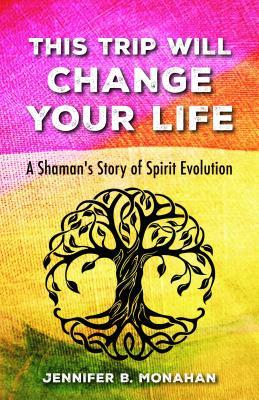
This is a firsthand account of Jennifer Monahan’s discovery of her spiritual path and budding abilities as she becomes a modern day shaman.

From the introduction: “Let me start off by saying that I’m nobody special- or at least not any more special than every other person on the planet. But I do believe in magic. And the power of the universe in our lives. This is a story about magic- everyday magic that exists in everyone’s life but that for many goes unnoticed and unappreciated.” loc 26, ebook.

I think that everyone has potential, but sometimes they don’t tap into it because they can’t see how or don’t realize that they can. Jennifer Monahan empowers the reader through her example.

Shamanism, though ancient, feels New Age.

Take this teaching about the mind: “The purpose of the mind, Antonio said, is to train it so that it focuses on those things that make the spirit sing and bring it joy- and to let everything else just slip on by without letting it get caught in the mind… Doing this enables people to live in a state of happiness, peace, and self-love.” loc 153, ebook.

That’s the message of Thank & Grow Rich: A 30-Day Experiment in Shameless Gratitude and Unabashed Joy, Ask and It Is Given: Learning to Manifest Your Desires, The Secret… I could go on. Perhaps the New Age teachers are on to something :).

My favorite parts of This Trip Will Change Your Life were the messages that Jennifer received during meditation and what she experienced during her vision walks. It is always positive, loving, supportive or healing wisdom that is shared.

Photo by Tobi on Pexels.com

Here’s the universe speaking to her while she breathes: “You don’t have to do anything. Just be. Radiate love out from your core. Focus on that and on being present. Be accepting of people- that is the first step. You’re doing that now; keep it up. Share your joy- find it! Tap into your life.” loc 503, ebook.

I can see this book not appealing to everyone: Jennifer has a few moments of “far out” behavior like talking to her crystals and receiving their wisdom, but if you believe that everything contains a spirit (the philosophy in The Life-Changing Magic of Tidying Up: The Japanese Art of Decluttering and Organizing comes to mind) then it is not such a stretch to entertain the idea that one could communicate with inanimate objects.

Western Qabalists have taught for centuries that everything has a guiding intelligence and that to tap into it, you just have to clear your thoughts, ask, and be ready for the response. But, if you don’t have a fairly open mind about such things, this might not be the book for you.

Overall, I loved the message of this book and the approachable way that Jennifer explains shamanism. “The realization that I’ve come to is that the basic human need is to be loved. And that love needs to come from within. When we feel love for ourselves, we are happy and feel good. We can then send our love unconditionally out into the world.” loc 751.

Highly recommended for those who are curious about shamanism or finding one’s spiritual calling- whatever that may be.

Recommended read alikes: the books I linked above as well as The Flying Witches of Veracruz: A Shaman’s True Story of Indigenous Witchcraft, Devil’s Weed, and Trance Healing in Aztec Brujeria by James Endredy (another modern shaman), The Way of the Shaman by Michael Harner(classic text, gives plenty of general knowledge and practices) or Active Dreaming: Journeying Beyond Self-Limitation to a Life of Wild Freedom by Robert Moss (incorporates the shamanistic practices of the Aborigines for a modern audience).

Thank you to NetGalley and She Writes Press for a free digital copy of this book! And, thank you for reading.

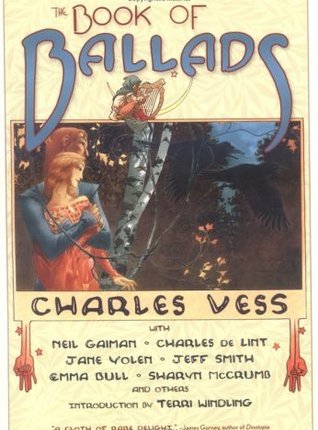
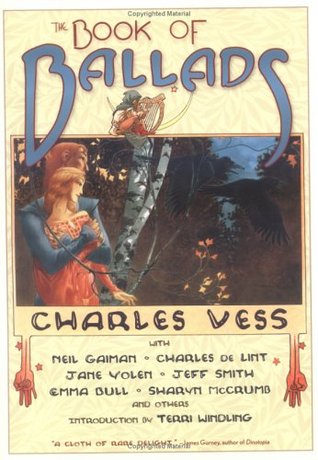
The Book of Ballads by Charles Vess, Introduction by Terri Windling

The Book of Ballads by Charles Vess, Introduction by Terri Windling
bookofballads

In this graphic novel, Charles Vess illustrates many traditional folk ballads that have been rewritten by some fairly popular fantasy artists like Neil Gaiman or Emma Bull.

I didn’t realize how many traditional ballads have negative interactions with strangers as their primary topic.

According to these stories, any stranger is either a fairy or the devil. If it is a male, he’ll either kill you or impregnate you and then come later to take your kid back to whatever magical land he came from.

If it is a female, she’ll either imprison you, change you into a snake, rape you, or take you away to fairyland.

An alternate title for this book could be: Strangers are Bad- Don’t Talk to Strangers or Let Them In Your House or Have Sex with Them Unless You Want to Die.

But all joking aside, there are very few ballads that end either happily or well. It is unsettling reading them altogether, like delving into a book of short horror stories.

From the introduction by Terri Windling: “Ballads, which are stories in narrative verse, are related to folktales, romances, and sagas, with which they sometimes share themes, plots, and characters (such as Robin Hood). No one knows how old the oldest are. It’s believed that they are ancient indeed…” pg 10

Which disturbs me even more when I consider that these stories were written for a reason. Can you imagine raising a kid in the dawn of time? ‘Don’t go talk to that stranger over there ’cause he might eat you. We don’t know about that exact dude, but seriously… it has happened. Remember how you used to have a sister?’

vess2

Take the ballad of Tam-Lin for instance: “O I forbid you, maidens a’, That wear gowd on your hair, To come or gae by Carterhaugh, For young Tam-Lin is there. There’s nane that gaes by Carterhaugh But they leave him a wad, Either their rings, or green mantles, Or else their maidenhead.” pg 92

In other words, don’t go over there or he’ll take your stuff or rape you.

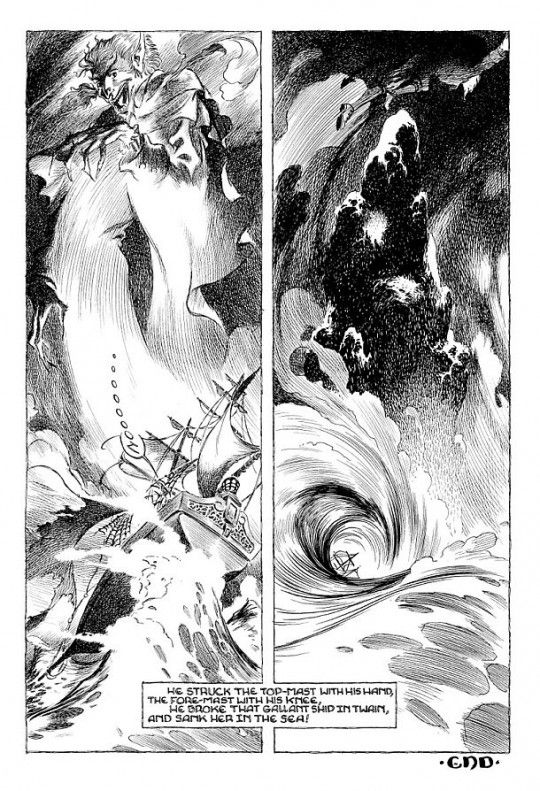
Despite the depressing nature of the stories, the artwork is very pretty and it’s all in black and white which makes the stories even starker. My favorite of the bunch is The Great Selchie of Sule Skerry which was re-written by Jane Yolen.

In it, a young maiden falls in love with a man from the sea. Guess how it ends?

Some read alike graphic novels: A Flight of Angels by Rebecca Guay, The Last Dragon by Jane Yolen, or The Sleeper and the Spindle by Neil Gaiman.

Thanks for reading!

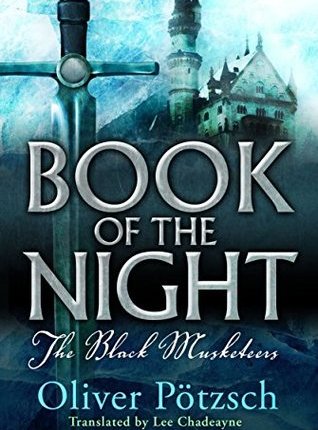
Book of the Night: the Black Musketeers by Oliver Pötzsch, translated by Lee Chadeayne

Book of the Night: the Black Musketeers by Oliver Pötzsch, translated by Lee Chadeayne

“Book of the Night” tells the story of Lukas Lohenfels, whose family is driven apart by an evil monk, intent upon finding a relic of power.

Along the path to revenge and redemption, Lukas makes some friends, some enemies, and discovers that magic may be more real than he ever imagined.

This is the 1600’s Germany, a land of princes and shifting alliances. A war has been going on for a very long time.

Photo by Kai Pilger on Pexels.com

Who are the Black Musketeers of the title?: “The Black Musketeers were the best fighters in the Reich,” he began, “trained in the use of all sorts of weapons and fear by everyone. They served as bodyguards to the Imperial General Wallenstein … We fought and shot like the devil, with swords, pikes, daggers, muskets, and pistols, and drove the Danes and their allies back across the Elbe River.” loc 129, ebook.

Lukas is forced to grow up quickly, not only because of what happens to his family, but also because of the unending war: “Lukas thought of the dreadful stories he’d heard about the war. Last year in Magedeburg, twenty thousand citizens had been slaughtered by mercenaries, who then completely destroyed the city.

Similar things had happened in other parts of the Reich. Whenever the troops passed by, no matter which side they were on, they left behind death, destruction, hunger, and disease. When he was young, Lukas had always imagined war as something heroic. … but for some time now, he had understood that war was not an adventure, but left horror and misery in its wake.” loc 1112, ebook.

Photo by Egor Kamelev on Pexels.com

Author Oliver Pötzsch is a master storyteller. His story flows smoothly and well.

I particularly enjoyed this homage to the classic, The Three Musketeers by Alexandre Dumas:

“If you have something to tell me or the others,” Gionvanni said softly, in order not to waken the other sleeping boys, “please don’t hesitate. We’re always here for you, do you understand?” He smiled. “One for all and all for one. I heard those words somewhere before, and they apply to us as well.” loc 1148, ebook.

I liked how Lukas and his friends were never entirely certain about the existence of magic until it entered their lives in a very real way: “Nonsense,” Paulus muttered. “Magic is humbug! I only believe things I can see and fight with my sword.” “It’s said there are certain vapors and gases that make people sick and can even cause the plague,” Giovanni replied matter-of-factly. “Can you see them, Paulus?

No. But still they’re there, invisible, all around us. Perhaps there’s lots more out there that we simpleminded little men can’t even imagine.” loc 1428, ebook.

Photo by Simon Berger on Pexels.com

When I saw the name, Oliver Pötzsch, and snapped up this book from NetGalley, not realizing that Book of the Night is intended for a young adult audience.

As I wrote earlier, it is very well-written and I had a lot of fun reading it. That being said, the Book of the Night isn’t very sophisticated nor are there any true surprises within its pages.

Book trailer for ‘Book of the Night’ in German.

However, it is a perfect pick for anyone in the 12 to 16 age group, or anyone who enjoys an adventure with some magical undertones.

If you’re looking for some more magical/coming-of-age young adult read-alikes try: Seraphina by Rachel Hartman, Archivist Wasp by Nicole Kornher-Stace, and Jackaby by William Ritter.

Thank you to NetGalley and Amazon Crossing Publishing for a free digital copy of this book!  And, thank you for reading.

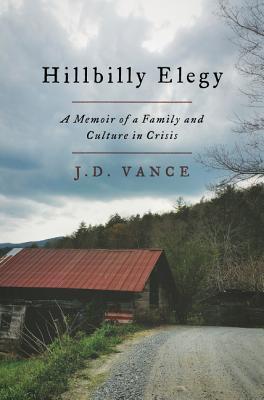
Hillbilly Elegy: A Memoir of a Family and Culture in Crisis by J.D. Vance

Hillbilly Elegy: A Memoir of a Family and Culture in Crisis by J.D. Vance
hillbilly

This is an intense memoir of J.D. Vance’s childhood and eventual rise.

It reminded me of Angela’s Ashes except that instead of Ireland, it took place in Kentucky/Ohio and the drug of choice was prescription pills rather than alcohol.

I was astonished that J.D. not only survived, but thrived. He credits his grandparents with saving his life, but a lot of different factors came together at the right time to propel him out of his dead end hometown.

This is that story.

In his own words: “Whatever talents I have, I almost squandered until a handful of loving people rescued me. That is the real story of my life, and that is why I wrote this book. I want people to know what it feels like to nearly give up on yourself and why you might do it.” pg 8, ebook.

My favorite parts of this book were the crazy, hillbilly history of his grandparents. They reminded me a lot of my own grandfather, who was a hell raiser in his time too.

In this passage, J.D.’s grandma (Mamaw) is teaching him how to take a punch to the face: “…when I asked her what it felt like to be punched in the head, she showed me. A swift blow, delivered by the meat of her hand, directly on my cheek. “That didn’t feel so bad, did it?”… This was one of her most important rules of fighting: Unless someone really knows how to hit, a punch in the face is no big deal.” pg 61, ebook.

My grandpa discouraged any kind of physical fighting since I was a girl and this went against his thoughts about what was appropriate for females. But, he told me stories about when he fought as a child, and he said he used bricks instead of his fists because it “evened the odds- those boys were bigger than me and there were more of them”.

Photo by Taylor Marx on Pexels.com

At heart though, my grandpa was a peaceful man, unlike Mamaw.

His favorite show in his twilight years was Pawn Stars, Mamaw’s was The Sopranos: “In her old age, with limited mobility, Mamaw loved to watch TV. …her favorite show by far was the HBO mob story, The Sopranos. Looking back, it’s hardly surprising that a show about fiercely loyal, sometimes violent outsiders resonated with Mamaw. Change the names and dates, and the Italian Mafia starts to look a lot like the Hatfield-McCoy dispute back in Appalachia.” pg 116, ebook.

Throughout the family stories related in Hillbilly Elegy, J.D. weaves a fascinating examination of hillbilly culture: “It would be years before I learned that no single book, or expert, or field could fully explain the problems of hillbillies in modern America. Our elegy is a sociological one, yes, but it is also about psychology and community and culture and faith.” pg 124-125, ebook.

J.D. has many epiphanies in this book. Here’s one of my favorites: “… there’s something powerful about realizing that you’ve undersold yourself- that somehow your mind confused lack of effort for inability. This is why, whenever people ask me what I’d most like to change about the white working class, I say, “The feeling that our choices don’t matter.” pg 151, ebook.

And, as much as this book highlights the problems in hillbilly America, it is also a call to action through greater self knowledge and personal responsibility.

J.D. asks some really tough questions: “How much of our lives, good and bad, should we credit to our personal decisions, and how much is just the inheritance of our culture, our families, and our parents who have failed their children? How much is Mom’s life her own fault? Where does blame stop and sympathy begin?” pg 195, ebook. I would say, with ourselves. All great change comes from within, at least, in my experience, I have found this to be true.

Some read alikes: A fictional work that examines some of the topics inHillbilly Elegy: Bull Mountain by Brian Panowich. A coming of age memoir under similar conditions: Angela’s Ashes by Frank McCourt.

Thanks for reading!

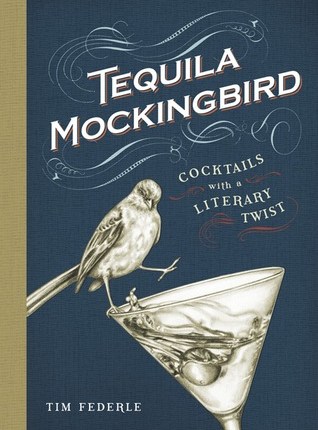
Tequila Mockingbird: Cocktails with a Literary Twist by Tim Federle

Tequila Mockingbird: Cocktails with a Literary Twist by Tim Federle
tequila-mockingbird

New life goals: buy this book. Read every classic mentioned within and try associated drink. (I was shocked by how few of these I’d read.)

I highly recommend this charming book of literary-themed drinks. For folks who are either underage or choose not to imbibe, there are a few non-alcoholic selections and snacks included.

The book summaries are hilarious and playfully presented. Some of my favorite drink titles: “Paradise Sauced”, “Are You There God? It’s Me, Margarita.”, and “Moby-Drink”.

This is a must-read for any bookworm or aspiring bartender. Five stars. Cheers!

Thanks for reading.

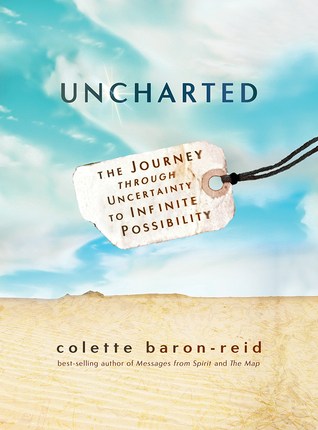
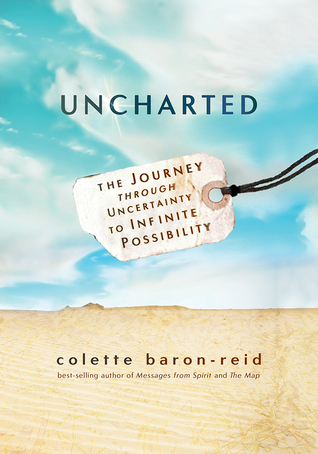
Uncharted: The Journey through Uncertainty to Infinite Possibility by Colette Baron-Reid

Uncharted: The Journey through Uncertainty to Infinite Possibility by Colette Baron-Reid
uncharted

In Uncharted, Colette Baron-Reid guides the reader with journaling, visualization, personal stories, and meditation exercises through unexplored realms of the spirit as a method for greater self knowing and actualization.

I enjoyed this book, but it felt a bit all over the place. Let me explain what I mean by examining some of the many subjects discussed:

In the introduction, Colette begins by giving some background information into what’s been going on with her for the past couple of years.

One of those big changes is that she is now channeling an group of beings, whereas, prior to this, she wasn’t.

In this passage, she’s talking about the entity helping her to write Uncharted: “It’s like “they” had the puzzle pieces, and when I was ready for them, they dropped them down on the page for me to discover. I’m not realizing that this is, in essence, what channeling an “entity” is. It’s something I never quite understood, and I’m afraid I didn’t respect its power as I should have. So I hereby surrender my inner critical cynic who doubted others when they shared their channeling stories. I get it now.” loc 55, ebook.

She calls this/these entities, Fred. Throughout the book, Fred pops up and shares a message or clarifies something. I felt as if the channeled messages could have composed a whole other book in addition to this one.

Plus, it’s clear that she’s still honing her ability to talk and understand to this inner knowing. Anyway, it “muddied the waters,” so to speak, of Uncharted from nearly the first page.

Colette doesn’t think much of the ego or what she calls the “small self”:“When you view the world through the limits of your small self, you see only the separated parts of the material world. You are guided by your personal narratives that tell you who you are based on your past experience, ambitions, and goals that were set within the Realm of Form. You’re oblivious to being part of one big matrix of interconnectedness. You forget where home is, and you feel lost.” loc 634, ebook.

Photo by Sachin C Nair on Pexels.com

I’ve read all sorts of different teachings about the ego, but I’ve started to lean towards Abraham Hick’s thoughts on the matter. They teach that the ego is the lens through which the divine within you perceives reality and that our desires are breadcrumbs along the path to eternal joy if we allow ourselves to realize them.

Hicks also says that (paraphrasing): “If you only remembered how much you wanted to be in these bodies, you wouldn’t be so quick to fault yourself and your desires. You are the leading edge of thought- you take spirit beyond which it has ever been before.”

In my mind, that is the function of ego: to express our unique personality. Isn’t the desire to be free of ego also a desire driven by the ego?

I did like Colette’s definition of co-creation, which is one I’d never heard before: “Here’s how it works between you and Spirit. You, as an individual, are always cocreating. The divine creative force is always there with you, along with spirits and allies who enthusiastically join in as you co-create reality. And you are never alone.” loc 712, ebook. Encouraging, I think.

Photo by Mayu on Pexels.com

I also liked the lesson on fate, our internal “stories” and the subconscious mind: “Listen, it’s not fun to admit that while your story about yourself has been influenced by other people and things that just seemed to happen “to” you, it was also co-written by you personally to a large degree. Fate played a role, to be sure, but you can take much greater control over your “fate.” As Carl Jung is supposed to have said, “Whatever is not brought from the unconscious into the awareness seemingly comes to us as fate.” loc 1568, ebook.

The fact that shadow dwells hand in hand with light is something that I’ve learned through my own meditation practice.

Here’s what Colette has to say about it: “In the Realm of Light, we recognize that light always exists in duality with a shadow- there’s no avoiding it. There is always a dark side to everything, a contrast between what is nourishing and loving and what is draining and entangled in fear, anger, or hatred. Those emotions will always exist, but they don’t have to overwhelm you or scare you away from the process of co-creation and transformation.” loc 1892, ebook. I believe that is true.

As for the movement through Colette’s “realms”, it reminded me of shamanistic work by Robert Moss. I’m not sure about the order in which she explores things (seems like every teacher has a different way to do it), but I think that, if your intention is greater self knowledge and if you practice what Colette teaches, you will find it.

In fact, if you try just a fraction of what she suggests in Uncharted, you will learn something about yourself. She gives plenty of exercises to attempt in here if one particular method doesn’t speak to you.

Recommended mainly for the New Age enthusiasts because of the subject matter, methods, and channeled material, but also for anyone who is curious about finding and embodying one’s authentic power.

Some similar reads: Thank & Grow Rich: A 30-Day Experiment in Shameless Gratitude and Unabashed Joy by Pam Grout, Ask and It Is Given: Learning to Manifest Your Desires by Esther Hicks, and Active Dreaming: Journeying Beyond Self-Limitation to a Life of Wild Freedom by Robert Moss.

A big thank you to Hay House and NetGalley for a free digital copy of this book!  And thank you for reading.

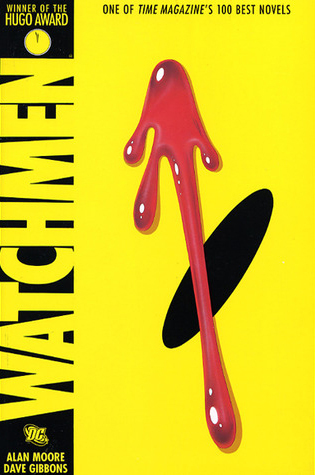
Watchmen by Alan Moore

Watchmen by Alan Moore
watchmen

I can’t stop thinking about this graphic novel. It’s not something I’d usually like- ultra-violent with a very dark vision of humanity- but there is something incredibly compelling about it.

It starts with a murder. Watchmen is the story of a group of super heroes who don’t fight crime anymore because vigilantism was outlawed. Among the many costumed regular heroes (The Comedian, Rorschach, Nite Owl), there is an actual superhero, Dr. Manhattan, who suffered a freak radiation accident and was changed, permanently. He perceives time as happening all at once and can manipulate matter in multiple dimensions. Each of the heroes has a story, some are very sad, and all of them are upset as one of their own has just been killed. Can they figure out who the murderer is before he/she strikes again?

My favorite character out of the bunch is Dr. Manhattan. “We gaze continually at the world and it grows dull in our perceptions. Yet seen from another’s vantage point, as if new, it may still take the breath away.” pg 27, Chapter XI. He’s nearly godlike in his capabilities but that makes it practically impossible for anyone to understand him.

My husband’s favorite is Rorschach, which I could understand, but he was far too violent for me to truly appreciate the character. I feel like there’s an underlying importance to that character though, something that I couldn’t quite grasp…I tried thinking about Rorschach as a rorschach blot for the Watchmen and it nearly broke my brain.

And the comic within the comic? Fascinating.

The Watchmen is more than a superhero story: it’s an examination of power both physical and in the heart. It’s a criticism of government, the media, and art used to manipulate others. It looks at gender roles, rape, and sexual preferences and predilections. It asks: why would a person dress up and create an alter ego in the first place? And, beyond all that, it is a mystery and a love story. There’s a lot to enjoy in here if you can get past the blood, gore, and soul crushing darkness. Recommended for an adult audience only.

A similar comic, in my mind, is The Walking Dead, Compendium 1 by Robert Kirkman. But, really, Watchmen is in a class all of its own.

Thank you for reading!

The Road by Cormac McCarthy

The Road by Cormac McCarthy

Dark but powerful, The Road is about a father and son who are travelling through a destroyed world.

Photo by Kaique Rocha on Pexels.com

They’re trying to get to the coast and south to warmer climates, but many obstacles lie in their way. In addition to starvation because of the nuclear fallout, the duo face external threats like cannibalistic tribes of savage men and women.

But it’s not just a battle to save their bodies, the father must teach the son the proper way to live (like not eating other people) to save his spirit from the crushing darkness that has overtaken everything. It is a struggle to retain the internal spark that divides humanity from the animals.

This is a book about survival in a dystopian reality, but it is also about the sustaining and literally life preserving power of love.

Photo by Juan Pablo Serrano Arenas on Pexels.com

My one complaint about this book is that the author didn’t clearly label who was speaking during the dialogue. He just went down a line to illustrate change of speaker. I had a really tough time keeping track of who was saying what.

Take this passage, for example: “Can I ask you something? he said. Yes. Of course. Are we going to die? Sometime. Not now. And we’re still going south. Yes. So we’ll be warm. Yes. Okay. Okay what? Nothing. Just okay. Go to sleep. Okay.” pg 9 The whole book is like that, anytime anyone is talking.

Otherwise though, this is an amazing, heart-pounding, thrill ride of a book.

I loved the father’s advice to the son throughout the journey: “A corpse in the doorway dried to leather. Grimacing at the day. He pulled the boy closer. Just remember that the things you put into your head are there forever, he said. You might want to think about that. You forget some things, don’t you? Yes. You forget what you want to remember and you remember what you want to forget.” pg 10

The father/son relationship described in here was fascinating to me. Generally, at least in my experience, the relationship between a mother and a child is the closer one in the family because of certain biological imperatives. McCarthy flips that whole paradigm on its head with this story. In here, it is the father who stands between the child and death. It is the father who finds meaning in a world gone mad through helping the child find food, stay clean, and stay protected from the elements.

“The boy sat tottering. The man watched him that he not topple into the flames. He kicked holes in the sand for the boy’s hips and shoulders where he would sleep and he sat holding him while he tousled his hair before the fire to dry it. All of this like some ancient anointing. So be it. Evoke the forms. Where you’ve nothing else construct ceremonies out of the air and breathe upon them.” pg 63.

Photo by Miri on Pexels.com

I think one of the main lessons in here is that life holds the meaning that you assign to it. And, even if civilization falls apart, you can create your own mini-civilization through your actions and intentions.

“He’d had this feeling before, beyond the numbness and the dull despair. The world shrinking down about a raw core of parsible entities. The names of things slowly following those things into oblivion. Colors. The names of birds. Things to eat. Finally the names of things one believed to be true. More fragile than he would have thought. How much of it was gone already? The sacred idiom shorn of its referents and so of its reality. Drawing down like something trying to preserve heat. In time to wink out forever.” pg 75 Beautiful.

If civilization ever ends, look for me at the library. Probably will be reading this book. 🙂

I picked this classic up because of David Schaafsman’s excellent review which you can read here: https://www.goodreads.com/review/show…

Some read alikes: Station Eleven by Emily St. John Mandel, Railsea byChina Miéville, or The Last One by Alexandra Oliva.  Thanks for reading!

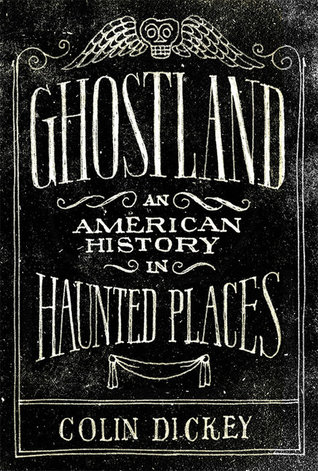
Ghostland: An American History in Haunted Places by Colin Dickey

Ghostland: An American History in Haunted Places by Colin Dickey
ghostland

Incredibly scary and a perfect read for the month of October, Colin Dickey examines ghosts, haunted buildings, and other urban legends throughout the United States. But, it’s not just about ghost stories, he also delves into the true histories of everything from cemeteries to asylums.

When I picked up Ghostland I thought: how creepy can the US be, it hasn’t been around all that long, comparatively speaking. And I found out: really, really creepy.

You don’t have to believe in ghosts to enjoy this book. Here’s what the author had to say in the intro: “Even if you don’t believe in the paranormal, ghost stories and legends of haunted places are a vital, dynamic means of confronting the past and those who have gone before us. Ultimately, this book is about the relationship between place and story: how the two depend on each other and how they bring each other alive.” loc 23, ebook.

I learned a lot of quirky, historical details about the United States. For example, did you know that Spiritualists were a huge part of the suffrage movement?: “Early suffrage meetings were heavily populated with mediums and trance speakers; in some places it was difficult to find suffragists who weren’t also Spiritualists. Spiritualism had given many of these women practice and confidence in speaking to groups with authority; by allowing others (the dead) to speak through them, American women began to speak for themselves in greater numbers. Spiritualism was only one of many factors and social movements that drove women’s suffrage, but it was a vital and important one.” loc 961-978, ebook.

One night, my ride home from work was late and I found myself alone in the library with all of the lights off and it was so spooky. I felt like I was being watched and jumped at every little creak in the stacks.

In this passage, Dickey explains why: “Few things are more unsettling than being somewhere emptied out, after everyone else has left. If you’ve ever worked a closing shift, or as a security guard, you know the way a place can change after the doors are locked and the lights are dimmed, when the lighting so carefully designed to spotlight the latest gadgets goes slack, when the mood lighting gets moodier. It’s as though you don’t belong there.” loc 1250, ebook

Photo by Lennart Wittstock on Pexels.com

The most disturbing moments, for me, were the true history portions of the narrative: “Early madhouses were often revealed to be nightmares of abuse and neglect. Reports of incontinent patients hosed down with icy water, naked women chained haphazardly to the walls, fleas and rats rampant, and other horrors gradually prompted a desire for something more sanitary and humane.”loc 2205, ebook. Eeeek. Is it any wonder that these places are haunted?

Dickey includes a poem by Goethe in his examination of the “ruins” of Detroit: “Goethe wrote in 1827: “America, you have it better Than our old continent, You have no ruined castles And no ancient basalt. Your inner life remains untroubled By useless memory And futile strife.” That was then. Now, almost two hundred years later, we’ve started to catch up to old Europe. We have plenty of ruined castles now, plenty of wasted strife to call our own.” loc 3217, ebook. I would have disagreed with that sentiment but then I readGhostland. Now, I know better.

Recommended for folks who are looking for a spooky, non-fiction read for Halloween or any other time that you’re looking for a good scare. Pick this one up with a hot drink and a warm blanket… you’re going to need it. Some read alikes: Hunt for the Skinwalker: Science Confronts the Unexplained at a Remote Ranch in Utah by Colm A. Kelleher (one of the scariest books I’ve ever read) or Mysteries and Monsters of the Sea by Fate Magazine (similar to Ghostland but nautically themed).

Thank you to Viking Publishing and NetGalley for a digital copy of this book for review purposes!  And, thank you for reading.