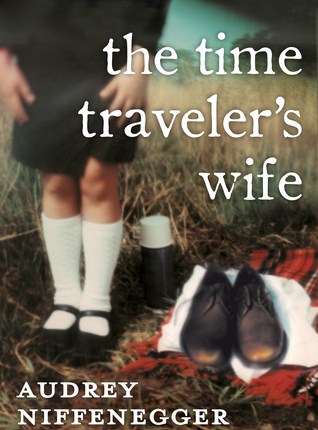
“Audrey Niffenegger’s dazzling debut is the story of Clare, a beautiful, strong-minded art student, and Henry, an adventuresome librarian, who have known each other since Clare was six and Henry was thirty-six, and were married when Clare was twenty-three and Henry thirty-one. Impossible but true, because Henry is one of the first people diagnosed with Chrono-Displacement Disorder: his genetic clock randomly resets and he finds himself misplaced in time, pulled to moments of emotional gravity from his life, past and future.”
Unpopular opinion time: I found the story to be quite different from that and have to say a big no thank you to The Time Traveler’s Wife.
To the legions of fans of this book, I’d like to know what you enjoyed about it. What did I miss? I see that it’s won a pile of awards and I just don’t get it.
I thought I was in for a sweet romance but all I got was a time traveler who cheated at the lottery, beat people up for clothes, and engaged in sexual hijinks with time traveling versions of himself.
I was completely creeped out by the fact that Henry is Clare’s best friend from the time that she was 6. She was groomed from that young age to be his wife, no matter that it wasn’t consummated until later. How awful is that.
When she is essentially date raped, she doesn’t go to the police, Clare goes to Henry who engages in some vigilante justice. It was horrible what happened to her, but she should have reported it to the authorities.
The yuck factor from a bunch of places absolutely ruined the book for me not to mention that fact that Clare never really had a childhood or life at all without Henry in it. That’s not romantic, it’s sad.
Anyway, my apologies if you loved it. Like I said, I am willing to consider other opinions on this book, I just really can’t recommend it.
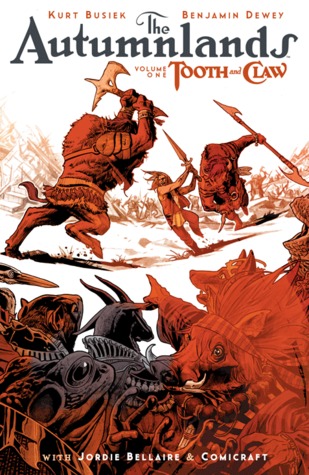
Excellent introduction to a world where anthropomorphized animals live on cities that float in the sky with the help of a magic that is fading from existence.
To combat this magic shortage, a talented magic user gathers a coalition of wizards to bring a great warrior from the past to the present in order to reawaken the powers.
The warrior is surprising, his summoning has unintended consequences, and the reader, after just a few pages, finds herself quickly caught up in a strange new world.
Highly recommended for adult readers who enjoy fantasy graphic novels.
There is a bunch of graphic violence and full frontal male nudity in here so, head’s up librarians. Make sure to shelve The Autumnlands in the appropriate section.
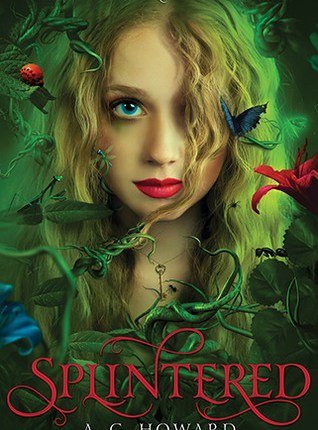
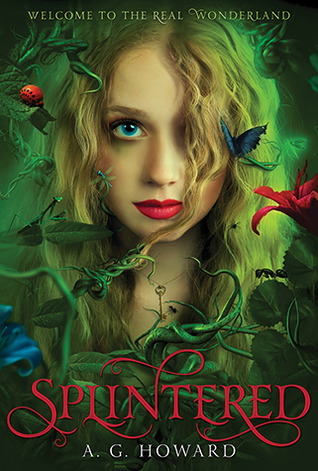
Alyssa is a descendant of Alice Liddell- the Alice who inspired Carroll to write his tale of white rabbits and fantastical creatures. But, Alyssa has a family secret: the women of her bloodline go insane when they come of age.
She tries to look on the positive side of this: At least one good thing has come out of my inherited insanity. Without the delusions, I might never have found my artistic medium.” pg 10, ebook.
Alyssa is in love with Jeb, a dark and brooding young man with a penchant for grunge clothing and a lip piercing (that she talks about all the time). But, he is dating the most popular girl in Alyssa’s high school class, Taelor (of course).
Things get really exciting when Alyssa starts to hear voices coming from the bugs and plants.
After a brief introduction where the reader learns that Jeb is freakishly controlling and Alyssa’s mother is in an insane asylum, she falls through a mirror and after some trials, finds her way into Wonderland.
I thought this could have been a potentially interesting re-telling of the classic Alice in Wonderland story, but Splintered‘s uniqueness is stifled under a bunch of teen angst and a love triangle.
Granted, I’m not the target audience for this book, but I’d been on a roll lately with awesome fairy tale re-tellings and I thought I’d give it a shot. Oh well.
I actually enjoyed A.G. Howard’s interpretation of Wonderland itself. The characters were familiar but twisted slightly.
Here’s a passage from the tea party- my favorite part: “Now we need to get back to our world. Like yesterday.” “Yesterday, you say?” the hatmaker warbles in his bouncing timbre. “Yesterday is doable.” Guffawing, the hare slaps a knee and adds, “Although two yesterdays would be impossible.” The Door Mouse snickers, slipping back into his uniform. “No, no! You can retrogress as many yesterdays as you please. Simply walk backward the rest of your life.” pg 187, ebook.
See? Howard nailed the classic characterizations, but Carroll’s original creations were far superior to Alyssa, Jeb, and Morpheus, who were her main contributions to the story.
Disregard my opinions on this book if you simply must read any and all fairy tale re-tellings because, at the very least, it is that.
Just be aware what you’re picking up- a young adult romance/coming of age- and if that’s what you’re in the mood for, you may really enjoy it.
I find that my expectations shape my opinion of a book almost as much as the text itself. For example, I think if I had been warned that Alice in Zombieland had really very little to do with the Wonderland story, I may not have disliked it as much as I did.
Splintered actually has a lot of the original Wonderland in it and, if I had to choose between Alice in Zombieland or Splintered, I’d pick this in a heartbeat.
All Darling Children asks the question: what if something corrupted the ‘boy-who-never-grew-up’?
Peter Pan is one of my favorite fairy tales and it has featured in quite a few beautiful re-tellings. (Tiger Lily is one.)
All Darling Children is a masterful, twisted take on a literary classic. I loved this for its horror filled examination of the spiritual cost of eternal youth and the strong female lead.
From her first moments in Neverland, Madge, the grandaughter of Wendy, can tell that something isn’t right: “Neverland. It seemed a hodgepodge of landscape ripped from a dream. Or maybe a nightmare. On one side, lush forest grew dense with heat and energy. Flowers bloomed in a rainbow of colors. They shuddered as Madge gazed at them, and then, as Pan looked in their direction, shriveled to pale, dry nothings.” loc 525, ebook.
This is not Disney’s version of Neverland.
Peter and his Lost Boys are dangerous in this world. Immature and wild, they try to force the traditional gender role of ‘mother’ on Madge (because they don’t know how to handle girls otherwise) and she resists: “Outsiders aren’t supposed to know how to find the tree house until they’ve been initiated.” “Initiated?” Madge’s stomach fell. “What’s that mean?” “It means you’re in the club, not that you’d ever get in, being a girl and all.” loc 692.
I never questioned the ‘Father’/’Mother’ roles of Peter and Wendy from the original book but, if the authority of the position was abused… it gets so creepy very quickly.
Madge’s story is told in-between entries from Wendy’s old diary. Here’s one of the passages: “I’ve learned much about (Peter), and while he is erratic and inconsistent in most ways, in one he is steadfast. Predictable. Peter must always be forced to try harder. If one gives in, he loses interest. I will never give in.”loc 921.
The back and forth from the story that the reader thinks she knows that is presented in Wendy’s diary, to the new story that Monroe is weaving with Madge, is awesome. There are enough similar elements drawn in from the original that the whole thing feels chillingly familiar- a mirror version of the classic.
Peter’s bragging about his exploits is presented as charming in Barrie’s version- Monroe takes a far more modern view: “Who wants to hear the story of how I cut off Captain Hook’s hand?” The boys whooped and smacked the table. Madge paled. He’d cut off someone’s hand? What was worse, he was bragging about it? Psycho.” loc 973
If you like twisted fairy tale re-tellings, you may love All Darling Children. I did. Another one that you’ve got to pick up if you liked this is Alice by Christina Henry. It’s an incredible, dark re-imagining of Alice in Wonderland and it’s also amazing.
Thank you to NetGalley and Red Adept Publishing for a free, digital ARC.
Also thank you to my Goodreads friend, Rosemarie Short, for writing a fantastic review that convinced me that I just had to read All Darling Children. You can see her review here: https://www.goodreads.com/review/show…
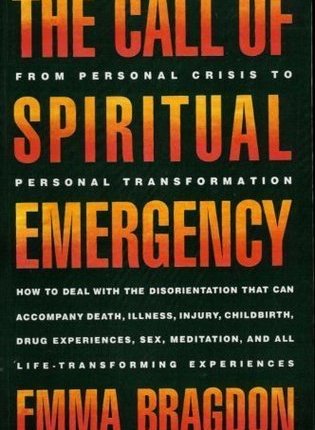
Though a bit dated (written in 1990), Emma Bragdon presents information about “spiritual emergencies,” what they are and how to help your loved ones or yourself through it.
To begin, what is a “spiritual emergency”? : “Spiritual emergence is a natural process of human development in which an individual goes beyond normal personal feelings and desires-ego- into the transpersonal, increasing relatedness to Higher Power, or God. … When spiritual emergence is punctuated by profound emotions, visions, psychosomatic illness, and compelling desires to behave in unusual ways, including suicidal thoughts, the spiritual emergence becomes a crisis, a spiritual emergency.” pg 1.
This process can be absolutely terrifying if the person has no idea what is going on and is surrounded by professionals who are also clueless.
I think that the main problem with integrating such experiences is that modern society neither supports or recognizes them as valid: “People in our culture are afraid of speaking openly about spiritual experiences, because psychic phenomena… have been considered symptomatic of psychosis. Most psychiatrists, psychologists, and even clergy have believed that most spiritual experiences are indicative of either retarded development or emotional disease.” pg 12.
The clergy part of that passage is particularly interesting to me. These are the so-called experts on the spiritual realm, yet, when something breaks through into reality, they’ve got nothing.
Bragdon then relates numerous instances of men and women from all over the world who have gone through this process and reminds us: “In all the major religions of the world can be found examples of people … who have been through intense and sometimes physically and emotionally debilitating periods of spiritual experiences and ultimately attained transpersonal levels of consciousness.” pgs 81.
It makes one wonder, if Jesus, Mohammed, Moses, or pick-your-prophet had been born in the modern era, would his/her vision just been medicated into oblivion?
Bragdon points out that the problem is in the attitudes of the religious and medical establishments- the places that should be the most educated and accepting of these sorts of troubles: “The administrators of (religious) institutions are inconsistent in their view of spiritual experience as part of spiritual growth. The conventional religious establishment is similar to the conventional medical establishment, which is so ambivalent about the reality of spiritual experiences that it doubts their validity altogether.” pg 101.
When did we completely separate the health of the body from that of the soul? After all, one won’t work without the other.
Then, she goes on to talk about all of the different ways that these sorts of experiences emerge from drug use, sex, stress, and just life.
It is so pervasive that it seems that it must be a part of the human experience, but it is hard to study and come to grips with in scientific terms because the phenomena can’t be forced or replicated.
Despite these difficulties to categorize and treat it, Bragdon suggests that being present for the person going through it is enough: “What these people do want is acknowledgement, recognition that they aren’t crazy, and the companionship of others who know what they have experienced is real.” pg 113
So, even though this book was written 26 years ago, I don’t think that we’ve really made that much progress in that time- at least not in the arena of holistic medicine or transpersonal psychology.
Rajiv Parti was living a materialistic dream with the house, car, and beautiful wife to prove it. But, the many things in his life didn’t bring him comfort when he developed prostate cancer and a bunch of unfortunate side effects from the surgery to remove it.
Addicted to pain pills and disconnected from the people around him, Dr. Parti underwent emergency surgery and experienced something so incredible, that when he woke up, he completely changed his life, developed a new form of holistic health treatment, and gave up many of the possessions that were weighing him down.
This is the memoir about that experience and Dr. Parti shares it in the hopes that it will change the reader’s life or at least bring comfort to those who are struggling in their current life experience.
Like many of the other memoirs I’ve read by medical professionals, Dr. Parti talks about the completely scientific view he had of the soul, which is to say, if you couldn’t see it and measure it, then it doesn’t exist.
Also, working on the technological edge of medical breakthroughs in the treatment of various diseases, had given him an invincible feeling.
This experience blew that attitude away: “Feeling like a master of the universe is easy in the world of modern medicine. … Maybe it’s a sense of cheating death for others that gives us cardiac surgical teams the vague feeling that we can overcome our own death. Of course that isn’t true. … Reality popped that myth for me.” pg 10
In his near death experience, Dr. Parti not only encountered his father, but also a huge crowd of his ancestors.
They shared messages of forgiveness and love: “Love is the most important thing there is, my grandfather communicated to me. I am glad to let you know that simple truth while you can still make change in your earthly life.” pg 44
But his time on the other side wasn’t all light and love, Dr. Parti also had the (fairly rare) experience of seeing hell and the suffering souls within it.
This is entirely my opinion, but I think that the detached manner in which Dr. Parti was living his life brought forth a major wake-up call from the spirit world. He saw hell first and then heaven and, in a way, that could be a metaphor for his life experience.
I don’t believe in “hell” myself other than the nightmare that people can create in their own minds and lives, but, I didn’t experience it like Dr. Parti did. This memoir does not focus on the hell portion of the narrative, but, with the rarity of that experience, it could have. That, in itself, says something.
When Dr. Parti “comes back”, he knows that he wants to start a new life and a new focus, but he doesn’t know how.
The information for developing a new type of medicine comes to him slowly during meditation: “What is (the new mode of healing) anyway?” “…It is how nonpharmacological treatments in combination with drugs can heal things like depression and addiction and other diseases. It’s about searching one’s own soul to fight back against the hollowness that pharmaceuticals alone or alcohol and illegal drugs create or don’t really fill.”pg 91.
He eventually develops meditations and lifestyle changes as well as a manifesto for treatment.
To me, the most fascinating part of this memoir was the communication between himself and the spirit world once he was back.
For readers who are unfamiliar with near death experiences, Dr. Parti provides a broad background with some of the major historical figures who went through it.
Like Jung: “(Carl) Jung’s NDE led to a split with Sigmund Freud, who believed that spiritual experiences were fantasies. Jung, however, considered spirituality an important part of our well-being saying that life has purpose beyond material goals and that our main task, the path we should all be on, is the one that leads to our own connection with the universe.” pg 124
The Sound of Gravel is in the running for my favorite book club read this year! (Bull Mountain is the other pick I really enjoyed.)
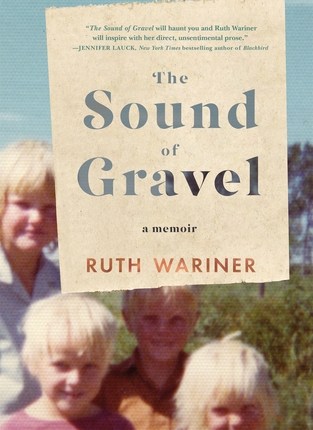
It is Ruth Warnier’s memoir about her poverty-stricken childhood in a polygamist cult in Mexico, her dysfunctional mother, abusive step-father, and struggle for survival along with her many siblings.
She pulls you in, first line: “I am my mother’s fourth child and my father’s thirty-ninth.” pg 10, ebook. I read that sentence to my husband and his reaction was, “Are you reading a book about royalty?” Unfortunately, no.
Ruthie’s father was a founding member of the “Firstborns”, a polygamist group that broke away from the Mormon church. He believed that, in order to live in the manner that God intended, men are supposed to have multiple wives and as many children as possible, to become like gods in the next life. He lived what he preached.
But, unlike members of royal families, Ruthie’s father, and later her stepfather, did not have the resources available to allow his wives to live in houses with running water or electricity. It is a hard existence but Ruth’s parents live it because of their faith.
“After all,” she said, “it is better to have ten percent of one good man than to have one hundred percent of a bad one.” The women of LeBaron (the colony in Mexico) were always saying that…” pg 12, ebook. But what about ten percent of a bad man…
At first, Ruth’s stepfather seems almost normal: “Everyone in the colony was always saying how Lane had a strong work ethic. He spent every day milking cows, planting and baling hay, fixing tractors, trucks, and other equipment- all of which broke down regularly. But in spite of all his hard work, he never made enough money to provide for his eleven kids and stepchildren.” pg 21, ebook.
And his family grew larger than that quite quickly. But, after a short time, he begins to show his true self.
It’s hard to imagine the level of poverty that Ruth and her family endured. Every month, her mother and all of her brothers and sisters made their way by bus from Mexico to the US to collect government assistance. The trip took all day and when they got back, if stepfather Lane did not show up at the bus stop to pick them up, they had to walk a mile home.
“The rest of us followed silently, watching and listening as Mom took a wide step over the highway shoulder and onto the dirt road, the gravel crunching beneath her footsteps, the sound of home.” pg 29, ebook.
Ruth’s mother tries to do what she can for her children but there’s only so much a perpetually pregnant, struggling mother of five (or more) can do. Some of Ruth’s siblings suffer from disabilities that make it dangerous for them to be left alone with any of the younger ones. After reading what her childhood was like, I am simply amazed that Ruth survived to write this book.
Major trigger warnings for sensitive readers: there are some seriously disturbing scenes of child abuse and domestic violence. But, it is worth the read.
They’re trying to get to the coast and south to warmer climates, but many obstacles lie in their way. In addition to starvation because of the nuclear fallout, the duo face external threats like cannibalistic tribes of savage men and women.
But it’s not just a battle to save their bodies, the father must teach the son the proper way to live (like not eating other people) to save his spirit from the crushing darkness that has overtaken everything. It is a struggle to retain the internal spark that divides humanity from the animals.
This is a book about survival in a dystopian reality, but it is also about the sustaining and literally life preserving power of love.
My one complaint about this book is that the author didn’t clearly label who was speaking during the dialogue. He just went down a line to illustrate change of speaker. I had a really tough time keeping track of who was saying what.
Take this passage, for example: “Can I ask you something? he said. Yes. Of course. Are we going to die? Sometime. Not now. And we’re still going south. Yes. So we’ll be warm. Yes. Okay. Okay what? Nothing. Just okay. Go to sleep. Okay.” pg 9 The whole book is like that, anytime anyone is talking.
Otherwise though, this is an amazing, heart-pounding, thrill ride of a book.
I loved the father’s advice to the son throughout the journey: “A corpse in the doorway dried to leather. Grimacing at the day. He pulled the boy closer. Just remember that the things you put into your head are there forever, he said. You might want to think about that. You forget some things, don’t you? Yes. You forget what you want to remember and you remember what you want to forget.” pg 10
The father/son relationship described in here was fascinating to me. Generally, at least in my experience, the relationship between a mother and a child is the closer one in the family because of certain biological imperatives. McCarthy flips that whole paradigm on its head with this story. In here, it is the father who stands between the child and death. It is the father who finds meaning in a world gone mad through helping the child find food, stay clean, and stay protected from the elements.
“The boy sat tottering. The man watched him that he not topple into the flames. He kicked holes in the sand for the boy’s hips and shoulders where he would sleep and he sat holding him while he tousled his hair before the fire to dry it. All of this like some ancient anointing. So be it. Evoke the forms. Where you’ve nothing else construct ceremonies out of the air and breathe upon them.” pg 63.
I think one of the main lessons in here is that life holds the meaning that you assign to it. And, even if civilization falls apart, you can create your own mini-civilization through your actions and intentions.
“He’d had this feeling before, beyond the numbness and the dull despair. The world shrinking down about a raw core of parsible entities. The names of things slowly following those things into oblivion. Colors. The names of birds. Things to eat. Finally the names of things one believed to be true. More fragile than he would have thought. How much of it was gone already? The sacred idiom shorn of its referents and so of its reality. Drawing down like something trying to preserve heat. In time to wink out forever.” pg 75 Beautiful.
If civilization ever ends, look for me at the library. Probably will be reading this book. 🙂
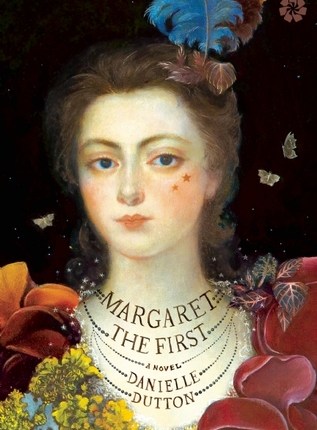
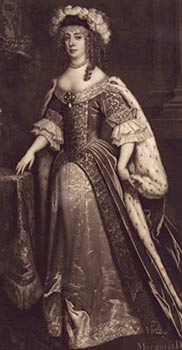
This book is life story of Margaret Cavendish, a duchess and one of the first popular female writers in England.
Nice hat, right? Digital image from nottingham.ac.uk
Margaret the First is written like a dream- the scenes come and go with little or no explanation in them and years pass in the blink or an eye or turning of the page.
Usually, I read historical fiction to immerse myself in the details of a time period, but this book doesn’t really cater to that. It’s a bubble in the wind or a glimpse from the windows of a fast moving car. It hints at depth more than delivers it.
But still, despite this strangeness, I was mainly captivated.
Margaret describing her mother: “As for our mother, she was beautiful beyond the ruins of time. None of her children would be crooked, of course, nor in any ways deformed. Neither were we dwarfish, or of a giantlike stature, but proportional, with brown hair, sound teeth, sweet breath, and tunable voices- not given to wharling in the throat, I mean, or speaking through the nose, unless we had a cold- yet we were none so prone to beauty as she, and I perhaps the least of them all.” pg 14, ebook. Beautiful.
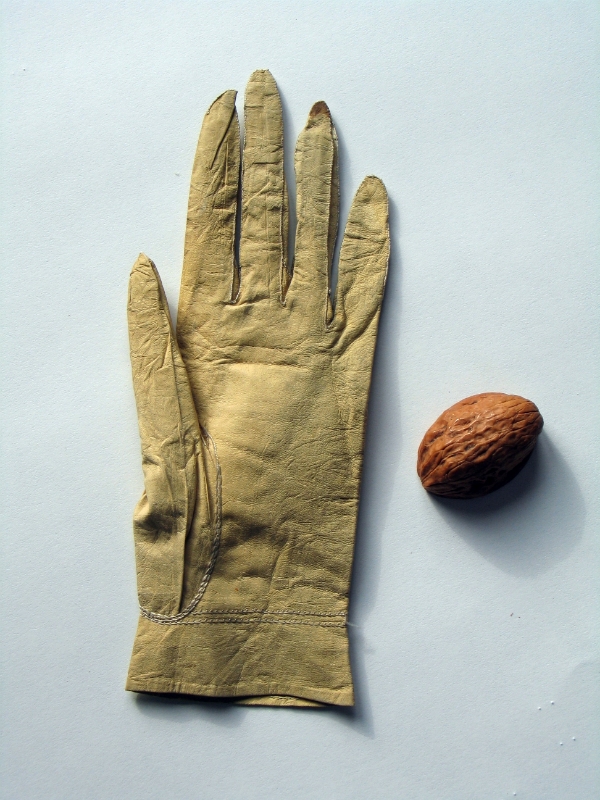
Margaret describing the difference between her childhood education and her brother’s: “You must wear chicken-skin gloves on your hands all night,” my mother began… “When inside the house,” my mother went on, “you must not spend all your time writing little books.” Yet out the window, as she spoke, under a net of branches, my youngest brother, Charlie, arrived on the lawn with a hawk. … It is nobler to be a boy, I thought- and looked back with nostalgia, as if I just had been.” pg 18, ebook
The first time Margaret speaks out in a group of intellectuals: “A second man then sportingly suggested they debate the nature of woman. “You will find, sir,” I abruptly spoke, “women as difficult to be known and understood as the universe.” The room fell silent. I was surprised as any man.” pg 43, ebook.
This may be a work of fiction, but I feel like that’s something that Margaret would have actually said. Don’t you?
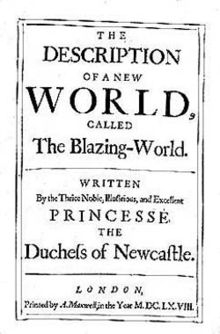
Cover of one of Margaret’s books. Photo from wikipedia.org.
The attitudes of that time period were astonishing: “Unlike Mr. Hobbes in his Leviathan, then under production in Paris, William thought that common man should be kept illiterate and happy, with sport and common prayer. “Too much reading,” he said, “has made the mob defiant.” I chewed my mutton and considered.” pg 56 (ebook)
Margaret undergoes a lot of unfortunate medical treatment in this book.
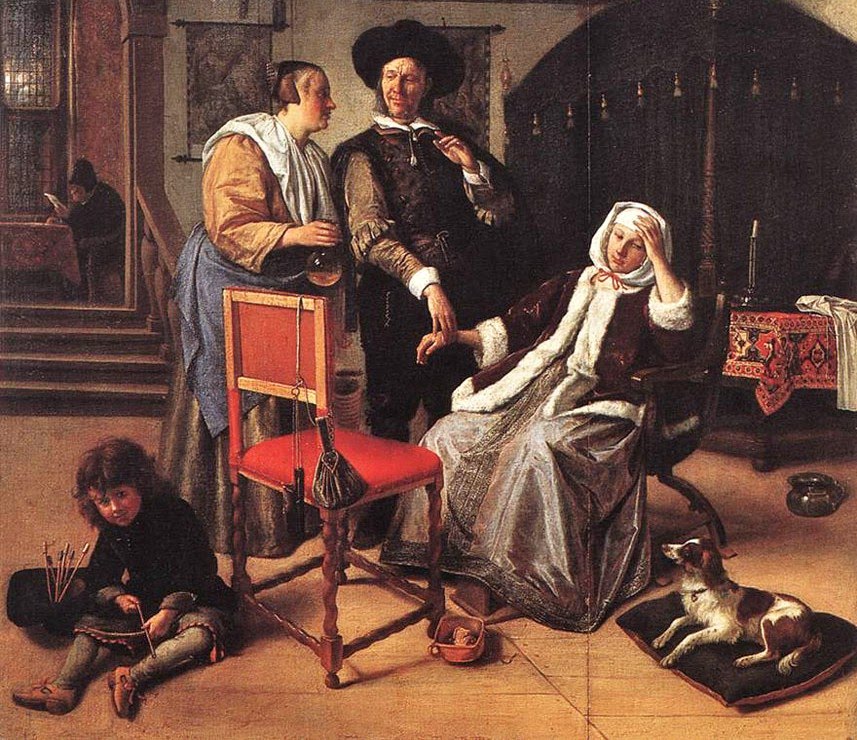
I thought that this passage was charming and really showed the time period rather than purely grotesque, bodily manipulations like some of the other doctor visits: “He (the doctor) tapped and patted, then scribbled in a book: how clear, how pale, how pink. I looked, he assured me, ten years younger than my age, in blossom, in perfect health, and prescribed only a new herb from China called tea. “The decoction of it drunk warm doth marvels,” he told Charles. “Very comforting, abates fumes.” To me he spoke nonsense, as he would to any child, suggesting candy or gossip, or candy with gossip, to lift my mood.” pg 64 (ebook)
The science of the 1600’s was so off from reality as to seem absurd now in retrospect.
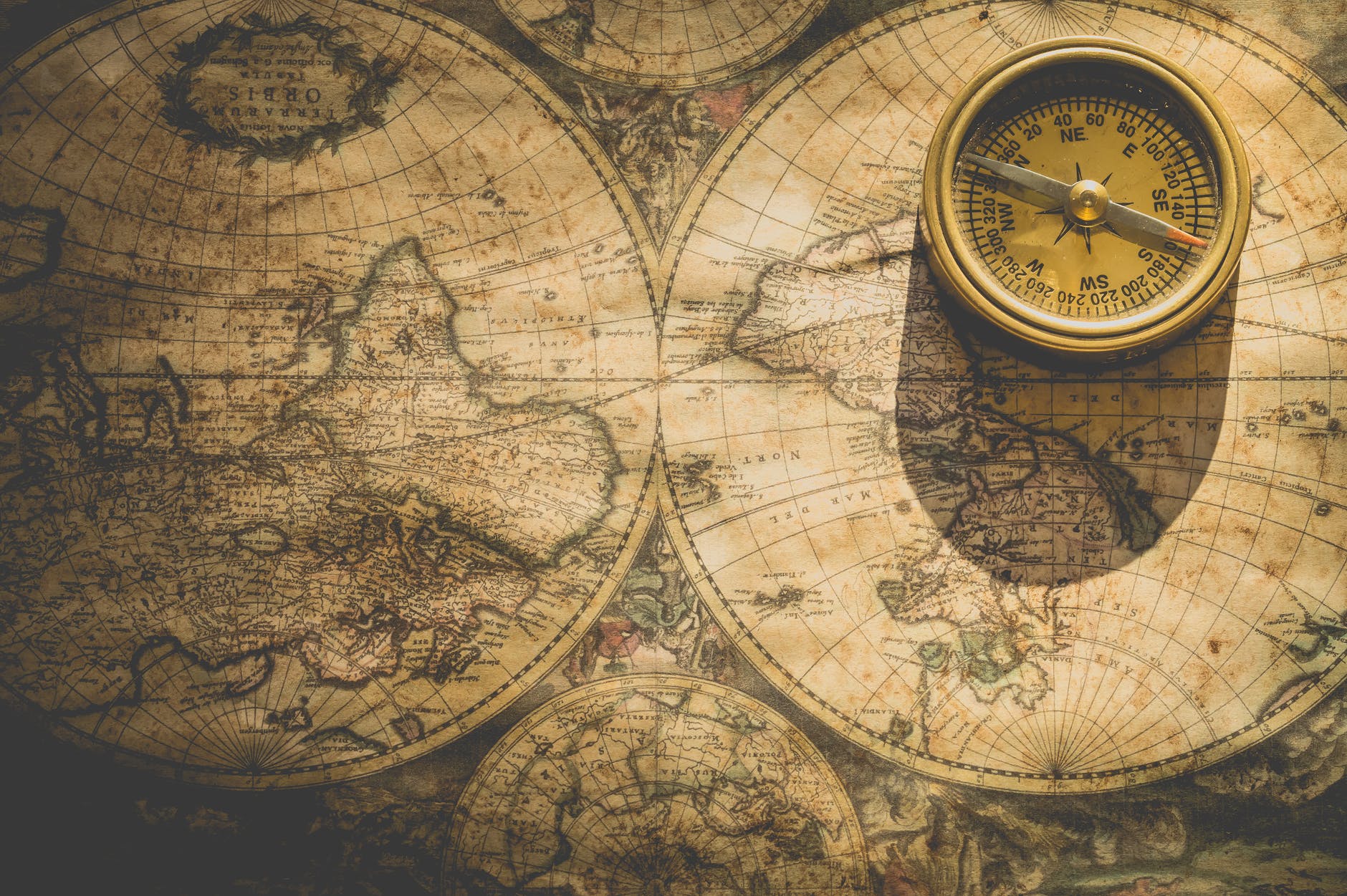
Take this scene where Margaret and an intellectual friend are viewing a map of the North Pole:“Here,” he said, “lies the very pole of the pole of the Earth, where all the oceans’ waters circle round and fall, just as if you’d poured them down a funnel in your head, only to see them come back out the southern end. And in the middle of the middle sits a large black rock, the very pole of the pole of the pole of the Earth, wholly magnetic, possibly magic, and thirty-three miles across!” “Where is the ice?” she wanted to know.” pg 100, ebook.
In this passage, Margaret’s husband asks her what she wants in life and I thought that Dutton captured the (occasionally) unsettled attitude of every woman who has ever lived nearly perfectly:“But Margaret wanted the whole house to move three feet to the left. It was indescribable what she wanted. She was restless. She wanted to work. She wanted to be thirty people. She wanted to wear a cap of pearls and a coat of bright blue diamonds. To live as nature does, in many ages, in many brains.” pg 102, ebook. I’ve been there.

 Alyssa is a descendant of Alice Liddell- the Alice who inspired Carroll to write his tale of white rabbits and fantastical creatures. But, Alyssa has a family secret: the women of her bloodline go insane when they come of age.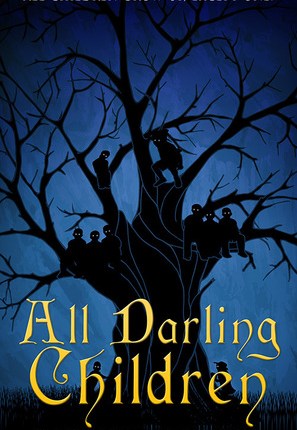














 The Help Desk Book Blog