All Darling Children by Katrina Monroe

All Darling Children by Katrina Monroe

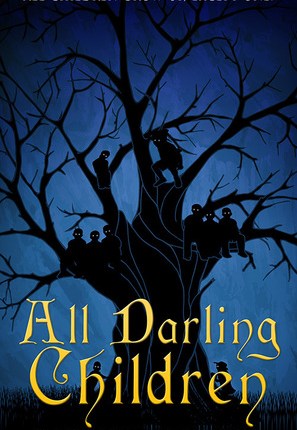
All Darling Children asks the question: what if something corrupted the ‘boy-who-never-grew-up’?

Peter Pan is one of my favorite fairy tales and it has featured in quite a few beautiful re-tellings. (Tiger Lily is one.)

All Darling Children is a masterful, twisted take on a literary classic. I loved this for its horror filled examination of the spiritual cost of eternal youth and the strong female lead.
Photo by luizclas on Pexels.com

From her first moments in Neverland, Madge, the grandaughter of Wendy, can tell that something isn’t right: “Neverland. It seemed a hodgepodge of landscape ripped from a dream. Or maybe a nightmare. On one side, lush forest grew dense with heat and energy. Flowers bloomed in a rainbow of colors. They shuddered as Madge gazed at them, and then, as Pan looked in their direction, shriveled to pale, dry nothings.” loc 525, ebook.

This is not Disney’s version of Neverland.

Peter and his Lost Boys are dangerous in this world. Immature and wild, they try to force the traditional gender role of ‘mother’ on Madge (because they don’t know how to handle girls otherwise) and she resists: “Outsiders aren’t supposed to know how to find the tree house until they’ve been initiated.” “Initiated?” Madge’s stomach fell. “What’s that mean?” “It means you’re in the club, not that you’d ever get in, being a girl and all.” loc 692.

I never questioned the ‘Father’/’Mother’ roles of Peter and Wendy from the original book but, if the authority of the position was abused… it gets so creepy very quickly.

Madge’s story is told in-between entries from Wendy’s old diary. Here’s one of the passages: “I’ve learned much about (Peter), and while he is erratic and inconsistent in most ways, in one he is steadfast. Predictable. Peter must always be forced to try harder. If one gives in, he loses interest. I will never give in.”loc 921.

The back and forth from the story that the reader thinks she knows that is presented in Wendy’s diary, to the new story that Monroe is weaving with Madge, is awesome. There are enough similar elements drawn in from the original that the whole thing feels chillingly familiar- a mirror version of the classic.

Photo by luizclas on Pexels.com

Peter’s bragging about his exploits is presented as charming in Barrie’s version- Monroe takes a far more modern view: “Who wants to hear the story of how I cut off Captain Hook’s hand?” The boys whooped and smacked the table. Madge paled. He’d cut off someone’s hand? What was worse, he was bragging about it? Psycho.” loc 973

If you like twisted fairy tale re-tellings, you may love All Darling Children. I did. Another one that you’ve got to pick up if you liked this is Alice by Christina Henry. It’s an incredible, dark re-imagining of Alice in Wonderland and it’s also amazing.

Thank you to NetGalley and Red Adept Publishing for a free, digital ARC.

Also thank you to my Goodreads friend, Rosemarie Short, for writing a fantastic review that convinced me that I just had to read All Darling Children. You can see her review here: https://www.goodreads.com/review/show…

And, thank you for reading!

The Breedling and the City in the Garden by Kimberlee Bastian

The Breedling and the City in the Garden by Kimberlee Bastian

thebreedlingBartholomew is a Breedling- an immortal spirit that guides the souls of the mortal dead to their eternal homes. He is tasked by his masters, the Fates, to find the Creators of the world, who have gone missing. Bartholomew finds the ones he’s seeking, but then refuses to reveal their location and as punishment, he is sealed in a prison until he changes his mind or the end of time, whichever comes first. But, magically, Bartholomew escapes and finds himself in 19th century Chicago in the company of two boys who are named Charlie and Jimmy. Bartholomew must find a certain mortal to bind his spirit to this world or he will end up back in his timeless prison. He also must complete his original quest- to find the Eden Wanderer. But, he must accomplish all of this without the mortals knowing who he really is or what he is really seeking. Will he succeed?
I have some serious reservations about this book. First of all, the plot isn’t nearly as straight forward as my description. The mythology of Bastian’s world is very complex and I felt like I wasn’t given enough background before I was thrown into the thick of it. Multiple characters are mentioned, but never make an appearance and, there was so much implied but not stated, that at times I felt as if I was reading the second book in the series instead of the first. Fantasy is a tricky genre because there’s a fine line between mysteriousness and utter confusion and, unfortunately, I spent much of my time in The Breedling and the City in the Garden trying to understand how everyone was connected.

On the other hand, there is much to enjoy in this debut novel beyond the complex/confusing world building. The young man, Charlie, has a big heart and spends much of his time trying to keep his cousin, Jimmy, safe from the gangs that rove the streets. He was my favorite character: “Are you prepared for the meeting tomorrow?”he asked, referring to the gang dispute Charlie had been asked to mediate, which was a nicer way of saying he was forced. “As ready as I can be, I suppose,” said Charlie. “It’s not as though they gave me a say in the matter.” loc 159, ebook.

Bastian paints a pretty picture of Chicago: “For miles, rooftops stretched in every direction. Smokestacks stood proudly as a testament to the modern age of industry. The calls of trains answered each other from east to west. To the north, the distant shrills of tugboats and barges floating along the river thundered through the air. The dark sky above blanketed every inch as far as the eye could see, the city lights hiding the stars.” loc 476, ebook

There is certainly a feeling of danger throughout the story- both for the success of the Breedling’s quest but also for the souls of the mortals who travel with him:“If Charlie were to uncover his secret, it would lift the veil of ignorance that blinded him to the truth about the supernatural elements in Eden (Earth). And for enlightened mortals, it never ended well. Their souls earmarked in the afterlife by the Mistress of Heaven or the Master of Hell.” loc 1321, ebook. “The Mistress of Heaven” is a tantalizing name for a character but Bastian never really gives the backstory for her- I wish she had.

I also liked the personal responsibility theme that cropped up again and again in this story: “…a man who runs has no life at all. He merely survives on the fringes and finds only regret. You leave here, now, like this, I swear to you there will be nowhere far enough for you to run. You will become miserable and reckless and in the end you’ll die alone, a world away, wishing you could take this moment back.” loc 3069. I’m a big believer in taking responsibility for one’s life rather than blaming it on fate or destiny. It seems like Bastian is too.

Recommended for readers who can tolerate a lot of unknown elements in the story and for people who enjoy urban fantasy. I think that Bastian shows a lot of promise and this series is only going to improve as she reveals more of the complex world she has created. Other fantasy debut recommendations: The Interminables, Funeral Games, or Chasing Embers.

Thank you to NetGalley and Wise Ink Creative Publishing for a free digital copy of this book. And, thank you for reading!

Robota by Doug Chiang

Robota by Doug Chiang

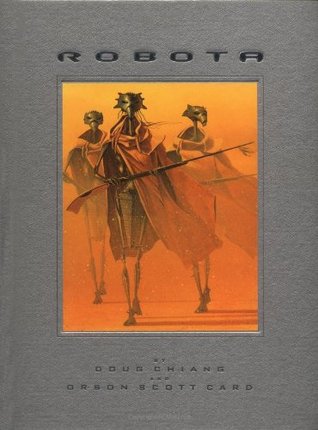
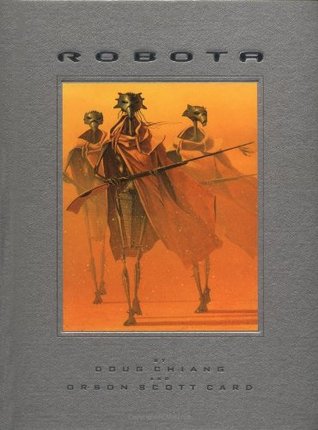
robotaRobota, like The Sleeper and the Spindle, is a story with extraordinary artwork accompanying the narrative. The prologue introduces the reader to a world that has been conquered by robots from the stars. Humankind had developed tools and machines, but nothing that equaled the alien invaders. Subdued and forced into hiding, humans fight a losing battle against an unstoppable robotic force. In the first chapter, a man awakens in an alien ship- he can’t remember his name or his past. He is encouraged out of the ship and deeper into the forest by a talking monkey named Rend. Together, they go to recover not only his memory but also his forgotten past, which may be more extraordinary than he ever imagined.

The story by Orson Scott Card is good but the artwork by Doug Chiang is astonishing. This book was originally published in 2003, but the edition I read is a 2016 re-print with a new foreword and additional concept art wasn’t released the first time around. Doug Chiang worked at LucasFilm on Star Wars: Episodes 1 & 2 and, more recently, The Force Awakens. You can really see those efforts in his art- the robot army from Episode 1 is all over this book.

My one (kind of silly) beef with Robota is the title. The story says that the robots took over Earth and renamed it “Robota” but what sort of robots would do that? I think they’d be far more likely to call it 1010010011111 or something in binary code. But, maybe I’m just biased against robots.

There was also an interesting side plot about magical jewels that gave animals on Earth the ability to talk and reason: “Once it changes an animal, it breeds true- all its offspring have speech as well. It brought a golden age to the world. It made the robots jealous, and the king of the robots, Font Prime, sent out Kaantur-Set and his hunters to destroy all the jewels. They think when the jewels are gone, we’ll all become dumb beasts again.” pg 45, ebook. The over-arching plot is nature vs machine, but Robota also asks the question: what makes life worth living?

Or what really makes a machine live?: “When there’s a living mind telling the machine what to do, it’s not a robot,” said Juomes. “Where there’s life, then the machine remains a tool.” “So a fungus with a stick is better than Font Prime,” asked Elyseo. “Probably not better at mathematics,” said Caps. No one was amused.” pg 68

Recommended for ages 14+: Robota is a feast for the eyes and may be a science fiction/fantasy that appeals to more reluctant readers. Some further reading: The Sleeper and the Spindle, Peter & Max, or Descender, Volume 1: Tin Stars (for 16+ for some disturbing images).

Thank you to NetGalley and Dover Publications for a free digital copy of this book! And, thank you for reading.

The Buried Giant by Kazuo Ishiguro

The Buried Giant by Kazuo Ishiguro

Axl and Beatrice are an aging married couple in the time of King Arthur. They’re on a quest to visit their son and face otherworldly threats like ogres and pixies as well as more regular dangers like Saxons on the road. They meet a boy named Edwin, who has a secret, and a warrior named Wistan, who is on a quest of his own.

Photo by Jimmy Chan on Pexels.com

Making matters even more difficult, there’s a mind-fogging mist covering the land that makes people forget things that just happened to them moments ago and the past is a puzzling blank. Axl and Beatrice would also like to solve the mystery of this mist, but first, they need to remember where their son lives.

This fantasy novel tackles the themes of love, forgiveness, and war- but, be warned, this is a ‘love it or hate it’ kind of read and will not appeal to everyone.

This is the first book I’ve read by Ishiguro and my feelings about it are complicated.

At first, I hated it because of the plodding pace and the fact that, although the author hinted at plenty of magical creatures and cryptic places, he didn’t do anything with them. But then, Ishiguro layered the themes on each other and brought the novel to a conclusion that I can’t stop thinking about… so I’m torn.

Photo by cottonbro on Pexels.com

Depending on where I was in the book, this was either a one star or a five star- so I’m going to come down right in the middle with three.

The mist is so pervasive throughout this story that it almost a character all of its own: “It’s queer the way the world’s forgetting people and things from only yesterday and the day before that. Like a sickness come over us all.” … She had said this while looking away into the mist-layered distance, but now she looked straight at him and he could see her eyes were filled with sadness and yearning.”pg 21, ebook.

A life lived without memories makes day-to-day living more simple, but remembering and appreciating the good times, almost impossible.

Throughout this story, I was cheering for Axl and Beatrice to remember their shared past. They’re my favorite characters in this tale.

Photo by Vlada Karpovich on Pexels.com

“Yet are you so certain, good mistress, you wish to be free of this mist? Is it not better some things remain hidden from our minds?” “It may be so for some, father, but not for us. Axl and I wish to have again the happy moments we shared together. To be robbed of them is as if a thief came in the night and took what’s most precious from us.” pg 113, ebook

Wistan is a Saxon warrior beyond compare, but he does not love Britons: “It was Britons under Arthur slaughtered our kind. … We’ve a duty to hate every man, woman and child of their blood. So promise me this. Should I fall before I pass to you my skills, promise me you’ll tend well this hatred in your heart. And should it ever flicker or threaten to die, shield it with care till the flame takes hold again.”pg 172, ebook.

Despite his efforts to remain detached, he develops a soft spot for Axl and Beatrice (Britons). Perhaps if he didn’t label people under blanket terms like “Britons” then he’d feel more kindly disposed towards them. Blind hate softens when you get to know someone and understand who they are. I think that is part of Ishiguro’s point… maybe.

Photo by Pixabay on Pexels.com

There were plenty of confusing moments in The Buried Giant for me.

What’s with the old lady slaughtering small animals in that ruin? What’s with the island where people go to live entirely by themselves? (Metaphor for death or a trip to fairyland?) What’s with Edwin’s memories? Or the priests who feed themselves to the vicious birds for things they can’t remember?

Or that ending? (Geez, that ending!)

I can see how this would make an excellent book club choice because there is so much that can be interpreted different ways and discussed.

Picking read alikes for this novel was tricky because the tone, pacing, and complexity of this book is so unique.

The Last Unicorn is a fairy tale with layers, like this read, but for young adults. Mythago Wood might be another solid choice, but it takes place in the modern era rather than the distant past. Or you could try: Suldrun’s Garden. I read that a long time ago and didn’t like it much, but it is a classic fantasy book set close to the same time as The Buried Giant.

Thanks for reading!

Zeroboxer by Fonda Lee

Zeroboxer by Fonda Lee

zeroboxerAt first, I thought that Zeroboxer was just Rocky in space, but as the story developed, I realized that it was more than that. Zeroboxer is also an examination of genetic ethics and, like most science fiction, poses some serious ‘what if’s. What if humanity begins to settle the universe- will they divide themselves into different races depending upon their planet of origins? What if the settlers develop their own system of government- how will humankind negotiate the potentially choppy waters of intergalactic politics? What if humanity could use gene therapy not just to eliminate disease but also to create a sort of super human? Fonda Lee has imagined a future filled with flawed but well-meaning people that feels very similar to our own and is, perhaps, not as far into the future as one may imagine.
The style of boxing in this story incorporates mixed martial arts with the added hiccup of no gravity: “To inflict any bare-handed damage to a person in zero gravity, you had to establish a brace or a point of leverage- preferably a vulnerable part of your opponent’s body- to keep them from floating away while you hurt them. Or you had to treat space itself as a weapon, using the infinite angles of movement to strike and rebound, strike and rebound, faster and harder than the other guy.” pg 13, ebook. Fans of MMA may enjoy this story more than I did- I don’t particularly care for violence but it was never too graphic or more than I could handle.

The colonists who settled on Mars (the Martians) embraced zero gravity sports while the people who stayed behind on Earth (the Terrans) didn’t. Luka, the main character in this story, is from Earth and he’s part of a group that is trying to popularize the sport on Earth- with mixed success: “I left Mars twenty-five year ago, saying I was going to grow the sport with the Terrans. I was practically laughed off the Red Planet. All the best zeroboxers in the Martian system… you know what they said to me? ‘Everyone on the old planet is a planet rat. The most daring and inventive Terrans left generations ago to build Mars and the other settlements. Why would a place with countless gravity-dependent sports want anything different?” pg 27, ebook.

The story becomes even more complicated because the Martians have accepted gene therapy as a way to improve and expand their race, while the Terrans only use it to keep children from developing poor eye sight or asthma. The Martian fighters are so dominant at the sport because not only were they born into a world that encouraged zero gravity sports, but also they were partially engineered to be that way. When the boxers from Earth face the boxers from Mars, it is more than planet vs planet- it is also a match up of nature vs science.

Luka doesn’t want to consider the complexities of it all and just wants to fight: “Two guys go into a Cube. They fight. One of them beats the other. How much simpler can it be? People don’t have to make it more than it is.” pg 176, ebook. Will Luka get his wish?

This book should appeal to fans of Ender’s Game or Red Rising (which is a much more adult examination of these themes). Thanks for reading!

Funeral Games by Colin Heintze

Funeral Games by Colin Heintze

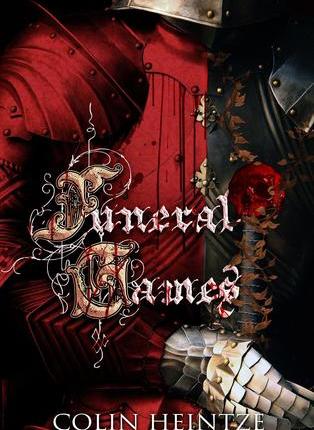
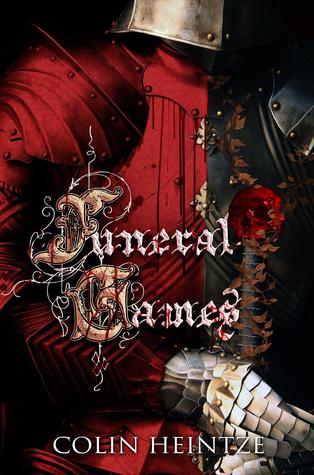
funeralgamesFuneral Games is a unique, fantastical romp through a medieval world. Syphax is a prince, but an unimportant one, being the younger son of one of his father’s many wives. He doesn’t excel in much of anything, other than reading and daydreams of greatness (reminds me of myself in some ways… I jest… but really). Syphax is a member of the nobility who are called the Undying because, when they shuffle off this mortal coil, they rise again as tangible ghosts called ancestors. These ancestors help govern the living and form another spooky faction in the sprawling complex of the capital city that is Ingerval Palace. The walls of the palace are filled with dead and living nobility who are divided into many different houses with a tangled history of treaties and backstabbing, all with the goal of more power for the members of their clan. The future looks, if not bright, then at least rosy, for our hero, Syphax, until, at one very memorable funeral celebration, something completely unexpected happens. And then, all hell breaks loose inside and outside the walls of Ingerval.
I loved the juxtaposition of the living and the dead in Funeral Games. It added a whole other level of political machinations to the usual struggles of a monarchy and its nobility. Here is the scene at one of the funerals: “The crowd roared with laughter- at least the Living among them. The Dead sat at their assigned places. They didn’t eat or drink, and weren’t the least bit amused by the antics of their descendants. There must have been two hundred ghosts and at least as many Living in attendance. Normally, the Dead kept their own company, but the day was a special one.” loc 56, ebook. I also loved how, in the course of the story, Heintze dealt with the ghost’s eternal nature, limitations, and struggle for recognition beyond the grave. It really is unlike anything else I’ve ever read.

There is a love interest in this but it doesn’t dominate the storyline or descend into the ridiculous. In fact, the girl/heroine, though she doesn’t play a huge part, is kind of hard core, which is a refreshing change of pace for the genre. In this passage, she’s talking to Syphax about one of the ancestors: “I feel like he watches me, Syphax.” “You’re in a palace full of ghosts. It’s natural to feel that way.” “Sometimes I have these dreams. And when I wake up, he’s always nearby…” … “It will be fine,” I said. “He’s harmless. All ghosts are.” loc 136, ebook. (suspenseful music building…)

My favorite part of Ingerval is, of course, the Library! “Ingerval Palace had many wonders. None were as great, nor so underappreciated, as the Library. Books were one of the few pleasures afforded to ghosts, and the Dead’s demand for the written word made Ingerval the world’s leader in the production, purchase, and dissemination of books.” loc 367, ebook. I would fit in well with the Undying, I think.

There is some rough language in this, some tense moments, and a small, if not too graphic, torture scene, so I’d suggest a reading audience of 14/15+ depending on the maturity level of the reader. I’d recommend Funeral Games for not-too-serious fantasy fans as it lacks the complexity of, say, the Malazan books, but for some folks (myself included), that may be considered a plus. Some similar reading: The Interminables by Paige Orwin (a ghost plays a large part in this story too), Ink Mage by Victor Gischler (fantasy world, lots of adventure), or The Quick by Lauren Owen (different time period, but also a fantasy).

Thank you to NetGalley and Curiosity Quills Press for a free digital copy of this book.  And, thank you for reading!

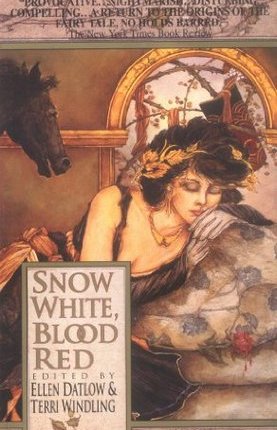
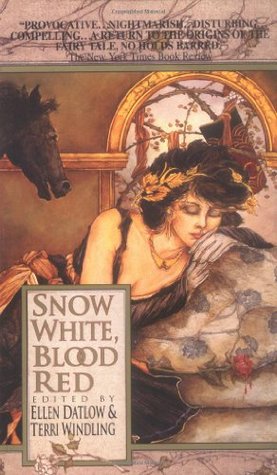
Snow White, Blood Red by Ellen Datlow

Snow White, Blood Red by Ellen Datlow

snowwhitebloodredFull credits for Snow White, Blood Red by Ellen Datlow (Editor), Terri Windling (Editor), Elizabeth A. Lynn (Contributor), Harvey Jacobs (Contributor), Steve Rasnic Tem (Contributor), Melanie Tem (Contributor), Caroline Stevermer (Contributor), Ryan Edmonds (Contributor) , Neil Gaiman (Contributor), Leonard Rysdyk (Contributor), Esther M. Friesner (Contributor)
This is a very adult collection of fairy tale re-tellings. From Little Red Riding Hood to Snow White, these are not stories that I’d share with my child or any impressionable young mind.

Fairy tales haven’t always been exclusively for children as Terri Windling explains in the introduction: “..most fairy tales were never initially intended for nursery duty. They have been put there, as J.R.R. Tolkien so evocatively expressed it, like old furniture fallen out of fashion that grown-ups no longer want. And like furniture vanished to the children’s playroom, the tales that have been banished from the mainstream of modern adult literature have suffered misuse as well as neglect.” pg 2

But fairy tales are important because they touch on dreams, archetypes, and the psyche. However, these re-workings were far more bleak than I expected. “The fairy tale journey may look like an outward trek across plains and mountains, through castles and forests, but the actual movement is inward, into the lands of the soul.” pg 10. And personally, I think that the soul is a rather light place.

The most disturbing of the bunch, in my mind was, Little Redby Wendy Wheeler, which told a tale of sexual relations between a mother/wolfish boyfriend/daughter. (A warning for any sensitive readers, triggers abound in these stories from rape to physical/sexual/emotional abuse towards adults as well as children.) “Before she climbed in, Helen looked in my face as though something in my smile disturbed her. “I’ve never noticed before what white teeth you have, Josef,” she murmured. “So large and white.” pg 140 The only saving grace for the darkness of these tales are that they’re short and you’re soon on to the next one.

My favorite was Puss by Esther M. Friesner: an excellent but nightmarish re-imaging of Puss-n-Boots. “Help! Help, ho!” My paws flailed the air; I brandished my plumed hat to make the coachmen see so small a creature as a cat before the horses trampled me. “Robbers, thieves, rascals and hounds! They have despoiled my good master, the Marquis of Carrabas!” pg 319

A close second was Troll Bridge by Neil Gaiman, based on The Three Billy Goats Gruff. His depiction of a troll was creepy but magical, that curious blend of two unrelated traits that Gaiman crafts so well. “Trolls can small the rainbows, trolls can smell the stars,” it whispered, sadly. “Trolls can smell the dreams you dreamed before you were ever born. Come close to me and I’ll eat your life.” pg 286

Recommended for ages 18+ and the brave at heart. Some read-alikes, if you dare: The Book of Ballads by Charles Vess, Alice by Christina Henry or The Library at Mount Char by Scott Hawkins.

Thanks for reading!

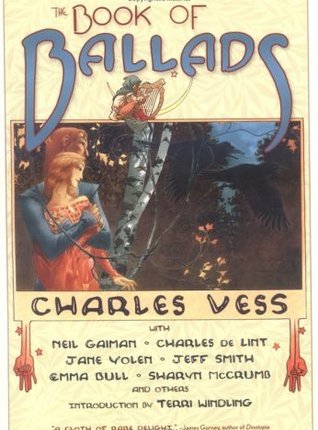
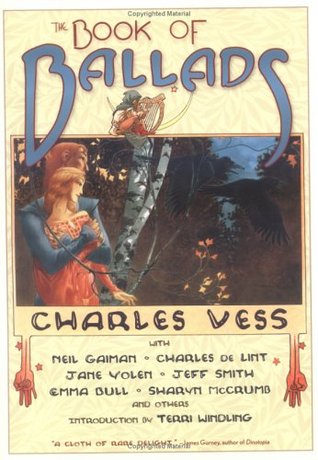
The Book of Ballads by Charles Vess, Introduction by Terri Windling

The Book of Ballads by Charles Vess, Introduction by Terri Windling
bookofballads

In this graphic novel, Charles Vess illustrates many traditional folk ballads that have been rewritten by some fairly popular fantasy artists like Neil Gaiman or Emma Bull.

I didn’t realize how many traditional ballads have negative interactions with strangers as their primary topic.

According to these stories, any stranger is either a fairy or the devil. If it is a male, he’ll either kill you or impregnate you and then come later to take your kid back to whatever magical land he came from.

If it is a female, she’ll either imprison you, change you into a snake, rape you, or take you away to fairyland.

An alternate title for this book could be: Strangers are Bad- Don’t Talk to Strangers or Let Them In Your House or Have Sex with Them Unless You Want to Die.

But all joking aside, there are very few ballads that end either happily or well. It is unsettling reading them altogether, like delving into a book of short horror stories.

From the introduction by Terri Windling: “Ballads, which are stories in narrative verse, are related to folktales, romances, and sagas, with which they sometimes share themes, plots, and characters (such as Robin Hood). No one knows how old the oldest are. It’s believed that they are ancient indeed…” pg 10

Which disturbs me even more when I consider that these stories were written for a reason. Can you imagine raising a kid in the dawn of time? ‘Don’t go talk to that stranger over there ’cause he might eat you. We don’t know about that exact dude, but seriously… it has happened. Remember how you used to have a sister?’

vess2

Take the ballad of Tam-Lin for instance: “O I forbid you, maidens a’, That wear gowd on your hair, To come or gae by Carterhaugh, For young Tam-Lin is there. There’s nane that gaes by Carterhaugh But they leave him a wad, Either their rings, or green mantles, Or else their maidenhead.” pg 92

In other words, don’t go over there or he’ll take your stuff or rape you.

Despite the depressing nature of the stories, the artwork is very pretty and it’s all in black and white which makes the stories even starker. My favorite of the bunch is The Great Selchie of Sule Skerry which was re-written by Jane Yolen.

In it, a young maiden falls in love with a man from the sea. Guess how it ends?

Some read alike graphic novels: A Flight of Angels by Rebecca Guay, The Last Dragon by Jane Yolen, or The Sleeper and the Spindle by Neil Gaiman.

Thanks for reading!

Book of the Night: the Black Musketeers by Oliver Pötzsch, translated by Lee Chadeayne

Book of the Night: the Black Musketeers by Oliver Pötzsch, translated by Lee Chadeayne

“Book of the Night” tells the story of Lukas Lohenfels, whose family is driven apart by an evil monk, intent upon finding a relic of power.

Along the path to revenge and redemption, Lukas makes some friends, some enemies, and discovers that magic may be more real than he ever imagined.

This is the 1600’s Germany, a land of princes and shifting alliances. A war has been going on for a very long time.

Photo by Kai Pilger on Pexels.com

Who are the Black Musketeers of the title?: “The Black Musketeers were the best fighters in the Reich,” he began, “trained in the use of all sorts of weapons and fear by everyone. They served as bodyguards to the Imperial General Wallenstein … We fought and shot like the devil, with swords, pikes, daggers, muskets, and pistols, and drove the Danes and their allies back across the Elbe River.” loc 129, ebook.

Lukas is forced to grow up quickly, not only because of what happens to his family, but also because of the unending war: “Lukas thought of the dreadful stories he’d heard about the war. Last year in Magedeburg, twenty thousand citizens had been slaughtered by mercenaries, who then completely destroyed the city.

Similar things had happened in other parts of the Reich. Whenever the troops passed by, no matter which side they were on, they left behind death, destruction, hunger, and disease. When he was young, Lukas had always imagined war as something heroic. … but for some time now, he had understood that war was not an adventure, but left horror and misery in its wake.” loc 1112, ebook.

Photo by Egor Kamelev on Pexels.com

Author Oliver Pötzsch is a master storyteller. His story flows smoothly and well.

I particularly enjoyed this homage to the classic, The Three Musketeers by Alexandre Dumas:

“If you have something to tell me or the others,” Gionvanni said softly, in order not to waken the other sleeping boys, “please don’t hesitate. We’re always here for you, do you understand?” He smiled. “One for all and all for one. I heard those words somewhere before, and they apply to us as well.” loc 1148, ebook.

I liked how Lukas and his friends were never entirely certain about the existence of magic until it entered their lives in a very real way: “Nonsense,” Paulus muttered. “Magic is humbug! I only believe things I can see and fight with my sword.” “It’s said there are certain vapors and gases that make people sick and can even cause the plague,” Giovanni replied matter-of-factly. “Can you see them, Paulus?

No. But still they’re there, invisible, all around us. Perhaps there’s lots more out there that we simpleminded little men can’t even imagine.” loc 1428, ebook.

Photo by Simon Berger on Pexels.com

When I saw the name, Oliver Pötzsch, and snapped up this book from NetGalley, not realizing that Book of the Night is intended for a young adult audience.

As I wrote earlier, it is very well-written and I had a lot of fun reading it. That being said, the Book of the Night isn’t very sophisticated nor are there any true surprises within its pages.

Book trailer for ‘Book of the Night’ in German.

However, it is a perfect pick for anyone in the 12 to 16 age group, or anyone who enjoys an adventure with some magical undertones.

If you’re looking for some more magical/coming-of-age young adult read-alikes try: Seraphina by Rachel Hartman, Archivist Wasp by Nicole Kornher-Stace, and Jackaby by William Ritter.

Thank you to NetGalley and Amazon Crossing Publishing for a free digital copy of this book!  And, thank you for reading.