Under the Empyrean Sky (The Heartland Trilogy #1) by Chuck Wendig

Under the Empyrean Sky (The Heartland Trilogy #1) by Chuck Wendig

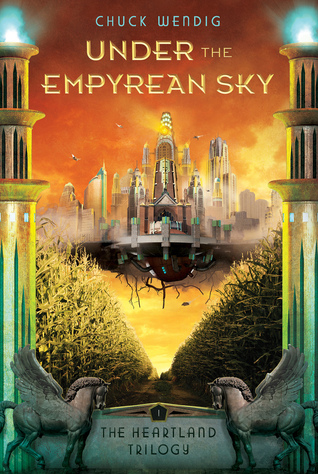
undertheempUnder the Empyrean Sky is the story of Cael and his friends, Rigo and Lane. They live in the Heartland, an agrarian world of genetically modified corn where no other crops thrive because of the aggressiveness of the new crop. There is little to no opportunity for education or work because the Empyreans, a separate section of their society that cruises overhead on their giant, flying machines, controls every aspect of their life from the food that they eat to who they can marry. Cael is the head of a scavenger crew who, in the course of their work day, stumbles across a forbidden garden and their lives change course forever.

This story was exciting. From the first scene of a race between scavenger crews for a malfunctioning piece of farm equipment to the end with an inevitable clash with the Empyrean, the story unfolds at a breakneck pace. If Cael isn’t dodging the local Overseers, he’s sneaking into quarantined cities or trying to harvest illicit vegetables. I loved how this novel was nearly constant action.

The dystopian world that Wendig creates feels scary and out of control. The plants, that the Heartlanders are forced to cultivate, attack them. The Empyreans, who aren’t properly introduced in this novel but I assume that they will be in future books, are outlandishly rich, extremely powerful through their advanced technology, and completely removed from the reality on the ground. The local authorities take advantage of the power of their position to line their own pockets at the expense of their neighbors. The reader feels Cael’s fury at his inability to control his life and the unfairness of the situation into which he was born.

It’s a small thing, but I didn’t like how the first half of the book was told nearly exclusively from Cael’s point of view and then towards the second half, the viewpoint began to bounce around between Cael and his friends. I think I would have enjoyed the story more if the narrator had remained the same throughout or had switched around from the beginning.

Another small complaint about the story is that the Empyrean lottery to join the ruling class on their air ships felt a lot like The Hunger Games or The Giver but with the outcome being presumably positive instead of a death match. Maybe it’s time for YA dystopian literature to move away from the lottery scenario.

That being said, fans of The Hunger Games or other survival/dystopian stories may really enjoy Under the Empyrean Sky. It’s fast-paced and surprising in its twists and turns. I sincerely hope that Cael’s story turns out well, but with the enormous odds stacked against him, it seems almost impossible that it could. I guess I’ll have to read the next book and find out.

I received this book as part of the Goodreads First Reads giveaway program.

Thanks for reading!

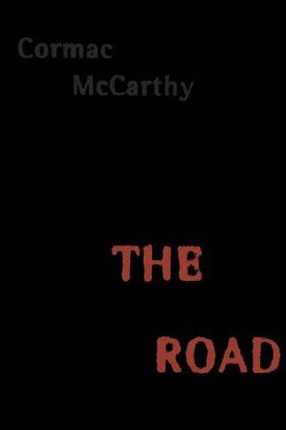
The Road by Cormac McCarthy

The Road by Cormac McCarthy

Dark but powerful, The Road is about a father and son who are travelling through a destroyed world.

Photo by Kaique Rocha on Pexels.com

They’re trying to get to the coast and south to warmer climates, but many obstacles lie in their way. In addition to starvation because of the nuclear fallout, the duo face external threats like cannibalistic tribes of savage men and women.

But it’s not just a battle to save their bodies, the father must teach the son the proper way to live (like not eating other people) to save his spirit from the crushing darkness that has overtaken everything. It is a struggle to retain the internal spark that divides humanity from the animals.

This is a book about survival in a dystopian reality, but it is also about the sustaining and literally life preserving power of love.

Photo by Juan Pablo Serrano Arenas on Pexels.com

My one complaint about this book is that the author didn’t clearly label who was speaking during the dialogue. He just went down a line to illustrate change of speaker. I had a really tough time keeping track of who was saying what.

Take this passage, for example: “Can I ask you something? he said. Yes. Of course. Are we going to die? Sometime. Not now. And we’re still going south. Yes. So we’ll be warm. Yes. Okay. Okay what? Nothing. Just okay. Go to sleep. Okay.” pg 9 The whole book is like that, anytime anyone is talking.

Otherwise though, this is an amazing, heart-pounding, thrill ride of a book.

I loved the father’s advice to the son throughout the journey: “A corpse in the doorway dried to leather. Grimacing at the day. He pulled the boy closer. Just remember that the things you put into your head are there forever, he said. You might want to think about that. You forget some things, don’t you? Yes. You forget what you want to remember and you remember what you want to forget.” pg 10

The father/son relationship described in here was fascinating to me. Generally, at least in my experience, the relationship between a mother and a child is the closer one in the family because of certain biological imperatives. McCarthy flips that whole paradigm on its head with this story. In here, it is the father who stands between the child and death. It is the father who finds meaning in a world gone mad through helping the child find food, stay clean, and stay protected from the elements.

“The boy sat tottering. The man watched him that he not topple into the flames. He kicked holes in the sand for the boy’s hips and shoulders where he would sleep and he sat holding him while he tousled his hair before the fire to dry it. All of this like some ancient anointing. So be it. Evoke the forms. Where you’ve nothing else construct ceremonies out of the air and breathe upon them.” pg 63.

Photo by Miri on Pexels.com

I think one of the main lessons in here is that life holds the meaning that you assign to it. And, even if civilization falls apart, you can create your own mini-civilization through your actions and intentions.

“He’d had this feeling before, beyond the numbness and the dull despair. The world shrinking down about a raw core of parsible entities. The names of things slowly following those things into oblivion. Colors. The names of birds. Things to eat. Finally the names of things one believed to be true. More fragile than he would have thought. How much of it was gone already? The sacred idiom shorn of its referents and so of its reality. Drawing down like something trying to preserve heat. In time to wink out forever.” pg 75 Beautiful.

If civilization ever ends, look for me at the library. Probably will be reading this book. πŸ™‚

I picked this classic up because of David Schaafsman’s excellent review which you can read here: https://www.goodreads.com/review/show…

Some read alikes: Station Eleven by Emily St. John Mandel, Railsea byChina MiΓ©ville, or The Last One by Alexandra Oliva. Β Thanks for reading!

Lord of the Flies by William Golding

Lord of the Flies by William Golding

Spoilers abound in this review, dear readers, so beware! Β If you haven’t read this one yet, stop now.

I had never read this classic before now. It was one of the options in Advanced Literature, my freshman year of high school, along with Wuthering Heights and Dune. I ended up choosingΒ Wuthering Heights, which, is an excellent read if you’re into the gothic romance stuff. So, I was bringing adult eyes to a book that most people seem to have read as a young adult. And, I have to say, I was enthralled.

As I mentioned in previous reviews, my undergraduate degree is in political science. For whatever reason, I love studying the building blocks of society, the structures of power, and the shifting sands of public opinion and group think. Lord of the Flies is a powerhouse of a book for all of those things.

For those like me who haven’t read this (I imagine there must be somebody out there), we start out on an island. There has been a plane crash and only children have survived. We’re on an island full of boys- no girls, interestingly enough. I guess Golding didn’t want to muddy the waters with gender issues in addition to the social hierarchy stuff. So, there’s a charismatic boy named Ralph who meets an overweight kid. Overweight kid shares with Ralph in confidence that the boys back at school used to call him, ‘Piggy’, but he’d rather be called anything but that. They find a huge conch shell on the beach and use it to call the other survivors to the shoreline. They’re sharing names and Ralph tells the group to call the fat kid, Piggy. Now, that was a huge red flag to me. When you tell somebody a secret and, not ten minutes later, they turn around and use that secret against you, you’ve got to know that you’ve got problems heading your way.

Well, the newly christened Piggy doesn’t have a lot of choice in the matter, because there’s an older group of choir boys on the island and the head of that group doesn’t like Piggy. So, to protect himself from the provocations of the bigger and stronger boy, Piggy allies himself with Ralph. The entire group takes a vote and decides that Ralph is going to lead this rag-tag bunch. Ralph wants to keep a smokey fire burning at all times, in order to attract the attention of any passing ships, and get the heck off of the island. Choir boy leader, Jack, wants to hunt the wild pigs on the island for meat. He becomes strangely obsessed with this chore and begins to go a bit bonkers- sort like Colonel Kurtz in Apocalypse Now. Remember, there are no adults around to keep the peace. And then things start to fall completely apart…

That’s the basic plot. Β Now for some quotes: “This is our island. It’s a good island. Until the grownups come to fetch us we’ll have fun. pg 54 ebook. Famous last words, right?

Superstition and fear enter the picture in some of the first moments on the beach: “He wants to know what you’re going to do about the snake-thing.”… Either the wandering breezes or perhaps the decline of the sun allowed a little coolness to lie under the trees. The boys felt it and stirred restlessly. pg 55 ebook.Β Golding could have taken this story a completely different direction and made the beast real. It would have been so cool in a science fiction type of way. Oh well.

My favorite character was, of course, Piggy: “Ralph moved impatiently. The trouble was, if you were a chief you had to think, you had to be wise. And then the occasion slipped by so that you had to grab at a decision… Only, decided Ralph as he faced the chief’s seat, I can’t think. Not like Piggy. … Piggy could think. He could go step by step inside that fat head of his, only Piggy was no chief. But Piggy, for all his ludicrous body, had brains. Ralph was a specialist in thought now, and could recognize thought in another.” pg 125, ebook. You think Roger ever got any psychological treatment for being such a psycho and killing people? One can only hope.

One of the original young adult dystopian reads, Lord of the Flies is an excellent pick for reluctant readers. Don’t let the label of “classic” fool you. It has a very fast pace and I’m still picking apart the details in my head even though I finished it a couple days ago. Some read alikes: The Hunger GamesΒ by Suzanne Collins (of course) and The Girl with All the Gifts by M.R. Carey (fresh take on a dystopian world, accepted social order, and power struggles between characters).

Thanks for reading!

Railsea by China MiΓ©ville

Railsea by China MiΓ©ville

“This is the story of a bloodstained boy.” That’s the first line of this strange and fantastical tale of giant creatures that “swim” in the earth’s soil and the brave and flawed “molers” who chase them for profit and life purpose. MiΓ©ville has created a dystopian world covered in railway ties with skies poisoned by chemicals and filled with monstrous, alien creatures who feast on those who get too close. But, there may just be something beyond the rails, if the characters in this story are determined and lucky enough to see their way through to the end of the world… Though based off of the tale ofΒ Moby Dick, Railsea is an engaging adventure and coming of age story that reads like nothing else I’ve ever experienced. MiΓ©ville has blended together steampunk, dytopian, and fantasy elements to create something completely different.

Sham is a boy on the cusp of manhood who can’t quite figure out what he wants to do with his adulthood: “Sham felt sure there was something he fervently wanted to do & to which he was excellently suited. Which made the more frustrating that he could not say what it was. Too vague about his interests for further study; too cautious in company, perhaps a little bruised by less-than-stellar school days, to thrive in sales or service; too young & sluggish to excel at heavy work: Sham’s tryings-out of various candidate activities left him het up.” pg 36, ebook. Anyone who has ever been lost about what path to follow in life will be able to empathize with Sham.

MiΓ©ville’s story, like Moby Dick has layers of meaning built into it: “Edging such places is the railseaside, called the littoral zone. Those are the shorelands. Port towns, from where transport, freight & hunting trains set out. Where lighthouses light ways past rubbish reefs breaking earth. “Give me the inland or give me the open rails,” say both the railsailor & the landlubber, “only spare me the littoral-minded.” pg 51 ebook. Clever, no? A warning, if you don’t enjoy reads where the author makes up words to tell the story, you may want to skip Railsea. There’s a bunch of creative adjectives and nouns mixed up in this one.

The religions of this world were a fascinating too. I wish MiΓ©ville had explored them more: “He muttered in his head to That Apt Ohm, the great rotund boss-god, one of the few deities worshipped across the railsea, whatever the peculiarities of local pantheons. Bollons was ecumenical, granted church-licences to any deities whose worshippers could pay the fees. But the disrespectful worship of That Apt Ohm was taken more seriously there, pursued with more verve, than at most stops on the railsea. Sham had no idea quite what, if anything, he believed, but there seemed little harm in a quick silent word with one of the few gods whose name he remembered.” pg 100, ebook.

Part of the homage to Moby Dick, finding a captain’s “philosophy”: “How many of these philosophies were out there? Not every captain of the Stereggeye Lands had one, but a fair proportion grew into a close antipathy-cum-connection with one particular animal, which they came to realise or decide-to decidalise-embodied meanings, potentialities, ways of looking at the world. At a certain point, & it was hard to be exact but you knew it when you saw it, the usual cunning thinking about professional prey switched onto a new rail & became something else- a faithfulness to an animal that was now a world-view.” pg 130 ebook. What’s your white mole?

I enjoyed Railsea but I can see how this writer might not be for everyone. He uses fragmented sentences and ampersands (&) to move the story along. The chapters are incredibly short which also kept the pace rolling but it could also be viewed as making the novel choppy. Sometimes, MiΓ©ville breaks through the fourth wall and addresses the reader directly. I thought that device was charming, conjuring up images in my mind of storytellers sitting in front of the fire or at a pub. But, again, this may not work for everyone.

Some read-alikes for Railsea: Chaos Walking series by Patrick Ness or Under the Empyrean Sky by Chuck Wendig. Β Thanks for reading!

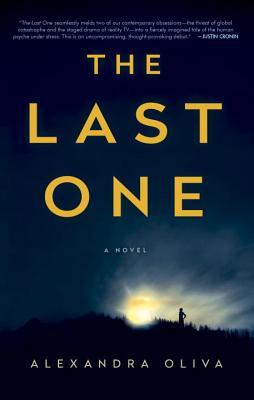
The Last One by Alexandra Oliva

The Last One by Alexandra Oliva

Twelve contestants go on a survival reality show. Β It’s a brutal competition and the only way off the show is to say the safe word. Β While the filming is taking place, something terrible happens in the real world… and no one tells the contestants. Β Will any of them survive? Β And, if they somehow survive, will they have a home to go back to?

In the book blurb, The Last One is compared to Station Eleven and The PassageΒ neither of which I liked very much. I thought Station Eleven was boring andΒ The Passage is the Game of Thrones of dystopian literature, it goes on and on and on… Unlike the other two titles, I think that The Last One got the mix of action to number of characters just right. If I had to pick the book that I think it’s most like, I would compare it to Oryx and Crake by Margaret Atwood but with far more like-able characters and a much more optimistic world view.

The Last One is told through a first person, present narrative and a third person flashback, alternating viewpoints between chapters. I was a bit frustrated with that set up until the timelines began to converge towards the end of the book, because Oliva kept putting in foreshadowing, but then not delivering on it until a couple chapters later- just long enough for me to completely forget about it. I’m much more of an instant gratification kind of reader, but I managed to push through it and really started to enjoy the novel despite the style of storytelling.

Mixing reality television with the end of the world was brilliant because the mind set of the people in the reality shows is already in survival of the fittest/game mode. I completely believed the mental breakdown that Zoo suffered when she tried to figure out where the game ended and reality began. She was put in a situation where she wasn’t supposed to know what was going on and then, she didn’t even know when exactly, no one knew what was going on. This type of world ending felt much more believable than the descent into chaos in World War Z or Station Eleven because of that slow transition to a different world provided by the reality tv show setting.

Also, anyone who’s ever watched reality tv will immediately grasp the archtypical roles that Oliva uses to label her characters and it makes it simple to keep a rather large group of people straight in your mind. Fans of Big Brother, Top Chef, The Jersey Shore, and any of the countless other offerings of that genre will eat this up.

What I loved most about this book is that it was so easy to put myself in Zoo’s shoes. In this passage, she’s talking about her reluctance to go on the show: “It didn’t used to be so difficult to leave, but it was different before I met my husband. Before- leaving Stowe for college, that summer hiking hostel to hostel across western Europe, six months in Australia after graduating from Columbia- my fear was always tempered by excitement enough to tip the scales. Leaving was always scary, but it was never hard. But this time I not only left familiarity behind, I left happiness. There’s a difference, the magnitude of which I didn’t anticipate.”advance reader, pg 24-25

Cooper, aka Tracker, was also so relatable. He reminded me of various people that I have known in my real life: “Cooper was kind of like that at first. Standoffish. I don’t know what drew me to him so strongly from the start. No- I do. His air of almost freakish competence. The way he scanned each of us, assessing without looking for allies, because from the moment he leapt into that tree it was clear he didn’t need anyone but himself. I bet his entire adult life has been like that: needing no one, being needed by no one- existing without apology and accomplishing wonders. I’d never been around someone so supremely independent before and was fascinated.” advance reader, pg 38

The reality show mentality begins: “Waitress’s animosity doesn’t surprise Exorcist, but Rancher’s agreement does, as do the many nodding heads around the campfire. Briefly, he looks into a camera lens, as though accusing the device of having put the others up to this. Indeed, that’s exactly what he’s doing; he thinks they’re performing- like he is. But the truth is most of the contestants have in this moment forgotten that they’re being recorded. An ancient instinct is kicking in, not so much a survival-of-the-fittest mentality as an unwillingness to carry an able but lazy individual.” advance reader, pg 174

Zoo’s confusion between reality and reality television makes for some really intense, introspective moments: “I wonder how I’m being portrayed now. I know what my role was when we started. I was the earnest animal lover, always cheerful and up for a Challenge. But now? Will they cast me as off my rocker? Probably not; that’s Randy’s role, with his stupid gold cross and his tales of possessed toddlers. But whoever I am now, I’m no longer who I was. I wonder if I can even do that anymore, be that person grinning until her cheeks ache. It was exhausting, as exhausting as this endless trekking, in its own way.” advance reader, pg 185 After awhile, I started to wonder if Zoo would ever accept what was really happening to her or choose to keep soldiering on and never come back from the world that she was building in her head. I liked her enough though, that I was cheering for her sanity, every step of the way. That’s the sign of a good book, I think.

Finally, I loved this moment, when Zoo’s happy mask begins to crack on the television show and how she’s received: “Waitress is shocked, as are Rancher and the camerman. The producers will be shocked too, and the editor, who will work so hard to explain away this moment. But there is at least one viewer who won’t be shocked: Zoo’s husband. He knows this secret competitive side of her, her impatience for wallowing and delay. He also knows how fear can turn her mean.” advance reader, pg 221. Ah marriage, the ultimate reality show.

There’s a lot more to The Last One that I’m not going to talk about here because I don’t want to spoil anything for anyone. It’s a great book. I recommend it for readers who enjoy dystopians, for television watchers who enjoy reality shows, and for anyone who has ever wondered about their capacity to survive the end of the world. Could you be as strong as Zoo? Could I? I wonder…

Thank you to the Goodreads First Reads and NetGalley for advance reading copies of this book. Β And, thank you for reading! The full text of this review has also appeared on my public library’s blog : ofplblog.info
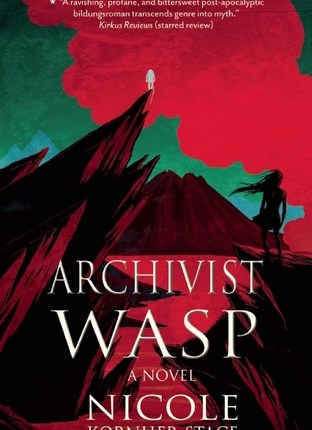
Archivist Wasp by Nicole Kornher-Stace

Archivist Wasp by Nicole Kornher-Stace

Overall, I enjoyed Kornher-Stace’s tale about a girl with claw marks on her face who traps and studies ghosts because she’s a priestess of a goddess who lives in the stars. I felt like Archivist Wasp was a combination of The Last Apprentice/Wardstone Chronicles by Joseph Delaney and What Dreams May Come by Richard Matheson. There’s also some dystopian and survival elements to it. There’s a few moments of rough language in here and some quick, brutal violence, but nothing worse than what a young adult would read in The Hunger Games.

Kornher-Stace throws the reader into an alien world with zero explanation or background info and it’s a lot of fun to pick out the story from the details. Take this passage describing a ritualistic painting in Wasp’s home:“The bones of the painting were nails, hammered straight into the wall to pick out the stars of Catchkeep’s constellation. And around them She had been outlined in thick black paint, all teeth and legs, Her back curved like a rainbow, caught in mid-leap over a shadowy abyss. … Catchkeep Herself was black and red. Stepping close to Her you could make out the outlines of handprints, darker where they overlapped. Wasp’s first day as Archivist, they’d rushed her here before the blood of the fallen Archivist could dry on her palms, and to the painting she had added the shape of her hand, which was the shape of her predecessor’s death.” pgs 14-15 ebook. Dark, eerie, awesome.

Wasp feels trapped in her role as priestess and lacks the confidence in herself to do anything else. Her personal development and stepping into her power is one of the main arcs of this story: “…beneath all her talk, she knew that what she was about to try would fail, as everything else she tried had failed, and then her life would go on as it had always done, pacing out the length of its leash, smashing into empty air at either end like a bird against a window. Take the knife out of the doorframe. Sweep the dust from the little house. Restock its jars with the useless dead.” pg 67 ebook. She’s a very strong, and believable, female main character. Think Buffy the Vampire Slayer… but with ghosts.

Kornher-Stace’s description of the afterlife was just like what is portrayed in What Dreams May Come or Otherwhere by Kurt Leland, the deceased shape their surroundings with the energy from their thoughts and emotions. In the ghost’s world, Wasp sees demon-like dogs that attack her again and again: “Still don’t believe the hunt is real?” Wasp shouted. She was having trouble modulating her voice. Her teeth were chattering too hard. She had never been so tired. “We bring our own monsters with us,” said the ghost. “It looks like these are yours.” pg 123 ebook. Goosebumps!

I liked the author’s description of what a ghost is: “You’re a ghost. You need answers. You need closure. You need them like the living need air to breathe. You think it’s just you, but from what I’ve seen, most of us die without getting either. And maybe that’s all a ghost is, in the end. Regret, grown legs, gone walking.” pg 155, ebook.

My favorite parts of the book are Kornher-Stace’s varied descriptions of the worlds through which Wasp travels with the ghosts. They are beautiful, desolate, bizarre, and, sometimes, scary:“They tromped through the snowfield for ages. They passed things that, to Wasp’s eye, might have been waypoints. A wind-shredded orange plastic tent. A cave hung with icicles that were mottled gray with ash. A distant huddle of dark birds circling and alighting on an unseen mass. A tiny pond, perfectly round, frozen into a mirror upon which no snow settled. The metal skeleton of something that had fallen from the sky and smashed there, its nose plowed deep into the earth. They walked on.” pg 172, ebook.

If you enjoyed Archivist Wasp and are looking for young adult read-alikes, you may want to try Fray by Joss Whedon (a graphic novel) or Revenge of the Witch (The Last Apprentice/Wardstone Chronicles, #1) by Joseph Delaney. If you’re looking for an adult read-alike, try The Library at Mount Char by Scott Hawking.

Thanks for reading!

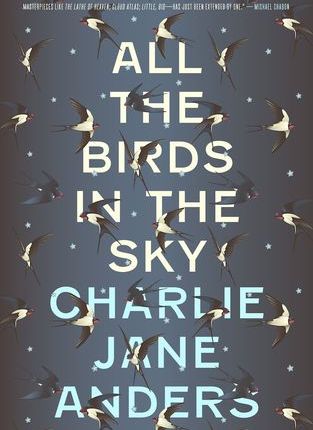
All the Birds in the Sky by Charlie Jane Anders

All the Birds in the Sky by Charlie Jane Anders

All the Birds in the Sky is about science vs nature, the end of the world, and love- in no particular order. Laurence and Patricia have two of the roughest childhoods that I’ve read so far this year. Their parents are duds, their school administrators are awful, and their peers are bullies and sadists. Somehow, despite these tragic beginnings, Laurence and Patricia manage to rise above and become something more, something extraordinary. And, together, they just might manage to save the world.

My favorite part of this book was the beginning- the development of the characters and the introduction to the extraordinary world of Laurence and Patricia. In this world, animals can talk! Here’s the “Parliament of Birds”:“Various other birds piped up, saying, “Point of order!” and a fidgety crow was listing important areas of Parliamentary procedure. One of them was so insistent that the eagle was forced to yield the branch to the Honorable Gentleman from Wide Oak- who then forgot what he was going to say.” pg 19 Politicians are politicians, no matter their species.

I loved Laurence’s internal dialogue: “Hey, Larry Fairy,” Brad Chomner said at school, “think fast.” Which was one of those phrases that never made sense to Laurence: People who told you to “think fast” were always those who thought much more slowly than you did. And they only said it when they were about to do something to contribute to the collective mental inertia.” pg 23

I also connected with Patricia. She’s imperfect, ruminative, and totally relatable: “Patricia felt jittery about throwing her first ever dinner party, because part of her clung to the fantasy of being someone who gathered cool people around her. A doyenne, someone who held witty salons. She cleaned the apartment for hours, made a playlist, and baked bread and bundt cake. … Patricia’s bread filled the marigold kitchenette with a yeasty warmth, and she took a deep breath. She was a grown-up. She had this.” pg 165 I’ve said that exact thing to myself when I’m stressed or trying to do something outside of my comfort zone. “I’m a grown-up. I have this.” Wish I was better at convincing myself of the truth of it. πŸ™‚

Laurence contemplating reality: “I wonder how many other things in our world are just the shadows of things in other places,” Laurence said, forming the thought as he spoke. “I mean, we always suspected that gravity was so weak in our world because most of it was in another dimension. But what else? Light? Time? Some of our emotions? I mean, the longer I live, the more I feel like the stuff I see and feel is like a tracing of the outline of the real stuff that’s beyond our perceptions.” pg 186 I feel like that sometimes too.

Anders writes some very touching passages about love and being in love:“… Laurence watched her the whole way back up the block, wondering if she would look back at him over her shoulder, or turn to wave one last time. She didn’t. His heart skidded like a dirt bike on black ice as he watched her disappear. pg 213 You can really feel the emotions sliding around his chest, can’t you? I can.

I did not like some of Anders transitions in All the Birds in the Sky, particularly the jarring leap of time between the childhoods and then adulthoods of Laurence and Patricia. I also thought that Anders relied on synchronicity a bit too much to bring the two main characters together and keep the story rolling. But, life is strange and full of unexplainable moments. And, to be fair, I’m complaining about synchronicity in a world where magic and time travel are real and animals can talk. Maybe I need to check my own perception of reality…

If you enjoyed this book, maybe you should try The Many Selves of Katherine North by Emma Geen or A Monster Calls by Patrick Ness.

Thanks for reading!