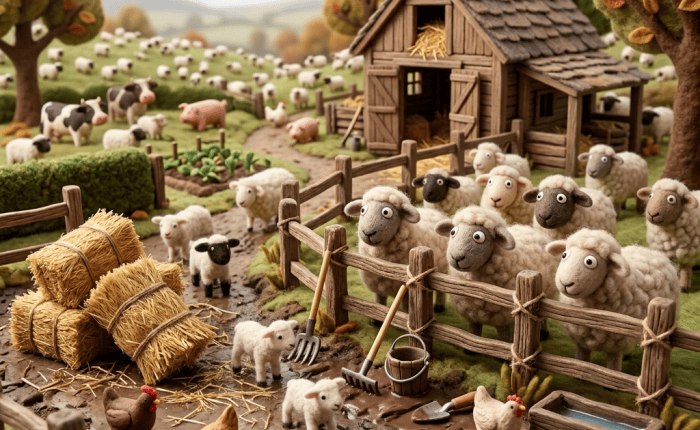
There’s something strangely satisfying about claymation. Maybe it’s the memories I retain of playing with Playdoh when I was little.
Watching claymation takes me back to a time when I had no worries beyond sharing my toys with my sisters. As I pressed the Playdoh into various shapes with my hands or with the stencils that the company provided with their rainbow-colored doughs, I remember the smell of the clay and the way my hands left fingerprints on it. It’s a viseral memory and, as I said, a calming one.
So, right from the start, Shaun the Sheep: The Beast of Mossy Bottom, put my mind into a younger and more relaxed state. Let’s be honest- with the way things have been going lately on the national and international stage, calm is becoming somewhat of a precious commodity.
Parents put your mind at ease, this is a film that can be enjoyed without the shadow of artificial intelligence popping out of the screen and making everyone frantic about the future or humanity’s inability to face any problem, even one we created, with a united front. That’s not even considering our propensity to make it worse with our own insecurities.
But I digress.
The Beast of Mossy Bottom is listed as a comedy horror on its Wikipedia page, a designation which I agree with. Horror doesn’t have to be scary to be horror. What I believe makes a horror show “horrible” is unanticipated (negative) consequences stemming from acts done from love or a desire to be of help to others.
There are lots of unanticipated and problematic consequences in this story.
It begins simply enough. (Spoilers ahead, readers beware.) Shaun’s flock creates a secret pumpkin patch. In their hidden field, they are producing pumpkins so lovely that the youngest member of their flock, Timmy, begins to dream about making the perfect jack-o’-lantern from one of them.
When the Farmer has a mishap and smooshes all the pumpkins, Timmy is heartbroken. In an effort to make Timmy smile again, Shaun puts on his mad scientist hat and develops a fast-growing formula to restore the pumpkin patch. He is successful at his endeavor and everyone is smiling once again. (The most sincere pumpkin patch from Charles Schulz’s Peanuts world comes to mind.)
But then, in an effort to be more attractive to a local veterinarian whom he wants to invite to the Halloween dance, the Farmer uses Shaun’s secret formula on his bald head. The formula works incredibly well, but doesn’t stop, causing the Farmer’s hair to grow and grow, with disasterous results. (Mickey Mouse’s animating spell from the Sorceror’s Apprentice of Fantasia feels applicable here.)
The rest of the film is spent trying to fix the problems in the pumpkin patch and with the Farmer’s exponential hairgrowth, an issue that is made even thornier when the veterinarian ships the Farmer off to Bigfoot Island because she believes he’s a missing link who belongs with his own people.
As you can see, everyone gets into trouble because they are acting with the very best of intentions. A horror show, indeed.
Beyond the satisfying appearance of the film and the excellent storytelling, there is another hidden aspect of The Beast of Mossy Bottom which I believe deserves a mention. No one speaks in the film.
At first, I found the non-verbal way in which the characters told the story to be somewhat distracting. I wanted to hear cute voices to match with the adorable characters onscreen. But after the first few minutes, I didn’t even notice because the story is told through pantamime and facial expressions, a universal language rather than the limited form that the spoken word forces storytellers into.
This could be a very helpful film for parents who have children who are non-verbal or have difficulty communicating. It is a learning tool like a book. And even if the child cannot speak about the film to his or her parents, then, at the very least, her parents and guardians would have something to talk about with him or her.
“Look at Shaun the Sheep.” I can almost hear them say. “What a silly thing to do. Why do you think Shaun is doing that?”
In my mind, the standout moment for modeled behavior in The Beast of Mossy Bottom is when the Farmer, changed by the magical formula into the Beast, appears upon his farm, having fled the veterinarian’s office in town when his hair started to grow like mad. The sheep and the Farmer’s faithful dog have no idea what has befallen the Farmer. They only know that a huge, hairy creature is coming their way.
They flee in terror, blockading all of the windows and doors to the Farmer’s house, so that, when the Farmer finally finds his way back home through his own terror and confusion, he can’t get in.
Oh, the horror. When faced with the unknown, how often do we run away, shutting ourselves in the safest places we can find, which are hopefully out of the reach of the monster outside our door? When, in reality, the monster is just the shadow of our friend and he needs our help. At least, this is the case in the children’s movie I’m discussing today, but if we take this metaphor a step further and apply it to the real world, I think we may find that there are elements that remain true.
For example, I choose not to demonize (shut the door on) those who have different political beliefs than me. I choose to believe that when our leaders and elected officials are making policies about anything that affects the future, which belongs to young people like my daughter, that they have not only their personal and best interests in mind, but also desire the best result for everyone on the planet.
And, if this second assumption is not true, I choose to believe that those around me will recognize this, like I do, and replace the leaders in their appropriate time (election cycle) for someone who does fit that expectation.
Are we living a horror story when it comes to AI? I say, not yet. But there is much work to be done to make sure that such a problematic consequence does not come from a creation that we originally made to help humanity, like Shaun and his fast-growing formula. Let’s not ruin the world or our lives, just because we wanted to reconstitute a smooshed pumpkin and dry a child’s tears.
I hope you all get a chance to watch the film with your families. Please take a minute to drop me a note if you do.
Thanks for reading,
Heidi
- Steve Cox and Matthew Walker’s Shaun the Sheep: The Beast of Mossy Bottom, a review
- Christopher Nolan’s The Odyssey, a review
- The Ballad of a Small Player, a review
- Otherwhere: A Field Guide to Nonphysical Reality for the Out-Of-Body Traveler by Kurt Leland
- Psychic Dreamwalking: Explorations at the Edge of Self by Michelle Belanger
 The Help Desk Book Blog