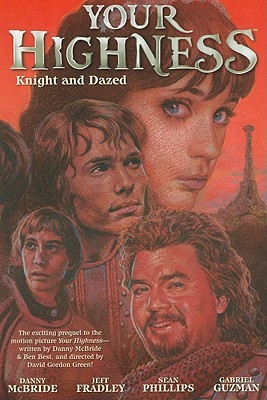
Your Highness, a two comic collection, is the prequel to a film called, you guessed it, “Your Highness”.
In these pages, Fabious, the elder prince, goes on a quest to slay a monster who was unleashed by an evil sorcerer. The younger brother, Thadeous, is sent by his father, the king, to secure a treaty with a nearby dwarven kingdom.
Both princes encounter adventures that they were not prepared for.
I wish, in preparation for reading this slim tome, that I had had the chance to rewatch the movie. But I didn’t. So, until then, I’ll just have to rely on my memory of the film from twelve plus years ago.
In the comic, as in the movie, both princes are caricatures of the angel/devil archetype of consciousness.
Fabious, the elder brother, stands in for our “angelic nature”. He is driven to bring justice and safety to those around him while carefully protecting his honor throughout the quest. The flipside to this personality is he suppresses his baser urges, leading to some amusing innuendo with his fellow knights.
(Sexual innuendo and clever word play isn’t something I necessarily find funny, but for those who do, Fabious provides this in spades.)
The other brother, Thadeous, represents humanity’s shadow mode of consciousness. He delights in excess whether that is food, marijuana, or sex. And though he is tasked by his father with as important a mission as his brother, readers know immediately that he will probably fail- not because he’s is incapable of doing what is required, but because he will most likely chose to indulge in his baser instincts to the detriment of his goal.
Overall, I liked the artwork in Your Highness. I thought the panels flowed nicely and the dialogue was well done too.
As for the story itself, I felt it was a tad predictable, but still enjoyable.
I wish, in the Thadeous storyline, the dwarves’ weed had had some magical properties that elevated it beyond bringing an excellent high. Maybe using it could cause one to see where minerals were hidden beneath the earth?
Anyway, recommended for fans of the movie and readers who enjoy fantasy comics in general.
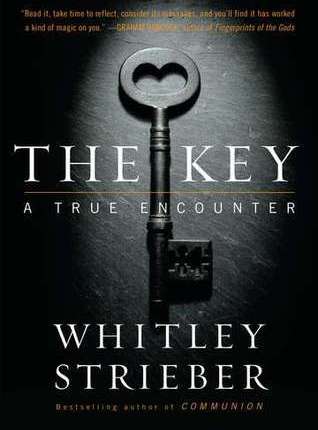
I enjoyed this book not necessarily for its message but because it’s a stunning example of a clear communication from a mysterious source of non-human/non-physical intelligence. It’s not a huge surprise to me that Strieber was able to make such a connection as he details his daily transcendental meditation practice and has previous experiences with the worlds and beings beyond the everyday waking world. (For an example, see his story in this book about meeting the small, withered old man or one of his numerous other non-fiction works.)
If you pick up this book, you’re either going to believe what Strieber has to say or dismiss the information- there’s not a lot of wiggle room. Let’s continue this review with the assumption that you, like me, believe Strieber saw and heard something or someone, received a message, and wrote it down. If you don’t believe that basic assumption, then this review is going to be a waste of your time. I’d suggest moving on to the next one. Peace.
Now, I believe that there are all manner of spirits that inhabit the unseen world. Like the “Master of the Key” described in Strieber’s midnight conversation, I believe there are forces that allow things to thrive and forces that deny this. I think the way to decide which force is what is to examine how the communication makes us feel and the actions that we feel compelled to take after the encounter.
What was the ultimate impact of the “Master’s” words for you, the reader? I felt fear- deep, bone-chilling fear.
First of all, I felt fear for the being’s assertion that the Earth is going to be destroyed in a climate related disaster that no one can stop now because we ruined the atmosphere. That not only affects me, but my children’s children’s children. There are always steps we can take to make the world, and the future, a better and brighter place. I will not give up this agency to anyone, despite what hidden knowledge they may profess to have.
Second, I felt fear for his idea that none of the major world religions (Christianity, Buddhism, Islam) reveal the full truth of conscious evolution, which, in one fell swoop, denied the inner truths for a majority of the people on this planet today. And, the quietly implied addendum to this revelation, that none of the major religions know the truth, BUT I DO- this mysterious guy who shows up in the middle of the night, dumps all of this in Strieber’s lap, then makes him drink a concoction to have him forget everything that he didn’t write down. This doesn’t feel like a benevolent act to me. It feels like a play to make Strieber feel afraid, directionless, and unwilling to seek out help from anyone from a major religion, which is a lot of people and shuts a lot of potential open doors.
Third, I felt fear for this mysterious being’s assertion that the world will be lost because of a child who was never born because of the Holocaust. What sort of creature/being/visitor would know the full extent of the evil caused by one of the worst atrocities in human history, save that knowledge until fifty years after the fact, and tell it to someone who, by his own admission, doesn’t have the power to do anything about it? Fiendishly clever, no?
And, again, this third bit of information seeks to remove Strieber’s, and any reader’s, feelings of hope for the future. I reject the idea that nothing can be done about future events. Everyone exists in the Now moment, which is quite a powerful place to be. It is here that we can change the world, not by ruminating on past horrors and the terrible fallout from them. I will not abandon hope. A dream of mine is that others will not give up also.
I find it interesting that the “Master of the Key” in the book planted enough prophetic tidbits in his fear-filled message to impress Strieber with a feeling of truth from the communication like with the gas-holding memory idea for machines. But, for me, the nature of the messenger himself is clear, given the underlying effect that almost everything the visitor had to say was to sow fear, create a feeling of impotence or divisiveness, and to manufacture a driving need to consciously evolve now, now, NOW in this brand new way or everybody’s going to die and be chained to a dying planet forever until the end of time.
Let’s go back to our existential questions again for a moment: what sort of being wants people to feel afraid, separate from the source of your being, feeling like you have forgotten important knowledge that is required to save your soul that only the mysterious being knows? What sort of being would counsel a soul to not go into the light because that isn’t God, it’s oblivion?
When Strieber asks this being his name, the reply was something like “You could call me, Michael. Or, you could call me, Legion. I would be honored to be called human.” This was a red flag for me. “Who’s in there with you, Legion?” would have been my next question to the being.
I think what Strieber experienced was real. I think that it was a cleverly packaged hodgepodge of truths, possible futures, and small twists of religious dogma designed to make Strieber doubt everything, even his own inner guidance. Strieber himself said that, after everything that had happened, what he most wanted was to talk to this being again. If I was in his shoes, I’d feel the exact same way. There are quite a few things that could use clarification. The first of which, in my mind, is why does this being instill such a feeling of fear in those he communicates with? Is that really necessary to get his message across or is it some kind of unfortunate side effect of the type of energy the being is emitting?
Despite my thoughts on the true nature of the “Master of the Key,” if you liked The Key and were able to distill some truths that rang true for you from all of the fear-mongering, you might like troubling predictions of Heaven is Real But So is Hell by Vassula Ryden. I got the same kind of vibe from her book. I feel like there may be truths there to be found but the large part of the message felt devoted to making the recipients of that message just quake in fear. Proceed cautiously.
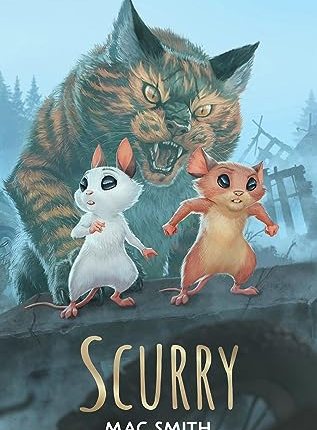
Wix is a mouse with a major problem: there aren’t enough resources to feed the colony he lives with. He braves hungry cats and birds, mysterious foxes and roaming wolves, as well as a myriad of other dangers in his quest to find food for his people.
Pict is the daughter of the leader of the colony whose name is Orim. Pict longs to be out in the wilderness but her many duties keep her at home. This is her life until something extraordinary happens and then she must go forth to warn Wix, as well as the others, about what has transpired.
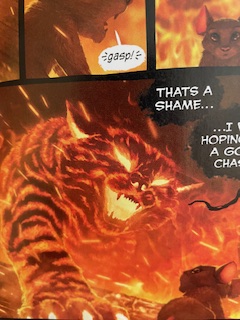
The story in this graphic novel has been told before. However, the artwork that accompanies the tale is beautiful. I especially liked the panels that contain flames. The light that shines on the characters brings additional depth to the drawings. It is worth picking the book up for that alone.
From the book’s cover, I learned Scurry was initially a webcomic. It definitely deserved getting its own printed medium.
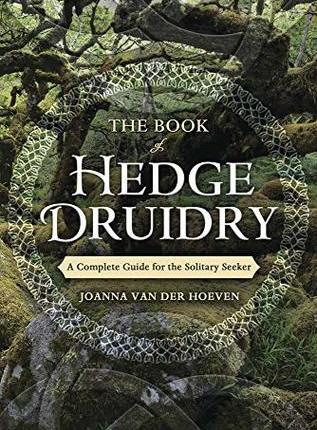
Joanna van der Hoeven, a practicing Druid, has written an excellent introduction for anyone interested in creating their own similar spiritual path.
The book has four parts: Theory, Practice, Study, and Skills and Technique
The first part, Theory, discusses various aspects of Druidry including the mysterious Awen, the role of gods and ancestors, the three realms, the world tree, the wheel of the year, the cycles of the moon and more.
“Druidry is the quest to find our place in the world and to work in the world in balance and harmony.” pg 2
I loved how the author presented this section, which could have been mammoth, very succinctly. She gives so many aspects of the practice because she’s encouraging readers to find the parts that work for them. You don’t have to embrace everything, only what speaks to you.
The second part, Practice, outlines various rites and rituals to incorporate one’s practice into daily life.
She talks about how the ancient practice of Druidry has been lost and how practitioners today are creating their own versions of what that might have looked like. I liked that she emphasizes that unbroken lineage doesn’t lend credence to the practice as much as personal exploration and empowerment. Again, she encourages readers to make these rituals their own.
“We don’t know what ancient Druids really did, nor do we wish to emulate them in every aspect. We seek to find out as much as we can and learn from it, thereby creating wisdom in our being.” pg 66
The third part, Study, looks into herblore, ogham (a type of alphabet that can be used like runes), and spellcraft. Practitioners are encouraged to study and learn these various topics in order to deepen their knowledge.
The final part, Skills and Technique, was the most interesting to me. In it, Joanna van der Hoeven discusses ethics, peace, voice, body and movement, as well as leadership roles.
I found the topics of ethics and peace to be timely.
“We cannot control how others behave. We only have control over how we behave in the world, how we act and react to others. We can lessen our reaction to others to a more intentional way of being through mindfulness of our thoughts, our bodies, and the world around us.” pg 296
Change ultimately starts at the individual level and goes from there. Thank you, Joanna, for the reminder.
Highly recommended for spiritual seekers who may be looking for an earth-based spiritual practice.
When the Maestros and his entire extended family are killed in an inter-dimensional fight, the only part of the Wizard King’s bloodline remains with a young man named Will who was banished to Earth with his mother, Margaret.
Now as Will takes the throne, his enemies, and his father’s enemies, are on the move. Will he be able to retain power or, in these uncertain times, his life? We shall see.
The artwork of this series is amazing. From the colors to the style, each page has eye-catching illustrations. Well done, Steve Skroce!
This graphic novel is rated Mature and it is easy to see why. There’s nudity, graphic violence, and some depictions of torture. So, librarians, please categorize it correctly.
Despite its mature, and occasionally disturbing, elements, I enjoyed the story in this comic quite a lot. It is a fantasy-laden coming-of-age tale that asks the question: does absolute power corrupt absolutely?
Highly recommended for mature comic book readers. Thanks for reading!
“The goal of this book is to teach skills that underlie the spiritual practices of a variety of traditions, from the ceremonial to the shamanic. But acquiring the ‘gifts of the spirit’ cannot be an end in itself. They have to be used.” pgs xv-xvi
Author Diana Paxson pulls from a variety of spiritual traditions in an effort to teach readers the basics of going into trance.
The first few chapters are about how to prepare yourself, set up cues for trance work, and to do the exercises “safely” which include setting up wards and how to come back out of trance.
“All of the senses can provide cues for psychic or magical work. By repetition, we condition ourselves to move into a particular state when we experience a specific stimulus.” pg 64
The next chapters delve into what practitioners may find once they’re in trance and how to navigate this other state of consciousness. This includes how one might find guides, how to behave, and how to deal with the various entities that may be encountered.
The final parts of the book tackle the difficult topic of spiritual emergencies and give some suggestions for group trance work.
Overall, this book covers a wide variety of topics that spiritual practitioners may need when they begin the practice of going into trance. In that way, it could be an invaluable addition to your library.
On the other hand, I didn’t agree with all of the advice given. It didn’t make sense with my experience of the trance work I’ve completed and I think it might scare beginners away.
The particular advice that I’m referring to is the idea that if you come out of trance too fast that you might leave parts of your soul behind, which you will then need to retrieve before you are able to feel like yourself again.
I understand, from the book, that soul retrieval is a common enough shamanic practice. Still, I feel like we are doing beginners a disservice to plant in their minds the idea that this is something that could happen.
Why not instead say it is best to come out of trance slowly and leave it at that? Anyone who falls asleep knows that it is more pleasant to wake up slowly than to be shaken to consciousness. Do we leave portions of ourselves behind when we’re jolted awake by an alarm clock? I say no.
In addition, when Paxson talks about the kinds of entities one may encounter in trance, including animal guides or even gods, she gives them all of the foibles that go along with being a part of the human race. In the section about developing a relationship with a god or goddess, she talks about how practitioners may have to deal with divine jealousy.
I think it might be better to say, you bring your entire self with you when you go into trance. Your strengths and failings are on full display in your interactions with what or who you find there. Again, this avoids planting any negative expectations for practitioners while still providing ample warning.
Recommended with reservations for spiritual seekers who are looking to add trance work to their repertoire.
Dr. Jonn Mumford takes the complex topic of tantra and attempts to translate it from its Eastern roots for the Western mind. He is somewhat successful, but gets bogged down in the history of tantra coming to the west as well as the etymology of tantric terms.
“The Tantrist seeks freedom (Moksha) through life (sensation, sentient, sensual) and not through escape (abstinence, abstaining, absence), using the body as an instrument of evolution.” pg 47
I think when Westerners consider tantra, they generally think about exotic sexual positions. This book tries to show that tantra is so much more than that.
Through the recognition of the divine in your partner, tantra can be a method of reaching divine states of being. I think it is more of a mindset than any particular exercise.
“The key secret of the Western tradition lies in the demonstration that the sexual function has deeper implications than procreation.” pg 30
Dr. Mumford provides a few rituals in this book so that readers can choose to practice some of his interpretations of tantra if they choose. He also includes illustrations of various chakras in order to encourage meditation upon the complex symbolism they contain. Through these practices, he says, one can begin to investigate the mystery that is tantra and the self.
“Although the major topic of this book has been sex magic and Tantric sexual practices, it must not be assumed that the whole of Tantra is concerned with these aspects. Tantra is the life science concerned with producing true individuals.” pg 122
I’m dubious about the efficacy of some of the exercises described in this book, like the practice of sucking ones bodily fluids back into oneself after expulsion. Maybe some of these things were meant to be metaphorical rather than literal? Who’s to say…
If you don’t allow yourself to be caught up in the strange (at least to my mind) details, there is some wisdom to be found in these pages. But the biggest problem of this book is that it tries to tackle too much.
It begins to do a comparison of witchcraft to tantra, which I feel could fill an entire book on its own. It also touches on similarities between tantra and western sex magic. Neither of these topics receive a thorough treatment, which was rather disappointing.
He also does a brief history of tantra coming to the west which I felt was over-simplified. History buffs might find that section off-putting.
However, if you’re looking for a brief introduction to tantra written for a Western audience, this might be a good place to start.
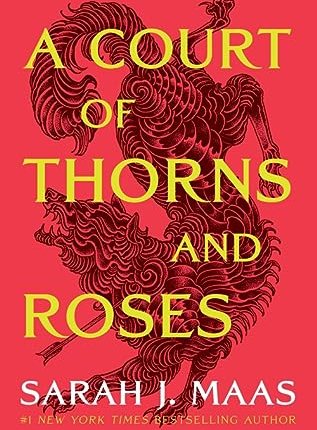
Feyre lives in a world where the fae are beyond a wall that separates them from the mortal world. Years and years ago, according to the myths, a great war was fought and a boundary was drawn between the two races.
When Feyre shoots an enormous wolf that is more than what it appears, she is drawn into the world beyond the wall which operates under magic and an entirely different set of rules than the world she knows.
I chose to read A Court of Thorns and Roses because of the millions of positive ratings it received on Goodreads. It is an engaging read, but I don’t think I enjoyed it as much as some other readers.
“… any bit of information might help, and if I showed interest in them, perhaps they would warm to me.” pg 79, ebook
I enjoyed the heroine’s discovery of the magical world. I really liked the different creatures and situations that she found there. The exploration part of the book was my favorite part.
I did not enjoy the romance portion of the book and felt like it slowed the action down to a crawl in the middle of the story. Also, this should not be rated as a young adult book. Some of the relationship and sexual elements mark it clearly as new adult, in my mind.
I get that this is a “Beauty and the Beast” re-telling, but there are very few similarities between the two stories. If you’re looking for a fairy tale re-telling, you might want to keep looking.
And, occasionally, I found the actions of the heroine to be infuriating. She made decisions based on no reasoning that I could understand- much like a spoiled teenager. I suppose some could argue that that is exactly what Feyre is, but it wasn’t much fun to read.
Recommended for any readers who are looking for a light fantasy mixed with a lot of romance. Thanks for reading!
Author S.A. Chakraborty brings her epic Daevabad Trilogy to an end with The Empire of Gold.
In the last book, we saw the fall of Daevabad and a new powerful leader, Manizheh, taking the throne with Dara, the ancient daeva, at her side.
“Dara was so sick of despairing over his fate, of guilt eating him alive. Now he was just furious. Furious at being used, at letting himself be used again and again.” pg 105, ebook
Meanwhile, Nahri and the prince Ali found themselves magically transported to the human realm of Cairo. Nahri knows they have to go back to the magical world to save not just their friends and family, but also the city of Daevabad itself. However, the charms of her old life make her want to stay and live as a healer.
She enjoys the peace while she can.
Ali is racked with guilt about the fall of his city and the loss of magic throughout the djinn’s world. He’s still struggling to learn how to control his strange new water magic. How can he use it to help save his people?
“How much of his life, all their lives and their histories, unraveled the more it was examined?” pg 392, ebook
I thought the conclusion to this series was magical. Chakraborty gives her huge cast of characters not only beautiful but fitting endings. She ties up every thread she’s woven through the story to give the reader a satisfactory experience.
I liked how the endings weren’t necessarily happy or perfect. Throughout her books, Chakraborty has painted a complex world where the characters aren’t all good or bad, but some mix of each. The conclusion stays with this method of storytelling and manages to feel somewhat real, despite all of the fantasy elements it contains.
“There is a time to fight, and you are all fierce warriors, students I am deeply proud of. But there is also a time to put down your weapons and make peace.” pg 701, ebook
Not only are these books morally complex, the cultures she’s created feel deep and true. In this book, readers get to enjoy the culture of Ali’s mother and learn much more about the prince’s special abilities.
I don’t want to say much more about it because discovering this storyline is so much fun. It was my favorite part of the book, which had so many wonderful moments to it.
Very highly recommended for fantasy readers. Thanks for reading!













 The Help Desk Book Blog