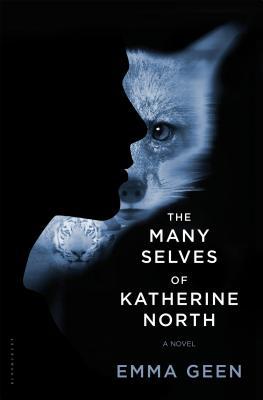
The Many Selves of Katherine North by Emma Geen

The Many Selves of Katherine North by Emma Geen

katherinenorthIn The Many Selves of Katherine North by Emma Geen, humanity has harnessed the power of consciousness and mechanized the ability to place that consciousness in different bodies at will.

Katherine is a teenager who works for a large research company. She’s the longest lasting “phenomenaut” (person who’s consciousness is put into the body of an animal) because she seems to be special.

The process of consciousness transfer seems to stop working when the brain ages and loses its plasticity. Despite her age, Katherine’s brain seems to be fine.

But then, one day, Katherine sees something strange when she’s out of her body… and perhaps she’s not as well as she imagined.

The Many Selves of Katherine North asks some pretty powerful questions like: What is consciousness? How does our physical body change how we perceive the world? What is reality?

I think that this story has the potential to open up a dialogue about these questions between readers who may not have considered them before. In that way, this is a very powerful book.

I did not like how the story flips back and forth between the present and the past. I think Geen was using the shifting timeline to build the mystery, but, because of the nature of Katherine’s many consciousness experiences, it made things rather confusing.

This is a complicated book. At times, maybe too complicated.

The richness and variety of Katherine’s experiences drives a wedge between her reality and the rest of humanity’s reality.

The reader really sees difference in this moment, when Katherine is preparing to go into work: “Later, I lie in bed quivering… because it’s only hours until I’m out of here. Here- not just a room but skin. How can other people call this their totality? There is so much more.” pg 19

Katherine captures the impossibility of explaining out-of-body experiences very succinctly here: “Because how do you cram the lived experience on to a page? The words available to me were never enough. Something would always slip the sentences. Human language developed around human bodies, it never quite fits other ways of being. pg 66

I loved all of the chapters when Katherine was in the body of an animal. In this one, she was a snake: “Old scents have imprinted upon the world like spoor into soft mud, the past blundering prey. I wonder if this is one reason many animals have a poor memory compared to humans. What’s the use in remembering when the world does it for you? pg 146 Fascinating.

Emma Geen included a disclaimer at the back of her book and it contained some of my favorite lines: “…what if there are other valid ways of knowing? What is the world is not one, but multitude, with as many ways of being as there are beings? What if literature were the opportunity to glimpse such refractions, thrown by the world as though from a diamond?” pgs 349-350 Loved that.

If you enjoyed The Many Selves of Katherine North, you may want to pick up The Night Circus by Erin Morgenstern or Mythago Wood by Robert Holdstock for more glimpses of worlds hidden within worlds.

Big thanks to Goodreads First Reads program, NetGalley, and Bloomsbury USA for providing me with an advance reading copy of this novel.

Thanks for reading!

The Abominable: a Novel by Dan Simmons

The Abominable: a Novel by Dan Simmons

The Abominable by Dan Simmons is a historical fiction novel about mountain climbing and a mystery that is set, for the most part, during the early years of World War II.

The story reads like less of an adventure novel and more like an homage to the sport of mountaineering.

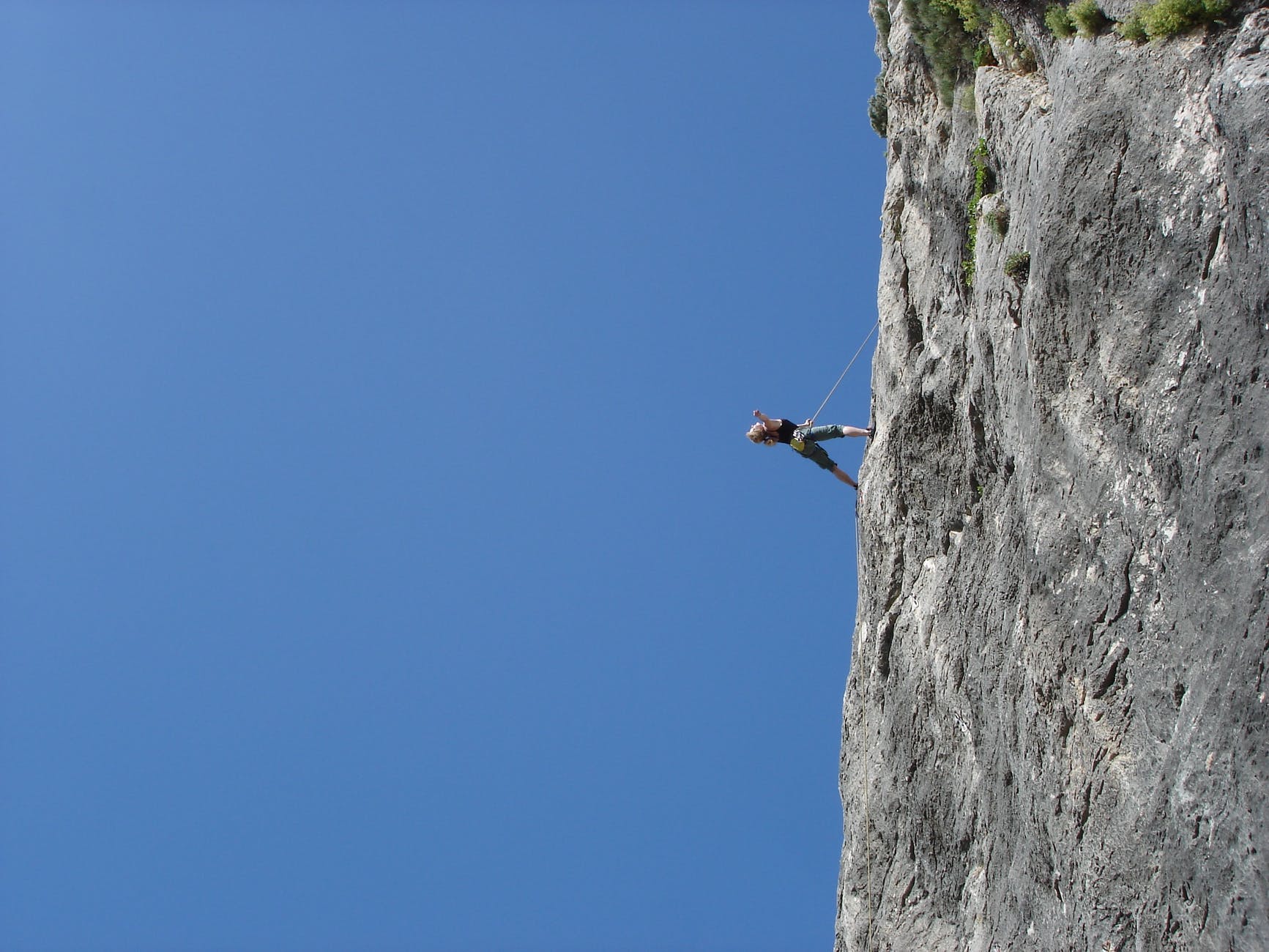
Photo by Pixabay on Pexels.com

Dan Simmons takes his time building the tension of the tale with back stories and detours until I nearly lost interest in the whole thing. But, to be fair, I have never been a serious mountain climber, having injured myself the first and only time I tried it.

I do enjoy long hikes in beautiful spaces. I don’t like risking my life or the lives of my companions in the process. So, not my thing, but maybe it’s somebody else’s.

Photo by Sagui Andrea on Pexels.com

If hiking is your jam, the long and technical descriptions of climbing techniques, knots, and methods in The Abominable might be just the read you’ve been looking for.

Here’s a pretty passage about viewing the night sky, high up in the mountains: “When you look at the stars near the horizon…especially when it’s really cold.. they tend to jitter around. Jumping left, then right… all while they jiggle up and down at the same time. I think it has something to do with masses of super-cold air lying over the land or frozen sea acting like a lens that’s being moved…” pg 18

One of the many passages that literally made my hands sweat in fear for the characters: “It’s tricky playing out the rope to Jean-Claude as I crab-shuffle to the left. Most of it is in my rucksack, which keeps trying to pull me back and off the face with just the weight of the extra rope and a few other small things in it, but some I’ve had to loop over my right shoulder to keep playing out to J.C. …

I’ve made it a little more than halfway to the pipe ledge when I slip…” pg 111

There are hundreds of pages with writing like that. I found it stressful, but again, I’m not a mountain climber.

Photo by eberhard grossgasteiger on Pexels.com

There’s a lot of wry humor in this read too: “…why are they so eager to get this blessing from the monastery’s holy man, Dzatrul Rinpoche? If everything’s predestined for them anyway, what difference will the abbot’s blessing make?” Pasang smiles his small smile. “Do not ask me, Mr. Perry, to make sense of the internal contradictions that are common in all religions.” pg 341

More love for mountain climbing: “Machig Labdron once wrote, Unless all reality is made worse, one cannot attain liberation… So wander in grisly places and mountain retreats… do not get distracted by doctrines and books… just get real experiences… in the horrid and desolate.” “In other words,” I say, “face your demons.” “Exactly,” says Reggie. “Make a gift of your body to the demons of the mountains and wilderness. It’s the best way to destroy the last vestiges of one’s vanity and pride.” pg 346

This book in two lines: “We were metaphorical inches from hypothermia-which has a wider range of terrible symptoms than merely going to sleep and freezing to death, not the least of which would be intemperate belligerence and a need to rip our clothes off as we froze-and literal inches from a 9,000-foot drop to our south side and a 10,000-foot drop a few more feet away to the north side. But for the moment, we were very happy.” pg 554

Photo by Aleksandr Slobodianyk on Pexels.com

And some people call that fun.

So, beyond being terrified during the climbing portions and bored by the never ending, rambling style of story-telling, I wanted much more of the fantastical in this tale, for example: the abominable snowman!

I’m not going to say anymore about yetis because I don’t want to spoil the surprising twists and turns of this tale for those who do choose to pick it up. Prepare yourself for one hell of a climb though- because it’s a long and meandering one.

Thanks for reading!

Expecting Someone Taller by Tom Holt

Expecting Someone Taller by Tom Holt

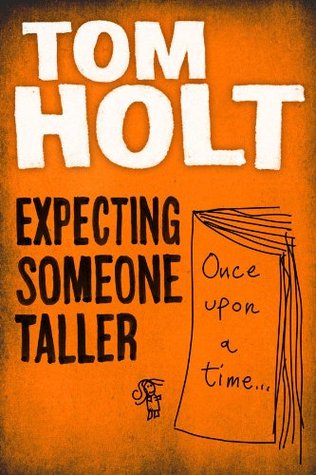
expecting someone tallerExpecting Someone Taller by Tom Holt is a humorous fantasy novel based off of the Ring Cycle of Norse mythology.  It’s older (published in 1990) but I like reading pulp fantasy fiction, no matter its age.
Full disclosure: I know The Lord of the Rings better than the Norse mythological stories it is based on. Holt provides a very short synopsis of the myths for folks like me and I was grateful for it. Otherwise, I would have not understood what on earth was going on.

Holt is an English fantasy-humorist and, like Pratchett’s many offerings, I enjoy his books but never have laugh out loud moments. I don’t know if the humor is lost-in-translation or what.

I expect that those who are more familiar with the Norse myths and who enjoy subtle humor might really love this rather silly tale of Malcolm and the ring.

There were some memorable lines: “Ingolf eased the plain gold ring off his finger and passed it to Malcolm, who accepted it rather as one might accept some delicacy made from the unspeakable parts of a rare amphibian at an embassy function.” pg 7 Nice.

“The next morning, Malcolm thought long and hard before waking up, for he had come to recognise over the past quarter of a century that rather less can go wrong if you are asleep.” pg 15 Absolutely true in my experience too.

Malcolm figuring out how the Tarnhelm (a hat that can change the wearer into anything) works: “Make me,” he said aloud, “as handsome as it is possible to be.”… He stood for awhile and stared… “We’ll call that one Richard” (he had always wanted to be called Richard). He resumed his own shape (which came as a bitter disappointment) then said “Richard,” firmly. At once, the Most Handsome Man reappeared in the mirror, which proved that the Tarnhelm had a memory, like a pocket calculator.” pg 20-21

The difference between smiles: “The girl looked at him and smiled. Malcolm had come to believe that he was fairly well equipped to deal with smiles, but this was a new sort; not a happy, optimistic smile but a sad, wistful smile. It didn’t say, “Wouldn’t it be nice if…” like the stock delivery of a Rhinemaiden, but, “It would have been nice if…” which is quite different.” pg 117

Why humans are the worst pick for ring bearing: “And so you give this irregularity in your minds a name of its own. You call it Love, which is meant to make everything all right. Rather than try to sort it out or find a vaccine, you go out of your way to glorify it. I mentioned your art and your poetry just now. What are your favourite themes? Love and War.”…”Now be fair,” he continued, “can you honestly say that a member of a species with this ancestral fallibility should be allowed to rule the universe?” pg 160 Fair question.

If you enjoyed Expecting Someone Taller, you may want to pick up The Good Fairies of New York by Martin Millar (a modern day fantasy with fairies) or Anansi Boys by Neal Gaiman (a fantasy about gods and their descendants).

Thanks for reading!

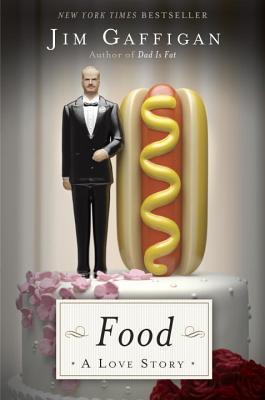
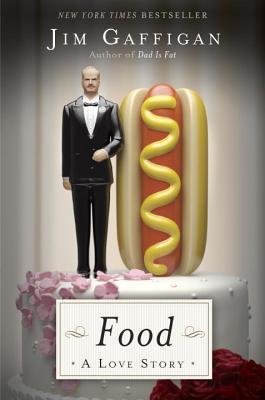
Food: A Love Story by Jim Gaffigan

Food: A Love Story by Jim Gaffigan
food a love story

In Food: A Love Story, Jim Gaffigan waxes poetic about one of his favorite topics – food.

Gaffigan is one of my favorite comics. He has clean, family-oriented humor (so I can watch his specials while my kid is awake rather than waiting for her to go to sleep) and he generally avoids political topics (so I can watch his specials without my husband getting mad and walking away).

I love his humor. However, this book was almost too much for me, even being the huge fan that I am.

At least, in his stand up, he switches topics. Gaffigan is funny in this, don’t get me wrong. But a book’s worth of jokes on just one thing… it’s a tall order. And not just of fries. 🙂

On why he doesn’t like oysters: “Once I had a friend defensively point out to me, “Pearls come from oysters.” I never really understood his reasoning, but I explained I make a rule not to eat things that also make jewelry. Diamonds come from coal, but we aren’t dipping that into cocktail sauce.” pg 60 (ebook)

On BBQ: “I’ve found barbecue to either be some of the best or the worst food I’ve eaten. There is no in between. Either it’s an amazing meal I can’t stop talking about, or I’m angry that I wasted the energy to lift the food to my mouth. Of course, I still finish the whole plate. As I mentioned before, I am not rude.” pg 72 (ebook)

On organic chips: “These potato chips are cooked with avocado oil, so I can eat ten bags. It’s good for me.” Usually the only discernible difference between a regular potato chip and a “healthy chip” is the difficulty in opening the bag. Supposedly there are good fats and bad fats. I like to think of myself as a good fat. It helps my self-esteem when I look in the mirror.” pgs 119-120 (ebook)

Photo by Edu Carvalho on Pexels.com

Kale: “People seem to bring up eating kale as if it’s something that’s going to impress me. Guy: I just ate kale. Me: I don’t care.” pg 154

Comparing different kinds of cakes: “Ice cream cakes: I never really understood the appeal of an ice cream cake. They are so temporary. They just end up stressing me out.” pg 401 (ebook)

And, finally, breakfast: You would feel guilty about eating most traditional breakfast items at any other meal during the day, but since it’s the morning, somehow these foods are considered okay.” pg 416 (ebook)

That’s a good sampling of Gaffigan’s food jokes. It goes on for pages, joke after joke.

The sheer amount of material Gaffigan had to construct about food is kind of impressive actually. Be aware though, it is a one note book.

Thanks for reading!

Thing Explainer: Complicated Stuff in Simple Words by Randall Munroe

Thing Explainer: Complicated Stuff in Simple Words by Randall Munroe
thing explainer

Book review of Thing Explainer by Randall Munroe.

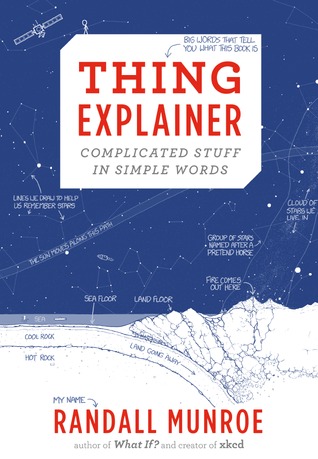
Randall Munroe uses stick figures and simple diagrams to explain abstract and difficult concepts.  It’s brilliant really.

Thing Explainer: Complicated Stuff in Simple Words is inspirational for educators who struggle to make complex concepts accessible.

I’ve run into this problem when trying to create fliers to describe, simply and succinctly, the process that you use to check out ebooks from the library. It feels like an impossible task.

Munroe shows in this clever book, that anything is possible to explain simply and with stick figures.

From Lifting Rooms (elevators) to Our Star (the sun), Munroe explains it all with only ten hundred (1000!) of the most commonly used words in the English language.

Every page is a gem, but I particularly loved The Pieces Everything is Made of (The Periodic Table of Elements) pg 47-48 and The US’s Laws of the Land (United States Constitution) pg 14.

Though simple enough for a child to understand, the cartoons contain small puns and inside jokes that adults will enjoy too.  So, I recommend this non-fiction book for everybody.

Thanks for reading!

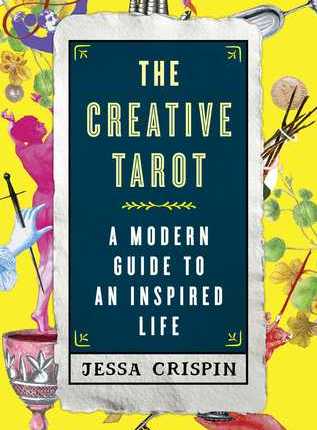
The Creative Tarot: A Modern Guide to an Inspired Life by Jessa Crispin

The Creative Tarot: A Modern Guide to an Inspired Life by Jessa Crispin

The Creative Tarot: A Modern Guide to an Inspired Life is an excellent tarot card reading manual for beginners to the more experienced card reader.

I loved that Crispin gives novel, art, and film suggestions for each card so that the reader can immerse herself in the “feel” or “mood” of them. That was a lovely touch and different from any other book on tarot cards that I’ve read.

Photo by Anna Tarazevich on Pexels.com

Mainly, the books that I’ve picked up have been about tarot card theory and how the cards tie in to the Tree of Life. It’s a complex system and can only be talked about in metaphors.

Imagine my relief to read a book about just the cards themselves and not an arcane “theory of everything.”

A.E. Waite was the co-creator of the Rider-Waite Tarot. He had some interesting thoughts about the tarot card reading qabalists, many of whom wrote books like the ones I’ve mentioned above.

A.E. Waite’s beliefs, which Crispin includes in the chapter entitled, A History of the Tarot, were: “Waite believed that the magical systems (tarot) of the Golden Dawn and other systems were not about imposing your will on a situation… or about telling the future… He believed they were for elevating the soul and for bringing what is unconscious conscious.” pg 7.

Photo by Jonathan Petersson on Pexels.com

I believe that too. But, if you can’t explain the system in a way that makes sense, then what’s the point of writing a beginner’s manual. There can be no “elevation of the soul” if the beginners can’t understand the first thing about reading tarot cards.

Thankfully, Crispin’s interpretations are simple and clear. This is a book that will see some use, not become another expensive paperweight.

I liked Crispin’s description of Temperance: “Temperance is an easily misunderstood card, as it has become associated mostly with abstention. Not drinking, not participating, denying yourself something. But that breaks away from the origins of the card, which traditionally portrays a hermaphrodite blending two cups of water- one hot and one cold- to create something in the middle between these two extremes.” pgs 76-77

Photo by Aleksandar Pasaric on Pexels.com

Temperance is about finding the middle way, not skirting along the edges from one extreme to another. Kind of ruins the idea of a “temperance movement,” doesn’t it.

I also liked this blurb about the Tower: “Remember that scene in Louisa May Alcott’s Little Women, where Amy throws Jo’s stories into the fire? That’s the feeling of the Tower: the realization that all is lost, and you will have to start over from the beginning.” pg 83

Yes, I’m a bookworm. Yes, Little Women is one of my favorite books. I think Crispin nailed the card’s description with that scene.

Photo by Pixabay on Pexels.com

I thought this description of The Moon was brilliant: “The Moon rules our dreams, and that’s a good way to think about this card. They don’t make sense on a logical level, but on a personal level, on an emotional level, they do. The location in a dream will shift without warning; dead people will walk beside the living; your mother will show up, say something nonsensical while wearing a jellyfish on her head, and then stab you in the heart. And you wake up and think, “Oh, of course, this is about that incident that happened when I was five.”

My dreams are just like that. In fact, I had that exact dream last night. 🙂

The tone in The Creative Tarot is very friendly and conversational, as if you asked your best friend to teach you a little bit about her favorite hobby- tarot cards. Highly recommended for artists, dreamers, and aspiring tarot card readers.

Its only weakness, in my opinion, is that I wanted more… more stories, more examples. I understand that we’re dealing with 50 plus cards and they can’t all receive extremely detailed treatment, otherwise we’d get the George R.R. Martin version of Tarot card books, but a girl can dream.

Jessa Crispin has modernized a system that seems to want to stay inaccessible to the beginner. I wish more of the books about the tarot were like this one.

Thanks for reading!

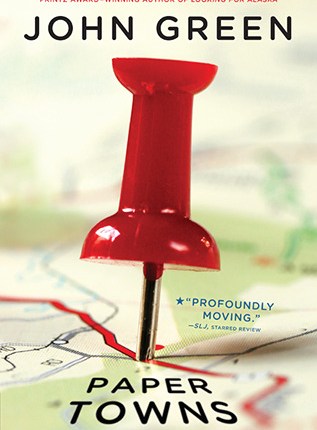
Paper Towns by John Green

Paper Towns by John Green

Warning: this is a book you either love or hate.  Consider yourself warned.

I fell more on the “hate” side of this equation but, surprisingly, enjoyed the film. This young adult, coming-of-age tale has elements of mystery to it.

Quentin has always loved Margo. One night, she wakes him up and they go on a wild tear about town, righting perceived wrongs and causing all sorts of hijinks.

Photo by David Besh on Pexels.com

The next day, Margo has disappeared. Their night out left all sorts of clues to where she went. Q decides to find her.

My negative reaction to Paper Towns surprised me because I loved John Green‘s The Fault in Our Stars so much.

Right off the bat, the reader is thrown into Margo and Quentin’s lives and we’re exposed to some of their worst traits rather than their best. Usually, people behave their best when you first get to know them and then, as they become comfortable with you, they let some of their more questionable sides out.

Photo by Alfonso Escalante on Pexels.com

The whole “rolling around the neighborhood at night and causing mayhem” takes place right at the start of Paper Towns. It isn’t fun because we don’t really know these characters yet.

It’s easier to forgive adolescent hijinks when you know and love the people who are doing them, but we’ve got almost zero time to form a connection before they’re breaking laws.

I think I would have given up on Paper Towns if I hadn’t watched John Green’s TedTalks video on the topic. If you haven’t seen it yet, here it is:https://youtu.be/NgDGlcxYrhQ

Quick summary of Green’s video: The basic idea behind a paper town (a made up town on a map) was copyright protection. The coolest part is that the mapmakers took something that wasn’t real and made it real because they presented it that way for so long.

I know that John Green can write amazing, sympathetic characters. He chose not to in this book and I’ve been rolling it around my brain, wondering why.

I think that Green wrote the characters in this story like a paper town.

At first, he presents the main characters as over-the-top clichés of what teenagers could be. The reader isn’t necessarily meant to bond with them at this point, they’re not real, they’re just “people on paper.”

Photo by Helena Lopes on Pexels.com

Then, through the second part of the book, let’s call it the “clue finding” part, Green slowly reveals more and more of the real parts of their characters just as Quentin finds more and more clues to where Margo has gone.

Through their hopes and dreams, relationships, daily struggles and hopes, they’re becoming more real.

Finally, in the last third of the book, as we join the characters on their mad rush to find Margo, they’ve become real. Real enough to have some close life-threatening moments on the road. Though they started out fake, Green built enough substance for the characters so that they have heft and dimension.

That’s my theory on why Green wrote such awful characters: he meant to. But, I still never liked any of them very much, even after they became “real.”

Photo by Buro Millennial on Pexels.com

I liked Green’s prologue: “The way I figure it, everyone gets a miracle. Like, I will probably never be struck by lightning, or win a Nobel Prize, or become the dictator of a small nation in the Pacific Islands, or contract terminal ear cancer, or spontaneously combust. … My miracle was this: out of all the houses in all the subdivisions in all of Florida, I ended up living next door to Margo Roth Spiegelman.” pg 15 ebook.

“Margo always loved mysteries. And in everything that came afterward, I could never stop thinking that maybe she loved mysteries so much that she became one.” pg 23 (ebook)

And that was the high point in this book for me. It was all downhill afterwards.

Here’s the passage that helped develop my theory about Green writing paper characters in Paper Towns: “… she looks like Margo Roth Spiegelman, this girl I have known since I was two- this girl who was an idea that I loved. And it is only now, when she closes her notebook and places it inside a backpack next to her and then stands up and walks toward us, that I realize that the idea is not only wrong but dangerous. What a treacherous thing it is to believe that a person is more than a person.” pg 406 (ebook)

Photo by Mihis Alex on Pexels.com

In conclusion, if you haven’t read any of John Green’s books, please don’t start with this one.

I highly recommend A Fault in Our Stars. It will break your heart. This one was not so good.

The film adaptation of Paper Towns was surprisingly ok. Borrow it from the library and let me know what you think.

I’m off to be more than a paper character in my own life- thanks for reading!

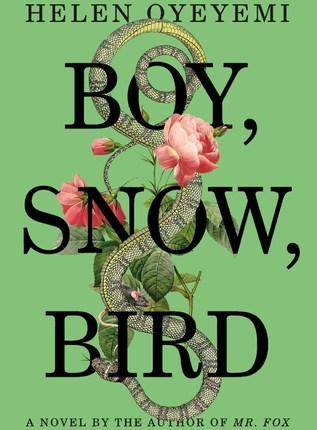
Boy, Snow, Bird by Helen Oyeyemi

Boy, Snow, Bird by Helen Oyeyemi

Boy, Snow, Bird is beautiful, haunting, modern and loose re-telling of the fairy tale of Snow White. The ending made me so mad that I almost chucked the e-reader across the room.

The story is about Boy Novak moving to a new place and starting her life over again. She meets a man named Arturo who has a beautiful daughter named Snow.

Photo by Pixabay on Pexels.com

Their relationship changes when she gives birth to a child named Bird. The interactions between Boy, Snow and Bird are what to watch for in this well-described tale.

I loved the characters and the huge twists in this book so much. I was reminded of the major twist in The Life of Pi. Oyeyemi was able to flip the narrative over and make it something else by unveiling a rather large surprise towards the end.

Still though, that ending. I can’t make up my mind whether it was awesome or infuriating.

Photo by cottonbro on Pexels.com

At any rate, this is a book that captured my attention and held it mercilessly until it was done.

Oyeyemi can write.

Check out this passage: “The town should really have been called Flax Hills, since it was huddled up between two of them, but maybe that was the locals’ way of instructing one of the hills to scram. The hills are ringed round with old, dark, thick-trunked trees. They’re so tall you feel a false stillness standing under them; when you look all the way up, you see the wind crashing through the topmost branches, but you hear all the commotion only distantly, if at all…” pg 26.

Photo by Eva Elijas on Pexels.com

Much of this story deals with gender politics and the balance of power between the sexes. Oyeyemi drives right to the heart of the issue with her descriptions.

“I watched wealthy men and their wives and dates dancing and playing cards and making deals: I will admire you exactly as much, no more or less, as you admire me. I will love you in the strictest moderation. Some couples seemed pleased with their negotiations and others were in despair.” pg 31

I loved Oyeyemi’s descriptive writing. She makes you feel what the characters are feeling and it’s beautiful.

For example, here’s the beginning of a love story in three lines: “Because he says he can’t stand you and you act like you can’t stand him, and whenever a man and woman behave like that toward each other, it usually means something’s going on. There’s a precious metal kind of gleam about you, and the man’s a jeweler, you know. So look out.” pg 33

Photo by Andrew Neel on Pexels.com

I really liked Oyeyemi’s character development. She writes flawed characters that readers can see themselves in. It makes for an engaging and emotional read.

In this passage, she takes a stab at describing the small things that we look for in each other: “…he knew how to lean in and light a girl’s cigarette with a look and a smile that had me stubbing my cigarette out whenever his attention was elsewhere, just so he’d light up another one for me. It could have been the way he guarded the flame with his palm, the unexpected care with which he carried it up toward your lips; who knows what makes a man’s gesture attractive?” pg 56-57

Finally, I enjoyed Oyeyemi’s interpretation of the magic that exists in every day life. Because I believe it is there, if we only knew how to look for it.

“…a whole lot of technically impossible things are always trying to happen to us, appear to us, talk to us, show us pictures, or just say hi, and you can’t pay attention to all of it, so I just pick the nearest technically impossible thing and I let it happen. Let me know how it goes if you try it.” pg 177

I’m off to try the “nearest technically impossible thing.” Thanks for reading!