The Queen of the Tearling (The Queen of the Tearling, #1) by Erika Johansen

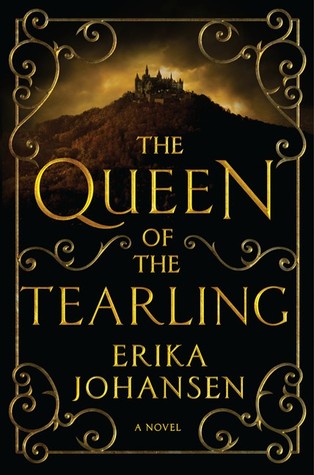
The Queen of the Tearling (The Queen of the Tearling, #1)  by Erika Johansen

tearling****Spoilers abound in this review. Please do not read if you haven’t read the book yet.****


Kelsea was born to be queen. Marked by fire and in possession of two magical sapphire necklaces, she’s taken away from the only home she’s ever known on her 18th birthday to go rule her country. Kelsea’s uncle, the regent, wants her dead. In the neighboring country, the perpetually young Red witch queen, who’s been ruling her people for a century, also wants her dead. There are very few people who don’t want Kelsea dead. She, obviously, wants to live and rule justly. So, our story begins.

I’m not so sure about this fantasy. First of all, the characterizations were so simplistic. Kelsea is good because she reads a lot and doesn’t want people to exist in poverty or slavery. Her mother was bad because she liked to wear dresses, have a lot of pillows on her bed, and sleep with a bunch of dudes. Lazarus is good because he wants the young queen to live long enough to make a difference and is quick with his sword. Arlen Thorne is bad because he supports the black market slave trade and black mails people to have his way. The Red Queen is bad because she keep slaves and rules with an iron fist. I think the most ridiculous characterization was the noble whose crown Kelsea commandeers in her coronation. (I listened to the audiobook so I’m having trouble recalling the name.) She is bad because she literally barred the doors of her keep against her own people when the neighboring army was invading. Not a lot of grey area, is there.

I thought, with the flat characterizations, that this was a young adult offering, but then, the author would slip in some graphic child rape details or language and I’d be reminded that this wasn’t for young adults. I couldn’t quite figure out the audience that Queen of the Tearling was reaching for. Maybe something entirely new like “cozy fantasy”? I suppose she could have been appealing to people who wanted to like a fantasy, but didn’t want to have to think too hard about it. Game of Thrones Lite or Diet Malazan Book of the Fallen.

Two of my best friends love this book. It grew on me a bit. I mean, towards the end, after fourteen hours of narration, I did feel like I wanted things to work out for Kelsea. But, I didn’t feel like the author gave us any of the details that were important. Who is Kelsea’s father for pete’s sake? It was only hinted at a dozen times. Inquiring minds need to know.

Lazarus’ past? More about Tearling history? We’re told that Kelsea spent her formative years with a historian who didn’t want to teach her any history. Why not! Or how about that intriguing scene with the Red Queen and the talking shadow? I could have read another six chapters about that alone.

Also, I had a bit of an issue about the world building. So it takes place in our world, but something cataclysmic happened or society fell apart? Then why is there magic. Did nuclear fall out mutate people so now magic is real? Basing this story in our world felt lazy to me. The author uses our monetary system, our names for drugs… it is the small details that make the world and all of these were so boringly familiar. I would much rather have had Kelsea spending sea stars or her uncle sniffing ground unicorn horn. But, maybe that’s just me.

I’m not sure who to recommend this to. With the material, I’d certainly lean towards the 18+, but I don’t think that the story is complex enough to really entertain adults. I did listen to the whole thing, so that’s saying something and, like I said, I know at least two discerning friends who loved it. I’m going to have to have an in-depth discussion with those ladies. I was neither thoroughly charmed nor disgusted by The Queen of Tearling and feel decidedly middle of the road about the whole thing.

Thanks for reading!

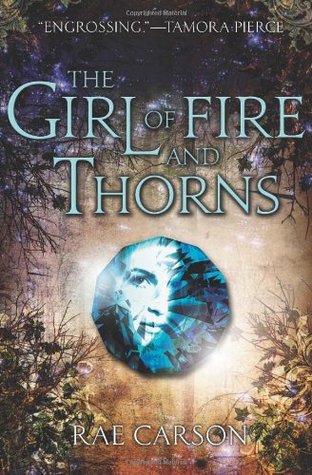
The Girl of Fire and Thorns (Fire and Thorns, #1) by Rae Carson

The Girl of Fire and Thorns (Fire and Thorns, #1)  by Rae Carson

girloffireThe Girl of Fire and Thorns takes navel gazing to a whole new level… but seriously. In this world, once in a hundred years, one person is chosen by God to do something (the main character is never quite sure what this is) and her position as the chosen one is indicated by a large jewel that mystically implants itself in the person’s belly button. To be fair, I was never really able to get over the silliness of this main premise to truly appreciate the story. The whole Godstone thing was too funny to me. It reminded me of Dark Helmet’s ring in Spaceballs, a religious artifact that inspires fear and reverence but was also patently ridiculous.
The main part of the action takes place in a desert setting (reminiscent of Dune). Elisa, the bejeweled heroine, doesn’t know her own strength, moves through tests that teach her that strength, and then it all leads to a conclusive, final action that was so hilarious that I had to put the book (e-reader) down for a moment to process it.

Now, the cultural struggle between Elisa’s people and the Invernie was interesting. I liked the juxtaposition of an earthy, animalistic, nomadic culture with the more civilized, religiously structured, city culture. I also liked the heroine herself. She seems to have an eating disorder and some seriously raging teen hormones, but otherwise, Elisa is a strong, female role model in the vein of Katniss Everdeen and Tris Prior.

If the reader can overlook the whole belly button situation, he or she may really enjoy The Girl of Fire and Thorns. You may also enjoy the young adult reads: The Sin Eater’s Daughter by Melinda Salisbury or The Girl, the Gypsy and the Gargoyle by Darcy Pattison.

Thanks for reading!

The Stone Heart (The Nameless City #2) by Faith Erin Hicks

The Stone Heart (The Nameless City #2) by Faith Erin Hicks

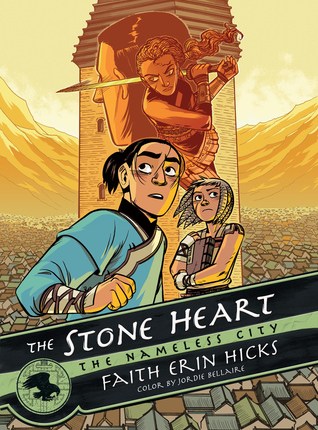
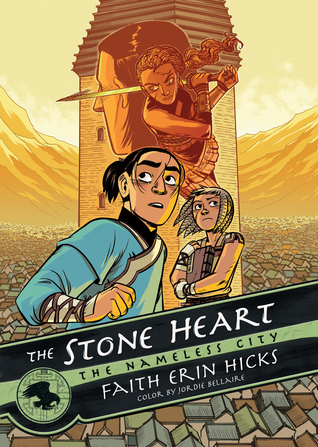
thestoneheartThe Nameless City graphic novels are excellent for kids aged 10 to 14. The Stone Heart like The Nameless City is well drawn with diverse characters and a plot that can be followed by young readers. It presents the difficulties of balancing cultural expectations, politics, and belonging with the natural emotions of friendship and understanding.

The kids, Kai and Rat, are from completely different social castes, but it doesn’t matter to them. If only the rest of the world didn’t live with prejudiced blinders over their eyes, then life could be sweet in the Nameless City. But, that’s not how it is.

The General of Blades wants to make a council of all of the nations within the city walls to decide and rule on all matters of importance within the Nameless City. His son, the heir apparent, wants the power that he’s been promised his entire life- to rule the city as the rightful conqueror. They can’t both have their way.

Meanwhile, rumors abound of the ancient power of the builders of the city itself. The monks may know something about it and, if in the wrong hands, this power could bring down the city that it helped to build.

Highly recommended for reluctant readers. There’s very little downtime in these pages.

A huge thank you to NetGalley and First Second Books publishing for an advance reader’s copy of this book. And, thank you for reading!

Don’t Let Anything Dull Your Sparkle: How to Break Free of Negativity and Drama by Doreen Virtue

Don’t Let Anything Dull Your Sparkle: How to Break Free of Negativity and Drama by Doreen Virtue

This book wasn’t for me.

Don’t get me wrong, I love sparkling.

Photo by Hope Aye on Pexels.com

But, what dulls my sparkle is considering all of the ways in which the world raises my histamine levels, which seems to be Doreen Virtue’s thesis for this book: “…the next day as I was walking along Post Street in Union Square, I heard the inner message that is the basis of this book. … “The reason why you and so many people are experiencing life drama is because you’re addicted to histamine.” loc 81, ebook.

She goes on to list various ways that one may lower this including: major dietary changes, laundry detergent, cleaning supplies, certain types of exercise, therapy, dry cleaning chemicals, what types of plastic bottles to drink from, what types of television programs to expose yourself to, what types of make up to wear and much, much more.

I hope that the readers who are looking for this type of information find Don’t Let Anything Dull Your Sparkle because it is one of the most complete types of books of this kind that I’ve ever read.

Photo by Matheus Bertelli on Pexels.com

The thing is, I could make myself crazy if I tried to control all of that stuff.

I’ve discovered, through my own life, that if I do the inner work of feeling better then external circumstances sort of fall into place on their own without me dancing around trying to make it so.

Don’t get me wrong- I am all for self care. Regular massages, aromatherapy, professional therapy, organic foods, support groups, whatever you need to make yourself feel better, do it.

I just don’t need to adjust those things to sparkle. I feel innately sparkly. I am a veritable disco ball of sparkles.

Photo by NEOSiAM 2020 on Pexels.com

Beyond the histamine issue, it is clear that Dr. Doreen Virtue had another career in psychotherapy. If you’ve experienced drama of any kind, trouble finding that special someone or encountered difficult personalities, she will help you get past that in this book.

There again, my significant other and friends are all quite normal and low drama- sparkling, if you will.

But, if you’ve had relationship troubles, this could be the book that you’re looking for. So, seriously, don’t let me deter you if you feel you need to read it.

“Remember, it’s not about how many friends you have; it’s the quality of the friendships that matter. Even one good friendship, built upon mutual respect and other healthy qualities, will help you sparkle throughout the day.” loc 2034, ebook.

Photo by fauxels on Pexels.com

Meditation and yoga, two of my favorite things, are highlighted in this book as ways to improve your life. I couldn’t agree more!

In this passage, Doreen is talking about dealing with potential drama in your family or with in-laws: “…any way you slice it, the situation will bring up stress hormones in your brain and body, and part of being responsible is taking care of yourself. So, go do yoga as soon as you can. Play gentle music, meditate, eat a low-histamine diet, and avoid chemicals.” loc 1961, ebook.

The trouble is: brownies are not low-histamine. That’s a deal breaker for me.

Photo by Jhon Marquez on Pexels.com

I recommend this book if you’re sick and fed up with the way life is going and you want to try something drastic to turn it all around. Otherwise, I’d have to suggest borrowing this one from the library.

I’ve heard that high library usage lowers histamine levels and makes you sparkle too. Kidding.

Thank you to NetGalley and Hay House publishing for a free digital copy of this book. And, thank you for reading!

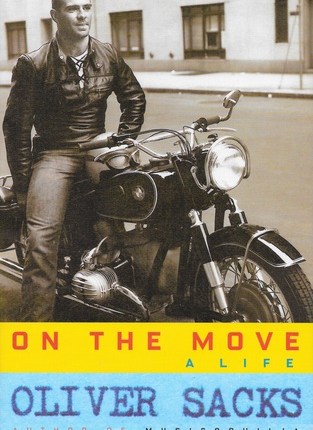
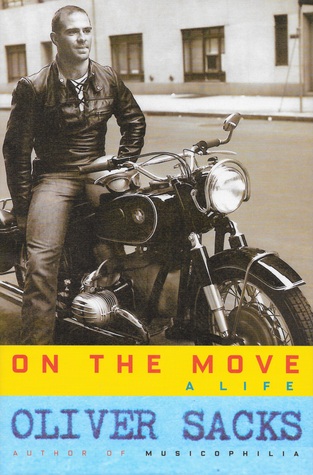
On the Move: A Life (Oliver Sacks’ memoirs #2) by Oliver Sacks

On the Move: A Life (Oliver Sacks’ memoirs #2) by Oliver Sacks
on-the-move

I knew nothing about Dr. Oliver Sacks before I read this book other than the fact that he was a prolific writer. Now I know much, much more.

I loved that Dr. Sacks didn’t hesitate to jump into the nitty gritty details of his life. One line that really stuck out to me: “It was just as well that I had no foreknowledge of the future for after that sweet birthday fling I was to have no sex for the next thirty-five years.” pg 203 Boom. It’s the last line of a chapter section, he neither explains it nor dwells on it. How extraordinary.

I also liked reading about the dramatic parts of his life like his early drug addiction, love of motorcycling, wild nights at the Y, and stint with the American truckers. I found myself dragging through his reminiscing about research or intellectual friends. I think the problem is that I don’t find the inner workings of the mind nearly as fascinating as he did.

Dr. Sacks lists his research pursuits in page after page of case studies, reading, and memories and it wasn’t very fun to slog through. I would probably enjoy the books that he wrote during these times more than this one that was about the writing of them. Another problem, sometimes during the narration, he moves backwards and forwards in time without noting that he is doing so other than writing the date. That was frustrating for me.

Despite some slow portions, Dr. Sacks does have some very beautiful writing in On the Move. Take this passage, where he’s thinking about why he lived so many years of his life on the East coast of the US when he really loved the West coast: “I suspect my nostalgia may be not only for the place itself but for youth, and a very different time, and being in love, and being able to say, “The future is before me.” pg 131

He also struck a chord with me in this line where he’s talking about his love of journaling: “My journals are not written for others, nor do I usually look at them myself, but they are a special, indispensable form of talking to myself.” pg 383 I feel that way too. I pour myself out on written pages in ways that I feel unable to do in the rest of my life through conversations or whatever else.

Dr. Sacks was extraordinarily bright, interested in life and all of its internal mechanisms. At least, after reading this memoir, one can say that he lived fully and well.

I received a free copy of this book through the Goodreads First Reads program. Thanks for reading!

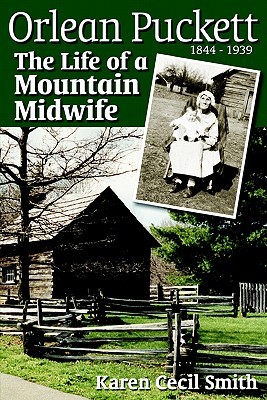
Orlean Puckett: The Life of a Mountain Midwife by Karen Cecil Smith

Orlean Puckett: The Life of a Mountain Midwife by Karen Cecil Smith
orlean-puckett

The Life of a Mountain Midwife is an interesting, but sometimes meandering, biography about a midwife named Orlean Puckett who lived and worked in rural Appalachia.

This reminded me of Laura Ingalls Wilder’s Little House on the Prairie books in that Karen Cecil Smith takes great care to detail the day-to-day chores, food, clothing, and lives of the people of Appalachian Mountains in the 1800’s to 1900’s. I loved those intimate details, many of which are completely gone from the modern lifestyle like chopping wood, lighting the stove, and cleaning laundry by hand.

Also, I am a big fan of BBC television show, Call the Midwives so the chapter detailing Puckett’s extraordinary midwifery skills was fascinating to me. Take this gem: “Aunt Orlean continued to ask, ‘Don’t you think it’s about time to feather her?’ Dr. Cundiff finally said, ‘Okay,’ at which point Aunt Orlean produced from her bag a goose feather. She stuck it into the fire and then placed the smoking feather beneath the mother’s nose. The mother started coughing and sneezing and the baby was born immediately.” pg 101 Can you believe that!

Astoundingly, Orlean Puckett delivered over 1000 babies with almost zero training and never lost a mother or child.

Photo by Pixabay on Pexels.com

Karen Cecil Smith utilizes actual interview tidbits from many of the people who knew Orlean Puckett for this book and that was also enjoyable. She maintained their improper grammar and local accent which lent real flavor to the narrative. For example, many of the children that Orlean helped deliver said that she “borned” them. Here’s a memory from a relative: “Now I was gonna stay up there one night with Granny (Orlean) and she was gonna learn me how to bake wheat bread the next mornin’ and Uncle Stewart he had to go to work and they waked me up and wanted to know if I wanted to put on bread.” pg 57

My only complaint about this book is that it wanders in places and the reader is led into extended stories about ancillary people to Orlean’s life when, this reader at least, just wanted to know more about the Orlean herself.

Photo by Lum3n on Pexels.com

If you are mainly interested in local history, this book is like a casual conversation with an elderly friend. I’d even go so far as to compare it to an unedited Story Corp interview. It can be charming but also frustrating when the story goes on and on but doesn’t seem to go anywhere.

If you enjoyed this book, I’d suggest any of the Laura Ingalls Wilder series. They have the same sort of detail oriented focus but with more of a story line.

I received a free copy of this book through Goodreads First Reads program. Thank you for reading!

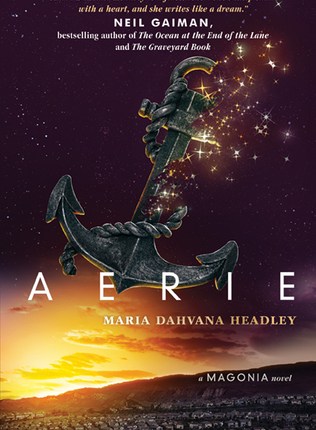
Aerie (Magonia #2) by Maria Dahvana Headley

Aerie (Magonia #2) by Maria Dahvana Headley

Warning: minor (and major if you haven’t read the first book) spoilers, proceed with caution.

Aerie is a very strange and complex, young adult fantasy. Allow me to explain.

In the first book, we met Aza, a girl who was drowning on Earth because, though she doesn’t know it, she’s actually from a kingdom in the clouds. She’s in love with Jason, a genius boy with obsessive thoughts like repeating the numbers of pi in his head over and over again.

Photo by Pixabay on Pexels.com

Many adventures happened in the first book, but essentially we learned that in Aza’s home, the Magonians use their voices in magical ways. Through changing vibrations, Magonians can make elements appear and change, control the weather and animals, manipulate the molecules of reality itself.

Like most young adult stories, Aza is special, a savior with godly abilities that she didn’t know she had until she was tested. She’s supposed to bring balance back to Magonia because Aza’s mother is crazy and wants to kill everyone on the ground- Jason included.

One of the things that happens at the end of the first book is that Aza’s mother is imprisoned. (Lots of other stuff happens too.)

This book picks up where the last one left off. Jason and Aza are deepening their relationship though Aza looks like a completely new girl because she trashed her “skin,” essentially a suit that allows her to look and breathe like a human, and had to acquire a new one.

Did I mention that Magonians have naturally blue skin with orange/red eyes and white tattoos that change depending on their emotional state? Yeah, that’s a thing.

Photo by Marcelo Dias on Pexels.com

Aza’s mother, Zal, breaks out of prison and someone has to stop her before she destroys the world. There are rumors of “The Flock,” a weapon of some sort that can stop Zal, but no one knows where or what it is.

And that, I think, is where this story really begins.

Headley’s world building is epic. Magonia itself is a treasure and the other supernatural creatures that the author introduces are tantalizing in their possibility.

However, I didn’t care much for the characterizations or the obvious plot twists.

The grand showdown itself was a huge disappointment like expecting a brightly colored balloon on your birthday only to have it pop in your hands when you receive it. Headley gathered all of these potentially awesome characters together but only the actions of three mattered.

I wanted ships firing at each other, creatures made of flame, earth, water, feathers… slamming into each other in waves, with the earth itself rising in fountains in an effort to touch the sky.

Photo by Pixabay on Pexels.com

But that didn’t happen.

Aza’s special, I get it.

Aza can sing a song that only she can sing, I get that too.

She FEELS things deeply then SINGS them deeply. Blah.

I just never connected with Aza the way Maria Headley wanted me to. Headley built a lovely world that was so much more than just three characters.

Perhaps I’m being unfair- did anyone who read this book feel differently? I would love to hear from you.

Photo by Ylanite Koppens on Pexels.com

Recommended for readers who are willing to overlook a weak story for some fantastical and wildly imaginative elements.

You don’t have to read the first book to appreciate this one, but I think you’d want to in order to absorb the outlandish world that is Magonia. Some similar reads: The Breedling and the City in the Garden, Archivist Wasp, or Under the Empyrean Sky.

Thanks for reading!

Rasputin’s Supernatural Dating Service by David D. Hammons

Rasputin’s Supernatural Dating Service  by David D. Hammons

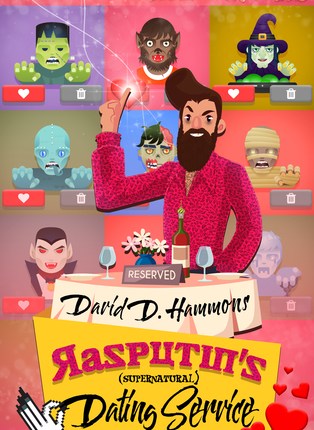
rasputinImagine for a moment that supernatural creatures are real. All of those bloodsucking vampires, toothy werewolves, wandering sasquatch, elves, ghosts, and witches from the stories, they actually exist. Why would all of these beings have notoriously difficult relationships with humans from hauntings to kidnappings to feasts made of human flesh? Rasputin has a theory. He thinks that they’re looking for love in all the wrong places. And the answer to the world’s problems lies through the doors of Rasputin’s Supernatural Dating Service.

Rasputin is THE Rasputin, a seemingly immortal mystic from tsarist Russia who has a way with the ladies, the supernatural, and, sometimes, the men too if he’s in the right mood. This ancient horn dog steers the agency from the golden hot tub in his office and sends his agents throughout the country, certifying legitimate supernatural creatures for dating service access. Eli Kowalski, the narrator, is one of those agents. His troubles begin when a vampires gives him an ancient artifact of unimaginable power and a sinister supernatural creature begins hunting Eli in order to take this power for himself.

Is this story ridiculous? Yes, it is. Did I love it? Surprisingly, yes, I did. David Hammons reminds me of a young Christopher Moore, a silly storyteller with heart. If you can see the humor in an elderly mystic driving a phallic shaped hot rod while demanding that his dating service underlings call him “the Love Machine” then you may enjoy this story too.

Just to give you a taste, here is Eli reading the privacy policy of the Supernatural Dating Service: “Your information will not be shared with any non-Certified member, nor will your home address, dwelling, lair, ethereal plane, or other physical, metaphysical, neo-physical, and existential contact details be divulged to any group outside the RSDS and appropriate government agencies. … Your privacy is important to us, as is your ability to make sweet love to whatever creature you desire.” Lawyers required us to say most of that. Rasputin required us to say the last part.” loc 106, ebook.

Recommended for readers who enjoyed Lamb: The Gospel According to Biff, Christ’s Childhood Pal or almost anything by Tom Holt.

Thank you to NetGalley and Curiosity Quills Press for a free advance reader’s copy of this book. And thank you for reading!

Fahrenheit 451 by Ray Bradbury

fahrenheit451In a not too distant future, owning books is against the law. Firemen burn property instead of protect it and everyone is dialed in to their televisions, subsisting on a steady stream of sensational media stories and vapid entertainment to numb their quickly congealing brains. The nation is always at war, but you would never guess it from the populace’s empty conversations and emptier dreams. Guy Montag longs for something different, but what exactly, he can’t even say, until he meets a girl who wanders outside for fun and sees faces in the moon. He becomes convinced that what society has labeled as wrong and anti-social is more real than anything he’s experienced in a long time. However, these are dangerous thoughts. And, being a fireman, Guy knows, more than anyone, the price that is demanded of people who dare to think, read, and entertain original thoughts.

Fahrenheit 451 was shocking to me. Ray Bradbury predicted internet/social media addiction long before such things existed. He also called society’s horrifically shortened attention spans. Where once, we would have read through a novel or a long article, now we spend less than thirty seconds absorbing information before scrolling onwards to the next thing, then the next, and the next. (Goodreads friends excepted from the majority, of course.)

I listened to the audiobook version where Tim Robbins performed the narration. It was brilliant. He is a natural fit for this material and I highly recommend it.

The only annoying thing about listening to the audiobook is Bradbury’s use of repetition to build the tension and pound his ideas home. You’ll particularly notice it when the war planes fly overhead or when Guy gets into a big fight with his wife and she won’t turn off the television. It’s headache inducing but Bradbury certainly knows how to make a point.

This is one of those classics that I never got the chance to read in school, but I wish I had. I would have enjoyed this much more than Hard Times, which I managed to yawn my way through. Recommended for those who are disturbed by the shallowness of modern life and long for real connections with the people and world around them. The lessons that Bradbury teaches are still very applicable today and, as I said, shocking in their implications.

Thanks for reading.