/rɪˈvjuː/ noun. a report in a newspaper or magazine, or on the internet, television or radio, in which somebody gives their opinion of a book, play, film, product, etc.; the act of writing this kind of report
“But now, here, once and for all, I set down my tale. I am not who I was then. I said I was ignorant, and I am not wrong, though by that point I had learned that men lived upside down from us, that for them the ocean was below, the Abyss above, our gravities only meeting at the surface.” pg 15
Patrick Ness weaves a re-telling of Moby-Dick, or, the Whale from the point of view of the whales. It falls some what short of his usual magic.
I think the trouble with re-telling major stories or fairy tales, (as I’ve discussed in previous reviews, Dorothy Must Die comes to mind) is that unless the remake is extraordinary in some way, it won’t surpass the original story. It’s exciting to revisit beloved worlds or, in this case, a classic tale and upend reader’s expectations. Using the point of view of the whales is unique, but the story seems to stall there.
The original Moby Dick gives us obsession and memorable characters. Bathsheba, the young apprentice whale in this tale, is a confused mess most of the time. That doesn’t lend itself to either greatness or memorability.
Ness is at his best when he’s describing Bathsheba’s world. I wish he had gotten more into how they respected and feared the depths of the ocean, which they considered the opposite of the ‘Abyss’ in our world. I also wish he had taken readers through one of the cities constructed by the whales. He hinted at a civilization beyond the hunt, but we never quite got there.
I guess he was trying to build tension with the hunt for Toby Wick. I wanted a more layered fantasy tale.
“Maybe it takes a devil to fight a devil,” I said. “But at the end of the fight, Bathsheba,” he said, “Don’t only devils remain?” And for a moment in the ocean, there was only blackness. We were alone. Even with ourselves. And whatever devils lurked, unseen. pg 99
The artwork by Rovina Cai is beautiful and spare, utilizing very few colors or many fine details beyond shading. I think she conveys the idea that most of the story takes place underwater very well. I liked the illustrations perhaps more than I liked the story.
If you must read And the Ocean Was Our Sky, may I suggest borrowing it from your local library.
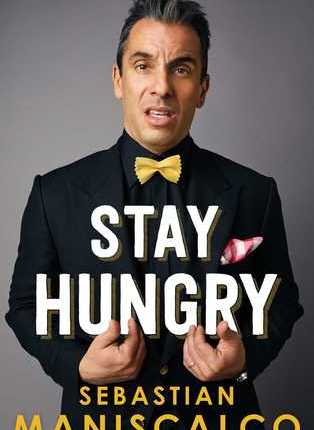
Sebastian Maniscalco (one of my favorite comics) shares his journey from just another funny guy to successful stand-up comedian.
I was so excited to see Sebastian had penned a memoir. If you’ve never had a chance to enjoy one of his specials or to see him live, I highly recommend it. He has a very physical style of comedy. You can see his emotions on his face while he runs all around the stage, mimicking other people and ridiculous situations for laughs. Sebastian is an observational comic who skewers the every day nonsense that others might miss because it’s so mundane. It’s a gift.
Unfortunately, it doesn’t translate as well into a book. However, I was notified by Netflix that he has a special coming out this week with the same name as this book, Stay Hungry. You better believe I’m going to watch it to see if any of what was in here makes it on the screen. I think it might have a chance to shine that way.
As it is, the material just doesn’t have the same flavor as the comedy I’m accustomed to from Sebastian.
For starters, I think Jim Gaffigan has the food angle of comedy pretty well sewn up. Sebastian apparently enjoys food too, but it didn’t feel like his introduction was particularly strong because I associate food so heavily with Gaffigan.
Another thing about me: I’m constantly starving. My entire day is planning around food. What’s for breakfast? Should I scramble a couple eggs like a normal human, or wolf down the dozen my appetite is telling me to do? pg 9, ebook.
On the other hand, Sebastian quickly moves away from the “food” type of hungry into the real meaning of this work, which is to always keep looking and moving towards the next step of your career. This is more about “being hungry” for success, not resting on your laurels.
He’s been a mover and a shaker almost his entire life, having worked multiple jobs from a very young age. Sebastian was kicked into the workforce by his father and supported by his large Italian family. This cocoon of family meant more to him than he realized, but its importance became clear when he moved to Los Angeles and his family was back in Chicago.
So I went from that environment, a welcoming, warm home with tons of people coming and going, to my one-bedroom in Hollywood with a naked man outside the only window. pg 20, ebook.
Success didn’t come either quickly or easily to Sebastian, but he never gave up. He always kept reaching for it. And he relied on his friends and family back home to never let him forget where he came from.
I love to share what I’m doing with my family and old friends. That’s where I get my enjoyment. No matter what, I can count on these guys to keep me grounded and rip me to shreds. pg 159, ebook.
In that way, this memoir is totally relatable. In other ways, Sebastian mingles with celebrities and lives an upper class lifestyle with his bride. He describes the first weeks of being a new parent and learning the ins-and-outs from a night nurse, who stayed with his baby so they could get some sleep. Not so relatable…
Recommended for readers who like memoirs about someone climbing the ladder to their dreams. Fans of Sebastian may want to stick to watching his stand up routines, many of which are available on Netflix.
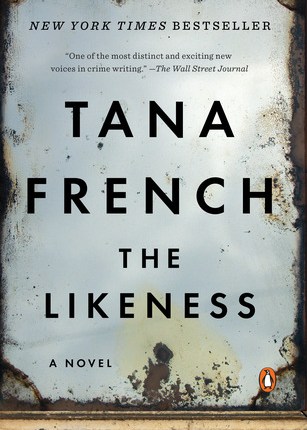
Tana French’s second book in The Dublin Murder Squad series packs a serious punch. Cassie Maddox, a former murder squad detective, has moved to a different unit because of the stresses of the case called “Vestal Virgin” and personal difficulties with her former partner. She’s dragged back into the murder squad, when a woman’s body is found and she’s carrying identification showing her name is one of Cassie’s former undercover personas.
This is the main thing you need to know about Alexandra Madison: she never existed. Frank Mackey and I invented her, a long time ago, on a bright summer afternoon in his dusty office on Harcourt Street. pg 12, ebook.
The slain woman has a unique living situation. She rooms with four other adults in a stately manor home called Whitethorn House. The group is a tightly-knit bunch of university students who not only live together, but also spend nearly every waking moment in each other’s company.
“Her main associates,” Sam said evenly, “were a bunch of other postgrads: Daniel March, Abigail Stone, Justin Mannering and Raphael Hyland.” pg 71
None of the group had a motive for killing Alexandra, whom they called Lexie. Or did they? Or perhaps it was someone outside the group, someone who had an old reason for hating them and the house. Or maybe it was a crime of opportunity… and who was Lexie Madison anyway?
Cassie’s superiors ask her to use her physical similarity to the dead woman to infiltrate the group in an undercover operation to try to dig up some answers. Can she pull it off? And, if she does, will whoever attacked Lexie come at her again?
“This is the part I didn’t tell Sam: bad stuff happens to undercovers. A few of them get killed. Most lose friends, marriages, relationships. A couple turn feral, cross over to the other side so gradually that they never see it happening till it’s too late…” pg 62, ebook.
The tension throughout this entire book is incredible. I noticed the same thing with French’s other book, In the Woods. She really has a way of building the story up through complex layers and then delaying the big reveal to pour on the stress.
The characters are fantastic. The conversations are dances, setting up further plot points.
“She’s fine,” said Abby. “She just said so.” “I’m only asking. The police kept saying—” “Don’t poke at it.” “What?” I asked. “What did the police keep saying?” “I think,” Daniel said, calmly but finally, turning in his chair to look at Justin, “that we should leave it at that.”
I had to suspend my disbelief at a couple points in the story. The big one was believing that Cassie looked enough like the dead woman to make the undercover part even possible. I suppose I’ve heard stories about doppelgangers, but I’ve never truly believed such a thing actually exists.
Highly recommended for readers who like their mysteries with a heaping side dish of tension.
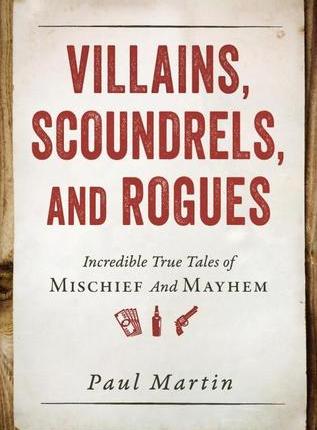
The past comes alive in Paul Martin‘s compilation of villains, scoundrels and rogues from history.
Although many of these people were famous in their own time, they’ve largely slipped into the shadows for most modern readers. … What makes these figures worthy of note is that their life stories all read like fiction. From the introduction.
And they really do. From the truly terrible like serial killers, including one who wore a suit made of human skin, to the less terrible like fraudsters and a counterfeiter of one dollar bills, these are people who made their mark on history in one way or another.
I find this kind of non-fiction read absolutely fascinating. It makes me wonder, these are the stories that almost slipped through the cracks. How many note-worthy people have been completely forgotten?
I have a small quibble about how this book was organized. Martin takes the reader from the awful to less-awful, which seems anticlimactic. Shouldn’t it have gone the other way?
Esther Hicks channels the wisdom of her inner being, called Abraham, to write these books. It sounds kind of far out there if you’ve never been exposed to that type of teaching before, but I have to say, I like it. If you’re in to self help and new age books, you may want to give them a try.
The majority of her (their) message seems to be to find joy. They teach that the purpose of life is to do what makes you happy as often as you can. Interestingly enough, that was the same lesson my grandfather taught me before he passed on. “Whatever you do in life, Heidi, be happy. The most important thing is to be happy.”
Maybe it is in memory of him that I connect so easily with these teachings. I don’t know.
I’ve really taken to heart her encouragement to start out your day in the proper mindset. Lately, I’ve been chilling in bed for a few minutes rather than jumping right into my day. I don’t really have the words to explain why this is making a difference, but it is. I take a second to think about something awesome, even if its as banal as, “My pillow is so soft.” Try it and let me know how it works out for you.
“So as you awaken, open your eyes and say Today I will look for reasons to feel good. Nothing is more important than that I feel good.” pg 37
Also, she’s a big proponent for imaging and living your own life to its fullest and not comparing yourself to others. In the new age of social media and twitter where it seems like everybody is into everybody else’s business, it’s refreshing.
Do not write your story like a factual documentary, weighing all the pros and cons of your experience, but instead tell the uplifting, fanciful, magical story of the wonder of your own life and watch what happens. pg 81
Overall, these teachings have changed my life. I can’t really say enough positive things about her books, of which there are several best sellers. She also does a bustling business of hosting workshops, which she does across the United States and on a few different cruises.
Last month, I went to an Abraham Hicks workshop for the first time. I’ve enjoyed her videos on YouTube for a long time and thought I might shake things up and see what she’s like in person. This was kind of a production because Esther doesn’t come to the St. Louis area. So, I went out west and heard her speak in Phoenix.
The papers for the workshop registration encourage attendees to write down questions about life, whatever comes into your mind that you’re curious about. I brainstormed with my husband and came up with about a dozen different things I’d talk about if I got to the “hot seat”. (That’s what she calls the chair up front.)
I arrived about 15 minutes before the whole thing started, which seemed like ample time to me, only to discover the auditorium was nearly filled! That was fine because I wanted a seat towards the outside anyway. If things gave me a weird vibe, I wanted to be able to get the heck out as fast as possible.
In the moments before Esther emerged, this music started up about “Joy, joy, joy. Joy is the key” and almost half the crowd got up and started dancing. I nearly bolted. It felt rather cultist in those moments.
But then the music cut and there she was and things settled down somewhat. What followed was a lot of laughs and learning about topics ranging from relationships to illness to someone’s dog. The whole day ended with a marriage proposal from one of the attendees to another. In fact, I enjoyed it so much, I’m kicking around the idea of going again next year.
I never made it to the hot seat and felt rather disappointed. But, later, as I was reading over the questions I took to the workshop, I found, to my surprise, that she had directly addressed every single one of them in other people’s questions. And then, that night, I dreamed I was back at the workshop. I was sitting in the chair and asking any question that came to my mind.
So, that’s my personal experience with this author and the “magic” of Abraham. I know these teachings aren’t for everyone. But they’re for me. And that’s pretty cool.
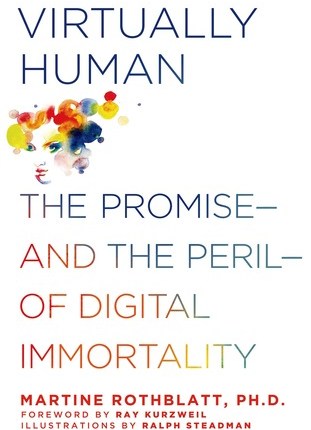
Dr. Martine Rothblatt, an expert in medical ethics, takes the time to imagine a future in which artificial intelligence is real and the potential problems that could arise from such interactions.
Unfortunately, I found Virtually Human to be virtually unreadable.
The introduction sounded promising enough — a description of the robot that Dr. Rothblatt created and its capabilities — but then Dr. Rothblatt launches into an abstract conversation about what is consciousness. She applies her definition to hypothetical artificial intelligences, which haven’t been created yet, and proceeds into a dizzying array of potential scenarios involving mindclones and “bemans”.
She talks about potential marriages between people and machines, various types of AI — some dysfunctional, some not — voting rights, reproduction rights, and more. It all reads like a discussion of very dry, very abstract human rights law mixed with a smidgen of science fiction, but not enough to be engaging.
Dr. Rothblatt certainly knows her stuff, but is seemingly unable to impart her knowledge in an approachable manner. Perhaps, I should say, this is a book that would probably be enjoyed by scholars interested the subject.
I suppose this might be more interesting when such technology actually exists, but in the meantime, it seems rather pointless to be asking ourselves if mindclones should have the right to vote or not. I’m not convinced that by asking ourselves unanswerable questions we’ll be better prepared for when/if this sort of thing actually occurs. Maybe we’ll just have to take life as it comes.
I received a free copy of this book through Goodreads First Reads.
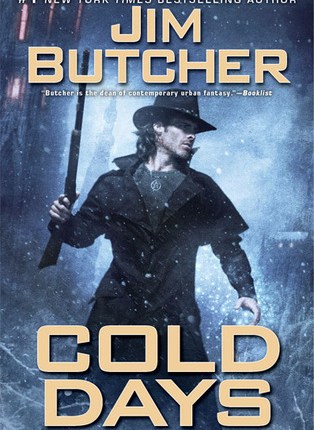
I liked having Harry back on this side of the veil, but I was so-so about the rest of Cold Days, the latest entry in The Dresden Files.
Man. Being mostly dead is hard on a guy. pg 11, ebook.
Harry Dresden, wizard for hire, is now the Winter Knight after a series of misadventures and serious adventures in the past couple of books. And the position isn’t very much fun.
The winter fae are hardcore. They’re mean, full of tricks and generally happy to kill without consideration for any consequences. So you can see how poorly Harry is going to fit in.
Queen Mab, his new boss, is smart and dangerous. She also has a lot of pans in the fire that the reader isn’t necessarily aware of until later in the book. But, being that it’s the freaking Queen of the Winter Fae, maybe I should have expected more backstabby things.
“Oh, the Sidhe’s influence had been waning as the Industrial Age gathered steam,” I said. “By making sure the tales kept being told to mortal children, she made sure that she and her folk were never forgotten.” pg 28
I didn’t like Harry’s character development as much in this book. It seems like much of his choice and free will was taken away when he took up the “mantle” of the Winter Knight. I’m not sure that my feeling is fair though. How much choice did he have when he was under the thumb of the White Council? Or being manipulated by the Red Court, etc.
See, that’s the tragedy of the human condition. No one wants to be corrupted by power when they set out to get it. They have good, even noble reasons for doing whatever it is they do. They don’t want to misuse it, they don’t want to abuse it, and they don’t want to become vicious monsters. Good people, decent people, set out to take the high road, to pick up power without letting it change them or push them away from their ideals. pg 30
Harry continues to use “blast first, ask questions later” but now he’s got ammunition made out of ice in addition to fire and he isn’t afraid to use it. His new job (and prior ghost experience) have driven some major wedges between Harry and his friends. I didn’t like that we saw less of the minor characters, some of whom I’ve grown quite fond of. Bob the Skull is the one that comes to mind first, but there were others.
I’m not entirely sure his relationship with Molly is ever going to be the same. The patchwork relationship fixes Harry makes with Karrin Murphy, Butters and Thomas are questionable. Overall, I just felt sad. Sometimes, we out grow our friends or they out grow us. I wanted Harry to be best of pals with those folks forever.
Butters tore off a final piece of medical tape, stuck the end of the bandage down with it, and sighed. “Yeah. Just try not to… well, move, or jump around, or do anything active, or touch anything dirty, or otherwise do anything else that I know you’re going to do anyway in the next twenty-four hours.” pg 287
That’s not to say there aren’t moments to enjoy in this book. There’s still magic, danger and adventure. But I feel like things have certainly changed since a few books ago, and Jim Butcher hasn’t necessarily recaptured the magic he conjured when his characters were racing to prevent the death of a little girl at the hands of Red Court vampires.
Wizarding just isn’t what it used to be. Not so many years ago, I’d think it was a busy week if someone asked me to locate a lost dog or a wedding ring. It had been horribly boring. I’d had lots and lots of free time. I hadn’t been rich, but I’d gotten to buy plenty of books to read, and I’d never gone hungry. And no one had tried to kill me, or asked me to make a horrible choice. Not once.pg 457
I’m dragging my feet on picking up the next entry, Skin Game, because I read that it was the last that Butcher has finished, for now. There are plans in the works for another book, Peace Talks but it isn’t finished yet. I’ve been burned by too many science fiction/fantasy writers like George R.R. Martin or Scott Lynch to expect that the next book will be finished any time in the near future.
Butcher writes on his professional website that he’s lost his dog, gotten a divorce, moved, been delayed in the construction of his new house and gotten engaged since the publication of the last book in the Dresden Files. That’s a lot of change. I wonder if it will come through in his writing…
Maybe I’m mourning the loss of Harry Dresden before the series even ends? The ending seems to be there or at least coming towards us, on the horizon. In addition to the approaching end, I feel like the quality of writing in the books isn’t as good as it was, even a few books ago, when Butcher almost blew up the world he had created with the awfulness that went on between Harry and Molly.
Anyway, of course I will read the next book. Maybe over the holidays, which are swiftly approaching.
In conclusion, I wish Cold Days was more whimsical like the first books in the series or action-packed like some of the last. Because it seems to exist in this middling reality where Harry can’t do anything right and seems to be losing friends faster than he’s making them, all the while spinning his wheels on ice and being manipulated by others who are far more powerful and inventive than he will ever be.
Similar to The Alchemist, The Little Prince is a metaphorical tale that people seem to love or not.
“In the face of an overpowering mystery, you don’t dare disobey. Absurd as it seemed, a thousand miles from all inhabited regions and in danger of death, I took a scrap of paper and a pen out of my pocket.” pg 4
A pilot crashes in the desert and discovers a child wandering around who claims to be from another planet. His planet is so small that the prince can see multiple sunsets by simply moving his chair. And there’s a rose with four thorns that the prince loves. But he left this planet because of a disagreement with the rose. After a series of adventures where he meets dysfunctional adults on other planets, sees that his rose isn’t the only rose in the universe and learns about love from a fox, the prince decides he wants to go back home.
How he’s going to do that is not really clear.
So that’s the literal story.
The allegorical part has to do with how differently children perceive life than adults, what love is or means and how growing up, change or death affects love… among other things.
Here is my secret. It’s quite simple: One sees clearly only with the heart. Anything essential is invisible to the eyes.” pg 63
I felt like there were layers to this story that I haven’t grasped yet. I suppose this could also be about a man contemplating his inner child. Then again, I suppose this story could be about a lot of things.
This was the first time I’ve ever read it and, to my amusement, when I checked it out from the library, my 12-year-old said she has already read it. I asked her what she thought of it and she just shrugged her shoulders. I liked it more than a simple shoulder shrug, but, in conclusion, I think there was stuff I was missing.
Andrew Weil travels around the world taking conscious-altering drugs or participating in mind-altering experiences (like a solar eclipse) to see what happens.
And to think, I assumed this book would be about meditation. 🙂
I recently read Weil’s Breathing: The Master Key to Self Healing and I really liked the way he presented Eastern teachings and techniques for a Western audience. I also like his mind-set, that practical knowledge is better than mere theory.
“I must emphasize at the outset my prejudice that the experience of an altered state of consciousness is intrinsically more valuable than any amount of theorizing about it, unless the theory helps individuals to make more and better use of the states available to them.” pg 241
This book is a collection of newsletters that Weil wrote for the Institute of Current World Affairs. They offered him a fellowship after the publication of his book The Natural Mind: A Revolutionary Approach to the Drug Problem, to further test his theories about consciousness in the real world. I think his results are fascinating.
All of the chapters converge toward the idea of unifying consciousness. pg 5
The dual consciousness Weil is talking about is the active mind, represented in ancient alchemy by the sun, and the subconscious mind, represented by the moon. Within each of us, both minds operate more or less in balance. Though many of his studies involve the conscious use of drugs to achieve that balance, Weil promotes natural methods above all else. He believes that though drugs may be used ritualistically and responsibly, that any state they reveal was already a latent potential in the mind.
Basically, you can get there without the drug.
The highs of altered states of consciousness such as those of trance and meditation are similarly related to the focusing of awareness. When we learn to bring about this kind of concentration at will, we can be independent of external triggers for highs, whether drugs, sex or mangoes. pg 26
Yes, according to Weil, mangoes, the fruit, have been used by mystics for millennia to unify the conscious and subconscious minds through a type of ecstasy of the mouth. Who knew?
Weil exposes himself some far out stuff. He has three different chapters about his experiences with mushrooms.
“In other words, there is no line between poisonous and psychedelic mushrooms. Mushrooms are a pharmacological continuum, from the white cultivated variety that has no action as a drug to species like the Death Cup that can easily kill. If one likes to get high by eating mushrooms, he can choose species over a wide range of toxicity.” pg 47
In addition to all kinds of drugs, there’s consciousness altering through purposeful vomiting in Mexico, chili eating, personally observing Uri Geller doing his metal-bending thing and more.
This book is perfect for readers who are interested in varying states of consciousness but, for whatever reason, aren’t able to make the trips or take the risks themselves. And there are risks because not everything that Weil tries is safe. At one point, he’s riding waves of nausea in the rain in the middle of the jungle while his friend vomits again and again an arm’s length away and there’s nothing he can do about it. Certainly doesn’t sound like something I’d want to attempt.
Though these newsletters were written in the ’70s and this book was published in 1980, I feel that it still has applicable uses for today. Just look at all of the states that are legalizing marijuana (and our Canadian friends!). Questions about altered states of consciousness and addiction are going to crop up that society, after decades of avoidance, is going to have to answer.
“Sooner or later we will learn that plants with effects on the body and mind, such as marijuana, are what we make of them. Used intelligently and carefully they can help us. Used irresponsibly they can harm us.” pg 98
Good thing we have trailblazers like Weil showing us a middle way.