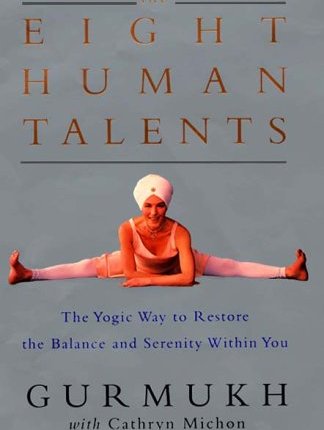
The Eight Human Talents is part-story and part-instruction manual for the practice of Kundalini yoga. I’ve only ever practiced hatha yoga and this is very different from what I’ve learned. I’ve tried a couple poses and this is definitely going to take some practice.
If I learned anything from this book, it is to breathe deeply. One of Gurmukh’s main points is that by connecting with the breath, we reconnect with ourselves.
Also, don’t be afraid to try, even if you fail. “If we can make one step towards happiness, towards healing, towards change, miracles begin to happen. The Kundalini Yoga and Meditation in this book are a way of making those small steps towards happiness. If you will try even one thing from this book-one breathing exercise, one stretch, one meditation- know that somewhere I am cheering right out loud for you, because I know that making that first step is the hardest thing to do…” introduction, xxii.
Some of Gurmukh’s stories were saccharine sweet, but I enjoyed most of them. “We are powerless over every other person on the planet, and we only have power over our own lives. No matter how problematic the people in your life are, you are always the solution.” pg 125.
I’ll have to get back to you on if these exercises deliver on the myriad of promises that Gurmukh makes. So far, I’ve discovered that my lower back needs to be strengthened and I should work on my neck flexibility.
She ties all of her suggested poses to different chakras and energies found within the body. If that concept is too far out for you, you may be better served with a different introduction to Kundalini yoga.
Recommended for beginners to moderately experienced practitioners.
Shonda Rhimes’ heartfelt memoir about the power of embracing who you are and having the courage to set aside what you are not.
Though outwardly successful, Shonda was miserable. Between over-working and her introverted tendencies, she turned down every invitation and social event. The ones that she was forced to accept were anxiety inducing trials or complete blanks because of panic attacks.
Shonda didn’t even realize she was unhappy until, one Thanksgiving, her sister tells her that she doesn’t say yes to anything. Something clicks and Shonda embarks on a Year of Yes. Her results are astonishing and so is this memoir.
I have never watched a single episode of Grey’s Anatomy. I didn’t even realize that that was her show. You don’t need to be an aficionado to appreciate this book.
Shonda begins with some crushingly honest passages about her discomfort at sharing her life and her passion for writing. “Making stuff up is responsible for everything-everything I’ve done, everything I am, everything i have. Without the tales, the fiction, the stories I’ve spun, it is highly likely that right now, today, I’d be a very quiet librarian in Ohio.” pg 6, ebook. Not that there’s anything wrong with that. 🙂
The first part of this book was actually hard for me to get through because she was so obviously uncomfortable at creating a window into her heart and mind. She gets over it and so did I. “When it was first suggested to me that I write about this year, my first instinct was to say no. Writing about myself feels a lot like I have just decided to stand up on a table in a very proper restaurant, raise my dress and show everyone that I’m not wearing panties. That is to say, it feels shocking.” pg 12, ebook.
Shonda is just so relatable. Take this confession about motherhood: “I don’t know about you, but the mistakes and missteps I have made since becoming a mother… before kids, my confidence could not be dented. Now it’s shattered on a daily basis. I don’t know what I am doing.” pg 63, ebook. I know, right! Nobody knows what they’re doing. I take comfort in that.
Throughout her year of challenging herself, Shonda discovers that she’s uncomfortable in her own skin because of her weight. This next passage is for anyone out there who has body image issues: “I believe everyone’s body is theirs and everyone has a right to love their body in whatever size and shape and package it comes in. I will fight for anyone’s right to do so. I will kick ass and take names if I have to. Your body is yours. My body is mine. No one’s body is up for comment. No matter how small, how large, how curvy, how flat. If you love you, then I love you.” pg 85, ebook. End of story.
I also liked how she came to a new understanding about how life works: “I’ve started to think we are like mirrors. What you are gets reflected back to you. What you see in yourself, you may see in others, and what others see in you, they may see in themselves.” pg 120, ebook. I’ve started to think that too.
The Year of Yes is recommended for readers who enjoy memoirs or for those folks out there whose lives are in need of an awakening- a shaking of the snow globe of your reality, if you will. Shonda said yes to things that scared her and discovered, on the other side of fear, a life truly worth living. I hope that we can all be as fortunate and as brave on our journeys.
Though a bit rambling at times, The Power of Myth is a great introductory text on archetypes found within all world mythologies from almost every time period.
In it, Joseph Campbell explains why the underlying stories are the same from all over the world and what they mean in both cultural, personal, and world contexts.
He breaks down some of the major archetypes like the sacrificed god and resurrection, virgin births, goddesses, trees, snakes, and more. As someone who has studied tarot and The Tree of Life extensively, I found it to be an illumination.
I particularly liked learning about the mythology of Star Wars. With the release of the new film, that particular series is back in the top of the pop culture charts. I think that The Power of Myth explains why it has such enduring appeal.
Or pick up any of the many books about mythology from any country you’d like. If you immerse yourself in enough of the stories, you will pick up on the reoccurring patterns yourself.
I believe that one of the many purposes of mythology, beyond its entertainment value, is to teach us about what we have in common with each other, and also, the hidden dimensions of ourselves.
As the doorway to the Delphic Oracle said, “Know Thyself.” And, really, that is the greatest power there is. Mythology helps you do that.
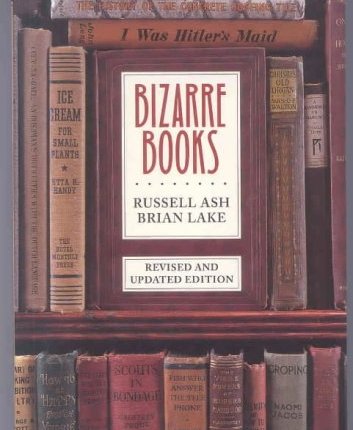
Though it relies too heavily on puns and doubles ententes, Bizarre Books is a humorous look at titles, subjects and author names in published materials. It is a must-read for any book lover or professional who deals with the printed word on a daily basis. *cough* Librarians. *cough*
“All the books recorded are real titles, with real authors. All of them were published with the serious intention of informing, not amusing. In this, they have signally failed.” introduction, pg 7.
I don’t think that ALL of them were meant to be informative. Take this entry from one of my favorite genres, science fiction: Planet of the Knob Heads. Stanton A. Coblentz. Science Fiction, Atlas Publishing, 1939. “Jack and Marjorie are brought to the distant world of their captors. In far Andromeda, they struggle against “favors” of the knob-heads – but hope fades as they face the High Knobule!” pg 40. Almost irresistible, isn’t it?
If science fiction isn’t your thing, how about this (I’m guessing) thriller: What Farrar Saw. James Hanley. Nicholson & Watson, 1946. “No story by Mr. Hanley is without its moral implications; here we have a glimpse of nightmare horror and chaos in a monstrous machine ridden world. It starts simply enough as chaos does. A young couple set off for a holiday in Scotland.” pg 44. Sounds at least as promising as The Girl on the Train, wouldn’t you say?
Those were some of the fictional books that caught my eye. On to the non-fiction. If it was on a shelf in front of me, I’d pick up Carnivorous Butterflies by Austin Hobart Clark, pg 62.
In the most ineffective category, the prize goes to: Atomic Bombing: How to Protect Yourself. Watson Davis, et al. New York: William H. Wise & Co. 1950. One of its suggestions was: “Curl up in a ball as you hit the ground.” pg 166.
By far, my most favorite selection is: The New Guide of the Conversation in Portuguese and English in Two Parts. Pedro Carolino.
Familiar phrases: Let us go on ours feet. At what o’clock is to get up? At which is this hat. Have him some children? pg 54. And so on. The authors dedicated another three pages to this gem alone.
Highly recommended from this bookworm. It made me laugh a lot and that is not easy to do.
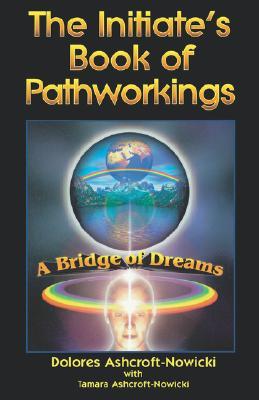
Dolores Ashcroft-Nowicki shares meditations which she calls pathworkings as a method of self actualization.
I understand that directed pathworkings are an actual technique that has been used by mystery schools for centuries to explore consciousness. I just don’t see its usefulness beyond a sort of tourist trip through what “may” be in your mind rather than what “is”.
Let’s compare it to riding a bike. Directed pathworkings are like watching a video of someone riding a bike. Passive pathworkings are like hopping on that bike and riding it all over your neighborhood. You get the visceral experience of being there.
If you’ve never ridden a bike before, watching the video might be safer, but it certainly isn’t more fun.
If we look at the Initiate’s Book of Pathworking as a journal of an adept’s inner work, it feels rather rehearsed and stilted as opposed to the out of body work that was chronicled in Multidimensional Man by Jurgen Ziewe.
If we consider the different approaches between Ashcroft-Nowicki and Ziewe, it also makes more sense that these pathworkings have a clear beginning, middle, and end as opposed to Ziewe’s offerings which are more like real life: random and, at times, nonsensical.
Because (I’m assuming) an adept from The Servants of Light School created these pathworkings through actual experiences on the inner planes, it has the curious side effect of unfolding like a structured lesson plan.
In Nick Ferrell’s book, Magical Pathworking, he discusses the importance of writing pathworkings like a story with a beginning, middle, and end for its consciousness shaping potential, but he never talks about how naturally occurring pathworkings or passive pathworkings, present themselves in that manner, organically. At least, that has been my experience.
I suspect that mystery schools experienced some pathworkings through their consciousness research, recorded the patterns that occur, and then sought to imitate that inner perfection by scripting pathworkings like the ones found in this book.
There is value to be found in this book as it provides a nice introduction to pathworking in general: “What is a pathworking? It is similar to a virtual reality trip. Pathworkings are perfectly natural and can occur spontaneously in the form of daydreams. Used as a structured series of visualizations, they hold many possibilities for the student.” Introduction, pg x
I found some of this book silly like the Healing Spring (Women only) pathworking on page 61. Women only? We’re dealing with consciousness here which is neither male or female, but pure being. If a guy wants to run the Healing Spring pathworking, I’m not going to be the one to say no.
Some of the poetry in the pathworkings is very beautiful and felt authentic, which again made me wonder who wrote these for the SOL. W.E. Butler? Dion Fortune? So curious:
“Forest Lord, with twelve-tined crown, Now we come to bed thee down. Rest content when sleeping deep, Leave the Summer Queen to weep.
Rest thee well till comes the Spring When harebells in the wood do ring; Then rouse thee up the maid to wed And seek the joy of the greenwood bed.
Hunter, blessed be thy sleep; Choose a maid thy bed to keep. Dreams of silver, dreams of gold Will guard against the winter’s cold.” pg 190
To give you a comparison, here is a chant from some pixies in a passive pathworking that I experienced a couple of months ago:
“Awake the trees, awake the night, awake the shining moon. Feed the plants, free the life that dwells within the bloom. To keep the forest growing tall, the pixie people sing, We bring the song and dance the call to wake the Forest King.
Awake the night, awake the moon, awake the powers old, We’re the ones that call upon the Spirit of the fold. Dance the dance, sing the songs, make the forest wake, In our stead, these plants have fed the thirst that never slakes.
Feels very similar, yes? That’s the fascinating thing about consciousness research to me. It feels so familiar but, at the same time, infinitely unknown.
It’s just my opinion but, I think, in addition to space, our own minds are the next frontier of human exploration.
“These “serial” workings will grow with you as you explore them, and can bring about many strange events, both in your astral life and in your physical existence. They are more potent than they seem, so take them slowly.” pg 214. One a week has worked pretty well for me. I feel like I’m learning and growing but not being overwhelmed by the changes.
A dated portion of this book that I found rather amusing, especially since the recent kerfluffle over the year 2012: “As the year 2000 comes ever closer, speculation as to the future of the world gets wilder. Exactly the same kind of hysteria hit the known world in the year 1000… The year 2000 will usher in a time of adventure, opportunity, and yes, a lot of changes. But we will survive. Things may be very different a hundred years from now, but we have survived big changes before and will do so again.” pg 231 Amen.
“One of the things an initiate learns is that every man and woman is essentially a “multi-versal” being. That is, we exist simultaneously in many dimensions and parallel universes. We have a consciousness in each one, a life in each one, a purpose and destiny in each one. But each is minutely different. With every passing moment in time, we change our future in each universe by constantly making decisions that affect the course of that future.” pg 240. I don’t know that I agree with everything in that passage, but isn’t it a beautiful view of reality? Layers within layers of truth, all interacting and changing each other, eternally.
If you liked the guided pathworkings in this book, you may want to read: Magical Pathworking: Techniques of Active Imagination by Nick Farrell, Pathworking and the Tree of Life: A Qabala Guide to Empowerment & Initiation by Ted Andrews, or the second half of A Garden of Pomegranates: Skrying on the Tree of Life by Israel Regardie. If you want examples of (mostly) passive, out of body experiences, read: Multidimensional Man by Jurgen Ziewe or Psychic Warrior: The True Story of America’s Foremost Psychic Spy and the Cover-Up of the CIA’s Top-Secret Stargate Program by David Morehouse.
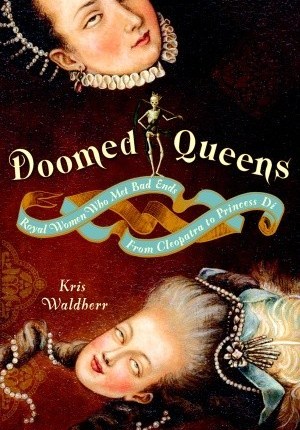
A quirky yet educational list of Doomed Queens that is organized by time period. I learned a lot and was entertained- everything that I look for in a non-fiction book.
“While kings were also vulnerable to political upheaval… for the most part men pulled the strings at court. Therefore any woman blocking the way to power was a threat to be eliminated. Common ways to bump off an inconvenient consort included beheading, burning, drowning, poison, stabbing, strangling, starving, and forcing suicide.” pg 8, ebook. Shocking, isn’t it. One would think that a queen’s power would afford her a measure of protection, but it didn’t.
Here’s one of the facts I learned: “Arsinoe’s story has been overlooked in the face of her more successful older sister, Cleopatra… But in death, Arsinoe was buried with the queenly honors that had been denied her in life. Her remains were interred in a tomb in the Temple of Artemis, one of the seven wonders of the ancient world.” pg 31, ebook. If you’d like a historical fiction book about Arsinoe, may I suggest The Drowning King.
I also learned the Roman viewpoint of the fury of Boudicca, queen of the Iceni: “Dio Cassius later wrote, “All this ruin was brought upon the Romans by a woman, a fact which in itself caused them the greatest shame.”pg 37, ebook. Silly Romans. Here’s a historical fiction about Boudicca if you’re interested: The Eagle and the Raven.
Doomed Queens includes plenty of puns and amusing witticisms. Take this passage from the chapter about Brunhilde: “… the queen of Austrasia incited a forty-year war between her realm and Neustria that made the Hatfields and the McCoys seem downright Merchant-Ivory. “ pg 44-45, ebook.
Or in Sibyl of Jerusalem’s entry: “Sibyl’s marital history took on Liv Taylor proportions as she became engaged, married, widowed, and annulled in varying combinations. pg 53, book. Burn.
Recommended for readers interested in royal stories and unfortunate yet powerful females. Reluctant readers may enjoy Doomed Queens because of the short chapters and light-hearted delivery of some seriously sad history.
The Four Agreements by Don Miguel Ruiz is a simple and short presentation of some very deep wisdom. In a world filled with spiritual reading material, this one’s a goodie.
This book just made a lot of sense to me. I liked the practicality of the teachings in addition to their simplicity.
These lessons come from the shamanic culture of Central America. Here’s an example: “Toltec knowledge arises from the same essential unity of truth as all the sacred esoteric traditions found around the world. Though it is not a religion, it honors all the spiritual masters who have taught on the earth. While it does embrace spirit, it is most accurately described as a way of life, distinguished by the ready accessibility of happiness and love. introduction pg x.
Happiness and love! Sign up the author of The Light Congress, pronto.
The book goes on to talk about how everyone has unconscious beliefs that we pick up as children. We view and experience our world through these beliefs.
Most folks aren’t even aware that they have them and this causes a myriad of misunderstandings and problems: “We keep searching and searching, when everything is already within us. There is no truth to find. Wherever we turn our heads, all we see is the truth, but with the agreements and beliefs we have stored in our mind, we have no eyes for this truth. We don’t see the truth because we are blind. What blinds us are all those false beliefs we have in our mind.” pg 17.
Sounds bleak. So, how do you cut through the fog of these beliefs to see clearly? Ruiz suggests using The Four Agreements.
The first is: “be impeccable with your word… you begin to see all the changes that can happen in your life. Changes first in the way you deal with yourself, and later in the way you deal with other people, especially those you love the most.” pg 46.
I am not a big news watcher. I try to keep up on current events, so I knew about the bombing at the Boston Marathon, but I didn’t watch the news broadcasts as they occurred nor did I see the (now famous) picture of Jeff Bauman being wheeled away from the bomb site. So, this whole book was a revelation and learning experience for me.
In a straight forward and honest manner, Jeff describes his life, what happened to him that tragic afternoon, and then how he and his family picked up the pieces of their lives and began to move on.
He also describes what happened at the shootout between Tsarnaev and the police from the officers’ point of view (he heard multiple first hand accounts from the men who were there). He details the trauma to his body and mind- some of it is very graphic, but that’s how he experienced it.
I think this was a very intimate memoir.
In addition to sharing his inner most thoughts and emotions, he doesn’t try to make the people in his life look better than they really are. For example, the portrait he paints of his mother is very unflattering. She tends to drink to excess and then vent her emotions while under the influence.
Apparently she has behaved this way Jeff’s entire life, so he doesn’t think much of it. It’s very dysfunctional, at best, and alcoholic, at worst. But, it’s real and not something that he had to share with the world.
Jeff chose to share it.
At multiple points in the book, Jeff denies that he’s a hero, but he is. He’s demonstrated the resiliency of the human spirit and sheer determination to move on with his life by learning to walk with his new legs a mere six months after the bombing.
I sincerely hope that his life continues to move forward and that he finds more peace than is detailed in his memoir. He deserves that, at least.
I received a free copy of this book through Goodreads First Reads. Thanks for reading!
The moral of today’s story is that people used to do terrible things to animals in the name of “sport.” Interspersed with fascinating tidbits about dueling with rubber bullets and auto polo, Fox Tossing, Octopus Wrestling and Other Forgotten Sports documents the nauseating practices of bear, dog and monkey baiting and more- so much more.
It describes mass hunts conducted in arenas by royalty and nobles were hundreds, if not thousands, of animals were slaughtered as entertainment. From shooting arrows at roosters to breaking apart a barrel with a cat inside, I could not believe the brutality.
If you can make it through the animal abuse sports, and I confess that I skimmed most of those, what’s left is amazing. “… from learning about how our ancestors entertained themselves we gain a unique insight into broader contemporary attitudes towards morality, humor, and the trials of daily existence.” pg 3. “The reasons why these forgotten sports fell out of favor are, of course, many and varied, but broadly speaking can be divided into three categories: cruelty, danger, and ridiculousness.” pg 5.
Ah, balloon jumping. This is a sport where a dude would attach a huge balloon to himself and leap across the landscape like a superhero. Why did we quit balloon jumping? “He did nearly clear the electrified cables, but unfortunately his feet became entangled, and when he tried to extract himself by grabbing one of the wires he was blown to the ground in a hail of sparks, dying instantly. Alas, balloon jumpers never quite managed to refine the sport to a level of safety below “frequently lethal”…” pg 24.
Then there was dwile flonking: “In mid-1960’s Norfolk, it became a favorite activity of locals to gather in a large group, dance to an accordion, and hit each other in the face with beer-soaked rags.” pg 87. What fun.
I would say that the practice of “flyting” is alive and well in some online forums: “Flytings were extemporary swearing matches that placed a value on the imagination and verbal dexterity of the participants, who would exchange insults with impressive wordplay in a sense similar to modern rap battles, but with an intensity of vitriol and florid vocabulary that is hard to fully comprehend by modern standards.” pg 101. But not on Goodreads, where civil discourse rules the day. 🙂
Recommended for trivia hounds and those interested in obscure history, Fox Tossing is full of hilarious and heart-breaking facts about some of mankind’s forgotten pastimes. Those who are triggered by animal cruelty would be best served by picking a different book.











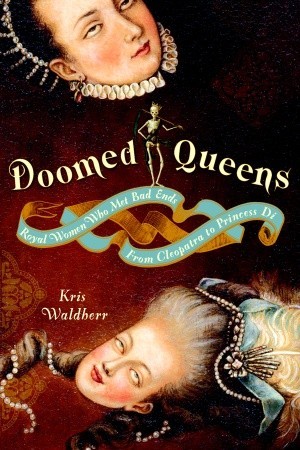 A quirky yet educational list of Doomed Queens that is organized by time period. I learned a lot and was entertained- everything that I look for in a non-fiction book.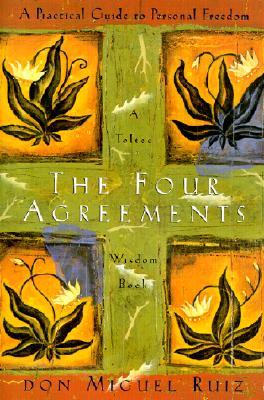


 I am not a big news watcher. I try to keep up on current events, so I knew about the bombing at the Boston Marathon, but I didn’t watch the news broadcasts as they occurred nor did I see the (now famous) picture of Jeff Bauman being wheeled away from the bomb site. So, this whole book was a revelation and learning experience for me.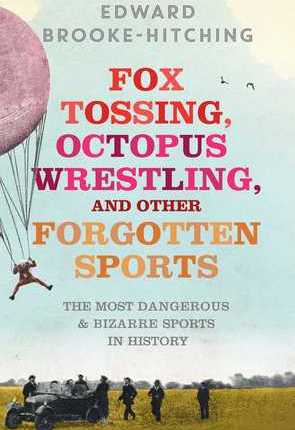
 The moral of today’s story is that people used to do terrible things to animals in the name of “sport.” Interspersed with fascinating tidbits about dueling with rubber bullets and auto polo, Fox Tossing, Octopus Wrestling and Other Forgotten Sports documents the nauseating practices of bear, dog and monkey baiting and more- so much more.
