Funeral Games by Colin Heintze

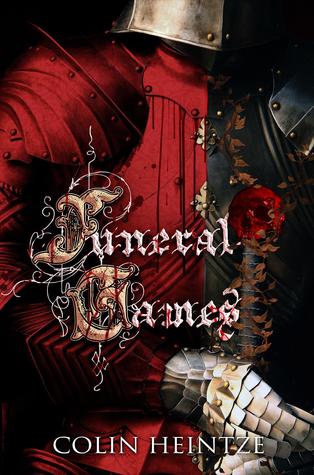
Funeral Games by Colin Heintze

funeralgamesFuneral Games is a unique, fantastical romp through a medieval world. Syphax is a prince, but an unimportant one, being the younger son of one of his father’s many wives. He doesn’t excel in much of anything, other than reading and daydreams of greatness (reminds me of myself in some ways… I jest… but really). Syphax is a member of the nobility who are called the Undying because, when they shuffle off this mortal coil, they rise again as tangible ghosts called ancestors. These ancestors help govern the living and form another spooky faction in the sprawling complex of the capital city that is Ingerval Palace. The walls of the palace are filled with dead and living nobility who are divided into many different houses with a tangled history of treaties and backstabbing, all with the goal of more power for the members of their clan. The future looks, if not bright, then at least rosy, for our hero, Syphax, until, at one very memorable funeral celebration, something completely unexpected happens. And then, all hell breaks loose inside and outside the walls of Ingerval.

I loved the juxtaposition of the living and the dead in Funeral Games. It added a whole other level of political machinations to the usual struggles of a monarchy and its nobility. Here is the scene at one of the funerals: “The crowd roared with laughter- at least the Living among them. The Dead sat at their assigned places. They didn’t eat or drink, and weren’t the least bit amused by the antics of their descendants. There must have been two hundred ghosts and at least as many Living in attendance. Normally, the Dead kept their own company, but the day was a special one.” loc 56, ebook. I also loved how, in the course of the story, Heintze dealt with the ghost’s eternal nature, limitations, and struggle for recognition beyond the grave. It really is unlike anything else I’ve ever read.

There is a love interest in this but it doesn’t dominate the storyline or descend into the ridiculous. In fact, the girl/heroine, though she doesn’t play a huge part, is kind of hard core, which is a refreshing change of pace for the genre. In this passage, she’s talking to Syphax about one of the ancestors: “I feel like he watches me, Syphax.” “You’re in a palace full of ghosts. It’s natural to feel that way.” “Sometimes I have these dreams. And when I wake up, he’s always nearby…” … “It will be fine,” I said. “He’s harmless. All ghosts are.” loc 136, ebook. (suspenseful music building…)

My favorite part of Ingerval is, of course, the Library! “Ingerval Palace had many wonders. None were as great, nor so underappreciated, as the Library. Books were one of the few pleasures afforded to ghosts, and the Dead’s demand for the written word made Ingerval the world’s leader in the production, purchase, and dissemination of books.” loc 367, ebook. I would fit in well with the Undying, I think.

There is some rough language in this, some tense moments, and a small, if not too graphic, torture scene, so I’d suggest a reading audience of 14/15+ depending on the maturity level of the reader. I’d recommend Funeral Games for not-too-serious fantasy fans as it lacks the complexity of, say, the Malazan books, but for some folks (myself included), that may be considered a plus. Some similar reading: The Interminables by Paige Orwin (a ghost plays a large part in this story too), Ink Mage by Victor Gischler (fantasy world, lots of adventure), or The Quick by Lauren Owen (different time period, but also a fantasy).

Thank you to NetGalley and Curiosity Quills Press for a free digital copy of this book.  And, thank you for reading!
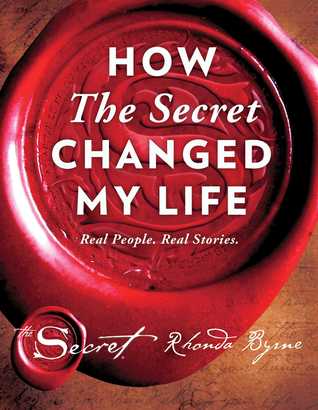
How The Secret Changed My Life: Real People. Real Stories. by Rhonda Byrne

How The Secret Changed My Life: Real People. Real Stories. by Rhonda Byrne
secretchangemylife

How the Secret Changed My Life adds nothing new to the Secret franchise, but it’s still fun to read if you enjoy hearing success stories about people who utilized the Law of Attraction.

The criticisms of it have been voiced elsewhere and more eloquently: that it is predominantly focused on material things and that it stresses being happy at any cost.

That being said, I liked the stories.

I liked hearing about how people hit rock bottom and then changed their lives for the better. I really liked hearing that you can do or have or be anything that you want. Who wouldn’t?

Here’s Rhonda in the introduction: “I want you to know how easily you can change your life, and it’s not by running around trying to force it into the shape you want. You change your life in the only way you can ever change it: change your mind, and then your life will change.” loc 47, ebook.

All true change comes from within, I do believe that. Until I typed this out, I didn’t realize just how many times she used the word “change” in those two sentences. Counting back I see… five times? That’s a lot of change, people.

I feel like this book warns the reader away from negative emotions, but they serve a purpose too. It gives you a starting point- if you know what you don’t want, then you know what you do.

I’m not suggesting that you wallow in negative emotion, but feeling it, acknowledging it, then moving on isn’t as bad as this book makes it out to be.

Photo by Andre Furtado on Pexels.com

In this passage, Rhonda is suggesting the use of “Secret Shifters” to control your mood: “The Secret Shifters… are things you can focus on whenever you find yourself feeling angry, frustrated, or any other negative emotion, in order to change those negative feelings in an instant. They might be beautiful memories, future events, funny moments, nature, a person you love, or your favorite music.” loc 409, ebook.

I say: feel whatever you’re feeling and trust that your emotions will eventually rise again like a cork in water. Helping yourself along with “Secret Shifters” or gratitude lists or whatever is fine, but for goodness sake, don’t force it. “What you resist, persists.”

I really agreed with this next passage: “Most of us have the wrong idea about happiness. We believe that if we get everything we want, and if life continually goes our way, we will be happy. And from that belief, we create all the excuses in the world for why we can’t be happy right now. … It’s those very excuses that are preventing you from being happy now.” loc 457, ebook.

I used to do that- looking forward to circumstances or events and ignoring where I was. The journey really is the point, so why not be happy now?

Recommended for readers who are looking for a quick, uplifting read about the Law of Attraction or for those who are interested in getting started but don’t necessarily believe or know how it works. The latter, in particular, may find a great deal of worth in these pages.

As I said, I liked it, but I’d also recommend reading Abraham Hick’s books too: to learn the value of negative emotion, not be afraid of feeling your full emotions, and to learn not to practice affirmations unless you’re feeling “in the zone” so to speak.

Additional reading: The Vortex: Where the Law of Attraction Assembles All Cooperative Relationships and Co-creating at Its Best: A Conversation Between Master Teachers.

Thank you to NetGalley and Atria Books publishing for a free copy of this book!  And, thank you for reading.

This Trip Will Change Your Life: A Shaman’s Story of Spirit Evolution by Jennifer Monahan

This Trip Will Change Your Life: A Shaman’s Story of Spirit Evolution by Jennifer Monahan
tripwillchangeyourlife

This is a firsthand account of Jennifer Monahan’s discovery of her spiritual path and budding abilities as she becomes a modern day shaman.

From the introduction: “Let me start off by saying that I’m nobody special- or at least not any more special than every other person on the planet. But I do believe in magic. And the power of the universe in our lives. This is a story about magic- everyday magic that exists in everyone’s life but that for many goes unnoticed and unappreciated.” loc 26, ebook.

I think that everyone has potential, but sometimes they don’t tap into it because they can’t see how or don’t realize that they can. Jennifer Monahan empowers the reader through her example.

Shamanism, though ancient, feels New Age.

Take this teaching about the mind: “The purpose of the mind, Antonio said, is to train it so that it focuses on those things that make the spirit sing and bring it joy- and to let everything else just slip on by without letting it get caught in the mind… Doing this enables people to live in a state of happiness, peace, and self-love.” loc 153, ebook.

That’s the message of Thank & Grow Rich: A 30-Day Experiment in Shameless Gratitude and Unabashed Joy, Ask and It Is Given: Learning to Manifest Your Desires, The Secret… I could go on. Perhaps the New Age teachers are on to something :).

My favorite parts of This Trip Will Change Your Life were the messages that Jennifer received during meditation and what she experienced during her vision walks. It is always positive, loving, supportive or healing wisdom that is shared.

Photo by Tobi on Pexels.com

Here’s the universe speaking to her while she breathes: “You don’t have to do anything. Just be. Radiate love out from your core. Focus on that and on being present. Be accepting of people- that is the first step. You’re doing that now; keep it up. Share your joy- find it! Tap into your life.” loc 503, ebook.

I can see this book not appealing to everyone: Jennifer has a few moments of “far out” behavior like talking to her crystals and receiving their wisdom, but if you believe that everything contains a spirit (the philosophy in The Life-Changing Magic of Tidying Up: The Japanese Art of Decluttering and Organizing comes to mind) then it is not such a stretch to entertain the idea that one could communicate with inanimate objects.

Western Qabalists have taught for centuries that everything has a guiding intelligence and that to tap into it, you just have to clear your thoughts, ask, and be ready for the response. But, if you don’t have a fairly open mind about such things, this might not be the book for you.

Overall, I loved the message of this book and the approachable way that Jennifer explains shamanism. “The realization that I’ve come to is that the basic human need is to be loved. And that love needs to come from within. When we feel love for ourselves, we are happy and feel good. We can then send our love unconditionally out into the world.” loc 751.

Highly recommended for those who are curious about shamanism or finding one’s spiritual calling- whatever that may be.

Recommended read alikes: the books I linked above as well as The Flying Witches of Veracruz: A Shaman’s True Story of Indigenous Witchcraft, Devil’s Weed, and Trance Healing in Aztec Brujeria by James Endredy (another modern shaman), The Way of the Shaman by Michael Harner(classic text, gives plenty of general knowledge and practices) or Active Dreaming: Journeying Beyond Self-Limitation to a Life of Wild Freedom by Robert Moss (incorporates the shamanistic practices of the Aborigines for a modern audience).

Thank you to NetGalley and She Writes Press for a free digital copy of this book! And, thank you for reading.

Book of the Night: the Black Musketeers by Oliver Pötzsch, translated by Lee Chadeayne

Book of the Night: the Black Musketeers by Oliver Pötzsch, translated by Lee Chadeayne

“Book of the Night” tells the story of Lukas Lohenfels, whose family is driven apart by an evil monk, intent upon finding a relic of power.

Along the path to revenge and redemption, Lukas makes some friends, some enemies, and discovers that magic may be more real than he ever imagined.

This is the 1600’s Germany, a land of princes and shifting alliances. A war has been going on for a very long time.

Photo by Kai Pilger on Pexels.com

Who are the Black Musketeers of the title?: “The Black Musketeers were the best fighters in the Reich,” he began, “trained in the use of all sorts of weapons and fear by everyone. They served as bodyguards to the Imperial General Wallenstein … We fought and shot like the devil, with swords, pikes, daggers, muskets, and pistols, and drove the Danes and their allies back across the Elbe River.” loc 129, ebook.

Lukas is forced to grow up quickly, not only because of what happens to his family, but also because of the unending war: “Lukas thought of the dreadful stories he’d heard about the war. Last year in Magedeburg, twenty thousand citizens had been slaughtered by mercenaries, who then completely destroyed the city.

Similar things had happened in other parts of the Reich. Whenever the troops passed by, no matter which side they were on, they left behind death, destruction, hunger, and disease. When he was young, Lukas had always imagined war as something heroic. … but for some time now, he had understood that war was not an adventure, but left horror and misery in its wake.” loc 1112, ebook.

Photo by Egor Kamelev on Pexels.com

Author Oliver Pötzsch is a master storyteller. His story flows smoothly and well.

I particularly enjoyed this homage to the classic, The Three Musketeers by Alexandre Dumas:

“If you have something to tell me or the others,” Gionvanni said softly, in order not to waken the other sleeping boys, “please don’t hesitate. We’re always here for you, do you understand?” He smiled. “One for all and all for one. I heard those words somewhere before, and they apply to us as well.” loc 1148, ebook.

I liked how Lukas and his friends were never entirely certain about the existence of magic until it entered their lives in a very real way: “Nonsense,” Paulus muttered. “Magic is humbug! I only believe things I can see and fight with my sword.” “It’s said there are certain vapors and gases that make people sick and can even cause the plague,” Giovanni replied matter-of-factly. “Can you see them, Paulus?

No. But still they’re there, invisible, all around us. Perhaps there’s lots more out there that we simpleminded little men can’t even imagine.” loc 1428, ebook.

Photo by Simon Berger on Pexels.com

When I saw the name, Oliver Pötzsch, and snapped up this book from NetGalley, not realizing that Book of the Night is intended for a young adult audience.

As I wrote earlier, it is very well-written and I had a lot of fun reading it. That being said, the Book of the Night isn’t very sophisticated nor are there any true surprises within its pages.

Book trailer for ‘Book of the Night’ in German.

However, it is a perfect pick for anyone in the 12 to 16 age group, or anyone who enjoys an adventure with some magical undertones.

If you’re looking for some more magical/coming-of-age young adult read-alikes try: Seraphina by Rachel Hartman, Archivist Wasp by Nicole Kornher-Stace, and Jackaby by William Ritter.

Thank you to NetGalley and Amazon Crossing Publishing for a free digital copy of this book!  And, thank you for reading.

Living with a SEAL: 31 Days Training with the Toughest Man on the Planet by Jesse Itzler

Living with a SEAL: 31 Days Training with the Toughest Man on the Planet by Jesse Itzler
livingwithaseal

Jesse Itzler leads an interesting life. As a successful businessman and entrepreneur, his off-the-wall ideas for solving difficult situations and for stirring the pot have served him very well.

In this book, Living with a SEAL, he documents a month of training with a real life SEAL (who is called just “SEAL” throughout the book).

The workouts were insane, potentially life threatening, but Jesse achieved some astonishing results in a very short period of time. He also bonded with his trainer and learned, through daily interactions, that the sort of conditioning that it takes to make a killer like his SEAL, takes place mainly in the mind and such training can leave its marks on the psyche.

Jesse explains his motivation:“I don’t know if I was thinking about my mortality, or fretting over how many more peak years I had left, or anything like that. I think I was just thinking that now was as good a time as any to shake things up. You know, to break up that same routine.” loc 91, ebook.

SEAL thinks very carefully, bordering on obsessively, about safety and potential disaster scenarios for Jesse and his family. In this passage, he’s purchased an inflatable raft so that, if another 9/11 happens, that Jesse and crew could get out by taking the river.

Here’s what Jesse’s wife, Sara, thought of this: “I’m supposed to grab my son, strap a fifty-pound pack on my shoulders, carry four oars, walk a mile to the river, inflate this survival raft, and then paddle to New Jersey… in the middle of a national emergency?” There is dead silence in the room. … I think to myself, she has a point. Finally SEAL interjects. … “Sara, don’t EVER underestimate the power of adrenaline,” he says.” pg 961, ebook.

SEAL is a man who gets things done, sacrificing his own health to finish tasks that he’s started: “I found out SEAL once entered a race where you could either run for twenty-four or forty-eight hours. Shocker: SEAL signed up for the forty-eight-hour one. At around the twenty-three-hour mark, he’d run approximately 130 miles, but he’d also torn his quad. He asked the race officials if they could just clock him out at twenty-four hours. When he was told they couldn’t do that, he said, “ROGER THAT,” asked for a roll of tape, and wrapped his quad. He walked (limped) on a torn quad for the last twenty-four hours to finish the race and complete the entire forty-eight hours.” loc 1483, ebook.

Photo by Victor Freitas on Pexels.com

Amazing what people can accomplish when they set their minds to it. Personally, I would have stopped when I broke myself, but then, I suppose I wouldn’t make a very good SEAL.

The extreme exercise that SEAL demanded of Jesse had some surprising mindfulness benefits:“…with SEAL around, I’m learning how to be more present. It’s primarily because I have to. If I don’t, there is no way I will be able to finish the tasks at hand. I just go one step at a time. One rep at a time. And when I’m done, I worry about the next step or rep.” loc 1909

I was continually impressed by the physical displays of power and endurance from SEAL. But then, he’d have an interaction with Jesse or his family and I’d question the man’s paranoia levels and ability to function in society.

In this passage, he’s encouraging Sara to mix up the times that she goes to get the mail: “Sara, you need to mix up your pattern.” “Pattern?” “Yeah, your pattern. … The time you get the mail. That’s your pattern. It’s the same every day. It’s predictable.” “I get the mail after lunch,” she says, “That’s the most convenient time.”… “Exactly. You know that. And I know that. The mailman most definitely knows that. So I bet EVERYONE knows that.”… “Just do me a favor. Change up the pick up time.” loc 2161, ebook.

Photo by Element5 Digital on Pexels.com

Living with a SEAL is a lot of fun, but as I said, there are hints of a darker reality that SEAL has learned to endure. It is never graphic or spills over, but you can feel it boiling under the surface.

Recommended for runners, people who like to read memoirs, and those who are interested in the sheer power of the mind and body. Some read alikes: Born to Run: A Hidden Tribe, Superathletes, and the Greatest Race the World Has Never Seen by Christopher McDougall, Explorers of the Infinite: The Secret Spiritual Lives of Extreme Athletes–and What They Reveal About Near-Death Experiences, Psychic Communication, and Touching the Beyond by Maria Coffey, or if the extreme nature of these books are just too much, pick up Confessions of an Unlikely Runner: A Guide to Racing and Obstacle Courses for the Averagely Fit and Halfway Dedicated by Dana L. Ayers.

Thank you to NetGalley and Center Street Publishing for a free digital copy of this book!  And, thank you for reading.

Ghostland: An American History in Haunted Places by Colin Dickey

Ghostland: An American History in Haunted Places by Colin Dickey
ghostland

Incredibly scary and a perfect read for the month of October, Colin Dickey examines ghosts, haunted buildings, and other urban legends throughout the United States. But, it’s not just about ghost stories, he also delves into the true histories of everything from cemeteries to asylums.

When I picked up Ghostland I thought: how creepy can the US be, it hasn’t been around all that long, comparatively speaking. And I found out: really, really creepy.

You don’t have to believe in ghosts to enjoy this book. Here’s what the author had to say in the intro: “Even if you don’t believe in the paranormal, ghost stories and legends of haunted places are a vital, dynamic means of confronting the past and those who have gone before us. Ultimately, this book is about the relationship between place and story: how the two depend on each other and how they bring each other alive.” loc 23, ebook.

I learned a lot of quirky, historical details about the United States. For example, did you know that Spiritualists were a huge part of the suffrage movement?: “Early suffrage meetings were heavily populated with mediums and trance speakers; in some places it was difficult to find suffragists who weren’t also Spiritualists. Spiritualism had given many of these women practice and confidence in speaking to groups with authority; by allowing others (the dead) to speak through them, American women began to speak for themselves in greater numbers. Spiritualism was only one of many factors and social movements that drove women’s suffrage, but it was a vital and important one.” loc 961-978, ebook.

One night, my ride home from work was late and I found myself alone in the library with all of the lights off and it was so spooky. I felt like I was being watched and jumped at every little creak in the stacks.

In this passage, Dickey explains why: “Few things are more unsettling than being somewhere emptied out, after everyone else has left. If you’ve ever worked a closing shift, or as a security guard, you know the way a place can change after the doors are locked and the lights are dimmed, when the lighting so carefully designed to spotlight the latest gadgets goes slack, when the mood lighting gets moodier. It’s as though you don’t belong there.” loc 1250, ebook

Photo by Lennart Wittstock on Pexels.com

The most disturbing moments, for me, were the true history portions of the narrative: “Early madhouses were often revealed to be nightmares of abuse and neglect. Reports of incontinent patients hosed down with icy water, naked women chained haphazardly to the walls, fleas and rats rampant, and other horrors gradually prompted a desire for something more sanitary and humane.”loc 2205, ebook. Eeeek. Is it any wonder that these places are haunted?

Dickey includes a poem by Goethe in his examination of the “ruins” of Detroit: “Goethe wrote in 1827: “America, you have it better Than our old continent, You have no ruined castles And no ancient basalt. Your inner life remains untroubled By useless memory And futile strife.” That was then. Now, almost two hundred years later, we’ve started to catch up to old Europe. We have plenty of ruined castles now, plenty of wasted strife to call our own.” loc 3217, ebook. I would have disagreed with that sentiment but then I readGhostland. Now, I know better.

Recommended for folks who are looking for a spooky, non-fiction read for Halloween or any other time that you’re looking for a good scare. Pick this one up with a hot drink and a warm blanket… you’re going to need it. Some read alikes: Hunt for the Skinwalker: Science Confronts the Unexplained at a Remote Ranch in Utah by Colm A. Kelleher (one of the scariest books I’ve ever read) or Mysteries and Monsters of the Sea by Fate Magazine (similar to Ghostland but nautically themed).

Thank you to Viking Publishing and NetGalley for a digital copy of this book for review purposes!  And, thank you for reading.

The Out of Body Experience: The History and Science of Astral Travel by Anthony Peake

The Out of Body Experience: The History and Science of Astral Travel by Anthony Peake

I found this to be a fascinating study into the various forms of out of body experiences and the science behind them. Unfortunately, the second half of the book that deals with quantum mechanics and multiple dimensions went over my head.

So, The Out of Body Experience may lend itself more towards engineers and mechanical-minded types rather than artists, but that’s ok. Engineers need interesting books to read too. 🙂

Photo by eberhard grossgasteiger on Pexels.com

Peake is very clear about the goals of this book: “In its pages I will review the evidence that such altered states of consciousness are subjectively real experiences; I will delve into the science by which consciousness can seemingly locate itself outside of the body and I will, finally, present my own hypotheses as to what may be happening when a person experiences such perceptions.” loc 98, ebook.

I felt like he accomplished all of that, but I was left with a sense of confusion/awe rather than clarity/awe. I had the same feeling when I tried to listen to a lecture by Amit Goswami. I knew enough to know that I had no idea what he was saying.

In this passage, he’s talking about shamanistic out of body experiences, something I do know a bit about: “Indeed, in my discussions with my shaman contacts, it became clear that what is encountered is a series of worlds full of archetypes pulled up from the deepest areas of the subconscious mind. However, what is of significance is that these beings seem to have motivations of their own, as if they have an existence independent of the shamanic traveller.” loc 261, ebook It is pretty trippy stuff.

Peake also tackled why remote viewers have trouble proving the validity of their experiences with verifiable facts in lab settings: “I am absolutely convinced that Ingo Swann believes he actually perceives information by remote viewing. In his books and articles he comes across as a genuine and honest individual, but the evidence seems to contradict this. … In my opinion he is remote reviewing, but not doing so in this dimension.” loc 1157, ebook.

Photo by Pixabay on Pexels.com

Frankly, I always wondered about that too — why can’t remote viewers see whatever they want whenever they want or why are they sometimes completely wrong? The US military spent a pile of money developing a protocol that only works some of the time, but, the fact that it works at all blows my mind.

Peake presents the hypothesis that lucid dreaming and out of body experiences are two sides of the same coin: “The hypnagogic and hypnopompic states are really the same phenomenon that places consciousness in that liminal region between sleep and wakefulness. The only difference is in the circumstances. The hypnogogic state is experienced on going to sleep and the hypnopompic state is experienced on waking up. We define an OBE when a subject is unaware of their soma.” loc 1541-1558, ebook.

So, in layman’s terms I think he’s saying: out of body experiences happen when you’re awake, lucid dreaming happens when you’re asleep, but otherwise it is the same type of non-ordinary consciousness.

One more interesting fact, just one though, because otherwise my brain might explode:“Now, the fascinating thing about (the) electromagnetic spectrum is that the human eye can only see a very small section, the part we call ‘visible light’… If the electromagnetic spectrum were a roll of movie film that stretched for 2,500 miles (this is the distance between London and Jerusalem), the visible spectrum would be the size of one film frame, about three inches. This is just how little we human beings see of the real universe that is out there and yet most of us believe that ‘seeing is believing’! If we could see radio waves we would see a sky full of galaxies, not stars.” loc 2024, ebook.

Can you imagine — a sky full of galaxies? I can.

Recommended for the seriously scientific minded.

If you’re more into the history of the phenomena rather than the science, just stop reading before the second half of the book.

Some of the reads mentioned in here that you may want to pick up: Journeys Out of the Body by Robert A. Monroe,Wisdom of Near-Death Experiences by Penny Sartori, or for some general remote reviewing information: The Seventh Sense: The Secrets of Remote Viewing as Told by a “Psychic Spy” for the U.S. Military by Lyn Buchanan.

Thank you to NetGalley and Watkins Publishing for a free digital copy of this book for review purposes!  And, thank you for reading.

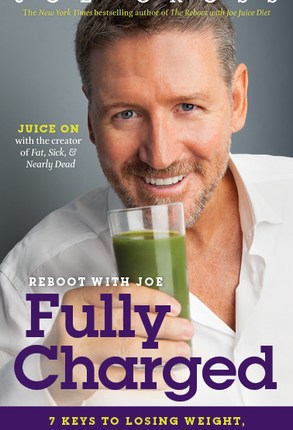
Reboot with Joe: Fully Charged: 7 Keys to Losing Weight, Staying Healthy and Thriving by Joe Cross

Reboot with Joe: Fully Charged: 7 Keys to Losing Weight, Staying Healthy and Thriving by Joe Cross

Fat, Sick, and Nearly Dead is one of the main reasons why I bought a juicer and have attempted to incorporate more plants into my diet. I’m not hardcore about it, but I try.

I didn’t know that Joe from that documentary is named Joe Cross and that he’s written multiple companion books for that film. This one, Reboot with Joe: Fully Charged, is excellent.

What I love about Joe is that he’s realistic. He doesn’t expect that he will eat perfectly for the rest of his life- he just wants to do the best that he can today then repeat the process tomorrow.

Photo by Wendy Wei on Pexels.com

He pushes the big lifestyle changers: diet, exercise, and rest but not in an extreme, unobtainable manner. In addition to common sense ideas about health and diet, Joe has spent years building an online community to support those who are working on major life changes. http://www.rebootwithjoe.com/weight-loss/

When you read this book, you also read examples of people who have turned their lives around with juicing and exercise. It’s inspiring and could be life changing for many people.

I also like that Joe included some of his go-to juicing recipes towards the back of the book. I’ve tried quite a few different juices, but I haven’t found any that I particularly liked. It’s always nice to have some new options that have appealed to other people in the past.

If you enjoyed Reboot with Joe: Fully Charged, I highly recommend his two documentaries: Fat, Sick, and Nearly Dead & Fat, Sick, and Nearly Dead 2. Also, I’d recommend the documentary Forks Over Knives which has a couple companion cookbooks out now.

A big thank you to the Goodreads First Reads program and NetGalley for free copies of this book.  And, thank you for reading!

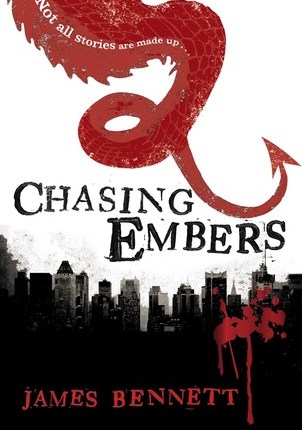
Chasing Embers by James Bennett

Chasing Embers by James Bennett

I seem to be on a dragon themed reading kick lately. And, as far as I’m concerned, that’s awesome!

Red Ben is a dragon, masquerading in human form so that he can walk down the street without everybody freaking out. Hundreds of years before this, he signed a pact called the Lore with a bunch of other magical creatures and knights, in which, he essentially agreed to hide his existence from humanity at large and the knights, in turn, would protect him. Tonight, he was attacked twice. What’s up with that? Ben doesn’t know, but he’s going to find out. He’s also had a falling out with his lady fair. Hiding your true nature from someone doesn’t make for a healthy relationship, but Ben’s enemies seem to know Rose’s (the girlfriend) name. So, now, he has to save his hide, her life, and still preserve the Lore.

Meanwhile, in a desert in Africa, an ancient power is awakening…

I enjoyed Chasing Embers. I really dig the basic premise that there’s a magical world existing alongside ours but we just can’t perceive it. Also, the idea that the Magna Carta wasn’t a political document but a secret, magical pact is fun too.“John, by the grace of God, King of England, Lord of Ireland, Duke of Normandy and Aquitaine and Count of Anjou, doth decree and grant this day, by common counsel of our kingdom, this Pact devised by the Curia Occultus and witnessed by those guardians of our realm. Those Remnants of the Old Lands, which yet linger amongst us, shall forthwith succumb to the Long Sleep…” loc 362, ebook.

The other magical creatures are straight up creepy- like magical creatures should be in my opinion. Also, Bennett seems to ascribe to the Terry Pratchett view that too much magic use thins the veil between worlds and draws attention of the things outside of this world to the magic user, which is also pretty creepy: “The nether wasn’t space, nor the ambient cosmos, but a place that lay beyond, or between, as inner as it was outer. Perhaps it was the raw, empyreal stuff of creation, for all Ben knew. Things lurked in that astral sea, creatures hungry for life, and all magic had its price. When a person drew on the nether- drew on it like a thread in a carpet- they risked unravelling the world entire.” loc 393, ebook.

The romance between Ben and Rose is just the perfect amounts of dysfunction and sparks (nothing graphic in here though for folks who look for such things): “I miss you,” she said, quiet and fierce. “I hate you.” Defeated, Ben rested his head on her shoulder, smoothing down the flowers on her dress. He let her anger hit him like a wave, tasting her muted fury at her love for him. Since he’d first crawled out of his egg, it had always been this way. Some women went for the knight. Others wanted the beast. Neither stood a chance of a happy ending.” loc 711, ebook.

Ben’s angst at his long-lived existence reminded me of Atticus in The Iron Druid Chronicles. He loves deeply but, at the same time, he realizes that those he loves aren’t going to be around that long: “Your love of humans. Do you never grow tired of it? You might as well love a sunbeam that flickers through a cloud. This world was not meant to hold them. Time will take them all so quickly. A blink in the life of a god.” loc 3112, ebook.

What kept Chasing Embers from being a five star read to me is that I thought Bennett explained himself too much. Leave some of the plot mysterious and murky, like magic itself. I don’t need to be spoon-fed why this happened or that happened. Otherwise, this was an excellent read. There’s some language in here and a few disturbing, physical descriptions, but nothing that a mature teen couldn’t handle. Highly recommended for urban fantasy and dragon readers!

Some read alikes: Hounded by Kevin Hearne or Lords and Ladies by Terry Pratchett.

A big thank you to NetGalley and Orbit books for a free, digital advanced reader’s copy of this book for review purposes.  And, thank you for reading!