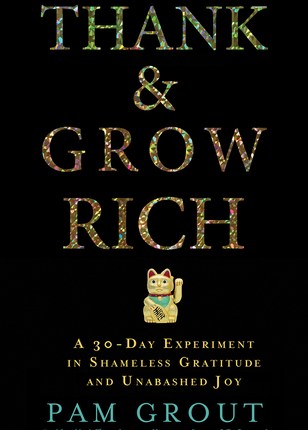
Thank & Grow Rich: A 30-Day Experiment in Shameless Gratitude and Unabashed Joy by Pam Grout

Thank & Grow Rich: A 30-Day Experiment in Shameless Gratitude and Unabashed Joy by Pam Grout

There is a disclaimer written in the description of this book on Goodreads that states it is not for everyone, but it was awesome in my opinion. I am going to admit that I am incredibly biased.
Photo by cottonbro on Pexels.com

I absolutely adored Pam’s other books on New Age thought and had some unbelievable experiences with the experiments recommended in them: E-Squared: Nine Do-It-Yourself Energy Experiments That Prove Your Thoughts Create Your Reality and E-Cubed: Nine More Energy Experiments That Prove Manifesting Magic and Miracles Is Your Full-Time Gig.

However, I couldn’t convince my public library to buy them because, I was told, they are “too fringe”.

Perhaps this book, which focuses on adopting an attitude of gratitude to improve your life, will be mainstream enough to make the cut.

Pam addresses the metaphorical elephant contained in her title early in the book: “No offense to Napoleon Hill, the author of the self help classic on which my title riffs, but the real power is in not thinking. If you want to override your brain’s unfortunate habit of leafing through your past and creating a present hologram to match, forget thinking. And start thanking.” Loc 108, ebook.

I read Think and Grow Rich last year and I could see how other people have beef with the classic. Napoleon Hill focuses on money, making connections, and doing the internal work to shoot yourself into the stratosphere of life success.

There’s very little in there about feeling your way to the same place.

Photo by fauxels on Pexels.com

Pam takes a different approach: “I should get this out on the table right now. This book won’t do a thing for your 401(k) or help you secure the McMansion you pasted onto your vision board. It’s not about getting rich in the traditional sense. … There’s nothing wrong with financial capital, but let me be very clear. It’s incapable of bringing any measure of real happiness.” Locs 324-337 ebook.

She gets to the heart of why seekers chase anything- because we believe that it will bring happiness. Pam suggests getting happy and then the success will come.

And, how does she say that we should “get happy”? By being thankful for what we already have.

“Be astonished by useless things. It’s easy to be thankful for the obvious- healthy kids, public libraries, strong marriages. But in this game we’re going to take it a step further. We’re going to build our gratitude muscle by also appreciating the insignificant and impractical…” Loc 856 ebook.

I had to include that passage for the library mention. Yay libraries!

Photo by Janko Ferlic on Pexels.com

Pam backs up her claims with scientific studies such as: “According to Richard Wiseman, psychology professor at the University of Hertfordshire in England and creator of Luck School, people who think they’re lucky actually are. After eight years of studying hundreds of self-identified exceptionally lucky and exceptionally unlucky people, he concluded that getting good breaks has nothing to do with karma or kismet and everything to do with how we see ourselves.” Loc 991 ebook.

I would like to state for the record that I am one of the luckiest people that I know. 🙂

She also includes a bunch of information from happiness researchers: “When it comes to success, research shows that while IQ, education, and training play cameo roles, the starring role, the headliner on the success stage, is “Do you have a vision? Do you believe it’s possible?” Shawn Achor, author of The Happiness Advantage: The Seven Principles of Positive Psychology That Fuel Success and Performance at Work… claims that predicting success using any other factor (say, your IQ or number of degrees) is about as effective as flipping a coin. What is effective, Achor and Frederickson and other happiness researchers have proven, is creating a happy brain that anticipates accomplishment, that knows success is just a matter of time.” Loc 1876 ebook.

I know that I have a pretty open mind when it comes to these types of books, but my thought is, what’s the harm in it? If it works for you, great! You’ve just discovered a new tool to use for living the best life for you.

If it doesn’t work, no harm done. At the very least, you would know for yourself.

Photo by Belle Co on Pexels.com

I recommend this book for readers of the Abraham Hicks materials because there are quite a few similarities in the philosophies contained within.

Some additional read-alikes for seekers like me who can’t get enough information about the law of attraction: The Power of the Heart: Finding Your True Purpose in Life, Happiness: A Guide to Developing Life’s Most Important Skill, or Dr. Quantum Presents: Meet the Real Creator–You!.

The opinions contained within this review are entirely my own. Thank you to NetGalley and Hay House for a free advance reader’s copy of this book for review purposes!  And, thank you for reading.

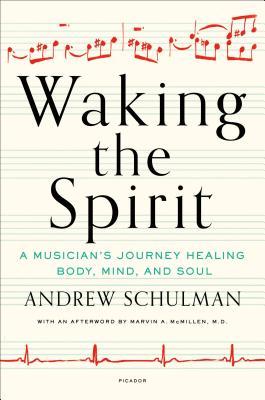
Waking the Spirit: A Musician’s Journey Healing Body, Mind, and Soul by Andrew Schulman

Waking the Spirit: A Musician’s Journey Healing Body, Mind, and Soul by Andrew Schulman
wakingspirit

Waking the Spirit is an educational and uplifting look at music therapy from a world class musician who, not only plays for a critical care unit at a hospital, but was also saved by music himself.

I’ve always known about the healing power of music for the spirit, but I didn’t realize that it had such marked effects on the body itself. When I’m having a bad day or just need to relax, I plop down in front of the piano and play the stress out.

What I did not know, and that Andrew discusses at length in this book, is that music has been used throughout history to treat sick people and the astonishingly positive effects that it has on the critically ill.

The idea behind music therapy in the ancient world is that everything is vibration.

If you play harmonious and balanced music, the human body will, in turn, put itself into harmony and alignment. Sickness was viewed as a simple imbalance: “Early records have been discovered from ancient Egyptian medicine, Babylonian medicine, Arurvedic (Indian subcontinent) medicine, and classical Chinese medicine that incorporated musical healing. The ancient Greeks valued the relationship between music and medicine in the god Apollo, whose gifts included both the musical and healing arts, and the first use of the term “musical medicine” began with Pythagoras, the fifth-century philosopher-mathematician. The Romans are said to have used musicians in their battlefield hospitals as a form of anesthesia.”

Before I read this book, I didn’t realize that music therapy was even a “thing” in hospitals.

It seems like, at least here in the U.S., and this is entirely my opinion, that medicine has moved ever so much farther away from holistic treatments. The preference is for high cost drugs and highly educated doctors to perform surgery… something concrete that people can hold in their hands and say, “Look! This is what I paid for. This thing right here.”

If something, like music therapy, works, but we can’t explain why it works, then people don’t value it as much. That’s where Waking the Spirit comes in.

Andrew provides tons of examples of beneficial music therapy treatments as well as studies to back up his real life experiences. I think this book could be helpful to doctors, nurses, or anyone who is looking to try something inexpensive to make the environment within their institution more appealing.

Take this experience: the patient was in pain and talking to herself (a side effect of the brain surgery she had just undergone). Then, Andrew shows up with his guitar: “At the sound of the first note she turned her head toward me, looking at my face and then at my right hand as it plucked the strings of the guitar. Gone was the scattered expression from her face as her eyes gained focus. She stopped talking, her mouth half-open in surprise, silent. Her face and shoulders relaxed, and she smiled. Not the plastered grin of before but a real smile of pleasure. She was here now, in this room, and not wherever she’d been for the past few hours. Something was connecting. We were just ten seconds into the music.” Powerful.

“Over the years, I’ve witnessed the most remarkable ways in which music can help the healing process, the ways it can calm a patient or lift their spirits, or reach them when they seem locked in a place that no one else can access. It can soothe a staff member’s exhaustion or anxiety and let them refocus on helping a patient, and it can provide a connection for a patient’s family, perhaps bring back old memories and open pleasant topics of conversation.”

Bringing beauty and dignity back to medicine with music.

In this passage, Schulman is talking to Dr. Richard Kogan, a professor of psychiatry, about how just the act of composing music has soothed individuals who are suffering from mental illness and then, their masterworks have gone on to help others: “While it’s important not to overromanticize mental illness- most depressed individuals are too paralyzed to write a symphony and most psychotic individuals are too disorganized to produce a work of art that is coherent- the suffering associated with mental illness can led to bursts of creative inspiration that are less likely to come from an individual that is emotionally content. For many of the greatest composers, music has been profoundly therapeutic.” In other words, artists who used their music to alleviate their own suffering composed some of the greatest music ever written, which in turn as the effect of ameliorating the suffering of others.” It’s a circle of healing.

You don’t have to be a musician to fully enjoy Waking the Spirit. I recommend it for anyone who’s interested in non-traditional treatments for pain and suffering. Thank you to NetGalley and Picador for a free digital ARC of this book.

Thanks for reading!

The Red Queen by Christina Henry

The Red Queen by Christina Henry

redqueenThe second book in The Chronicles of Alice is scheduled to be published on July 12th.

Though it lacked the grittiness and extreme horror of Alice, Red Queen is a fantastic second effort by Henry. We’re reintroduced to Alice and Hatcher as they escape the City and make their way into the wilderness, on a hunt for Hatcher’s long lost daughter, Jenny. Magic, danger, and monsters wait on the path ahead, but those things are nothing compared to what Alice and Hatcher bring with them in their own damaged and twisted minds.

Cheshire, one of my favorite characters, gives a quick summary of the first book in the beginning of this one, in case you didn’t get a chance to read it:“Hatcher and Alice escaped from the hospital, and traveled through the Old City in search of their pasts and in search of a monster called the Jabberwocky who made the streets run with blood and corpses.” The girl shuddered. “I know about him… What about Alice? Did she have a happy ending?” “I don’t know,” Cheshire said.”

Henry weaves enough of the classic tale into her story so that you know that it is a retelling, but still manages to introduce enough original elements in to make it feel entirely new. Like the toll that magic takes on the people who wield it, something that Carroll never addresses: “Maybe power corrupts them,” Alice said. It was a frightening thought, one that made her suddenly reluctant to try any magic at all. She’d spent years under the influence of drugs that made her think she was insane. She was only just learning who Alice was, what it was like to be her own self. She would rather use no magic at all than become some one unrecognizable.”

The world that Hatcher and Alice inhabit feels like the real world in that, there are no guarantees of happily ever after for the main characters. It’s reminiscent of George R.R. Martin in that, Henry makes you feel truly concerned that either Alice or Hatcher are going to be struck down at any moment. But, Henry actually manages to tell a story in 300 or so pages, something that Martin can’t do. Not that I’m bitter or anything… : “The world gobbles us and chews us and swallows us,” Hatcher said, in that uncanny way she had of reading her thoughts. “I think happy endings must be accidents.” “But we hope for them all the same,” Alice said.” I do too.

Alice really comes into her own in this story. She’s brave, but fragile- a damaged hero but resilient. If you’re looking for a strong female protagonist, you’ll find one in this book: “Alice thought, my magic doesn’t seem to be good for much at all. And there is no one who can help me learn, for all the Magicians I have met have been mad or cruel or both. I was mad once too, but it doesn’t seem to have taken properly. I didn’t come out of the hospital with any powerful powers.” Or did she?

This passage summed up the book for me: “This is really all very strange,” Alice murmured. “One of the strangest things I’ve seen, and I have seen lots that is strange. More than my fair share, as a matter of fact.”

Highly recommended for adult readers who enjoy dark fairy tales, magic, and transformation through suffering. I’ve really become a fan of Henry and I can’t wait to see where she takes this story next. If you enjoyed this tale, you may want to try The Library at Mount Char by Scott Hawkins or The Circle by Mats Strandberg.

Thank you to NetGalley and Ace Publishing for a free digital ARC of this book. And, thank you for reading!

The Light: A Modern-Day Journey for Peace by Judith Lambert

The Light: A Modern-Day Journey for Peace by Judith Lambert

In The Light, Judy, the author, chronicles her dreams and her search through various countries and cultures for their ultimate meaning. She calls this book, a memoir, with some pieces changed to protect the privacy of the people involved.

I found it to be an engaging look into the life of a spiritual seeker and a fascinating comparative study of all religions, their symbols, and common meanings.

Judy talks to a librarian named Bill about symbols: “I’ve been having some dreams with symbols that seem to be very powerful and consistent, and I’m wondering whether these symbols have a history or a larger meaning…” “Oh, yes, absolutely,” he broke in. “All symbols have a history and a commonality. There’s no question about that… Images are the means people must employ to understand ideas and feelings. Without them, we cannot reason… but, you see, we often don’t know where these symbols and images come from, do we? We forget their origin and the long history of their use, until we end by thinking that the symbol is the thing itself!”

I’ve heard it said that all symbols are mere pointers. It is like a man trying to draw our attention to the moon by pointing at it, but we mistake the moon for the finger doing the pointing.

Photo by Aron Visuals on Pexels.com

A beautiful description of the chaos at the river, Ganges: “Over the course of the day, blessed pilgrims gathered at Mother Ganga to wash away their sins. Motionless holy men sat absorbed in rumination, their faces turned toward the sun in celebration of the endless cycle of mornings like this. The striking of wet clothing against the steps was accompanied by the distant ringing of temple bells, whose pitch and resonance varied with the preciousness of the material from which they were made- bronze, brass, or iron. And over it all hung a fetid haze smelling of smoke and of- well, I didn’t want to think what else.”

I enjoyedThe Light because Lambert made me feel as if I was there beside her in her spiritual wanderings. I enjoyed the travel parts of this book very much.

The City of Light: “…The Gita,” now he looked out at the Ganges, “speaks of a radiant river of light. Westerners.. well, they often see a surface, and then they have no idea how to look beyond that surface.” He gestured as if to indicate the whole city. “This is the City of Light. Is this not what you were looking for? I do not mean any disrespect, madam,” he hurried on before I could react, “but if one cannot see the Light here, then one has not looked long enough.”

A description of inner illumination: “Nothing changed. Or everything did, for though monk, mandala, walls, cushions, and robes all seemed to remain the same, I felt at last- and only for an instant- the sense of peace that had eluded me since my dreams began.”

Photo by Pixabay on Pexels.com

The author changes immensely over the course of her journey: “I feel a reassuring contentment from all I’ve discovered and all that I’ve been privileged to learn. I am a Jew, a Christian, a Hindu, a Muslim, a Buddhist, everything else, and nothing, all at once. I am…whole… And I believe that all religions possess and have knowledge of the Light. By claiming the Light myself, I can also retain my own personal stories, my own place, and time, and history…” An empowering message and a timely one.

If you enjoyed The Light, you may want to pick up The Realization of Being by Eckhart Tolle (a lecture, any of his talks are along this subject line) or The Invisible Hand: Business, Success & Spirituality by David Green (a memoir about another spiritual seeker and how he found the “Light”).

Thank you to NetGalley and Ann Duran Productions for the opportunity to read and review a digital ARC of this book!  And, thank you for reading.

The New Science of the Paranormal: From the Research Lab to Real Life by Carl Llewellyn Weschcke & Joe H Slate, PhD.

The New Science of the Paranormal: From the Research Lab to Real Life by Carl Llewellyn Weschcke & Joe H Slate, PhD.

Carl Llewellyn Weschcke died last year- may he rest in peace. I eagerly looked forward to reading The New Science of the Paranormal, one of his last (I’m guessing) books that we will ever see from him.

The primary message in here is one of self empowerment and the potential for anyone to develop powers that could be considered “paranormal”. What an appropriate departing lesson from a man who ran a publishing firm dedicated to bringing the occult and mysterious to light.

Photo by Rafael Guajardo on Pexels.com

The New Science of the Paranormal isn’t an “easy” read in that it includes a lot of tables and metaphysical philosophizing about the new age and levels of spiritual evolution.

To me, the most engaging bits were the accounts of students and researchers trying to swing a pendulum with their minds or use dowsing rods to predict the gender of unborn babies.  The scientific experiments that were included are fascinating in their implications.

Also, many of the techniques like water gazing and hand prints in the sand are not ones that I had been exposed to. I’ll definitely be trying some of this out on my own.

“The objective study of paranormal power can dispel many of the myths and “stories” surrounding the topic, including the belief that very few individuals possess paranormal powers. Although certain individuals, often called “advanced beings” or “gifted psychics”, may appear to be extraordinarily empowered, everyone to some degree possesses paranormal potential. Not unlike intelligence, the distribution of paranormal potential within the general population seems to occur in a so-called “normal curve”…

Photo by Lucas Pezeta on Pexels.com

Empowerment: “We are more than we think we are, but we don’t know we are until we develop that level of awareness and related sense of perception. We must grow to become more than we are and all we can be.”

Water gazing, who knew? : “Validated in the lab setting and successfully applied beyond the lab, water gazing is among the most effective self-empowerment techniques known. Whether to increase creativity in writing and art, activate telepathic sending and receiving, facilitating clairvoyance, improve memory, promote successful goal attainment, or generate a state of mental, physical, and spiritual attunement, the powers of water gazing appear to be without limits.”

Photo by Anastasia Shuraeva on Pexels.com

The Crumpled Paper technique was also surprising in its incredible amount of potential uses. Actually, this whole book kind of blew my mind. Perhaps I was dreaming too small.

A bit reminiscent of Abraham Hicks: “…one simple self-administered procedure is: Pay Attention to Your ‘Feelings.’ By that, we don’t mean to get all emotional when ‘feeling’ an idea, concept, event, situation, person, etc., but rather to analyze: what your feelings are telling you, what is it you are sensing, what is the basis for your emotional reaction, etc. And then let yourself explore the ‘answers’ to those questions.”

Know thyself. A message as old as the Delphic oracles.

I’ll close with a quotation included in Chapter Twelve: “Not in the clamor of the crowded street, Not in the shouts and plaudits of the throng, But in ourselves are triumph and defeat.” Henry Wadsworth Longfellow, “The Poets” (1876)

Thank you to NetGalley and Llewellyn Publishing for a free digital ARC of this book!  And, thank you for reading!

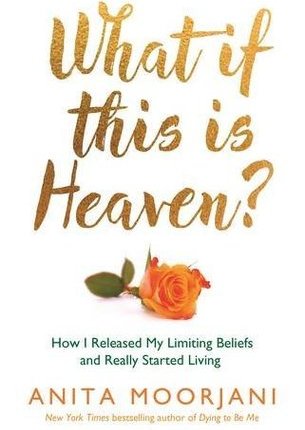
What if This is Heaven?: How I Released My Limiting Beliefs and Really Started Living by Anita Moorjani

What if This is Heaven?: How I Released My Limiting Beliefs and Really Started Living by Anita Moorjani

I was so excited to read What If This Is Heaven?: How I Released My Limiting Beliefs and Really Started Living. Moorjani’s first book, Dying to Be Me, was one of the first accounts of near death experience that I read. In it, she details how she was on her death bed, experienced the world beyond, and then came back to fulfill her life’s purpose.

When she came back, the tumors in her body disappeared and she’s been fine ever since.

It’s an astonishing and uplifting reminder of who we are as eternal beings and why we’re all here. What If This is Heaven is a continuation of this message in that, now, Moorjani is a teacher and lecturer on the topics of spirituality, healing, and self actualization. It’s wonderful.

And, it’s different enough from the first book that readers don’t feel like they’re re-reading the same messages. Moorjani has evolved and I’m very interested to see where life takes her from here.

Here are some passages that I loved:
“A major reason why I chose to return to this life during my NDE (near death experience) was because I understood that heaven is a state and not a place, and I wanted to experience, firsthand, the heaven that this life could actually be.”

“Remember, your only work is to love yourself, value yourself, and embody this truth of self-worth and self-love so that you can be love in action. That is true service, to yourself and those who surround you.”

“On the physical plane, we see love as an emotion, something we have for some people and not others. But the truth is that unconditional love is a state of being, and it’s our birthright. Once we begin to tap into that, we realize is has the power to transform all of our relationships simultaneously- including our relationship with ourselves- for the better.”

“… illness is our body’s way of communicating with us and showing us a better path. Yes, we may die from cancer- or from countless other things- and each of us will die from something at some point. But death is not the enemy. What often is the enemy is the way we view illness…”

Some fascinating teachings about the positive aspects of the ego are included in here: “The ego gives us our sense of identity, our individuality. It’s what allows us to know who we are as individuals and to express our uniqueness. If our ego weren’t necessary, we wouldn’t have been born with it.”

There’s so much more to enjoy in What if This is Heaven beyond these small bits. I highly recommend this read for spiritual seekers and those who are interested in self actualization.  If you enjoyed this book, you may want to read Moorjani’s other book, Dying to Be Me or Co-creating at Its Best: A Conversation Between Master Teachers by Wayne Dyer and Abraham Hicks.

A big thank you to NetGalley and Hay House for the opportunity to review this book!  They sent me a free digital ARC for review purposes. And thank you for reading!

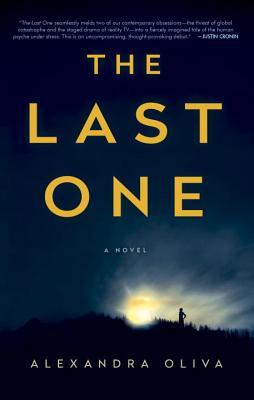
The Last One by Alexandra Oliva

The Last One by Alexandra Oliva

Twelve contestants go on a survival reality show.  It’s a brutal competition and the only way off the show is to say the safe word.  While the filming is taking place, something terrible happens in the real world… and no one tells the contestants.  Will any of them survive?  And, if they somehow survive, will they have a home to go back to?

In the book blurb, The Last One is compared to Station Eleven and The Passage neither of which I liked very much. I thought Station Eleven was boring and The Passage is the Game of Thrones of dystopian literature, it goes on and on and on… Unlike the other two titles, I think that The Last One got the mix of action to number of characters just right. If I had to pick the book that I think it’s most like, I would compare it to Oryx and Crake by Margaret Atwood but with far more like-able characters and a much more optimistic world view.

The Last One is told through a first person, present narrative and a third person flashback, alternating viewpoints between chapters. I was a bit frustrated with that set up until the timelines began to converge towards the end of the book, because Oliva kept putting in foreshadowing, but then not delivering on it until a couple chapters later- just long enough for me to completely forget about it. I’m much more of an instant gratification kind of reader, but I managed to push through it and really started to enjoy the novel despite the style of storytelling.

Mixing reality television with the end of the world was brilliant because the mind set of the people in the reality shows is already in survival of the fittest/game mode. I completely believed the mental breakdown that Zoo suffered when she tried to figure out where the game ended and reality began. She was put in a situation where she wasn’t supposed to know what was going on and then, she didn’t even know when exactly, no one knew what was going on. This type of world ending felt much more believable than the descent into chaos in World War Z or Station Eleven because of that slow transition to a different world provided by the reality tv show setting.

Also, anyone who’s ever watched reality tv will immediately grasp the archtypical roles that Oliva uses to label her characters and it makes it simple to keep a rather large group of people straight in your mind. Fans of Big Brother, Top Chef, The Jersey Shore, and any of the countless other offerings of that genre will eat this up.

What I loved most about this book is that it was so easy to put myself in Zoo’s shoes. In this passage, she’s talking about her reluctance to go on the show: “It didn’t used to be so difficult to leave, but it was different before I met my husband. Before- leaving Stowe for college, that summer hiking hostel to hostel across western Europe, six months in Australia after graduating from Columbia- my fear was always tempered by excitement enough to tip the scales. Leaving was always scary, but it was never hard. But this time I not only left familiarity behind, I left happiness. There’s a difference, the magnitude of which I didn’t anticipate.”advance reader, pg 24-25

Cooper, aka Tracker, was also so relatable. He reminded me of various people that I have known in my real life: “Cooper was kind of like that at first. Standoffish. I don’t know what drew me to him so strongly from the start. No- I do. His air of almost freakish competence. The way he scanned each of us, assessing without looking for allies, because from the moment he leapt into that tree it was clear he didn’t need anyone but himself. I bet his entire adult life has been like that: needing no one, being needed by no one- existing without apology and accomplishing wonders. I’d never been around someone so supremely independent before and was fascinated.” advance reader, pg 38

The reality show mentality begins: “Waitress’s animosity doesn’t surprise Exorcist, but Rancher’s agreement does, as do the many nodding heads around the campfire. Briefly, he looks into a camera lens, as though accusing the device of having put the others up to this. Indeed, that’s exactly what he’s doing; he thinks they’re performing- like he is. But the truth is most of the contestants have in this moment forgotten that they’re being recorded. An ancient instinct is kicking in, not so much a survival-of-the-fittest mentality as an unwillingness to carry an able but lazy individual.” advance reader, pg 174

Zoo’s confusion between reality and reality television makes for some really intense, introspective moments: “I wonder how I’m being portrayed now. I know what my role was when we started. I was the earnest animal lover, always cheerful and up for a Challenge. But now? Will they cast me as off my rocker? Probably not; that’s Randy’s role, with his stupid gold cross and his tales of possessed toddlers. But whoever I am now, I’m no longer who I was. I wonder if I can even do that anymore, be that person grinning until her cheeks ache. It was exhausting, as exhausting as this endless trekking, in its own way.” advance reader, pg 185 After awhile, I started to wonder if Zoo would ever accept what was really happening to her or choose to keep soldiering on and never come back from the world that she was building in her head. I liked her enough though, that I was cheering for her sanity, every step of the way. That’s the sign of a good book, I think.

Finally, I loved this moment, when Zoo’s happy mask begins to crack on the television show and how she’s received: “Waitress is shocked, as are Rancher and the camerman. The producers will be shocked too, and the editor, who will work so hard to explain away this moment. But there is at least one viewer who won’t be shocked: Zoo’s husband. He knows this secret competitive side of her, her impatience for wallowing and delay. He also knows how fear can turn her mean.” advance reader, pg 221. Ah marriage, the ultimate reality show.

There’s a lot more to The Last One that I’m not going to talk about here because I don’t want to spoil anything for anyone. It’s a great book. I recommend it for readers who enjoy dystopians, for television watchers who enjoy reality shows, and for anyone who has ever wondered about their capacity to survive the end of the world. Could you be as strong as Zoo? Could I? I wonder…

Thank you to the Goodreads First Reads and NetGalley for advance reading copies of this book.  And, thank you for reading! The full text of this review has also appeared on my public library’s blog : ofplblog.info

Awakening from the Daydream: Reimagining the Buddha’s Wheel of Life by David Nichtern

Awakening from the Daydream: Reimagining the Buddha’s Wheel of Life by David Nichtern

Awakening from the Daydream: Reimagining the Buddha’s Wheel of Life is an accessible and modern reworking of the Buddhist Wheel of Life.

I took a course on Buddhism in college (seems like a million years ago now) and I remember being deeply affected by the Wheel of Life then- the original version.

For thousands of years, Buddhist practitioners have been studying the mind, how it perceives the world, and how it creates a perpetual cycle of suffering. The original Wheel captures this in extraordinary detail. David Nichtern’s re-imagining of it is brilliant.

Photo by carol wd on Pexels.com

I think that this could be very helpful for many people. It’s similar to artists updating and customizing Tarot decks. Sometimes, new images spark new ways of looking at situations and new solutions arise.

Nichtern is clearly an expert on this topic but he never ventures beyond the basics of the teaching into spaces that beginners can’t grasp. His philosophic writing is understandable and relatable. I appreciated that because not all Buddhists texts are simple reads- Stages of Meditation by the Dalai Lama comes to mind.

“Tradition says that the Buddha directed the creation of the original Wheel painting, which he commissioned as a gift to teach Dharma to an Indian king. When the king who received the painting contemplated it and fully understood its meaning, he attained enlightenment- he brought the suffering caused by unconscious habitual patterns to an end… The image of the Wheel survives not just because it sustains tradition, but because the message it conveys is powerful and timelessly relevant.”

Nichtern reminds us in this book that Buddha gave the painting to a king not a monk. This shows that we can live in the world and also transcend it. These teachings are for everyone.

Photo by RODNAE Productions on Pexels.com

Nichtern discusses the Buddhas contained in each part of the picture- in the suffering areas and outside of it: “There is also usually a Buddha standing outside of the Wheel, representing transcending the six realms altogether. Such people are said to be free from imprisonment in the six realms- free of karma- and only appear in the six realms in order to teach and liberate the beings within the realms out of compassion. Sometimes we are fortunate enough to meet people who remind us of this kind of possibility.” People, I would say, like Nichtern himself.

How to find opportunity in the midst of suffering: “The abject misery that we experience in the hell realm mindset offers us the opportunity to relate to the suffering of others… This isn’t to say that we simply forgive the harmful behavior of others. Instead, we can use our own intense experiences of hatred or depression to realize a deeper truth about all of us living beings in general: none of us are immune from this.” None of us.

Nichtern offers meditation practices for beginners or more experienced folks. Here is a snippet of his advice: “…it is good to help manage people’s expectations. Meditation can include boredom, irritation, discomfort, frustration, grasping, aggression, a discursive waterfall of thoughts and emotions coming and going, and perhaps occasionally a sense of peace and acceptance of things as they are. In a nutshell, it can and will include all the aspects of who we are and of what our lives are actually made.” He also offers concrete suggestions on how to find instructors.

I recommend Awakening from the Daydream for anyone interested in Buddhism, at all levels of knowledge, but this would probably be most helpful for beginners to intermediate practitioners.

Some books that cover similar topics that you may want to check out: You Are Here: Discovering the Magic of the Present Moment by Thích Nhất Hạnh, Happiness: A Guide to Developing Life’s Most Important Skill by Matthieu Ricardo, or The Buddha Walks into the Office: A Guide to Livelihood for a New Generation by Lodro Rinzler.

Thank you to NetGalley and Wisdom Publications for a free digital copy of this book and thank you for reading!

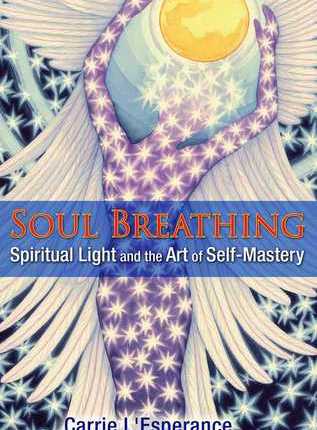
Soul Breathing: Spiritual Light and the Art of Self-Mastery by Carrie L’Esperance

Soul Breathing: Spiritual Light and the Art of Self-Mastery by Carrie L’Esperance

An incredibly ambitious book, Soul Breathing: Spiritual Light and the Art of Self-Mastery covers most major spiritual topics- from chakras to meditations and the evolution of the soul to aliens.

With this very diverse amount of material, readers are certain to find at least one chapter or section that resonates with them.

Photo by Egor Kamelev on Pexels.com

Unfortunately, he or she will probably also discover something that doesn’t, which is just fine, because as Carrie points out in this book, everyone experiences the “Universal Mind” in a different way.

What is enlightenment? In the author’s own words: “Enlightenment is a way of freeing oneself from ignorance in order to act, operate, and contribute as a Light in the world. It is through the balanced integration of body, mind, and spirit that a deeper and more profound Intelligence is expressed.”

The vocabulary in Soul Breathing is definitely New Age, but the reader doesn’t have to have any background in that to understand what Carrie is talking about. She starts out with a bit of her personal history and then jumps into general teachings about the soul and transcendence, which I found to be very reminiscent of Eckhart Tolle’s A New Earth.

After that, Soul Breathing goes in a bunch of different directions, which I didn’t enjoy nearly as much as the opening few chapters.

Photo by Jill Wellington on Pexels.com

What is Soul Breathing anyway? “Soul Breathing is the ability to create a balanced life on Earth through a conscious connection to Spirit. It is a state of grace achieved through action and experience.”

Carrie L’Esperance is at her strongest when she’s relating personal stories or giving concrete instructions- like specific affirmations or methods of meditating to support positive spiritual change.

I felt that Soul Breathing stumbled in the parts where Carrie talks about what is wrong with the world or how things have gone so badly. (The rampant energy pollution and government-alien conspiracy sections come to mind.)

All personal stories of spiritual or the otherworldly have value as Carrie reminds us: “There have always been the unbelievers and the hyperrational scientific intellectuals who attempt to devalue what for some people are the most powerful, transformative, and sacred experiences of their lives. In truth, there is really no one who can denigrate the authentic spiritual experiences of the individual.” I would add, except his or herself.

I thought that this book with its myriad of suggestions and prohibitions would be impossible for anyone to ever implement in their lives in a manageable way.

Photo by Chermiti Mohamed on Pexels.com

Carrie says: “We don’t have to dissect every aspect of how and why we exist in order to appreciate the miracle of life. We can experience all that is needed in the natural stages and steps that we take along the way. Ultimately we are to choose what capacities we will develop within the laws of existence.”

Despite that passage, Carrie seems to be a very demanding teacher.

It is clear that Carrie is passionate about spiritual, physical, earthly, and even galactic health and well-being.

Don’t read this book if you are unwilling to have an open mind about all manner of spiritual topics. Do read this book if you’re looking for more information about sensing, managing, and healing with subtle energy in the body, mind, and soul.

Photo by Magicbowls on Pexels.com

Her beliefs about aliens and a grand government conspiracy to control and manipulate the population were a bridge too far for me, but I’m certain that there are some readers out there who will resonate with her teachings.

Perhaps fans of Whitley Strieber or John Keel will enjoy Soul Breathing.

A big thank you to Netgalley and Bear & Company for a free digital Advance Reader copy of this book for review purposes!  And, thank you for reading.