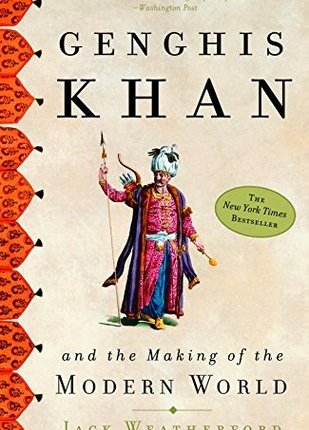
Genghis Khan and the Making of the Modern World by Jack Weatherford

Genghis Khan and the Making of the Modern World by Jack Weatherford

“Fate did not hand Genghis Khan his destiny; he made it for himself.” pg 9, ebook

Author Jack Weatherford follows the Mongol empire from Genghis Khan to his grandson, Khubilai, and on to the distant descendants and faded glory of a once-great kingdom.

The early years of Genghis Khan’s life were the most interesting part of this book. However, this history relies on a single text, The Secret History of the Mongols, which was written in code, filled with exaggerations and inflated numbers (perhaps as propaganda) and still has not been thoroughly interpreted.

Photo by Mathias P.R. Reding on Pexels.com

So, Genghis Khan, the historical personage, remains a shadowy figure. On the other hand, Weatherford opines that Genghis Khan’s empire had long lasting effects even to the present day.

“Seemingly every aspect of European life- technology, warfare, clothing, commerce, food, art, literature, and music- changed during the Renaissance as a result of the Mongol influence.” pg 14

Because the Mongols subjugated so many people, they controlled huge areas of the world and facilitated trade among different kingdoms. Weatherford writes that the Mongols didn’t press their culture upon the peoples they conquered (like the Romans) but adopted and adapted pragmatic customs and manners of civilization from everybody they ran into.

This diversity made the empire strong. For a little while.

But as the years passed, Genghis Khan’s descendants began to suffocate under the weight of this sprawling empire. They squabbled among themselves and spent lavishly on entertainment and comfort.

Photo by Pixabay on Pexels.com

Their social policies weren’t as open as their patriarch’s. Notably, some of the rulers began to torture and abase their enemies, something that was not practiced during Genghis Khan’s time according to Weatherford.

Plague further divided the empire as the world’s populations decreased and trade faltered. The empire’s ending wasn’t a clear cut cessation, but more of a slow descent into darkness.

As a student of history, I was fascinated by the relatively recent disappearance of Genghis Khan’s Spirit Banner, a ceremonial spear with strands of horse hair braided atop it. It was a potent symbol of the Mongol’s strength and leadership.

“Somewhere in the 1960s, eight centuries after the birth of Genghis Khan, his sulde, the Spirit Banner that he had carried across Eurasia, disappeared from where the Communist authorities had kept it. … others hope that just perhaps the sulde lies forgotten in some dusty basement or bricked-up room from which it will, one day, be brought out to lead and inspire the Mongols once again.” pg 199, ebook
Photo by David Bartus on Pexels.com

Rather like the Arc of the Covenant at the end of an Indiana Jones movie.

Genghis Khan arguably wasn’t the only conqueror whose empire shaped the modern world, but Weatherford has convinced me that he’s one of the big ones.

Recommended for readers who love history, particularly Mongol military history, as this book is heavy on that.

Thanks for reading!

Lean In: Women, Work, and the Will to Lead by Sheryl Sandberg

Lean In: Women, Work, and the Will to Lead by Sheryl Sandberg

Sheryl Sandberg stresses the need for collaborative approaches and teamwork because both strategies lead to greater success and gender equality in business. She then takes that idea a step further and ventures to say that if this collaborative model could be applied both on the job, in relationships, and at home that this could change the world.

It probably could. I’m certainly willing to give it a try.

Photo by RF._.studio on Pexels.com

The part of Lean In that I was most receptive to was the discussion about the Queen Bee syndrome of females in upper management and how, sometimes, women keep other women down because of the attitude that “there can only be one”.

Probably because of my background, I’ve always approached friendships with other women with the mind set of a “world family” and do my best to help others with their needs in whatever capacity I can. I have rarely found a friend or business associate who responds with the same level of support. I suspect that this tendency in life to look out for number one is caused by the lack of unconditional love that a supportive family unit provides first developmentally as a child and then into adulthood.

It is no wonder that women, if made to feel inferior to other family members at home, react in an aggressive way when “competing” with other females on the job rather than reaching out a hand in welcome.

Photo by Tima Miroshnichenko on Pexels.com

I was fortunate to grow up in an all female household (plus Dad) so gender equality wasn’t an issue that I ever had to consider until I had a child of my own and had to make decisions about work and childcare. My sisters and I weren’t compared to brothers or ever told that we couldn’t have something that we wanted or be successful simply because we were female.

In fact, my mother’s father was on the forefront of the integration of females into the Air Force. He gave his daughter a male name (Allyn) because his thinking was that gender equality was going to shift to a more equal stance during her lifetime. But, it was going to take some time for attitudes to change. In the meantime, he wanted her resume and career to be judged and advanced on its merits, which, he figured, would be smoother and avoid all the pitfalls of sexism if recruiters thought she was a man.

Photo by Maryia Plashchynskaya on Pexels.com

Clever Grandpa and hooray for me that my mother had a positive, feminist role model for a father.

I’m also lucky in that, because of my many female siblings, I have a ready-made “sisterhood” of support. Many of the issues that Sandberg discusses in Lean In, I’ve encountered, but I was lucky enough to have solutions for in the embodiment of my family. I know that not everyone has that type of support in their career and personal life, and I fully appreciate that I’m spoiled in my lifestyle.

If you enjoyed Lean In, I’d suggest Spinster: Making a Life of One’s Own (a discussion of feminist issues in relationships and marriage) and Artemis: The Indomitable Spirit in Everywoman (a feminist dissection of a few mythological archetypes to empower women through the exploration of the subconscious mind).

Thanks for reading!

Bed Yoga for Couples: Easy, Healing, Yoga Moves You Can Do in Bed by Blythe Ayne

Bed Yoga for Couples: Easy, Healing, Yoga Moves You Can Do in Bed by Blythe Ayne

“If it’s a lazy Saturday morning and you don’t feel like getting up just yet, you can ease into your day with a few shared yoga poses. It’s a great way to feel connected, to hook up your energies and get on the same wavelength.” pg 3, ebook

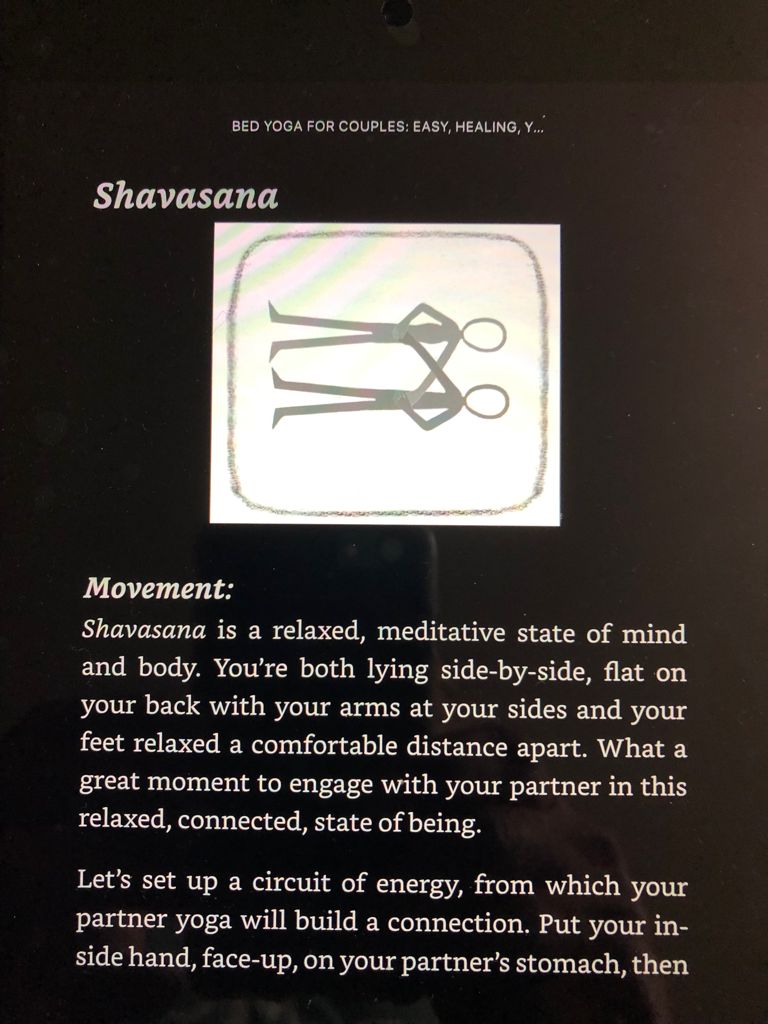
Bed Yoga for Couples is a simple yoga manual for two practitioners that includes stick figure diagrams, brief explanations of each pose, and a few basic breathing techniques.

I’ve practiced hatha yoga for nearly two decades so I was familiar with the poses in this book. However, even if you have zero experience, most are so simple that beginners shouldn’t have any problems either.

That being said, I’m not convinced of the efficacy of the moves while laying down. Part of yoga, at least for me, is experiencing gravity working on different areas of my body while holding the poses. Clearly, this will be very different while on one’s side rather than standing.

But, as the author Blythe Ayne points out, this method of practice is much easier for anyone who has trouble standing for long periods of time or other health issues that make regular yoga practice difficult.

“The most important point for the two of you to remember is that yoga is about you and for you. … Always communicate clearly with one another about any of the poses- if you’d like to go further into the movement, or if you’ve reached your ‘comfort zone.'” pg 4, ebook

Photo by u0410u043bu0435u043au043au0435 u0411u043bu0430u0436u0438u043d on Pexels.com

I could see this book being most useful for couples who are looking for creative and meditative ways to connect. However, it is not an in-depth examination of the subject. If you’re looking for a detailed history of yoga or the poses, you would be best served looking elsewhere.

Yoga has always had that centering and calming effect on me. The only thing that could possibly improve that experience would be to have it simultaneously with a loved one.

Highly recommended. Thanks for reading!

Hildegard von Bingen: A Journey into the Images by Sara Salvadori

Hildegard von Bingen: A Journey into the Images by Sara Salvadori

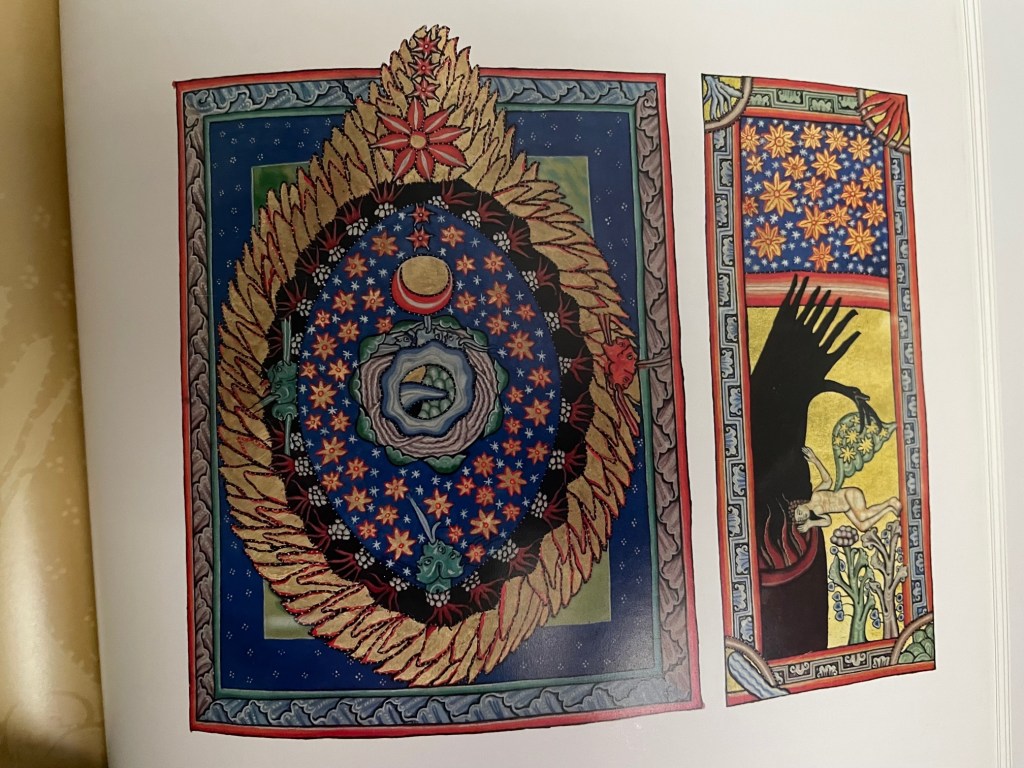
“What I do not see I do not know,” an elderly Hildegard wrote to the Cistercian monk Guibert of Gembloux, describing the visions from which she gained her knowledge of the cosmic, human and divine dimension, from childhood until the end of her life.” From the preface.

Hildegard von Bingen, born 1098-died 1179, was a female mystic of the Christian tradition. She had extraordinary visions, which she recorded, and in her later years, she shared with others.

“The ‘Sybil of the Rhine‘ appears to us in the 21st century as a real woman who developed the many aspects of her femininity: worldly and joyous, learned and visionary, profoundly human yet open to the divine, inclined to dance, friendship and leadership.” pg 6

But this is not all Hildegard accomplished. She also composed the music she heard in these visions. She traveled extensively at a time when travel was not a simple task in order to bring together communities of believers.

All in all, Hildegard was a pretty cool lady who experienced fairly trippy visions.

“Our historical human condition enables us to appreciate her fascinating, layered personality, which made her equally at home with plants and flowers, angelic powers and the virtues that courted them; and capable of dialoging with the powerful of the Earth both inside and outside the Church, without feeling in any way intimidated or inferior.” pg 7

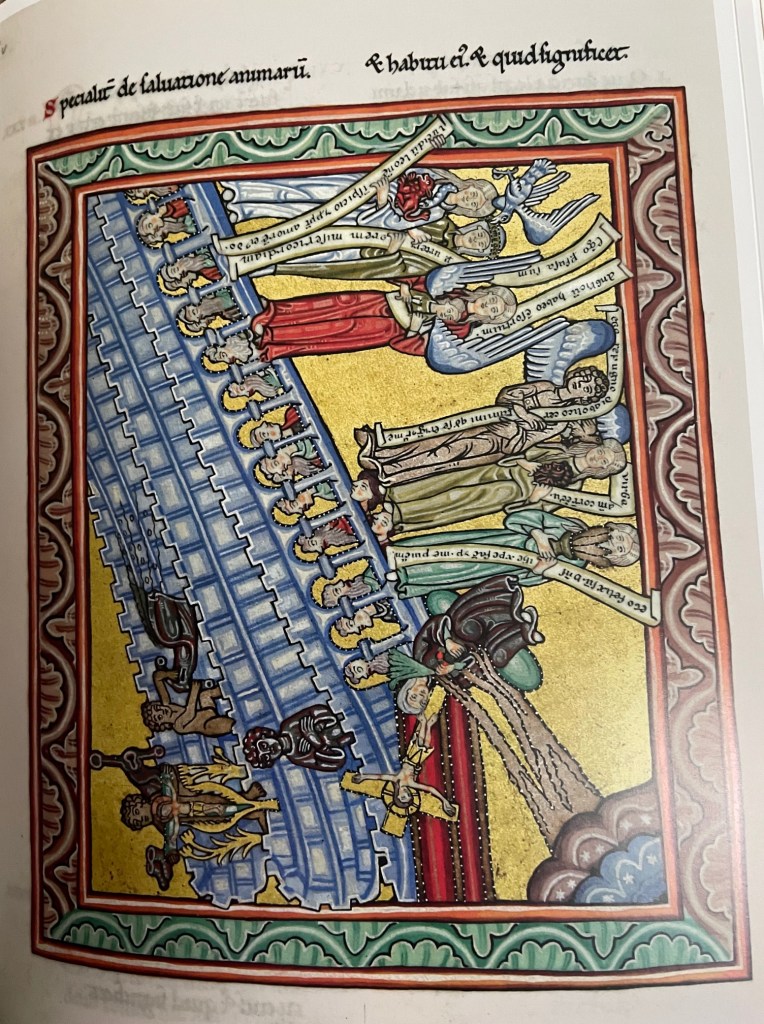
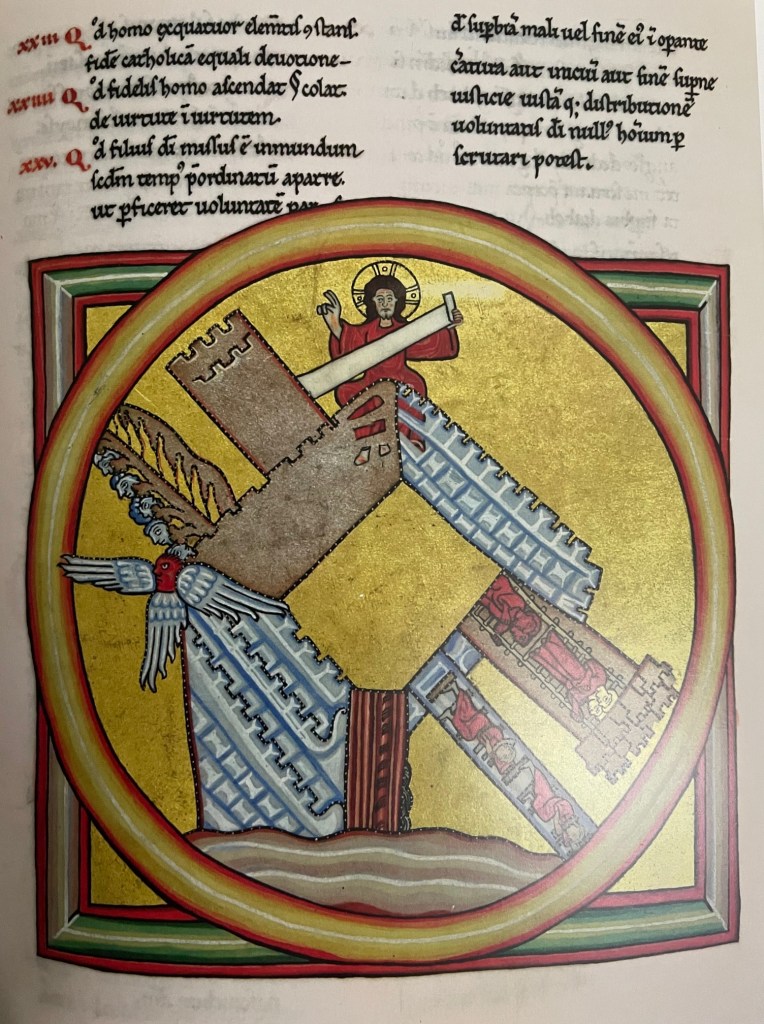
The visions themselves are organized into sections. Hildegard gave each a title, summarized list of chapters, description, explanation and Biblical passages to go along with each. In a time when very few were literate, Hildegard’s illustrated visions were used as teaching tools, similar to medieval bestiaries. (Which I learned about here: Book of Beasts: The Bestiary in the Medieval World)

The colorful visions of Hildegard are meant to be experienced rather than enjoyed second-hand, so I won’t bore you with extensive descriptions about them. But I will share my impression of her work.

I found Hildegard to be transportive. I didn’t understand all of them, but the images speak to my subconscious mind through their beauty and repetitive patterns. “Look at the mystery of existence,” they seem to say.

I think its fascinating that Hildegard was a female mystic in a tradition where the divine feminine was relegated to a backseat role. (No offense meant to the tradition by the way, just an observation.) It makes me wonder where such mystics are today, if they exist.

And if they do, would we listen and learn from them like Hildegard? Or dismiss their experience as a brain malfunction and put them on medication.

Something to consider. Highly recommended for spiritual seekers.

Thanks for reading!

Blood of Elves (The Witcher, #1) by Andrzej Sapkowski

Blood of Elves (The Witcher, #1) by Andrzej Sapkowski

In a fantasy realm where the races of humankind, elves, dwarves, and gnomes have ceased to co-exist peacefully, there lives a princess whose inner power, if left uncontrolled, could destroy the world. Geralt of Rivia, also known as the Witcher, and his friends, are tasked with not only protecting this girl but also instructing her so that her abilities don’t destroy her mind from the inside-out.

“Ciri had heard such reassurances in the past. … Now she believed it. Because it was Geralt of Rivia, the White Wolf, the Witcher, who said it. The man who was her destiny.” pg 11, ebook

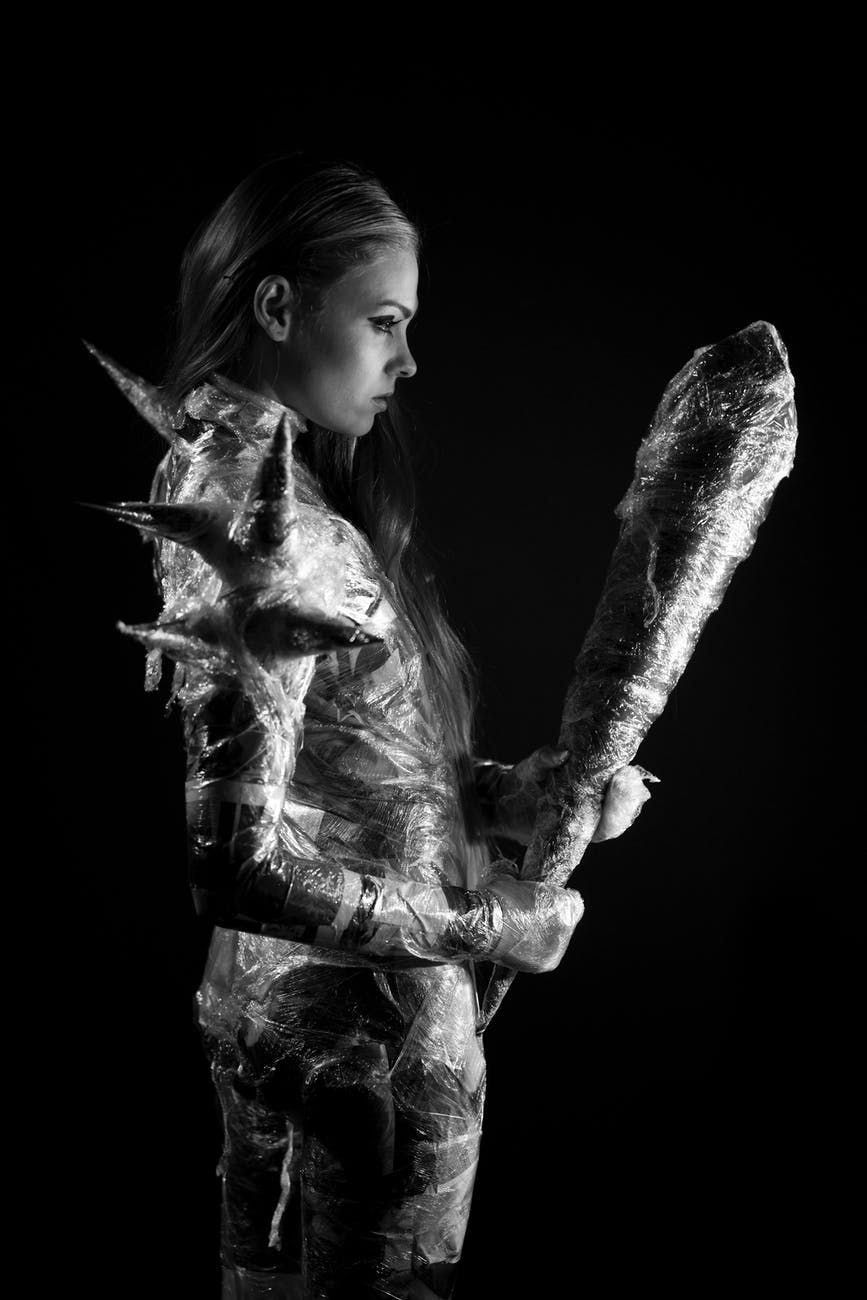
Photo by Lukas Hartmann on Pexels.com

But there are forces in this world who are seeking Ciri for other reasons. She has the potential to be a force for the greater good or a weapon of chaos.

“Difficult times are approaching,” she said quietly. “Difficult and dangerous. A time of change is coming. It would be a shame to grow old with the uncomfortable conviction that one had done nothing to ensure that these changes are for the better.” pg 23, ebook

I picked up Blood of Elves because I recently watched most of the Netflix show based on the video games and also these books. I thought Blood of Elves was the first in the series, but apparently I missed a short story collection prior to this book.

That didn’t lessen my enjoyment of this tale, but I do enjoy having context. Andrzej Sapkowski does a good job of dropping bread crumbs about who Witchers are, who Ciri is, and the complex interactions of the different powers in the world, so newcomers to the book-version of the story, like me, can keep up and it doesn’t feel like an information dump.

“You are not learning in order to kill and be killed. You are not learning to kill out of fear and hatred, but in order to save lives. Your own and those of others.” pg 59, ebook

Photo by Engin Akyurt on Pexels.com

A small complaint though, and I had this same comment about the Netflix show, is that the storyline bounces around quite a lot. If you’re not paying attention, or reading carefully, you’re in danger of losing the thread because this isn’t a simple world nor is it populated by one dimensional characters.

Sapkowski shines in the dialogue between these characters, especially during the action sequences. It is easy to see why a video game was created using this material.

“Remember,” she repeated. “magic is Chaos, Art and Science. It is a curse, a blessing and progress. It all depends on who uses magic, how they use it, and to what purpose.” pg 147, ebook

Highly recommended for fans of the genre, the games or show. Blood of Elves delivers.

Thanks for reading!