The Girl Who Circumnavigated Fairyland in a Ship of Her Own Making by Catherynne M. Valente

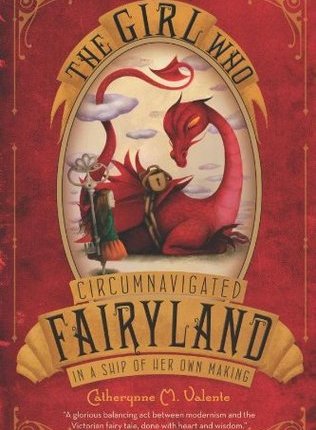
The Girl Who Circumnavigated Fairyland in a Ship of Her Own Making by Catherynne M. Valente

The Girl Who Circumnavigated Fairyland in a Ship of Her Own Making is a modern take on more traditional fairy tales wherein a child finds a way to another world and comes back changed.

Photo by Pixabay on Pexels.com

I first read the title of this book in Catherynne Valente‘s much more adult novel, Palimpsest. I think it was mentioned as sitting on someone’s book shelf. I remember thinking how I wish I could read that book too. Imagine my surprise to discover it was actually a book in the real world. Of course, I had to pick it up.

“You seem an ill-tempered and irascible enough child,” said the Green Wind. “How would you like to come away with me and ride upon the Leopard of Little Breezes and be delivered to the great sea, which borders Fairyland?” pg 2

Photo by Geran de Klerk on Pexels.com

How could any heroine refuse an invitation like that?

The main character of this tale, a girl with the curious name of September, has read enough books to know a once-in-a-lifetime chance when she sees it. Though she doubts, at first, that she is the appropriate girl for the adventure.

“In stories, when someone appears in a poof of green clouds and asks a girl to go away on an adventure, it’s because she’s special, because she’s smart and strong and can solve riddles and fight with swords and give really good speeches, and… I don’t know that I’m any of those things.” pg 14
Photo by Ksenia Chernaya on Pexels.com

Part of Valente’s fairytale, like most good fairytales, is how September realizes how special she actually is — one of the conclusions heroes tend to arrive at during their various journeys.

September’s journey is a danger-filled jaunt through a land under the thumb of a smartly-hatted villain named the Marquess. September meets curious characters along the way including a trio of witches, a wyvern who claims his father is a library, and a boy from under the ocean with dark eyes and a secret.

The story contains plenty of winks and nods to anyone who loves reading: “Stories have a way of changing faces. They are unruly things, undisciplined, given to delinquency and the throwing of erasers. This is why we must close them up into thick, solid books, so they cannot get out and cause trouble.” pg 36

Photo by Zichuan Han on Pexels.com

And: “She sounds like someone who spends a lot of time in libraries, which are the best sorts of people.” pg 55

They are the best sorts, aren’t they.

Recommended for young adults, the young-at-heart, or anyone who enjoys quirky portal fantasy reads. I thought this book was charming.

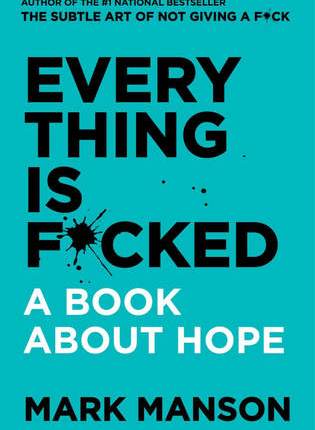
Everything is F*cked: A Book About Hope by Mark Manson

Everything is F*cked: A Book About Hope by Mark Manson

This creatively titled self-help book, Everything is F*cked, presents psychology, philosophy and the author’s view of reality.

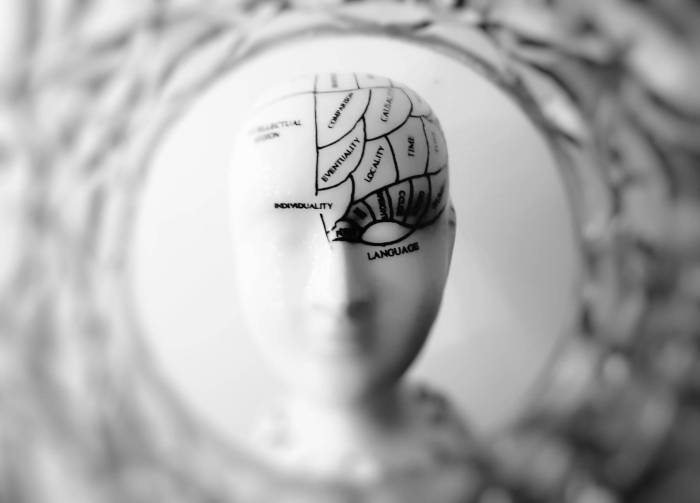
In a series of essays, Mark Manson discusses a variety of topics including the differences between the “thinking brain” and “feeling brain.” He uses Isaac Newton’s laws to create a parallel universe’s version of emotional laws and completes a fairly scathing dissection of religion.

Throughout the various topics, he circles back to the idea of hope and how it can potentially create more problems than it solves.

Photo by meo on Pexels.com

Why did Manson write a book about hope?

“This book is my little source of hope. It gives me purpose; it gives me meaning. And the narrative that I’ve constructed around hope is that I believe this book might help some people, that it might make both my life and the world a little bit better.” pg 15

I did not read Manson’s other incredibly popular title, The Subtle Art of Not Giving a F*ck: A Counterintuitive Approach to Living a Good Life, so I went into this one not knowing what to expect. I found Manson to be particularly adept at breaking down complex topics into simple, easy-to-understand analogies.

For example, here’s his take on the psychological cause of a underlying feeling of unworthiness: “This feeling of unworthiness is usually the result of some bad sh*t happening to us at some point. We suffer through some terrible stuff, and our Feeling Brain decides that we deserved those bad experiences. Therefore, it sets out, despite the Thinking Brain’s better knowledge, to repeat and re-experience that suffering.” pg 46

Photo by Pixabay on Pexels.com

And here’s the analogy he crafts around his explanation of unworthiness: “Put another way, the problem isn’t that we don’t know how not to get punched in the face. The problem is that, at some point, likely a long time ago, we got punched in the face, and instead of punching back, we decided we deserved it.” pg 46

His writing is simple and succinct, which could be incredibly useful for readers who are looking for more information about the self help topics presented. I didn’t particularly care for Manson’s overall style, but that’s a personal preference rather than a commentary on the value of what he’s discussing.

“The stories of our future define our hopes. And our ability to step into those narratives and live them, to make them reality, is what gives our lives meaning.” pg 70

Photo by Engin Akyurt on Pexels.com

I think this author may be similar to Sarah Knight and her series of self help books about The Life-Changing Magic of Not Giving a F**k. Readers either love or hate those, I fell somewhere in between.

My favorite part of this was when Manson dived into some Buddhist philosophy in the chapter, “Pain is the Universal Constant.” He discusses the teaching of suffering being similar to a person struck by arrows. The first arrow brings physical pain and the second brings the emotional pain, which can be far worse and last longer than the physical pain because of the narratives we weave around it.

Through meditation, the second arrow, emotional pain, can be diminished or perhaps eliminated.

“That while pain is inevitable, suffering is always a choice. That there is always a separation between what we experience and how we interpret that experience. That there’s always a gap between what our Feeling Brain feels and what our Thinking Brain thinks. And in that gap, you can find the power to bear anything.” pg 186

Photo by Aleksandar Pasaric on Pexels.com

Recommended for readers who aren’t offended by strong language and have the ability to hold the book they’re reading in that gap in their minds — between the thoughts and the emotions, in the space of pure being.

I’ll meet you there. 🙂

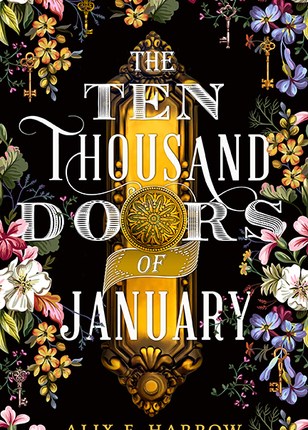
The Ten Thousand Doors of January by Alix E. Harrow

The Ten Thousand Doors of January by Alix E. Harrow

The Ten Thousand Doors of January is a beautiful portal fantasy novel wherein our heroine learns the world contains far more magic than she imagined and so does she.

Photo by Pixabay on Pexels.com

“If we address stories as archaeological sites, and dust through their layers with meticulous care, we find at some level there is always a doorway. A dividing point between here and there, us and them, mundane and magical. It is at the moments when the doors open, when things flow between the worlds, that stories happen.” pg 2

January has never quite fit into the glittering and privileged world of her fabulously wealthy guardian, Mr. Locke. She perpetually waits for her father to return from his many voyages where he’s constantly seeking lost treasures for his demanding employer.

She has very few friends, except Samuel, the local grocer’s son, and, eventually, a feisty hound named Sinbad, “Bad” to those who know him. In her enforced solitude, January has a lot of time to herself. One day, she discovers something strange in a field.

Photo by Irina Iriser on Pexels.com

“I almost didn’t notice the Door at all. All Doors are like that, half-shadowed and sideways until someone looks at them in just the right way.” pg 8

Once she has found the way to another world, January’s life is never quite the same.

I really enjoyed this debut novel by Alix Harrow. The writing is beautiful and most of the book acts as an homage to reading as an escape.

“It smelled of salt and age and adventure. It smelled like another world, and I want to return right this minute and walk those strange streets. Instead, I added articulately, “I liked it.” pg 13

Photo by Harrison Haines on Pexels.com

It also asks the reader to consider the magic of thresholds. The two-headed Roman god, Janus, from which we get the name of the month, January, had an interesting place in the pantheon. Though he didn’t necessarily have a priest dedicated to only him, Janus would be invoked at the start of each religious ceremony, no matter who the ceremony was dedicated to. It was appropriate because Janus holds the authority over beginnings and endings.

He also has a mystical association with the conscious and subconscious mind. The two faces of the god coincide to the two portions of a person’s psyche. Janus can symbolize the unification of these two minds in order to become something greater.

Photo by Octoptimist on Pexels.com

It relates to this story as January comes of age and claims her own, very unique, abilities as well as discovering her mysterious past.

It is also somewhat of a love story: “It’s a profoundly strange feeling, to stumble across someone whose desires are shaped so closely to your own, like reaching toward your reflection in a mirror and finding warm flesh under your fingertips. If you should ever be lucky enough to find that magical, fearful symmetry, I hope you’re brave enough to grab it with both hands and not let go.” pg 91

Photo by Ashley Williams on Pexels.com

Highly recommended for readers who enjoy fantasy. There’s plenty of magic and escape to enjoy in these pages.

Thanks for reading!