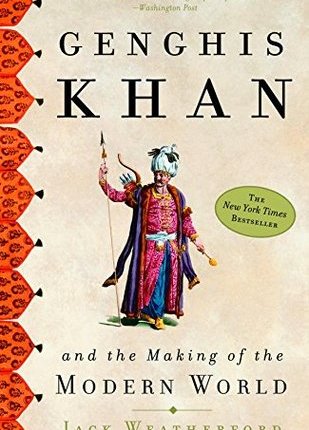
Genghis Khan and the Making of the Modern World by Jack Weatherford

Genghis Khan and the Making of the Modern World by Jack Weatherford

“Fate did not hand Genghis Khan his destiny; he made it for himself.” pg 9, ebook

Author Jack Weatherford follows the Mongol empire from Genghis Khan to his grandson, Khubilai, and on to the distant descendants and faded glory of a once-great kingdom.

The early years of Genghis Khan’s life were the most interesting part of this book. However, this history relies on a single text, The Secret History of the Mongols, which was written in code, filled with exaggerations and inflated numbers (perhaps as propaganda) and still has not been thoroughly interpreted.

Photo by Mathias P.R. Reding on Pexels.com

So, Genghis Khan, the historical personage, remains a shadowy figure. On the other hand, Weatherford opines that Genghis Khan’s empire had long lasting effects even to the present day.

“Seemingly every aspect of European life- technology, warfare, clothing, commerce, food, art, literature, and music- changed during the Renaissance as a result of the Mongol influence.” pg 14

Because the Mongols subjugated so many people, they controlled huge areas of the world and facilitated trade among different kingdoms. Weatherford writes that the Mongols didn’t press their culture upon the peoples they conquered (like the Romans) but adopted and adapted pragmatic customs and manners of civilization from everybody they ran into.

This diversity made the empire strong. For a little while.

But as the years passed, Genghis Khan’s descendants began to suffocate under the weight of this sprawling empire. They squabbled among themselves and spent lavishly on entertainment and comfort.

Photo by Pixabay on Pexels.com

Their social policies weren’t as open as their patriarch’s. Notably, some of the rulers began to torture and abase their enemies, something that was not practiced during Genghis Khan’s time according to Weatherford.

Plague further divided the empire as the world’s populations decreased and trade faltered. The empire’s ending wasn’t a clear cut cessation, but more of a slow descent into darkness.

As a student of history, I was fascinated by the relatively recent disappearance of Genghis Khan’s Spirit Banner, a ceremonial spear with strands of horse hair braided atop it. It was a potent symbol of the Mongol’s strength and leadership.

“Somewhere in the 1960s, eight centuries after the birth of Genghis Khan, his sulde, the Spirit Banner that he had carried across Eurasia, disappeared from where the Communist authorities had kept it. … others hope that just perhaps the sulde lies forgotten in some dusty basement or bricked-up room from which it will, one day, be brought out to lead and inspire the Mongols once again.” pg 199, ebook
Photo by David Bartus on Pexels.com

Rather like the Arc of the Covenant at the end of an Indiana Jones movie.

Genghis Khan arguably wasn’t the only conqueror whose empire shaped the modern world, but Weatherford has convinced me that he’s one of the big ones.

Recommended for readers who love history, particularly Mongol military history, as this book is heavy on that.

Thanks for reading!

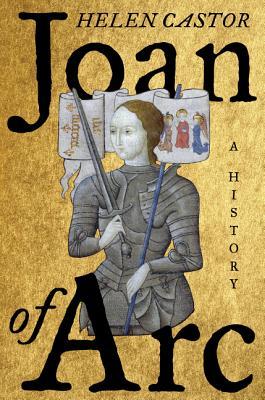
Joan of Arc: A History by Helen Castor

Joan of Arc: A History by Helen Castor
joanofarc

The review that I’m about to give Joan of Arc: A History has nothing to do with the historical accuracy of the book. On the contrary, I found this to be an extraordinarily well researched and cited biography.

Unfortunately, that mega-effort did not lend itself to a readable or enjoyable book.

The general idea behind Joan of Arc is sound. Helen Castor wanted to present Joan’s story in context with an extended history of France for years before and after her appearance on the world stage.

In that way, she thought that the legend of the woman could be separated away from the reality. The reader could appreciate the main players, the attitude towards spiritual visions, the belief of divine will in war and the monarchy, and capture the overall general flavor of the time period.

It was a good premise, but it just didn’t work. Maybe this was a doctoral thesis that Castor tweaked a bit and published? It reads like that.

Why is it that experts on topics are rarely able to translate that interest and depth of knowledge into stories that the general public would enjoy? I love medieval history, especially the backgrounds of the handful of female figures who made it into print during that period. This should have been right up my alley.

Photo by Pixabay on Pexels.com

Joan of Arc: A History read like a school textbook- the dull kind.

Actually, it reminded me of translating Livy’s History of Rome from Latin into English during college. It should have been fascinating stuff as he was writing about a particularly exciting period in Roman history when Hannibal was crossing the Alps to invade. But, sadly, Livy got caught up in listing endless details, particularly the size and shape of the elephants. Through description after description, the pace of Hannibal’s army slowed to a trickle and then it turned into a snooze-fest.

That also happened in this book.

If you enjoy scholarly research to the point that you just have to have it and nothing else will do, read this book. If you want history to come alive and punch you in the face, pick up something (anything really) by Margaret George or Bernard Cornwell.

I particularly liked The Memoirs of Cleopatra or The Autobiography of Henry VIII: With Notes by His Fool, Will Somers. George may not have the exacting research standards of this biography, but her historical fictions are informative in addition to a delight to read.

I received a free copy of this book through Goodreads First Reads. Thanks for reading!

The Art of War by Sun Tzu

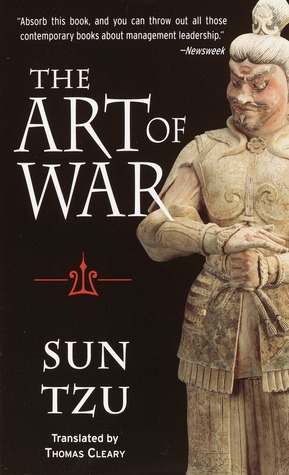
The Art of War by Sun Tzu
theartofwar

Frankly, I got tired of my husband quoting this and having no idea what he was talking about. So, Heidi-the-Hippie-Librarian picked up The Art of War. I must love him a great deal because this was so not my thing though I valiantly struggled my way through it. I’d say about three quarters of the book was commentary and translation quibbles on the text itself, which is really rather brief and kind of pretty in a “this is how you kill a bunch of people” sort of way.

My big take-aways from this were:
1 Pay attention to where you are and what’s going on around you all the time, especially in war. And also be super sneaky about what you’re going to do. “..concealing courage under a show of timidity presupposes a fund of latent energy; masking strength with weakness is to be effected by tactical dispositions. Thus one who is skillful at keeping the enemy on the move maintains deceitful appearances, according to which the enemy will act.” loc 1143

2 If you have to fight, do it fast because it’s too expensive to do for long.“There is no instance of a country having benefited from prolonged war.” loc 822, ebook.

3 Everybody uses spies and if you don’t, then you’re going to lose because the other guy is for sure using spies.

4 Be flexible and make the call as things happen. Don’t stick to orders from an emperor who’s really far away because he doesn’t know what the heck is going on like you do. “Water shapes its course according to the nature of the ground over which it flows; the soldier works out his victory in relation to the foe whom he is facing. Therefore, just as water retains no constant shape, so in warfare there are no constant conditions.” loc 1296, ebook.

Photo by Pixabay on Pexels.com

5 Know who you are and who you’re fighting. This knowledge makes you strong so other people can’t determine your future. Use it to win your war.“The art of war teaches us to rely not on the likelihood of the enemy’s not coming, but on our own readiness to receive him; not on the chance of his not attacking, but rather on the fact that we have made our position unassailable.” loc 1542, ebook.

6 Have a vision beyond what is right in front of you and guide yourself toward it, one good decision at a time. “To see victory only when it is within the ken of the common herd is not the acme of excellence. Neither is it the acme of excellence if you fight and conquer and the whole Empire says, “Well done!” To lift an autumn hair is no sign of great strength; to see the sun and moon is no sign of sharp sight; to hear the noise of thunder is no sign of a quick ear. What the ancients called a clever fighter is one who not only wins, but excels in winning with ease.”loc 1011-1030, ebook

7 The place that you fight is very important as well as the officer who is calling the shots and telling you which way to go. If either of these things suck, you’re in trouble. “The natural formation of the country is the soldier’s best ally; but a power of estimating the adversary, of controlling the forces of victory, and of shrewdly calculating difficulties, dangers and distances, constitutes the test of a great general.” loc 1886, ebook.

Photo by Pixabay on Pexels.com

8 Knowing small details about the enemy is very important. For example, if the dudes you’re going to war against put their pots and pans away, they’re planning on dying in battle. Who knew, right? “When an army feeds its horses with grain and kills its cattle for food, and when the men do not hang their cooking-pots over the campfires, showing that they will not return to their tents, you may know that they are determined to fight to the death.” loc 1752, ebook.

So, that’s The Art of War. Now back to my regularly scheduled reading. πŸ™‚ Β And, thank you for reading.