The Art of True Healing: The Unlimited Power of Prayer and Visualization by Israel Regardie, Marc Allen (Editor)

The Art of True Healing: The Unlimited Power of Prayer and Visualization by Israel Regardie, Marc Allen (Editor)

Israel Regardie is a little-known thought leader of western occultism. In this book, “The Art of Healing,” Dr. Regardie explains a few meditation techniques in a way that anyone from beginners to advanced practitioners can understand.

I remember reading somewhere (not this book) about Dr. Regardie’s internship with Aleister Crowley and how he realized Crowley wasn’t teaching him anything beyond the superficial when it came to occult matters.

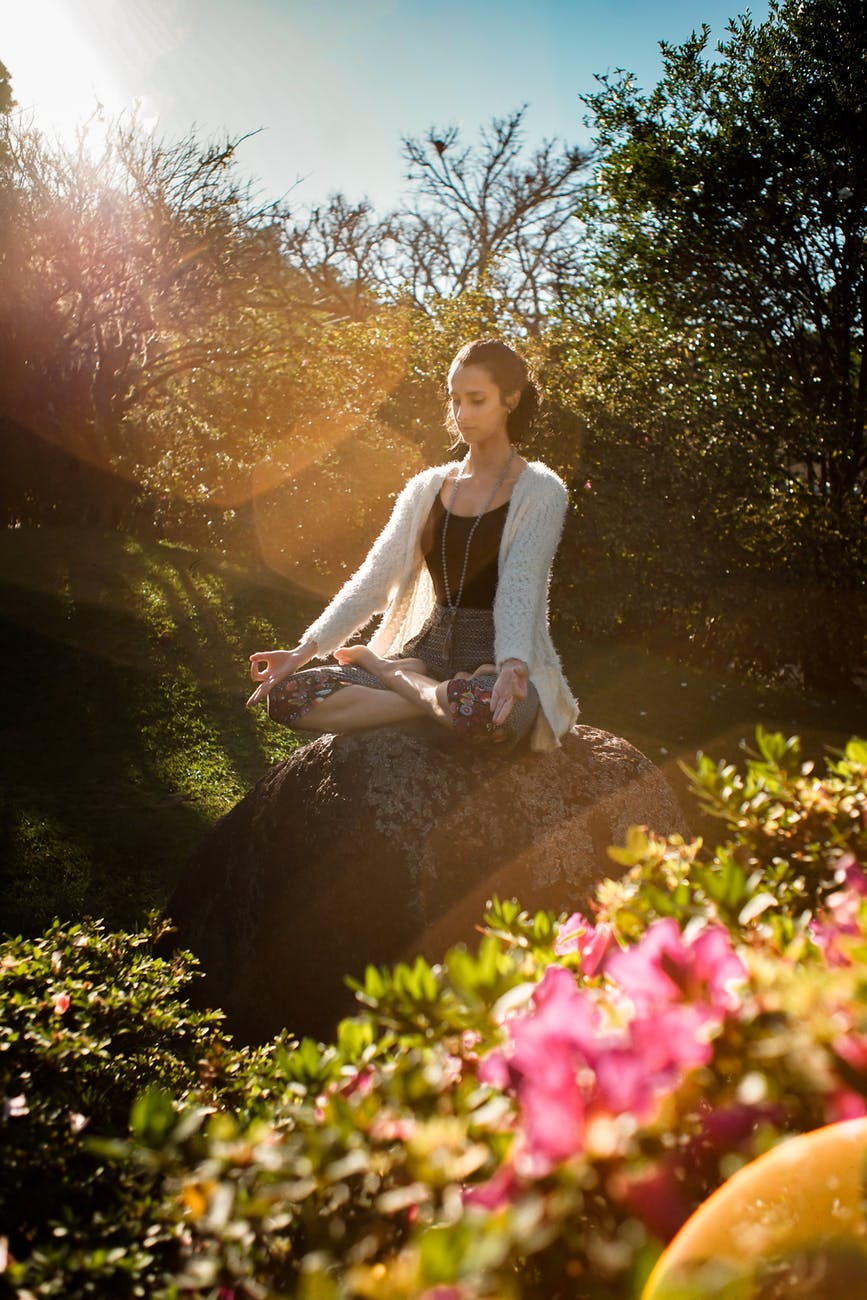
Photo by Luis del Ru00edo on Pexels.com

He ended up breaking away and being one of the leaders of a new approach to occultism-
which brings me back to this book.

The meditation techniques will feel quite familiar to anyone who has practiced chakra meditations or color visualizations on the body.

“By these means, the healing force is distributed to every part of the body. No single atom or cell in any organ or limb is omitted from the influence of its healing, regenerative power.”
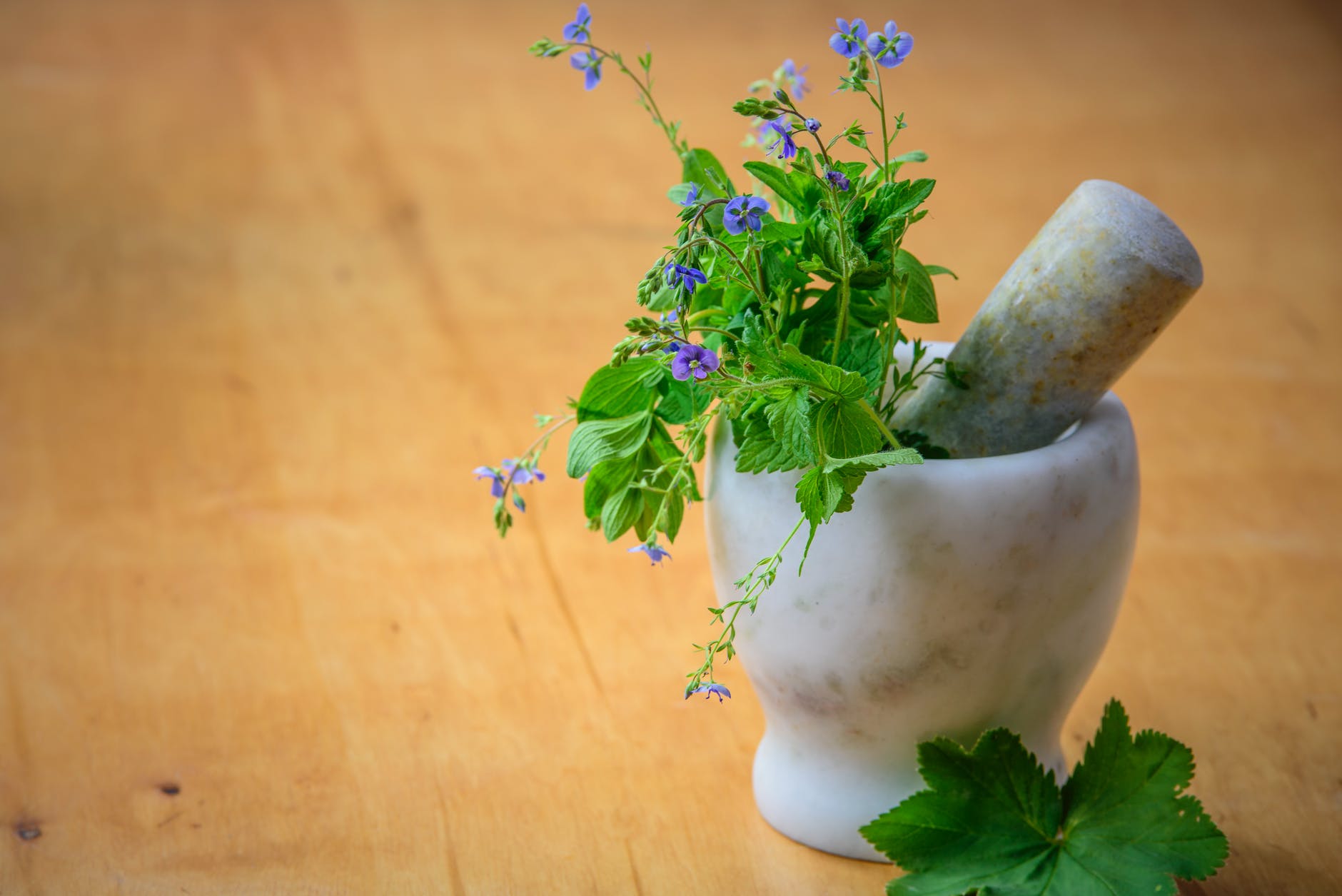
Photo by PhotoMIX Company on Pexels.com

The curious part of this book is that Dr. Regardie uses five centers of energy down the center of the body instead of the more standard seven of eastern occultism.

Of course, as Dr. Regardie states, these exercises are in no way a substitution for competent medical care or therapy when necessary – but they are a wonderful addition to it, for they are able to aid the healing process in a great many mysterious, profound, and positive ways. intro

I’m not entirely sure why he does this though I am familiar with the Middle Pillar exercise (which is what the technique is called). Perhaps he’s basing the whole practice off of a teaching Crowley created for his occult studies.

Dr. Israel Regardie and the Middle Pillar exercise.

Whatever the reason, I think it is a noteworthy and definite change from other meditations I’ve practiced.

Highly recommended for readers looking for new meditation techniques and who are interested in western occultism. Another book you may want to pick up if you are into these topics is High Magick: A Guide to the Spiritual Practices That Saved My Life on Death Row.

Damien Echols‘s style of writing reminds me of Dr. Regardie in both its refreshing simplicity and honest assessment of the Great Work.

Thanks for reading!

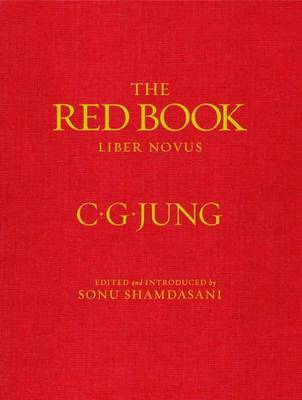
The Red Book: Liber Novus by C.G. Jung

The Red Book: Liber Novus by C.G. Jung

“The years, of which I have spoken to you, when I pursued the inner images, were the most important time of my life. Everything else is to be derived from this.” preface

The Red Book is a stunning publication. It is a physically large book which mimics Jung’s own handwritten copy which measured 11.57 inches by 15.35 inches.

Carl Jung’s calligraphy

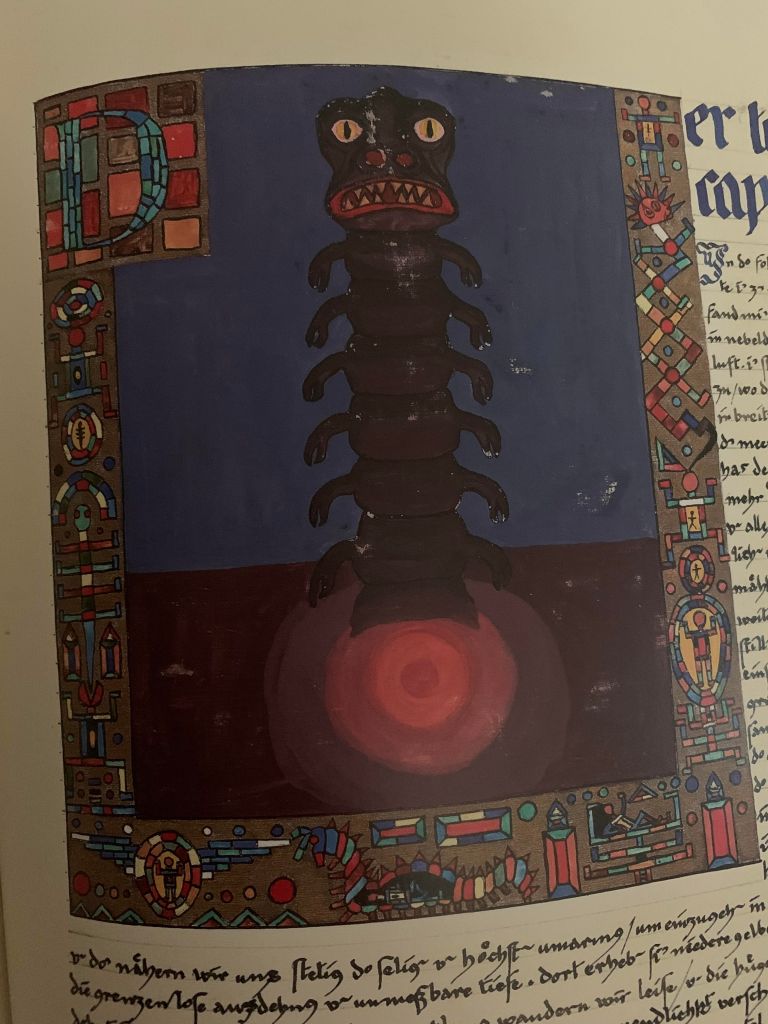
The contents are just as impressive. The first part is a brief history of Jung and his publications. The second contains pages of calligraphy in both German and Latin of his “active imagination” visualizations as well as sketches and paintings created by Jung to accompany the text.

The last section of the book is the English translation of the second part.

“Jung described his technique for inducing such spontaneous fantasies: ‘The training consists first of all in systematic exercises to eliminating critical attention, thus producing a vacuum in consciousness.'” pg 209

Painting from Carl Jung’s The Red Book

The visions themselves are interactions between Jung and voices or figures that he named his soul, gods and other archetypical figures.

“To this my soul spoke a word that roused my anger: ‘My light is not of this world.’ I cried, “I know of no other world.” The soul answered, “Should it not exist because you know nothing of it?” pg 240

As he stated in the preface, Jung felt as if his ‘confrontations with his subconscious’ affected his work for the rest of his life. It is a fascinating, little-examined side of a man who has had a huge effect on psychology and is credited, by some, as being one of the leading figures of the New Age movement.

The road to publication for this book is a story in itself. At first, Jung’s family carefully kept The Red Book in a safe deposit box to protect it as they recognized its value as a one-of-a-kind creation. They also believed that Jung wouldn’t have wanted its contents made public as he hadn’t left any specific instructions in his will about it.

Painting from Carl Jung’s The Red Book

However, researchers and scholars have since examined the text and found parts where Jung addresses, “my dear friends,” leading to the opinion that he did intend to share it with a wider audience. They also point to its importance to Jung’s following works as another reason why it should be published.

Whatever their reasoning, I’m so very glad his family and foundation made the decision to publish. This book is a treasure.

Curiously, The Red Book ends in an incomplete sentence.

Here it is:“I knew of nothing better than to write them down in a ‘precious,’ that is to say, costly book and to paint the images that emerged through reliving it all- as well as I could. I knew how frightfully inadequate this undertaking was, but despite much work and many distractions I remained true to it, even if another/possibility never…” epilogue

Painting from Carl Jung’s The Red Book

I wonder what he was going to write next.

Though I didn’t use Jung’s method of active imagination, I too have undertaken lengthy ‘confrontations’ of my subconscious and have come back with pages of material that read, in some ways, quite similar to this book.

Perhaps, one day, I will also find the courage to publish it.

Highly recommended for any readers interested in Carl Jung’s methods, archetypes or dream interpretation.

Thanks for reading!

Five Good Minutes: 100 Morning Practices to Help You Stay Calm and Focused All Day Long by Jeffrey Brantley, Wendy-O Matik, Wendy Millstine

Five Good Minutes: 100 Morning Practices to Help You Stay Calm and Focused All Day Long by Jeffrey Brantley, Wendy-O Matik, Wendy Millstine
fivegoodminutes

Things have been stressful in my neck of the woods, so I picked up Five Good Minutes to help me cope.

I’m in the fourth month of having my house on the market and my husband has been looking for employment for over a year. Yeah, I’m feeling it…

Five Good Minutes is simple enough for beginners to the mindfulness/meditation practice and filled to the brim with suggestions for ways to focus in the morning and get your day off on the right foot.

The best part of this book is that there is something for everyone- it is that broad. The techniques that it uses varies from visualizations to mindfully drinking your morning cuppa.

The worst part of the book is that, because it covers so much, that it doesn’t really talk about anything in depth. If you’re looking for detailed methods of meditation and relaxation, this is not the book for you.

Why the focus on early in the day?: “The morning is the best time to break away from old habits of thinking and feeling and to set a new direction for yourself and how you will be in your day. Any exercise in this book- done in the morning- has the power to impact greatly on your experience throughout the day, if you allow it!

Photo by Felipe Borges on Pexels.com

Personally, I’ve found that I’m at my best in the mornings- well, once I blink the sleep out of my eyes. My mind is clearer and I can focus for longer periods of time.

But, if you’re more an afternoon/evening type person, don’t let the title of this book stop you. I think that these practices could be beneficial at any time of the day.

My favorites were- the Five-Fingered Peace pg 32: In which you use your hands almost as a rosary and remember awesome things that have happened to you.

Freedom from Tension pg 58: In which you scan your body and focus your relaxation on the stressed out bits.

Photo by Alexandr Podvalny on Pexels.com

Your First Sip of Tea pg 94: or coffee, for me. Take your time and mindfully drink your morning pick-me-up.

A Shot of Faith pg 186: You use visualization to picture a problem turning out perfectly.

And finally, Cultivate Gratitude pg 206: “This practice invites you to turn toward the good in your life and to express gratitude as recognition grows.”.

If none of those spoke to you, there are 95 others for you to choose from.

Recommended for stressed out people everywhere and those who are interested in bringing a bit of mindfulness or meditation to their day but don’t know where to start. Some further reading: Thank & Grow Rich: A 30-Day Experiment in Shameless Gratitude and Unabashed Joy, Meditations for Breaking the Habit of Being Yourself, or 10% Happier: How I Tamed the Voice in My Head, Reduced Stress Without Losing My Edge, and Found Self-Help That Actually Works. Peace and thanks for reading!