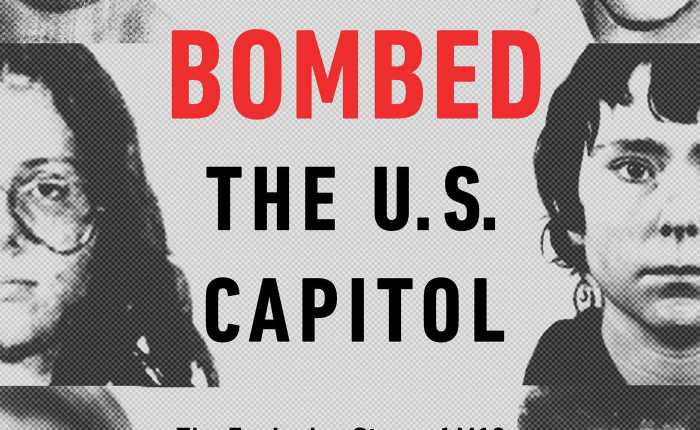
It is simple to pretend that people who perform shocking acts of violence are different than everyone else. It’s got to be something in their childhoods, we think, or maybe it’s a mental illness.
The most disturbing part of this book, and it admittedly has many, was that these women seemed so normal, just like you or me.
William Rosenau has combed through court files, newspaper articles and more to write Tonight We Bombed the U.S. Capitol, a non-fiction account of a radical leftist terrorist group. They planted multiple homemade bombs, robbed and killed people, all in the name of freeing the world from imperialism.
The majority of the group were highly educated, white women.
“They’d spent their entire adult lives embroiled in political struggles: protesting against the Vietnam War, fighting for black, Puerto Rican, and Native American liberation, and fighting against what they called U.S. ‘imperialism’ – that is, U.S. military aggression, political domination, and economic exploitation, particularly in the Third World.”

Rosenau paints a careful picture to reveal how, step-by-step, the people involved in the group felt more and more marginalized and victimized to the point where they felt any and all actions were justified.
“Their vision of what this heaven on earth would look like was hazy, but one thing was certain: creating it would require nothing less than violent revolution. This vagueness about ultimate objectives is typical among terrorists.”

There is so much information about a number of different people in this book that it can be overwhelming. But I think, ultimately, it is better to know what has gone on in the past because it affects the future in such a profound way.
“I discovered that during the 1970s and 1980s, the United States had waged an earlier ‘war on terror’ against violent domestic extremists, and it was during that period that the government created many of the counter-terrorism tools and approaches that continue to be used today.”

The privilege of living in a free society is that all manner of ideas can be discussed and embraced or dismissed depending upon their merits. I want equality, freedom from tyranny and opportunities for all people – no matter what you’re from, what you look like, or what your background is.
However, I won’t use violence to try and bring those ideals about. That seems to be the line in the sand for many. The people in this book didn’t have that line but they seemed to espouse higher ideals.
And what a tragedy that is. If only their brilliant minds had been directed towards methods of bringing about change that worked within society rather than against a nameless enemy, our country might have been better for all of them.
Thank you to NetGalley and the publisher for a free advance reader copy of this book. The brief quotations cited in this review may change or be omitted entirely from the final print version.
- The Ballad of a Small Player: a Metaphysical Movie Review
- Otherwhere: A Field Guide to Nonphysical Reality for the Out-Of-Body Traveler by Kurt Leland
- Psychic Dreamwalking: Explorations at the Edge of Self by Michelle Belanger
- Archetypes on the Tree of Life: The Tarot as Pathwork by Madonna Compton
- The Goddess and the Shaman: The Art & Science of Magical Healing by J.A. Kent



















 The Help Desk Book Blog