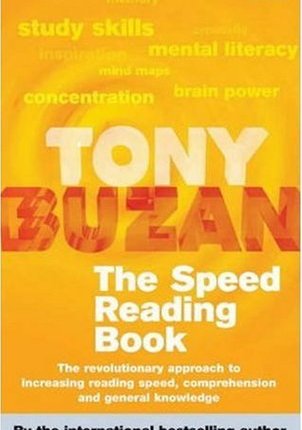
I did not speed read Tony Buzan’s The Speed Reading Book because I found it to be rather a slog. There is useful information in here about the physical capabilities of your eyes and brain, methods for training your eyes how to move, the benefits of improving your vocabulary, how to recognize patterns in the way paragraphs are structured, and the basics of logic.
However, it’s interspersed with information that I felt was better presented in Use Your Head.
“Quite apart from important improvements in the technique of learning how to read fast which are set forth in this book, what I wish to emphasize in my system is that understanding and remembering factual material is not nearly as important as knowing how to relate new material to what you already know. This is the all-important ‘integrative factor’, or if you will, learning how to learn.” pgs 12-13

He re-hashes the proper way to make a mind-map and the importance of previewing all reading material, even mystery novels, which I felt was silly. I can’t speak for the whole world, but I read mysteries to be entertained, not create a template into which I fit important details as I go along.
“The purpose of the preview is to develop a structure into which the mind can more easily fit the smaller details of that structure. … Previewing should be applied whatever kind of material you are going to read, which it be letters, reports, novels or articles.” pg 115
Though he did backpedal on his “preview everything” stance somewhat in a chapter about reading poetry: “When reading literature and poetry, bring to bear all your knowledge and judgment, and if you feel that it is the kind of writing you wish to treasure forever, forget about speed reading through it and reserve it for those occasions when time is not so pressing.” pgs 167-168
Thank you, I will.

Perhaps part of my problem with this book is that it revealed to me just how slowly I read and assimilate non-fiction, because Buzan offers the reader information about the absolute limitlessness of human capability.
“Theoretically, the human visual system can photograph an entire page of print in one-twentieth of a second, and thus a standard length book in between six and twenty-five seconds, and the entire Encyclopaedia Britannica in less than an hour. Advanced skinning and scanning skills take you on the first step of that incredible and inevitable journey.” pg 70
Let’s say I have much room for improvement.
The book also showed its age somewhat during a chapter on the importance of organizing how you take in information from newspapers: “Newspapers are so much a part of our everyday life that we seldom stop to think that they are a very recent development.” pg 148
But are they still? I’m not so sure.

The book ends on a high note and, of course, I plan to continue practicing and improving my skills: “Your continuing success in all fields of speed reading depends on your personal decision to continue the course you have begun, and on the capacity of your brain to read, assimilate, comprehend, recall, communicate and create, abilities which we know approach the infinite. Your success is therefore guaranteed.” pg 177
But if you’re only going to read one book by Tony Buzan, I recommend Use Your Head.
- The Ballad of a Small Player: a Metaphysical Movie Review
- Otherwhere: A Field Guide to Nonphysical Reality for the Out-Of-Body Traveler by Kurt Leland
- Psychic Dreamwalking: Explorations at the Edge of Self by Michelle Belanger
- Archetypes on the Tree of Life: The Tarot as Pathwork by Madonna Compton
- The Goddess and the Shaman: The Art & Science of Magical Healing by J.A. Kent



 The Help Desk Book Blog