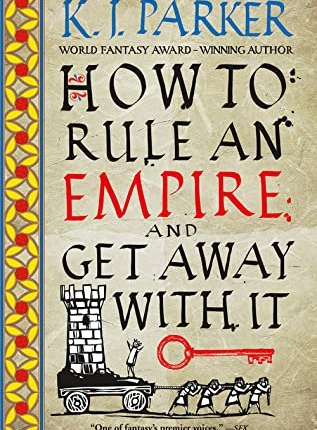
How to Rule an Empire and Get Away with It (The Siege #2) by K.J. Parker

How to Rule an Empire and Get Away with It (The Siege #2) by K.J. Parker

“… what the people want is something that looks at first sight like real life, but which actually turns out to be a fairy tale with virtue triumphant, evil utterly vanquished, a positive, uplifting message, a gutsy, kick-ass female lead and, if at all possible, unicorns.” pg 11, ebook

K.J. Parker (pen name for Tom Holt) gives readers all of that in this book – sorry, minus the unicorns.

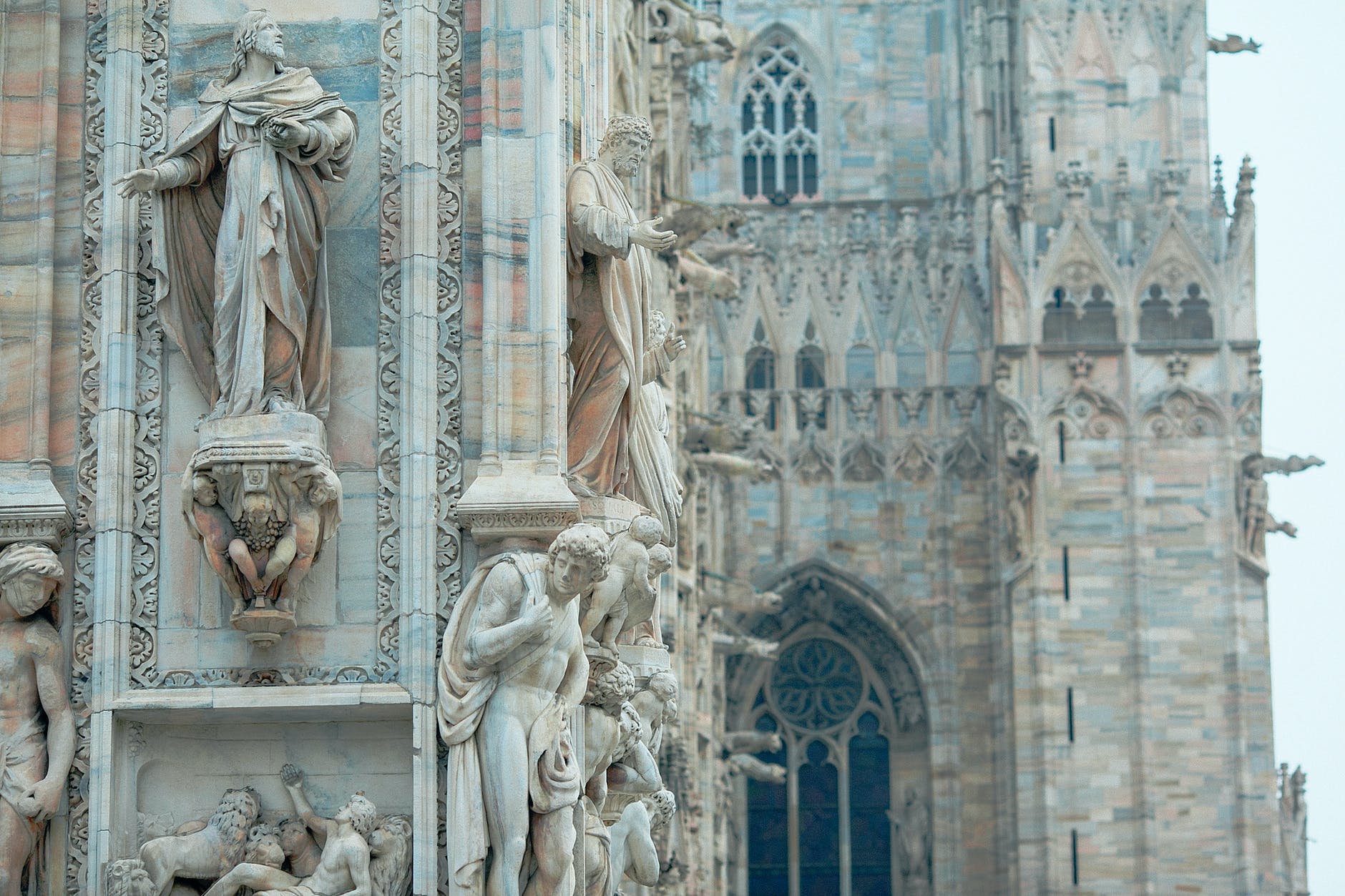
Photo by mark glancy on Pexels.com

The city has been under siege for decades. Readers are given the history of all that in the last book.

In this entry in the series, it is all about surviving and keeping hope alive against unbelievable odds. The enemy outside the gates outnumbers the survivors in the city by thousands. What hope can be had?

Enter Notker, a professional actor who, among other things, excels at mimicking city leaders.

“Accordingly, the death of Lysimachus – if true – was a devastating blow to me personally, purely because imitating him accounted for something like forty per cent of my income. Sure, you can still imitate people after they’re dead, but there just isn’t the same demand.” pg 24, ebook
Photo by Wendy Wei on Pexels.com

When Notker gets pulled into government, he shows an unexpected talent for keeping the city’s hopes alive. It is a delight finding out how he does all of it, so I won’t spoil it for you.

You don’t have to have read the first book in the series to appreciate this one. (I read the first months ago and didn’t really remember much of it.) But I imagine if you read them back to back, you’ll find some hidden gems tying the two books together.

“If you stopped to think about it you’d never do it, so don’t stop and think.” pg 98, ebook

Photo by Pixabay on Pexels.com

The most interesting character in the book is a tie between Notker and Hodda (the female lead, so to speak). Both develop as the story goes along in predictable and unpredictable ways. I loved every twist as the characters fought for their survival.

I enjoyed this book a lot. It is a cross between historical fiction and something that feels like a Shakespearean play. Highly recommended.

Sixteen Ways to Defend a Walled City (The Siege, #1) by K.J. Parker

Sixteen Ways to Defend a Walled City (The Siege, #1) by K.J. Parker

“Orhan.” Nobody called me that. “You’re a clever man and you use your brain, which makes you unique in this man’s town, but you’ve got to do something about your attitude.” “Attitude? Me?” pg 16

Through a series of unfortunate events, Orhan, the leader of a group of military engineers, finds himself in charge of the defense of “the City”, the capital of the Robur empire. The Robur empire seems to have been loosely based on the Roman empire, which, in its conquering of the world, took diverse sets of people and organized them into useful groups under its overarching control.

Orhan is one of these conquered peoples. But he has a unique set of skills, all of which will be put into use during the siege that is to come.

“My meteoric rise, from illiterate barbarian serf to commander of an Imperial regiment, is due to the Hus, the Sherden, the Echmen and, last but not least, the Robur, who are proud of the fact that over the last hundred years they’ve slaughtered in excess of a million of my people.” pg 5

Photo by Maria Orlova on Pexels.com

The story is told entirely from Orhan’s point of view in first-person narrative. This invites the reader to step into Orhan’s shoes and makes the tale quite exciting and immediate.

On the other hand, Orhan is emotionally bereft and runs his life through merciless logic, which doesn’t always serve him, or the people around him, very well.

“That’s one thing about human beings I don’t see the point in: love. It does nobody any good. You love someone, and either they let you down or they die. Either way, you end up crucified.” pg 55

He is an impatient and, occasionally, violent character, who literally punches people when they don’t conform to his view of the world fast enough.

In other words, wearing Orhan’s shoes for the length of the story is an uncomfortable ride for anyone who uses a modicum of emotional intelligence in their lives.

Photo by Miquel Rossellu00f3 Calafell on Pexels.com

That being said, K.J. Parker (pen name for Tom Holt) has done a brilliant job of creating an unforgettable, if unpleasant, narrator. By the end of the book, even though I didn’t like him, I found myself rooting for Orhan anyway because that’s the kind of reader I am.

But if you have trouble connecting with stories where you don’t like the characters, this might not be the book for you.

The one moment where I did connect with the narrator was when he discovers his importance in the siege that is to come.

“If, as I was horribly afraid, I was the senior military officer in the City, I needed confirmation or a warrant or something. If there was someone higher up than me, I desperately wanted to hear about him and ask him for orders.” pg 78

I used to have similar feelings when I first started working as a reference librarian at the library. Prior to that, as a circulation assistant, if I had any question about anything having to do with the library or technology or research, I’d call up whoever was sitting at the reference desk and they’d supply me with the answer.

Photo by Olenka Sergienko on Pexels.com

It was my own version of chain-of-command. There was an unspoken faith that I carried- if I didn’t know the answer, the reference librarian would so there was never any reason to worry.

The day that my training was done, my supervisor went home, and I was left alone at the reference desk, that was my Orhan moment. If I didn’t know or couldn’t find the answer, there was no one else for me to turn to.

It is humbling to realize that it all rests on your shoulders, but it is also a character making moment. How you respond to the pressure says so much about you. And that is the strength of this story, the slow revelation of Orhan’s character under pressure.

Recommended for readers who enjoy historical fiction. Though this is classified as a fantasy too, I feel like it veers more into a parallel universe than a true fantasy world where magic is real and otherworldly creatures are running around. I’d be curious to know what other readers think about its genre.

Thanks for reading!

Expecting Someone Taller by Tom Holt

Expecting Someone Taller by Tom Holt

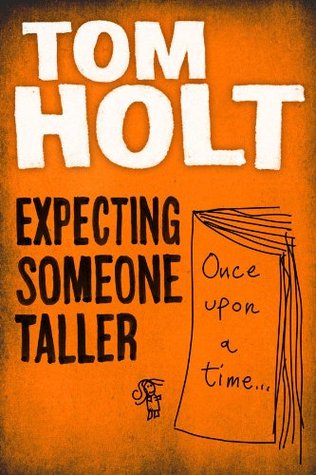
expecting someone tallerExpecting Someone Taller by Tom Holt is a humorous fantasy novel based off of the Ring Cycle of Norse mythology.  It’s older (published in 1990) but I like reading pulp fantasy fiction, no matter its age.

Full disclosure: I know The Lord of the Rings better than the Norse mythological stories it is based on. Holt provides a very short synopsis of the myths for folks like me and I was grateful for it. Otherwise, I would have not understood what on earth was going on.

Holt is an English fantasy-humorist and, like Pratchett’s many offerings, I enjoy his books but never have laugh out loud moments. I don’t know if the humor is lost-in-translation or what.

I expect that those who are more familiar with the Norse myths and who enjoy subtle humor might really love this rather silly tale of Malcolm and the ring.

There were some memorable lines: “Ingolf eased the plain gold ring off his finger and passed it to Malcolm, who accepted it rather as one might accept some delicacy made from the unspeakable parts of a rare amphibian at an embassy function.” pg 7 Nice.

“The next morning, Malcolm thought long and hard before waking up, for he had come to recognise over the past quarter of a century that rather less can go wrong if you are asleep.” pg 15 Absolutely true in my experience too.

Malcolm figuring out how the Tarnhelm (a hat that can change the wearer into anything) works: “Make me,” he said aloud, “as handsome as it is possible to be.”… He stood for awhile and stared… “We’ll call that one Richard” (he had always wanted to be called Richard). He resumed his own shape (which came as a bitter disappointment) then said “Richard,” firmly. At once, the Most Handsome Man reappeared in the mirror, which proved that the Tarnhelm had a memory, like a pocket calculator.” pg 20-21

The difference between smiles: “The girl looked at him and smiled. Malcolm had come to believe that he was fairly well equipped to deal with smiles, but this was a new sort; not a happy, optimistic smile but a sad, wistful smile. It didn’t say, “Wouldn’t it be nice if…” like the stock delivery of a Rhinemaiden, but, “It would have been nice if…” which is quite different.” pg 117

Why humans are the worst pick for ring bearing: “And so you give this irregularity in your minds a name of its own. You call it Love, which is meant to make everything all right. Rather than try to sort it out or find a vaccine, you go out of your way to glorify it. I mentioned your art and your poetry just now. What are your favourite themes? Love and War.”…”Now be fair,” he continued, “can you honestly say that a member of a species with this ancestral fallibility should be allowed to rule the universe?” pg 160 Fair question.

If you enjoyed Expecting Someone Taller, you may want to pick up The Good Fairies of New York by Martin Millar (a modern day fantasy with fairies) or Anansi Boys by Neal Gaiman (a fantasy about gods and their descendants).

Thanks for reading!