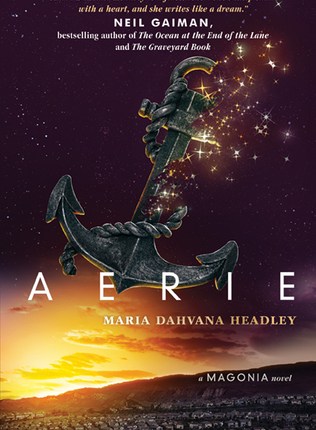
Aerie (Magonia #2) by Maria Dahvana Headley

Aerie (Magonia #2) by Maria Dahvana Headley

Warning: minor (and major if you haven’t read the first book) spoilers, proceed with caution.

Aerie is a very strange and complex, young adult fantasy. Allow me to explain.

In the first book, we met Aza, a girl who was drowning on Earth because, though she doesn’t know it, she’s actually from a kingdom in the clouds. She’s in love with Jason, a genius boy with obsessive thoughts like repeating the numbers of pi in his head over and over again.

Photo by Pixabay on Pexels.com

Many adventures happened in the first book, but essentially we learned that in Aza’s home, the Magonians use their voices in magical ways. Through changing vibrations, Magonians can make elements appear and change, control the weather and animals, manipulate the molecules of reality itself.

Like most young adult stories, Aza is special, a savior with godly abilities that she didn’t know she had until she was tested. She’s supposed to bring balance back to Magonia because Aza’s mother is crazy and wants to kill everyone on the ground- Jason included.

One of the things that happens at the end of the first book is that Aza’s mother is imprisoned. (Lots of other stuff happens too.)

This book picks up where the last one left off. Jason and Aza are deepening their relationship though Aza looks like a completely new girl because she trashed her “skin,” essentially a suit that allows her to look and breathe like a human, and had to acquire a new one.

Did I mention that Magonians have naturally blue skin with orange/red eyes and white tattoos that change depending on their emotional state? Yeah, that’s a thing.

Photo by Marcelo Dias on Pexels.com

Aza’s mother, Zal, breaks out of prison and someone has to stop her before she destroys the world. There are rumors of “The Flock,” a weapon of some sort that can stop Zal, but no one knows where or what it is.

And that, I think, is where this story really begins.

Headley’s world building is epic. Magonia itself is a treasure and the other supernatural creatures that the author introduces are tantalizing in their possibility.

However, I didn’t care much for the characterizations or the obvious plot twists.

The grand showdown itself was a huge disappointment like expecting a brightly colored balloon on your birthday only to have it pop in your hands when you receive it. Headley gathered all of these potentially awesome characters together but only the actions of three mattered.

I wanted ships firing at each other, creatures made of flame, earth, water, feathers… slamming into each other in waves, with the earth itself rising in fountains in an effort to touch the sky.

Photo by Pixabay on Pexels.com

But that didn’t happen.

Aza’s special, I get it.

Aza can sing a song that only she can sing, I get that too.

She FEELS things deeply then SINGS them deeply. Blah.

I just never connected with Aza the way Maria Headley wanted me to. Headley built a lovely world that was so much more than just three characters.

Perhaps I’m being unfair- did anyone who read this book feel differently? I would love to hear from you.

Photo by Ylanite Koppens on Pexels.com

Recommended for readers who are willing to overlook a weak story for some fantastical and wildly imaginative elements.

You don’t have to read the first book to appreciate this one, but I think you’d want to in order to absorb the outlandish world that is Magonia. Some similar reads: The Breedling and the City in the Garden, Archivist Wasp, or Under the Empyrean Sky.

Thanks for reading!

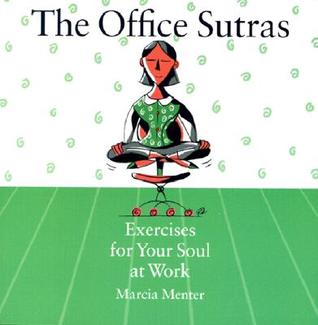
The Office Sutras: Exercises for Your Soul at Work by Marcia Menter

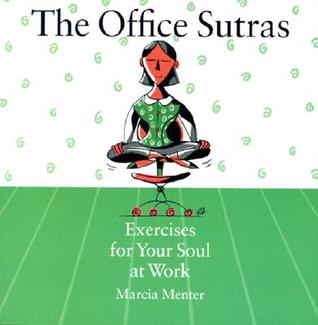
The Office Sutras: Exercises for Your Soul at Work by Marcia Menter
officesutras

The Office Sutras sums itself up in the first couple of pages: “The basic premise of this book is that we’re on a spiritual journey every second of our lives, not just during those times we set aside to contemplate the cosmos. The job you have right now, no matter how frustrating, no matter how screamingly imperfect, is part of your spiritual path.”pg 3

Every page there after pretty much repeats the same theme.

This book just wasn’t for me. Every chapter presents a common problem that one can encounter at work and then gives exercises that you can use to come to an understanding about it.

I realized that I was never going to do any of the exercises and I didn’t regret that in any way. Big fail.

If you’re going to read a self help book that deals with work and has a Buddhist vibe, I’d suggest Peace Is Every Breath: A Practice for Our Busy Lives.

Thich Nhat Hanh is brilliant and I find his writing to be more appealing than this offering. Thanks for reading!

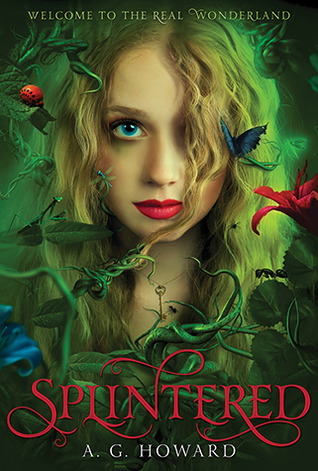
Splintered by A.G. Howard

Splintered by A.G. Howard

splinteredAlyssa is a descendant of Alice Liddell- the Alice who inspired Carroll to write his tale of white rabbits and fantastical creatures. But, Alyssa has a family secret: the women of her bloodline go insane when they come of age.
She tries to look on the positive side of this: At least one good thing has come out of my inherited insanity. Without the delusions, I might never have found my artistic medium.” pg 10, ebook.

Alyssa is in love with Jeb, a dark and brooding young man with a penchant for grunge clothing and a lip piercing (that she talks about all the time). But, he is dating the most popular girl in Alyssa’s high school class, Taelor (of course).

Things get really exciting when Alyssa starts to hear voices coming from the bugs and plants.

After a brief introduction where the reader learns that Jeb is freakishly controlling and Alyssa’s mother is in an insane asylum, she falls through a mirror and after some trials, finds her way into Wonderland.

I thought this could have been a potentially interesting re-telling of the classic Alice in Wonderland story, but Splintered‘s uniqueness is stifled under a bunch of teen angst and a love triangle.

Granted, I’m not the target audience for this book, but I’d been on a roll lately with awesome fairy tale re-tellings and I thought I’d give it a shot. Oh well.

I actually enjoyed A.G. Howard’s interpretation of Wonderland itself. The characters were familiar but twisted slightly.

Here’s a passage from the tea party- my favorite part: “Now we need to get back to our world. Like yesterday.” “Yesterday, you say?” the hatmaker warbles in his bouncing timbre. “Yesterday is doable.” Guffawing, the hare slaps a knee and adds, “Although two yesterdays would be impossible.” The Door Mouse snickers, slipping back into his uniform. “No, no! You can retrogress as many yesterdays as you please. Simply walk backward the rest of your life.” pg 187, ebook.

See? Howard nailed the classic characterizations, but Carroll’s original creations were far superior to Alyssa, Jeb, and Morpheus, who were her main contributions to the story.

Disregard my opinions on this book if you simply must read any and all fairy tale re-tellings because, at the very least, it is that.

Just be aware what you’re picking up- a young adult romance/coming of age- and if that’s what you’re in the mood for, you may really enjoy it.

I find that my expectations shape my opinion of a book almost as much as the text itself. For example, I think if I had been warned that Alice in Zombieland had really very little to do with the Wonderland story, I may not have disliked it as much as I did.

Splintered actually has a lot of the original Wonderland in it and, if I had to choose between Alice in Zombieland or Splintered, I’d pick this in a heartbeat.

Some highly recommended horror/fairy tale re-tellings (for adults): Alice or All Darling Children.

Thanks for reading!

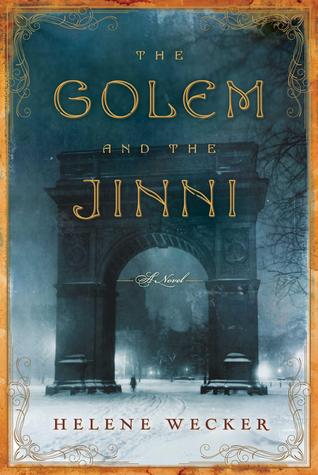
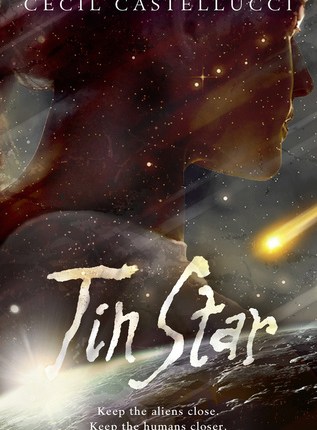
The Golem and the Jinni by Helene Wecker

The Golem and the Jinni by Helene Wecker

golemandjinniThis is the story of a golem and a jinni, how they discover who they are, their strengths, their weaknesses, and how, even though they’re composed of completely different elements, they may just be the best friend for each other in a human world where they will never truly belong.
As I was reading The Golem and the Jinni, enjoying their adventures and waiting to see how they would discover their origins, I didn’t consider for a moment the idea that the tale could be a metaphor for something else.

When I read the Q&A with the author at the end of the book, I was really kicking myself. Of course, it made total sense as a metaphor for cultural differences. And, when I thought about it that way, I liked the story even more.

On the other hand, this tale can be completely enjoyed and interpreted as a historical fiction/fairytale and, if you’re not in the mood to think any deeper than that, it doesn’t matter, because it’s still awesome. So, it’s a win/win book for the deep thinkers and the no-thinkers.

The Golem and the Jinni is not a fast read. Wecker really builds the characters and gives the back story for everybody who comes across the page.

At first I was like, “Do we really need to know the ice cream guy’s life story?” and I was getting frustrated with the pacing of it. But, as her characters came together and their lives began to intertwine, I began to appreciate the true artistry of the novel.

It is like an orchestral fugue in which the instruments play their themes one by one at the beginning, which is beautiful, but when the tones combine, it lifts the piece to a whole other place. That is The Golem and the Jinni. Give it the time and space to build the characters and you will be blown away by the ending. At least, I was.

Wecker has a talent for creating multi-layered characters. Though the golem is only a few hours old, the author manages to instill in her a childlike curiosity mixed with the timelessness of a magical creature.

In this passage, the golem is seeing the Statue of Liberty for the first time: “The deck was crowded with people, and at first the Golem didn’t see what they were waving at. But then, there she was: a gray-green woman standing in the middle of the water, holding a tablet and bearing aloft a torch. Her gaze was unblinking, and she stood so still: was it another golem? … And those on deck were waving and shouting at her with jubilation, crying even as they smiled. This, too, the Golem thought, was a constructed woman. Whatever she meant to the others, she was loved and respected for it. For the first time… the Golem felt something like hope. pg 17 ebook.

She also describes scenes just beautifully. In this passage, the Jinni sees New York harbor: “The Jinni leaned against the railing, transfixed by the view. He was a creature of the desert, and never in his life had he come so close to this much water. It lapped at the stone below his feet, reaching now higher, now lower. Muted colors floated on its surface, and afternoon sunlight reflecting in the ever-changing dips of the waves. Still it was hard to believe that this was not some expert illusion, intended to befuddle him. At any moment he expected the city and water to dissolve, to be replaced by the familiar steppes and plateaus of the Syrian Desert, his home for close to two hundred years.” pg 23 ebook

I loved the little, let’s call them “wisdom nuggets,” that Wecker sprinkled throughout the story. Like: “A man might desire something for a moment, while a larger part of him rejects it. You’ll need to learn to judge people by their actions, not their thoughts.” pg 40 ebook. Or: “Men need no reason to cause mischief, only an excuse!” pg 172 ebook.

I also connected with this passage where the Jinni is thinking about the power of names: “To him the new name suggested that the changes he’d undergone were so drastic, so pervasive, that he was no longer the same being at all. He tried not to dwell on such dark thoughts, and instead concentrated on speaking politely, and maintaining his story- but every so often, as he listened to the chatter of yet more visitors, he spoke his true name to himself in the back of his mind, and took comfort in the sound.” pg 68 ebook.

I recommend The Golem and the Jinni for folks who enjoy historical fiction blended with fantasy, folks who love deep characters, and for anyone who loves to read beautiful prose. This book has all of that.

Thanks for reading!

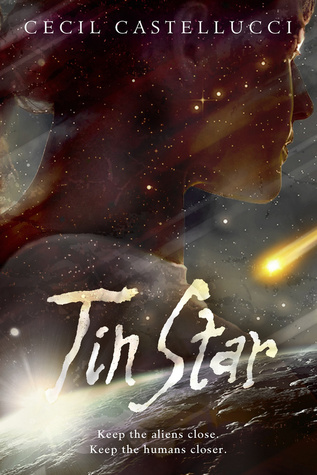
Tin Star by Cecil Castellucci

Tin Star by Cecil Castellucci

tinstarTin Star is the story of Tula Bane, a teenager who joined a space colonizing cult from Earth. She is abandoned on a way station near the edge of the known universe on the way to her new home.
How will Tula Bane survive among aliens who think human beings are the worst? Will she ever be able to go home to Earth or the colony’s planet? How will she manage to put bread on the table?

I love a good space opera and I thought that I would enjoy Tin Star more than I did.

The promise of books set in space, in my opinion, is the opportunity for unique interstellar exploration and worlds created entirely from the author’s imagination. Because of Tula’s unique plight- being stuck in what is essentially a space gas station- the author left herself very little room to write a creative story.

Mainly, Tin Star deals with character development and social struggles, not adventuring in new places.

The villain of the tale was charismatic and creepy. Take this description: “He had his hand on my shoulder in a way that he had a million times before. Only before it was comforting, encouraging, affectionate. Now it was menacing. He was looking at me and his face was smiling. To anyone looking from afar, he seemed to be pleased with me, but it was just a mask. His attitude shifted from concerned leader to unknowable monster.” pg 4

Tula manages to befriend a shady, insect-like alien named Heckleck. He’s my favorite character.

In this passage, Heckleck explains the problems Tula will face in trying to leave the station: “I know about you,” Heckleck said. “Everyone does. And you will never get off this station. You are nobody. And worse, you’re a Human. Even if you did not get on a ship that would take one of your kind, you’d have nowhere to go but to roam like the others of your kind do.” pg 35.

Keeping it real: with Heckleck.

I thought Cecil Castellucci could have done more with the cultural differences between Tula and the others on the station.

One of the most interesting exchanges in the book was between Tula and Tournour, the head of the outpost. She’s trying to figure out how old he is and, because they’re from different planets/species, it’s a surreal conversation. More of that would have been nice.

But Castellucci wrote cultural and language barriers out of the story by introducing nanites into Tula’s bloodstream to translate alien languages for her.

Something that Castellucci did well was writing profound silences between characters into her story. For much of this story, Tula finds herself standing around with Heckleck and Tournour and having nothing to say. But, somehow, it works.

I liked how Castellucci wrote the thoughts spinning through Tula’s mind at these moments. It reminded me of myself when I can’t think of anything to say: “It was a silent agreement between us that if we spoke too much then we would have to talk about the practical things. … If we ever spoke of the things that truly pressed up against us, our very real worries, our seemingly impossibly plans for escape, our divergent hopes for the future, our bubble would blow apart.” pg 184

This book in three lines: “In the end, good must win over evil. The trouble is trying to figure out which is which. Sometimes they look so much alike.” pg 204

Read this book if you enjoy light, young adult drama in space. If you’re looking for a meaty, space adventure, you’ll need to find another title.

Some read-alikes are: The Knife of Never Letting Go (teen trying to survive on an alien planet) or Gated (teen trying to leave a cult).

Thank you to Roaring Brook Press for sending an advance reader copy of this book. And, thank you for reading!

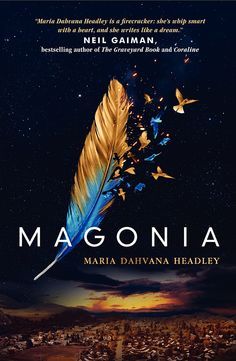
Magonia by Maria Dahvana Headley

Magonia by Maria Dahvana Headley

magoniaAza Ray Boyle can’t breathe. It seems like she has always been sick- inexplicably short of breath and weak.
This continuous illness has made her always feel different from the people around her. But, perhaps, there are stranger and more exotic reasons why she is different. Ones that Aza can’t even imagine…

Jason is Aza’s dearest friend. They are so close that they almost speak their own language.

He realizes there is more to Aza than meets the eye. How will Jason handle it when he discovers the shocking truth?

This young adult fantasy is weird, but I enjoyed it.

That’s probably because I read a lot of weird, non-fiction. The story of Magonia, a world in the sky above the every day world which we know, has shown up in some of those books.

One of those books, Passport to Magonia: On UFOs, Folklore, and Parallel Worlds, captured my imagination.

That book recounts an incident where a bunch of villagers were holding church service and they heard a crash outside. They went to investigate the noise and discovered what appeared to be a ship anchor attached to the roof of their church. It was connected to, this just blows my mind, a ship in the sky. This supposedly happened in 1211 AD.

The astonishing thing about Passport to Magonia is it has pages and pages of stories like that, eyewitness accounts of bizarre ships, people, and incidents concerning people from the sky. And they all actually happened, reportedly.

I remember thinking that an author needed to get her hands on these stories and turn it into something fantastic. Maria Dahvana Headley used a different source material than the book that I read, but does a good job bringing a mysterious blip in history to life.

She has the ability to interweave actual events with fantasy fiction story lines so that the two begin to blur in the reader’s mind.

I read Headley’s first book Queen of Kings years ago and I remember being struck by its originality.

Headley took Cleopatra’s life and turned it into a vampire story. It sounds sort of silly described that way, (oh, ANOTHER vampire story) but it is actually rather fun.

I had read Margaret George’s The Memoirs of Cleopatra shortly before Queen of Kings so I had a pretty good idea of the actual story of the Egyptian queen.

Back to this book, Magonia isn’t going to appeal to everyone.

I was, at first, rather turned off by the uber-intellectual back and forth conversations of the main characters- Jason and Aza.

I think, since the mega success of John Green’s The Fault in Our Stars, authors make their teenage protagonists so brainy and well-spoken, it is just unbelievable.

I mean, it’s been awhile, but I remember high school. My peers and I were lucky if we could string two cogent sentences together, let alone present verbal dissertations on the meaning of pi.

Anyway, once I was able to look past their flowery repartee, I got really into the story.

Headley paints a magical and dangerous world.

If you enjoyed Magonia, you may also enjoy The Mermaid’s Sister or Under the Empyrean Sky. Both are young adult novels and take place in fantasy worlds that are so close to the world we know, but different in surprising ways.

Check out my review of Aerie, the sequel to this book.

Thanks for reading!

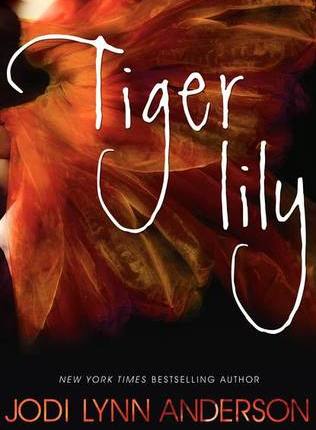
Tiger Lily by Jodi Lynn Anderson

Tiger Lily by Jodi Lynn Anderson

tigerlilyThis book is an absolutely magical re-telling of the story of Tiger Lily from Peter Pan. The narrator is the fairy, Tinker Bell.
I’ve always had a soft place in my heart for J. M.Barrie’s masterwork. Who among us hasn’t wanted to go to a place where you could remain young forever and never grow up?

Jodi Lynn Anderson writes that “never aging” magic of Neverland quite well: “Englanders had come to Neverland before. … The Englanders had the aging disease. As time went on they turned gray, and shrank, and, inexplicably, they died. It wasn’t that Neverlanders didn’t know anything about death, but not as a slow giving in, and certainly not an inevitability.” pg 13 (ebook)

Tiger Lily’s tribe may age, but how old they appear is contingent on something other than time. It’s curious and magical.

The lost boys come alive in this book with a wildness and unpredictability that I loved: “There was a joyfulness and- at the same time- a fragility about each of them. They were sloppy and uncared for and wildly alert and full of energy.” pg 61, ebook.

Despite their untamed natures, they are still children: “Straw beds had been separated haphazardly into different areas of the burrow, as if the boys hadn’t counted on wanting to live separately when they’d first built it, and only recently pushed themselves as far apart from each other as possible. Still, on one of the beds there was a worn home-sewn toy in the shape of a rabbit, and lying on a pillow, as if it had just been played with, a model of a ship.” pg 61, ebook.

Peter is the boy who has emotions but doesn’t understand them- perpetually young yet always on the verge of growing up.

He’s fiercely admired by his lost boys and, eventually, Tiger Lily: “Peter picked at his hangnail again. “Actually, I never get sad. It’s a waste of time, don’t you think?” Tiger Lily didn’t answer. She was impressed by the idea of deciding not to be sad. His words made him seem very strong. Impervious.” pg 67, ebook

Peter is still Peter in this tale. As far as girls go, he can be charming but also rude and aloof: “I think we could be good friends,” he said, falling into step with her. “It’s perfect because I wouldn’t fall in love with you, like I do with the mermaids. Girls always seem so exotic. But it would be okay with you, because you’re more like… you know. Not like a girl.” pg 77, ebook.

Tinker Bell was a sympathetic character in this book, rather than the spoiled, jealous creature that she is portrayed as in Peter Pan“A faerie heart is different from a human heart. Human hearts are elastic. They have room for all sorts of passions, and they can break and heal and love again and again. Faerie hearts are evolutionarily less sophisticated…. Our hearts are too small to love more than one person in a lifetime. … I tried to talk sense into my hard little heart. But it had landed on Peter, a creature two hundred times my size and barely aware of me, and there was no prying it loose.” pg 77-78, ebook.

Hook is extra creepy and villainous: “Neverland had called to him out of legends. A green place. A wild place. And most of all, a place where he’d never grow old. Most people in London hadn’t believed it existed, but some still insisted it did, and Hook had cast his lot with them. To get to the island, he’d begged, stolen, and eventually murdered.” pg 89-90, ebook.

And so is Mr. Smee. But, I’ll let Anderson tell you his story. She does a wonderful job of it.

The relationship between Tiger Lily, Peter, and Wendy makes a lot more sense in this story. It is less about any potential failings by the girls. The main source of conflict seems to be Peter’s emotional immaturity: “As you may have guessed already, Peter had a soul that was always telling itself lies. When he was frightened, his soul told itself, “I’m not frightened.” And when something mattered that he couldn’t control, Peter’s soul told itself, “It doesn’t matter.” pg 169, ebook.

The ending of this book was totally satisfying as well for all of the characters, even little Tinker Bell. I can’t say enough good things about it.

It’s easy to see why fairy tell retellings are so popular with books like Tiger Lily out there, waiting to be discovered.

Thanks for reading!

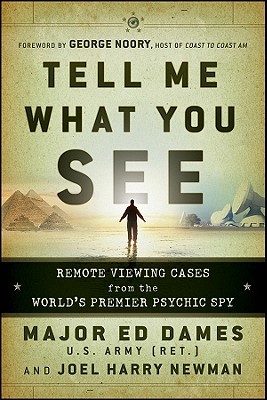
Tell Me What You See: Remote Viewing Cases from the World’s Premier Psychic Spy by Edward Dames

Tell Me What You See: Remote Viewing Cases from the World’s Premier Psychic Spy by Edward Dames

Tell Me What You See: Remote Viewing Cases from the World’s Premier Psychic Spy  is a book about remote viewing written by Edward Dames.

Remote viewing is a military protocol by which a “viewer” goes into a meditative state, sends his or her consciousness “out” to a target, and then reports on what he or she perceives while there.

In this book, Dames writes story after story about using this protocol for the government. And, later, cases that he and his group worked on, as a private company.

Confession time again: I love to read fringe-y non-fiction.  From the paranormal to the other worldly, I can’t get enough of it.

Books by former remote viewers from the military are such a trip to read.

These guys were/are on the cutting edge of consciousness exploration. It makes me wonder what humans are potentially capable of, but we don’t know it yet.

It also makes me wonder what else is out there to be perceived.

Don’t go to these books for feel good stories. I’m sure that it is because remote viewers were all trained as human weapons to root out threats to the government, but they all seem so dark and obsessed with shadows.

Even when Dames sets out to have a “fun” RV session on the Ark of the Covenant, his viewers see mainly blood shed and despair.

The methods used in Dames’ sessions were different from others that I’ve read.

David Morehouse and Lyn Buchanan, also former military RVers, described RV sessions in which separate viewers with handlers would run through coordinates. They would do this in completely secluded rooms. Later, the different sessions would be put together to try to create a complete picture.

Dames, on the other hand, described group RV sessions in which he’d act as the handler and give out the coordinates to the group. Then, his viewers would sit in a group setting and say what they were seeing, as they saw it.

I found this approach to be interesting. I wonder which technique had more accurate results.

What is RV?: “Remote viewing is about reaching beyond the five senses into the unconscious mind, to look inside and miraculously gather information stored like web pages on a cosmic computer. Even more miraculous is that we all have the innate potential to do this, a prescient sixth sense.” pg 16

The way the mainstream considers RV: “It’s part of my regular curriculum to discuss how badly the authorities treat remote viewing. … What people can’t pigeonhole they often reject. We were dealing with a system that treats what we do like watching someone have a seizure from behind a two-way mirror- uninvolved yet shamefully fascinated.” pg 27

Which is why I was surprised when he so vehemently rejects the contributions of the natural psychics, mediums, channelers to his military unit: “Gauvin and his broomstick pals were running us into the ground… Angela’s channeling was bound to be judged useless and scrapped and then maybe she’d go back to her crystal ball. … Who knew, by participating in an actual session maybe she’d catch on to how remote viewing really works. Maybe.” pg 120-121

Unlike mainstream folks, those types of spiritual “witches”, as Dames describes them, don’t need to be convinced that there are levels of perception beyond those utilized in day-to-day life.

If he had taken the time to look beyond their strange methods and encourage them to organize their natural talents within developed protocols, I think Dames could have found some powerful allies within the military RV program.

But, that’s not how he played it. Instead, you were either completely with Dames or against him. I suppose it goes back to his role as a soldier.

Dames’ comparison of RV to out-of-body experiences: “OBEs aren’t anything new. The concept has been around and practiced for thousands of years, dating back to the monks of ancient China and India. Their wizened mystics called it “astral projection,” a practice where, either awake or dreaming, certain adept individuals could cast off their earthly skin and propel their consciousness- astral body- into unknown spirit dimensions across time and space.” pg 153

And possibilities for RV in the future: “The ability to remote view is the next step in the evolution of the mind… What started out as a military tool based on the desperate need of warriors seeking to destroy their enemies in battle has now developed into an invaluable instrument in the search for enlightenment. Remote viewing is a teachable psychic-like skill anyone can learn. What is often overlooked is its potential to help us more deeply experience life.” pg 257 I would say so.

If you’re interested in more books like Tell Me What You See, you may want to look into The Seventh Sense: The Secrets of Remote Viewing as Told by a “Psychic Spy” for the U.S. Military by Lyn Buchanan or Remote Viewing: The Complete User’s Manual for Coordinate Remote Viewing by David Morehouse.

Thanks for reading!

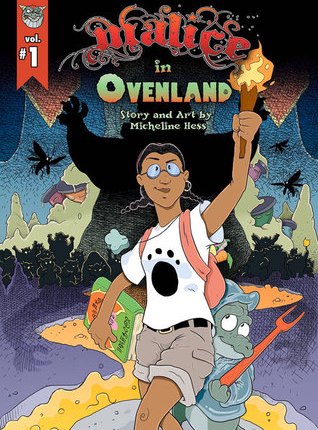
Malice in Ovenland: Volume 1 by Micheline Hess

Malice in Ovenland: Volume 1 by Micheline Hess

Malice in Ovenland by Micheline Hess is a graphic novel for children. Lily Brown’s mom tells her to clean the kitchen- and her adventure begins.

An excellent pick for reluctant readers, this story is a cute, gross, and, endearing romp through a fantastical world hidden behind an oven.

Lily’s heroic journey reminded me of the comic series, Princeless by Jeremy Whitley. In Princeless, the heroine tires of waiting for a prince to come save her, so, she sets about saving herself.

Lily is no wilting flower either, despite her name. 🙂

With art and a storyline appropriate for the pre-teen crowd and an empowered female protagonist, I could see this being a great addition to any juvenile’s graphic art collection.

What I enjoyed most about Malice in Ovenland were the homages to other great works of children’s literature.

The obvious one, of course, is to Alice in Wonderland but I also caught shades of the Lord of the Rings in the poem included at the end of Chapter 1.

The moment that Crumb comes to visit Lily in the dungeon reminded me of when Taran met Gurgi in the Black Cauldron.

The Queen’s advisor, named Crispodemus, reminded me of Nicodemus the rat from the classic children’s story, Mrs. Frisby and the Rats of NIMH by Robert O’Brien. (One of my all-time favorites, by the way)

And finally, The Royal Rangers reminded me of the Beagle Boys from Duck Tales– bumbling, minimally intelligent thugs, who would be harmless if they weren’t so determined to be bad.

Malice in Ovenland would be a great title for a reluctant reader or a reluctant eater. The story, in addition to the adventure, teaches kids to not be afraid to try new things- either food or life related.

It’s a message that can’t be repeated enough.

The humor is mainly gross-out or potty-related but, as a mother of a soon-to-be-10 year old, that’s exactly where her humor is at right now. It’s perfect for the audience that it is seeking.

Big thanks to NetGalley for providing me with a free digital edition of this title for review purposes and thanks for reading!