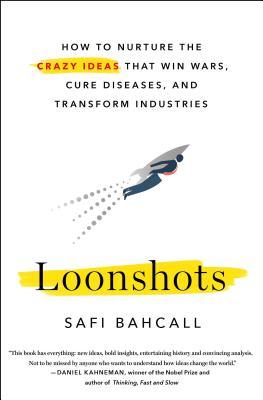
Loonshots: How to Nurture the Crazy Ideas That Win Wars, Cure Diseases, and Transform Industries by Safi Bahcall

Loonshots: How to Nurture the Crazy Ideas That Win Wars, Cure Diseases, and Transform Industries by Safi Bahcall

“New frontiers of the mind are before us, and if they are pioneered with the same vision, boldness, and drive with which we have waged this war we can create fuller and more fruitful employment and a fuller and more fruitful life.” — Franklin Delano Rooseveltpg 257

Safi Bahcall has applied a physics-based approach to understanding innovations and creativity in group settings. Through the careful study of a bunch of historical examples, he has discovered ways leaders can structure their businesses to best encourage the growth of “loonshots.”

Photo by Pixabay on Pexels.com

The author has defined a “loonshot” as “a neglected project, widely dismissed, its champion written off as unhinged.” It is through these, Bahcall believes, that world-changing ideas are produced that can be applied from arenas as diverse as business to war.

“The twisted paths leading to great discoveries are the rule rather than the exception. And so are their revisionist histories: victors don’t just write history; they rewrite history.” pg 56

He suggests these breakthroughs are generally created by large groups of people, rather than solitary geniuses. And he thinks that “applying the science of phase transitions to the behavior of teams, companies, or any group with a mission provides practical rules for nurturing loonshots faster and better.”pg 2

Photo by Andrea Piacquadio on Pexels.com

For example: By examining Theodore Vail and the way he structured AT&T’s “fundamental research” department to Vannevar Bush’s non-military leadership for the Office for Scientific Research and Development for the military, Bahcall has come to some actionable conclusions.

He believes that, in a business, you need to separate the creative-types in the innovation departments from what he called the “soldiers” or people who run the rest of the business. Both are absolutely imperative to the success of the business, but if the two are working too closely together, “loonshots” can be strangled in their infancy.

The same risk of failure is faced by leaders who try to micromanage “loonshots”. Trust your people to do what they do best, whether that’s development or running the business, so that you don’t drive a business into the ground because you’re too attached to your own pet project.

Photo by Pixabay on Pexels.com

Bahcall reminds us that structure is important but culture is as well. He makes a biological comparison to drive the point home: “Both genes and lifestyle matter. And so with teams and groups: both structure and culture matter. The aim of this book is not to replace the idea that certain patterns of behavior are helpful (celebrating victories, for example) and others are less so (screaming), but to complement it.” pg 227

I can’t say I completely understand what a “phase transition” is but Bahcall’s storytelling manner of imparting information is easy to understand. His writing is reminiscent, in some ways, of The Black Swan: The Impact of the Highly Improbable but with more emphasis on structure and culture instead of probability.

Readers who enjoyed one book, may like the other. Recommended for readers seeking more information about how to help businesses succeed, innovate and thrive.

Thanks for reading!

#GIRLBOSS by Sophia Amoruso

#GIRLBOSS by Sophia Amoruso

#GIRLBOSS is Sophia Amoruso’s story about her wild childhood, unlikely and extraordinarily successful business venture and her treatise on how to be yourself and bring what is unique to you to your professional life.

I googled Sophia after I finished this book and was dismayed to discover she has declared bankruptcy.

It seems she still has a successful motivational speaker program going on, but, for whatever reason, her business hasn’t worked out.

I suspect, she will land on her feet and start again. That is a large part of the philosophy contained in #GIRLBOSS.

Photo by Sam Lion from Pexels

“In about eight years, I went from a broke, anarchist ‘freegan’ dead set on smashing the system to a millionaire businesswoman who today is as at home in the boardroom as she is in the dressing room. I never intended to be a role model, but there are parts of my story, and the lessons I’ve learned from it, that I want to share.” pg 23, ebook.

Sophia believes in being yourself. Let your freak flag fly. Embrace your weirdness- because that is what ultimately makes you great.

“#GIRLBOSS is a feminist book, and Nasty Gal is a feminist brand in the sense that I encourage you, as a girl, to be who you are and do what you want. Being a Girlboss is as much about being the boss of your career as it is of your home.” pg 29, ebook.

Photo by Skylar Kang from Pexels

Between Sophia’s business tips and memoir, she includes quotations. Such as: “It was the straying that found the path direct – Austin Osman Spare.” pg 56

In her case, that was absolutely true. Sophia wanted a job where she didn’t have to work and could get paid for doing, essentially, nothing.

She found that job and surfed the internet most of the time. In doing so, she studied online communities like MySpace and eBay and concluded that she could network and sell items with the best of them.

And she did.

Photo by cottonbro from Pexels

Sophia is a believer in creating your own reality: “… there’s also the everyday kind of magic that we make for ourselves. And that’s really not magic at all. It’s just recognizing the fact that we control our thoughts and our thoughts control our lives. This is an extremely simple, totally straightforward concept, but for a lot of people, it’s so alien that it might as well be magic.” ebook, pg 109.

Sophia, like Obi Wan Kenobi, does not believe in luck. She believes in hard work, action and selective focus.

“Focus on the positive things in your life and you’ll be shocked at how many more positive things start happening. But before you start to think you just got lucky, remember that it’s magic, and you made it yourself.” ebook, pg 115.

Come bankruptcies and whatever else, I believe Sophia Amoruso will be just fine. Don’t you? 🙂

And have you watched the #GIRLBOSS series on Netflix? I did and it didn’t appeal to me as much as this book did. Not recommended.

Thanks for reading!

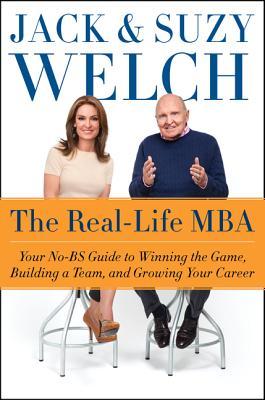
The Real-Life MBA: Your No-BS Guide to Winning the Game, Building a Team, and Growing Your Career by Jack Welch, Suzy Welch

The Real-Life MBA: Your No-BS Guide to Winning the Game, Building a Team, and Growing Your Career by Jack Welch, Suzy Welch
the real life mba

Jack & Suzy Welch have years of corporate experience under their belts. The Real-Life MBA is filled with some of their best practices culled from this background. Some of it I found helpful, other suggestions I didn’t enjoy as much, but I think that this may be because I’m coming from a non-profit career track rather than a cut-throat, competitive one.

Let’s get the negative out of the way first. Mr. Welch is well known for his practice of sorting his employees into tiered groups- the top 20%, the middle 70%, and the bottom 10%. If you are in the bottom 10% and you don’t improve within a certain amount of time, he promptly and tactfully assists you in finding new employment.

Now, I understand that there needs to be a balance when applying the carrot and the stick in business relationships. But, their approach just seems harsh. Welch insists that this system is more fair to the employer and employee- if you’re a bad fit, you’re not doing anyone any favors by sticking around.

Photo by fauxels on Pexels.com

On the other hand, your business will always have a bottom %10 so there will always be the shadow of that looming ax. I suppose that this could lend itself to an environment of continual growth, but I feel like it would be more motivated by fear than love. And, really, who wants that.

I liked the vision of organizational structure that was presented in Yes, And: How Improvisation Reverses “No, But” Thinking and Improves Creativity and Collaboration by Leonard Kelly. I think that creativity, trust, safe environments for occasional failures and career success go hand-in-hand. By encouraging an “ensemble” effort rather than a “team” mindset and fostering collaboration rather than a score board, I suspect that one would see just as excellent receipts with less turnover and a closer team bond.

Photo by Andrew Neel on Pexels.com

I haven’t tested this theory though and Mr. Welch does have forty or fifty more years business experience than me, so take it with a grain of salt. But, that’s my two cents.

I liked the section on career development: It’s About You, starting on page 177. Most of it is just common sense advice, but it’s solid. Do what you love to do and don’t waste your time in a career you hate.

We spend most of our time at work so we may as well be happy when we’re there- it’s the fuel of success, etc. No big surprises, but sometimes the most useful and applicable advice isn’t surprising.

If you enjoyed The Real-Life MBA, I’d recommend Yes, And: How Improvisation Reverses “No, But” Thinking and Improves Creativity and Collaboration by Leonard Kelly to give you a slightly different viewpoint on teamwork.  Also, Work Rules!: Insights from Inside Google That Will Transform How You Live and Lead by Laszlo Bock so that you can read about HR practices inside one of the most successful and employee friendly companies on the planet.

I received a free copy of this book through the Goodreads First Reads program. Thanks for reading!

Unmistakable: Why Only is Better than Best by Srinivas Rao

Unmistakable: Why Only is Better than Best by Srinivas Rao
unmistakable

A call-to-action for artists and business people of all types to create the work that only they can create which makes them irreplaceable and also Unmistakable.

“When you’re the only person who could have created a work of art, the competition and standard metrics by which things are measured become irrelevant because nothing can replace you. The factors that distinguish you are so personal that nobody can replicate them.” pg 2.

That makes sense to me. You’re essentially writing the book so no one can tell you how it’s supposed to go.

The theory of becoming Unmistakable is fairly simple but the journey to that place is not. There are no maps to this realm because it is different for everyone and the paths to that place vary as widely as the talents that people bring with them.

As Srinivas reminds us: “Unmistakable work is a process of self-discovery. We start our ride not knowing what it is that makes us unmistakable, and a thread reveals itself through the creation of a body of work. Dots connect, patterns emerge, and our unmistakable gift is revealed. Time is the critical ingredient required for this to take place, hence the role of longevity and commitment in the quest to become unmistakable.” pgs 56-57

So, you can’t give up. Create and fail and try again. That is as hard and as easy as it is.

“…creating unmistakable work might be one of the hardest things to do: you have to look into the depths of who you are, explore what matters to you, and infuse that into every element of your work until it can’t possibly be mistaken for something anybody could have done but you.” pg 68.

The messages contained within Unmistakable become repetitive after a few chapters, but Srinivas threads some of the stories and artists from his podcast to break up the material as well as his personal testimony.

Unmistakable encourages creation even in areas that you may have no prior experience: “Lack of formal instruction might keep us from attempting some sort of creative pursuit or starting anything in which we don’t have experience. … When we lack experience, we also have the advantage of lacking preconceived notions of what’s possible.” pg 113.

And, you don’t know what you’re capable of until you get started. So, what are we waiting for!

As Srinivas writes from an interview with Seth Godin: “The enemy of creativity is fear; that seems pretty clear. The enemy of fear is creativity; that doesn’t seem that obvious.” The antidote to our fear is to put our heads down, do our work, and make something each day.”pg 189.

Let’s all become Unmistakable.

Some further reading: Creativity: The Perfect Crime, Do the Work, and How to Fly a Horse: The Secret History of Creation, Invention, and Discovery.

Thanks for reading!