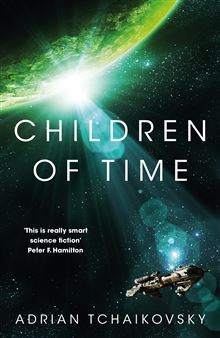
Children of Time (Children of Time, #1) by Adrian Tchaikovsky

Children of Time (Children of Time, #1) by Adrian Tchaikovsky

“And then the great bulk of the Gilgamesh is drawing close, at the end of its long deceleration, its ailing thrusters fighting to slow it to the point where the momentum of a dive past the planet will mesh with the reaching gravity and bring the ark ship into orbit.” pg 536, ebook

In Children of Time, humanity has poisoned Earth and needs to find a new home. An ark ship, the Gilgamesh, carries a cargo of sleeping humans as they search for a fresh planet to colonize.

In an earlier era, a scientist was working on elevating other species through an evolutionary vaccine. When her project goes awry, she does her best to salvage the situation, but not even she can predict what is going to happen next with her virus on an alien planet.

Photo by Jaymantri on Pexels.com

This story is told from a few different perspectives. Readers get to enjoy the story of the human colonists, the ancient scientist, and the species that is changed by her virus- the spiders.

The brilliance of this book is the spider portion of the story. I was amazed at how Adrian Tchaikovsky was able to make spiders relatable. (Not a huge fan myself, though not phobic.)

“For now they can only cling to their webs, as the extended senses their technology gives them track the approach of the end.” pg 536, ebook
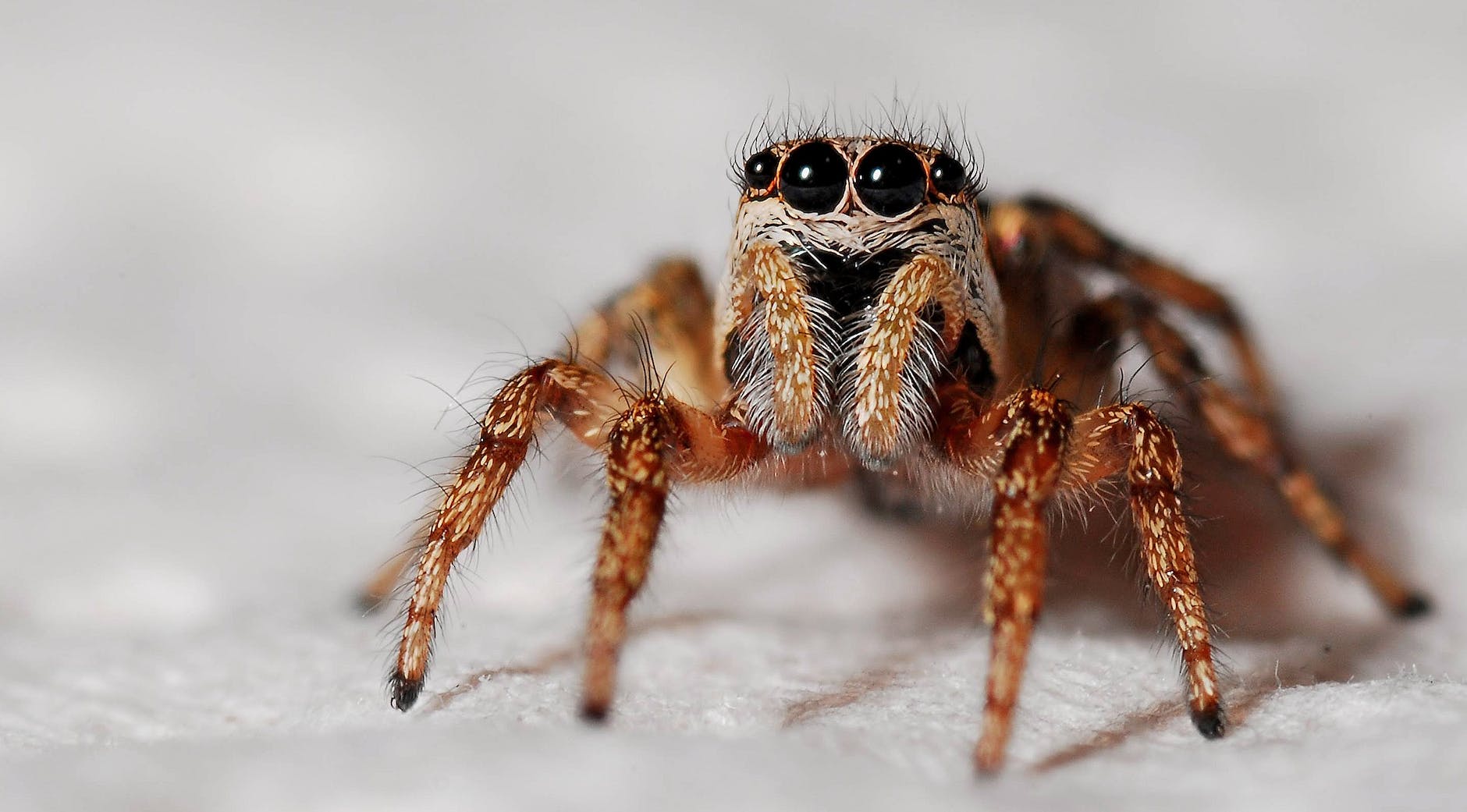
Photo by Pixabay on Pexels.com

I was cheering for the spiders as they struggled and evolve throughout the tale.

That’s not to say the human portions are lacking, they are also fascinating to follow.

How would humanity fare, being many light years away from home and knowing that they have no fixed destination in mind? How long would a space ship hold together with millennia of use? I thought Tchaikovsky’s story nailed the problems that would arise in such a situation.

The ending of Children of Time is fantastic and definitely worth the build up to it. I don’t want to say too much here beyond that because I don’t want to ruin someone else’s enjoyment of such a great science fiction tale. Highly recommended.

Thanks for reading!

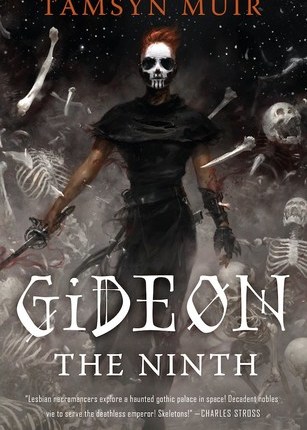
Gideon the Ninth (The Locked Tomb, #1) by Tamsyn Muir

Gideon the Ninth (The Locked Tomb, #1) by Tamsyn Muir

Gideon wants to escape from her dreary life on a dead end planet but when her plans are hijacked by the head of her household, she ends up having to become a cavalier for her nemesis. Snarky humor, profanity, and gothic themes follow.

“Gideon marveled that someone could live in the universe only seventeen years and yet wear black and sneer with such ancient self-assurance.” pg 24

Photo by Jeremy Mu00fcller on Pexels.com

I was unprepared for the violence and blood-soaked pages of this book. (Maybe I should have read some of the reviews first!)

I also had trouble keeping track of character’s titles. Each character could be referred to in three or four different ways, and the author used the titles interchangeably.

It made it hard for me to enjoy the story. The pacing was slow in the middle, which didn’t help matters.

One positive thing I have to say about Gideon the Ninth is the story is quite unique. I’ve never read a story about necromancers in space – until now.

Also, the humor was note-worthy. Tamsyn Muir, the author, uses modern language to build sparkling dialogue and funny interactions. If readers are fond of Deadpool, they may enjoy this story too.

I wish I had enjoyed it more. Only recommended for readers who like their humor dark, their bloody wounds flowing and their character lists massive.

Thanks for reading!

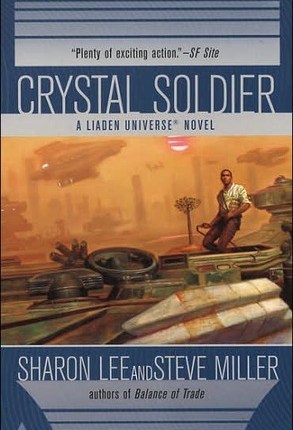
Crystal Soldier (The Great Migration Duology, #1; Liaden Universe, #1) by Sharon Lee and Steve Miller

Crystal Soldier (The Great Migration Duology, #1; Liaden Universe, #1) by Sharon Lee and Steve Miller

Pilot Jela has crashed on a lonely world where great forests once stood. He was in a fight in space against a highly advanced robotic society that seeks to destroy life itself.

Photo by mali maeder on Pexels.com

The sheriekas, for that’s what the enemy are called, have done a number on this world with its endless, lifeless forests. Until, after days of hardship, Jela finds a sign of life.

“The sheriekas (eliminated life) wherever they could, as if life itself was anathema. Overt signs of sheriekas action were an indication that a planet or system held something worthwhile… pg 23, ebook.

Cantra is a pilot whose hauls are generally on the up-and-up. She crosses paths one night with Jela. And that’s where the story truly begins.

Photo by Alberlan Barros on Pexels.com

The first entry in the Liaden Universe was written later as sometimes happens with these mammoth science fiction series. As the authors explain in the prologue, they felt creating Jela and Cantra’s story took a type of maturity that they did not yet have in the 1980’s, when they began writing the series.

“The problem we face,” he murmured, “is that someone- and we must assume that someone equals the Enemy- is experimenting with dismantling the universe.” pg 63

Photo by Tara Winstead on Pexels.com

I’ve been considering what to think about that. Certainly, authors don’t have to experience everything they write- imagine Suzanne Collins and her “Hunger Games.” But every artist has her process so, whatever works for them.

This is a well-written book, if a bit plodding at times. The pacing problem is offset with sparkling dialogue between Jela and Cantra. They converse in both words and a type of sign language called “pilot speak.”

It gives a different dimension to the communication between them. I liked that a lot.

Photo by Tatiana on Pexels.com

The universe itself, like other science fiction works I’ve read, is full of promise for both adventures and exploration. The nemesis- a group seeking to destroy life itself- is a fitting metaphor for industrialization run amok with its climate change implications.

I’m sure there are other comparisons that can be drawn. That’s simply the first one to pop into my mind.

I also liked that one of the main characters in this story is a tree. Wouldn’t life be fun if you could take a walk and talk to the trees lining your path? I think so.

Highly recommended for readers who enjoy science fiction and don’t mind an occasional pacing problem. Thanks for reading!

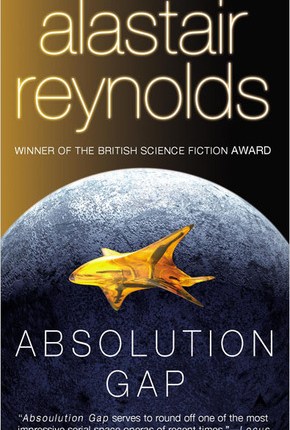
Absolution Gap (Revelation Space, #3) by Alastair Reynolds

Absolution Gap (Revelation Space, #3) by Alastair Reynolds

Alastair Reynolds ends his space opera trilogy with Absolution Gap. Many of the characters from the last book are desperately fighting the Inhibitors, but humankind seems to be losing the war. In a final hail Mary, the Conjoiners and a new member of their race seek a distant star system where a planet seems to disappear and the phenomena is worshiped by a group of fanatics led by a prophet with religious fervor literally in his bloodstream.

For a fraction of a second something inexplicable had occurred. A sensor anomaly. A simultaneous hiccup in every sensor that happened to be observing Haldora as the ship made its approach. A hiccup that made it appear as if the gas giant had simply vanished. Leaving, in its place, something equally inexplicable.” pg 54

Photo by Edvin Richardson on Pexels.com

Reynolds weaves two main story lines together to create an adequate, but perhaps not entirely satisfying, ending. The science in his books is impeccable. But, like in my previous reviews, I wanted a bit more from the characters.

“Are you all right, sir?” he had asked. Clavain had looked at him sharply. “I’m an old man,” he had replied. “You mustn’t expect the world of me.” pg 77

Readers have come to care about Clavain, Anoinette Bax, Scorpio, and the myriad others characters in this world. The endings given to them are, in my opinion, abrupt and almost given as an aside.

But some of Reynolds writing is simply beautiful and it makes up for a variety of quibbles I had with the story telling.

“It was quiet now, but coming nearer, and he knew that when it reached its awesome crescendo it would fill his soul with joy and terror. And though the bridge looked much the way it had before, he could see the beginnings of stained-glass glories in the black sky beyond it, squares and rectangles and lozenges of pastel light starting to shine through the darkness, like windows into something vaster and more glorious.” pg 100

Photo by Pixabay on Pexels.com

The broader themes are worth considering as well. What would happen to the human mind if the body becomes essentially immortal? Why does it seem like we’re so alone in the universe when there are so many inhabitable planets? What would advanced technological warfare look like? How would technology and its awesome capabilities change society, our modes of transport, and us?

“Brane theory suggested that the universe the senses spoke of was but one sliver of something vaster, one laminate layer in a stacked ply of adjacent realities. There was, Quaiche thought, something alluringly theological in that model, the idea of heavens above and hells below, with the mundane substrate of perceived reality squeezed between them. As above, so below.” pg 286

Photo by Miriam Espacio on Pexels.com

Recommended for science fiction readers who want to ponder those types of questions.

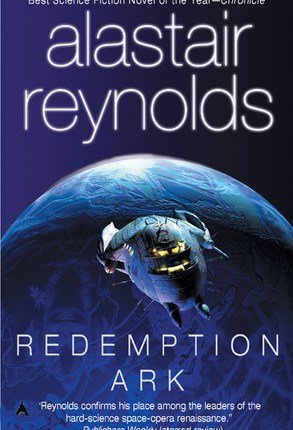
Redemption Ark (Revelation Space, #2) by Alastair Reynolds

Redemption Ark (Revelation Space, #2) by Alastair Reynolds

In Redemption Ark, we return to the universe of Revelation Space in the second book of Alastair Reynolds’ science fiction series. Some of the characters readers will recognize, others are new. As usual, we are treated to Reynolds’ prodigious talent when it comes to heaping helpings of the science part of science fiction.

Those are the best parts of this book: the futuristic space battles and the mysterious machinations of the Inhibitors, machines designed by an alien intelligence to wipe out civilizations that develop the technology to travel among the stars. For the reasoning behind this decision, you’ll have to read the book. 🙂

Photo by Pixabay on Pexels.com

They had never encountered another extant machine-using intelligence, nothing to measure themselves against. Until now. And what this machine-using intelligence did, so it seemed, was stalk, infiltrate and slaughter, and then invade skulls. pg 7

Humanity has divided itself into distinctive groups during its expansion into space, one of the most notable of these being the Conjoiners, a technologically advanced society that has linked its digital implants in a sort of hive mind. This link created a sort of “enlightenment” and connected the Conjoiners together in ways that aren’t quantifiable by those outside of the group.

“Down at the very deepest level Skade detected a few partitioned private memories that he did not think she could read. For a thrilling instant she was tempted to reach in an edit the man’s own blockades, screening one or two tiny cherished memories from their owner. Skade resisted; it was enough to know that she could.” pg 30

Photo by Suzy Hazelwood on Pexels.com

However, not everyone wants to allow the neural Conjoiner implants for fear of the loss of autonomy or privacy (see above) and embrace a more Luddite view of technology. This limited use of technology was pushed further by the appearance of a “melding plague,” an alien infestation that invades technology in an organic manner and consumes it, creating something else.

As you can tell from my rambling, Reynolds has created a universe populated with fascinating cultures, technologies and relationships. My main quibble with this book, as it was with his last, is his seeming inability to write about emotions. The extraordinary breakthrough of the Conjoiners was intimately connected to emotion and sharing it in a way that was impossible prior to the neural implants- an evolution of mankind. Reynolds puts all that depth into one or two lines of one paragraph of the book, which was fascinating to me, but also infuriating.

“Once you’ve touched someone else’s mind, walked through their dreams, seen the world through their eyes, felt the world through their skin… well… there never seemed to be any real need to go back to the old way.” pg 528

Photo by cottonbro on Pexels.com

He could have written a whole book about that one idea if he wanted to- I’d read it.

Another issue I had was the conclusion, which I won’t spoil for anyone here, but he writes it as almost an afterthought. For more than 500 pages, he built to this spectacular conclusion, which he then tossed away.

I was so mad.

On the other hand, he sets up the next book in the series beautifully, which must have pleased his publisher.

Highly recommended for science fiction readers. There are few who write the science better than Alastair Reynolds, but don’t expect too much in the way of emotional depth or exploration.

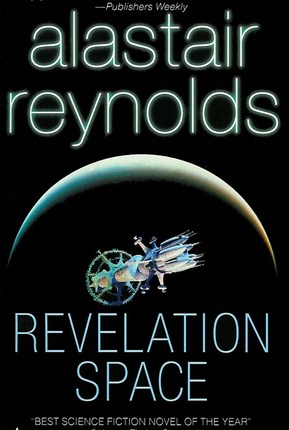
Revelation Space (Revelation Space, #1) by Alastair Reynolds

Revelation Space (Revelation Space, #1) by Alastair Reynolds

Through the interweaving stories of a scientist, soldier, and weapons expert, Alastair Reynolds explores classic science fiction themes in Revelation Space, a space opera and mystery.

“Despite being buried for nine hundred thousand years – at the very least – the chambers were almost intact, with the bones inside still assuming a rough anatomical relationship to one another. They were typical Amarantin skeletons.” pg 11, ebook

Photo by Pixabay on Pexels.com

Nearly a million years previous, an entire species called Amarantin disappeared in a mysterious celestial-based disaster called, by those who study the geological record, “The Event”. Dan Sylveste, a scientist with unique machines for eyes, is trying to unearth the truth of what happened to them.

Khouri, a former soldier turned assassin for a semi-secret agency, goes on a routine assignment, only to have the experience turn into something entirely unexpected.

“Assassins, it turned out, had to be among the sanest, most analytic people on the planet. They had to know exactly when a kill would be legal – and when it would cross the sometimes blurred line into murder and send a company’s stocks crashing into the Mulch.” pg 45, ebook

Photo by Ivan Siarbolin on Pexels.com

Meanwhile, on an enormous space ship capable of traveling across the universe at nearly the speed of light, Volyova has a serious problem. Her captain has a strange disease that is assimilating his ailing body into the ship itself and the man she hired to run the ship’s guns has gone insane. Could these two disasters be connected somehow?

“It was not something to which she was ever going to become totally accustomed, Volyova knew, but in recent weeks visiting the Captain had begun to take on definite tones of normality. As if visiting a cryogenically cooled corpse infected with a retarded but potentially all-consuming plague was merely one of life’s unpleasant but necessary elements…” pg 35, ebook

Throughout the story, Reynolds asks the reader to imagine a humanity that has split itself into factions. Some groups travel among the stars, assimilating rare machines into their bodies, losing touch with what it means to be human as they spend years in frozen animation while the rest of the universe ages as usual.

Other groups are just as isolated on far-flung planets and develop their own cultures, ways of government, and quickly-shifting alliances.

Photo by Felix Mittermeier on Pexels.com

Also, through the story of the extinct Amarantin, Reynolds examines what it would mean if humanity discovered aliens were real, but mysteriously absent from huge swathes of what is otherwise inhabitable space. Are we really as alone in the universe as we appear to be? And why is that so.

“Something had reached into his mind and spoken to him. But the message that was imparted to him was so brutally alien that Sylveste could not begin to put in human terms. He had stepped into Revelation Space.” pg 100, ebook

The broad themes of Revelation Space are fun questions to ponder, but Reynolds’ storytelling suffers in some of his more technical moments and during a truncated love story. A couple times during the beginning of the book, I had difficulty picturing scenes because I would get so bogged down in the details. But that became easier as the story progressed.

The love story though, was one of the worst I’ve read in science fiction literature. It made me feel like the woman was just a plot device for Reynolds to be able to explain some of the more complex plot twists. That’s fine if that’s what she was meant to be, but it was rather off-putting. I do enjoy a good love story and felt like, if you were going to make it so awkward, maybe it didn’t belong in there.

Photo by burak kostak on Pexels.com

Otherwise, I enjoyed this read and intend to start the next soon. Highly recommended for readers who enjoy science fiction and stories that make you want to go stand outside and stare at the stars for awhile.

Sons of Ares (Sons of Ares, #1) by Pierce Brown

Sons of Ares (Sons of Ares, #1) by Pierce Brown
sonsofares

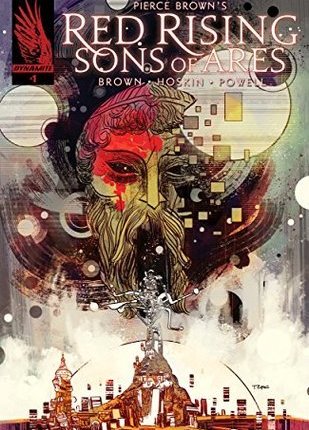
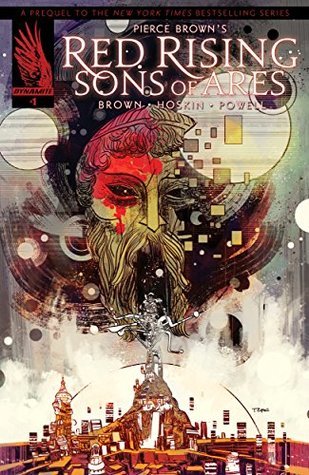
A comic that claims is going to give us the backstory of the Sons of Ares. But, in this entry, it just rehashes what goes on in the Gold school with an intro and conclusion teaser.

For anyone who hasn’t had the chance to read Red Rising, you’d need that backstory. For someone like me, who has, I wanted more new details. I didn’t get them.

I suspect that these comics, another coming out in June, are whetting the appetites of readers for the 2018 debut of Iron Gold. (Can’t wait, by the way.)

The art is beautiful but not breath-taking or highly stylized like Monstress, Vol. 1: Awakening.

The story takes place in a world I’ve come to love. But, it was only 32 pages and that was not enough.

On the other hand, I actually bought this comic. I wasn’t patient enough to recommend it for purchase at the library and then wait to see if they picked it up. I had to have it NOW. That says something for how much I love it. Having worked as a librarian, I take my book purchasing very seriously.

If you’re not a die-hard fan like me, you may want to wait until the libraries get their hands on it. As I said, this entry doesn’t give the reader much beyond a small window into Brown’s world. If you’re satisfied with crumbs, buy it now.

Thanks for reading!

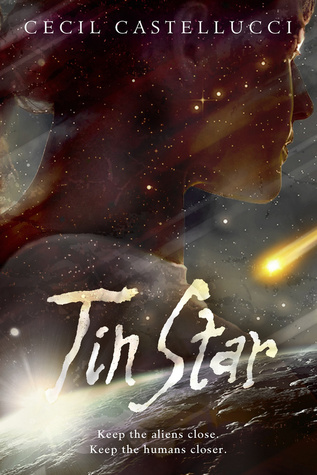
Tin Star by Cecil Castellucci

Tin Star by Cecil Castellucci

tinstarTin Star is the story of Tula Bane, a teenager who joined a space colonizing cult from Earth. She is abandoned on a way station near the edge of the known universe on the way to her new home.

How will Tula Bane survive among aliens who think human beings are the worst? Will she ever be able to go home to Earth or the colony’s planet? How will she manage to put bread on the table?

I love a good space opera and I thought that I would enjoy Tin Star more than I did.

The promise of books set in space, in my opinion, is the opportunity for unique interstellar exploration and worlds created entirely from the author’s imagination. Because of Tula’s unique plight- being stuck in what is essentially a space gas station- the author left herself very little room to write a creative story.

Mainly, Tin Star deals with character development and social struggles, not adventuring in new places.

The villain of the tale was charismatic and creepy. Take this description: “He had his hand on my shoulder in a way that he had a million times before. Only before it was comforting, encouraging, affectionate. Now it was menacing. He was looking at me and his face was smiling. To anyone looking from afar, he seemed to be pleased with me, but it was just a mask. His attitude shifted from concerned leader to unknowable monster.” pg 4

Tula manages to befriend a shady, insect-like alien named Heckleck. He’s my favorite character.

In this passage, Heckleck explains the problems Tula will face in trying to leave the station: “I know about you,” Heckleck said. “Everyone does. And you will never get off this station. You are nobody. And worse, you’re a Human. Even if you did not get on a ship that would take one of your kind, you’d have nowhere to go but to roam like the others of your kind do.” pg 35.

Keeping it real: with Heckleck.

I thought Cecil Castellucci could have done more with the cultural differences between Tula and the others on the station.

One of the most interesting exchanges in the book was between Tula and Tournour, the head of the outpost. She’s trying to figure out how old he is and, because they’re from different planets/species, it’s a surreal conversation. More of that would have been nice.

But Castellucci wrote cultural and language barriers out of the story by introducing nanites into Tula’s bloodstream to translate alien languages for her.

Something that Castellucci did well was writing profound silences between characters into her story. For much of this story, Tula finds herself standing around with Heckleck and Tournour and having nothing to say. But, somehow, it works.

I liked how Castellucci wrote the thoughts spinning through Tula’s mind at these moments. It reminded me of myself when I can’t think of anything to say: “It was a silent agreement between us that if we spoke too much then we would have to talk about the practical things. … If we ever spoke of the things that truly pressed up against us, our very real worries, our seemingly impossibly plans for escape, our divergent hopes for the future, our bubble would blow apart.” pg 184

This book in three lines: “In the end, good must win over evil. The trouble is trying to figure out which is which. Sometimes they look so much alike.” pg 204

Read this book if you enjoy light, young adult drama in space. If you’re looking for a meaty, space adventure, you’ll need to find another title.

Some read-alikes are: The Knife of Never Letting Go (teen trying to survive on an alien planet) or Gated (teen trying to leave a cult).

Thank you to Roaring Brook Press for sending an advance reader copy of this book. And, thank you for reading!