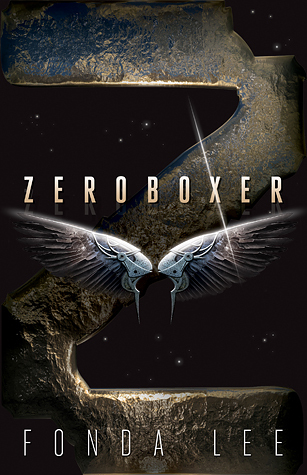
 At first, I thought that Zeroboxer was just Rocky in space, but as the story developed, I realized that it was more than that. Zeroboxer is also an examination of genetic ethics and, like most science fiction, poses some serious ‘what if’s. What if humanity begins to settle the universe- will they divide themselves into different races depending upon their planet of origins? What if the settlers develop their own system of government- how will humankind negotiate the potentially choppy waters of intergalactic politics? What if humanity could use gene therapy not just to eliminate disease but also to create a sort of super human? Fonda Lee has imagined a future filled with flawed but well-meaning people that feels very similar to our own and is, perhaps, not as far into the future as one may imagine.
The style of boxing in this story incorporates mixed martial arts with the added hiccup of no gravity: “To inflict any bare-handed damage to a person in zero gravity, you had to establish a brace or a point of leverage- preferably a vulnerable part of your opponent’s body- to keep them from floating away while you hurt them. Or you had to treat space itself as a weapon, using the infinite angles of movement to strike and rebound, strike and rebound, faster and harder than the other guy.” pg 13, ebook. Fans of MMA may enjoy this story more than I did- I don’t particularly care for violence but it was never too graphic or more than I could handle.
The colonists who settled on Mars (the Martians) embraced zero gravity sports while the people who stayed behind on Earth (the Terrans) didn’t. Luka, the main character in this story, is from Earth and he’s part of a group that is trying to popularize the sport on Earth- with mixed success: “I left Mars twenty-five year ago, saying I was going to grow the sport with the Terrans. I was practically laughed off the Red Planet. All the best zeroboxers in the Martian system… you know what they said to me? ‘Everyone on the old planet is a planet rat. The most daring and inventive Terrans left generations ago to build Mars and the other settlements. Why would a place with countless gravity-dependent sports want anything different?” pg 27, ebook.
The story becomes even more complicated because the Martians have accepted gene therapy as a way to improve and expand their race, while the Terrans only use it to keep children from developing poor eye sight or asthma. The Martian fighters are so dominant at the sport because not only were they born into a world that encouraged zero gravity sports, but also they were partially engineered to be that way. When the boxers from Earth face the boxers from Mars, it is more than planet vs planet- it is also a match up of nature vs science.
Luka doesn’t want to consider the complexities of it all and just wants to fight: “Two guys go into a Cube. They fight. One of them beats the other. How much simpler can it be? People don’t have to make it more than it is.” pg 176, ebook. Will Luka get his wish?
This book should appeal to fans of Ender’s Game or Red Rising (which is a much more adult examination of these themes). Thanks for reading!
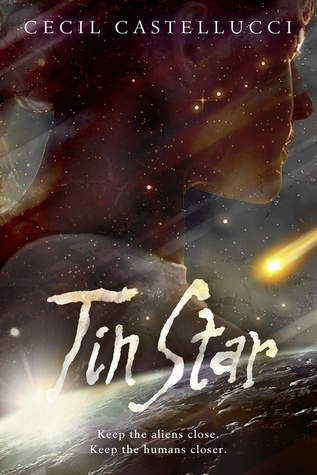 Tin Star is the story of Tula Bane, a teenager who joined a space colonizing cult from Earth. She is abandoned on a way station near the edge of the known universe on the way to her new home.
 The Help Desk Book Blog