The Speed Reading Book by Tony Buzan

The Speed Reading Book by Tony Buzan

I did not speed read Tony Buzan’s The Speed Reading Book because I found it to be rather a slog. There is useful information in here about the physical capabilities of your eyes and brain, methods for training your eyes how to move, the benefits of improving your vocabulary, how to recognize patterns in the way paragraphs are structured, and the basics of logic.

However, it’s interspersed with information that I felt was better presented in Use Your Head.

“Quite apart from important improvements in the technique of learning how to read fast which are set forth in this book, what I wish to emphasize in my system is that understanding and remembering factual material is not nearly as important as knowing how to relate new material to what you already know. This is the all-important ‘integrative factor’, or if you will, learning how to learn.” pgs 12-13

Photo by fotografierende on Pexels.com

He re-hashes the proper way to make a mind-map and the importance of previewing all reading material, even mystery novels, which I felt was silly. I can’t speak for the whole world, but I read mysteries to be entertained, not create a template into which I fit important details as I go along.

“The purpose of the preview is to develop a structure into which the mind can more easily fit the smaller details of that structure. … Previewing should be applied whatever kind of material you are going to read, which it be letters, reports, novels or articles.” pg 115

Though he did backpedal on his “preview everything” stance somewhat in a chapter about reading poetry: “When reading literature and poetry, bring to bear all your knowledge and judgment, and if you feel that it is the kind of writing you wish to treasure forever, forget about speed reading through it and reserve it for those occasions when time is not so pressing.” pgs 167-168

Thank you, I will.

Photo by Mark Cruzat on Pexels.com

Perhaps part of my problem with this book is that it revealed to me just how slowly I read and assimilate non-fiction, because Buzan offers the reader information about the absolute limitlessness of human capability.

“Theoretically, the human visual system can photograph an entire page of print in one-twentieth of a second, and thus a standard length book in between six and twenty-five seconds, and the entire Encyclopaedia Britannica in less than an hour. Advanced skinning and scanning skills take you on the first step of that incredible and inevitable journey.” pg 70

Let’s say I have much room for improvement.

The book also showed its age somewhat during a chapter on the importance of organizing how you take in information from newspapers: “Newspapers are so much a part of our everyday life that we seldom stop to think that they are a very recent development.” pg 148

But are they still? I’m not so sure.

Photo by Masha Raymers on Pexels.com

The book ends on a high note and, of course, I plan to continue practicing and improving my skills: “Your continuing success in all fields of speed reading depends on your personal decision to continue the course you have begun, and on the capacity of your brain to read, assimilate, comprehend, recall, communicate and create, abilities which we know approach the infinite. Your success is therefore guaranteed.” pg 177

But if you’re only going to read one book by Tony Buzan, I recommend Use Your Head.

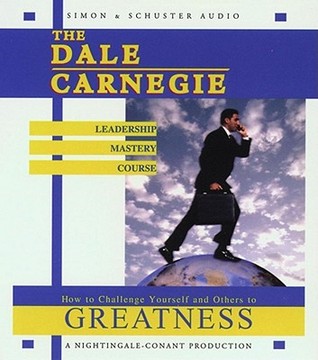
The Dale Carnegie Leadership Mastery Course: How To Challenge Yourself and Others To Greatness by Dale Carnegie

The Dale Carnegie Leadership Mastery Course: How To Challenge Yourself and Others To Greatness by Dale Carnegie

The version I listened to of The Dale Carnegie Leadership Mastery Course, published in 2001, has not necessarily aged well, but still had some applicable lessons for business leaders.

On the positive side, this audio program encouraged me to examine my own leadership style, something I’d never considered before. Are you a innovative or organizational leader? Do you bring people together or drive them apart, intentionally or unintentionally? What is your risk tolerance and why?

Photo by RODNAE Productions on Pexels.com

In addition to introspection, this program asks you to plan for the future based on your strengths and take steps towards those dreams. What are your goals, personally, professionally and for your current company? What would you like to see happen to your company after you die?

It also examines a leader’s entire life with the idea of success isn’t success if you lose your family and important relationships while building your career or vice versa. Are you capable of taking time off? Do you devote time to those who are most important to you at home and at work?

Those are just a few of the positive aspects of this program. On the other end of the spectrum, the music between sections is hilariously dated, almost like motivational elevator music. And there seemed to be what amounted to hero-worship of Dale Carnegie slipped in between the lessons or at the end of sections.

For example, in the lesson on handling disasters and poor decisions as a leader, the program was discussing a CEO’s almost universally hated idea of putting a thermometer on soda dispensers and having the price of a drink go up as the temperatures rose. The narrator closed the section with a statement like: “If Dale Carnegie had been at that meeting, he would have suggested the price of a drink go down as the temperatures went up.” (Cue motivational elevator music.)

Photo by Karolina Grabowska on Pexels.com

I don’t want to dismiss Carnegie’s extensive contributions to the realm of business and leadership skills, but he was human too. To assume he would have been able to turn around some spectacularly bad corporate decisions with just his mere presence struck me as a bit ridiculous.

In that same vein, some of the fable-like stories put into the lessons for emphasis felt heavy-handed, particularly one where a father expected too much of his son. It was a lesson about empathy but it was over the top.

As I said, I did learn some valuable skills from this audiobook and continue to ponder some of the lessons it presented. At the same time, I did have a few giggles at material that, I don’t believe, was ever intended to be satirical. Recommended for those interested in building their leadership acumen, but prepare yourself for a few misses in the presentation.

If you’re interested in non-fiction, business and self improvement books, here are a few I’ve recently reviewed:

Eat That Frog!: 21 Great Ways to Stop Procrastinating and Get More Done in Less Time by Brian Tracy

The Lost Prosperity Secrets of Napoleon Hill by Napoleon Hill

The Art of Exceptional Living by Jim Rohn

Thanks for reading!

How to Be Dull: Standing Out Next to Genius by Basil Morley, Esq.

How to Be Dull: Standing Out Next to Genius by Basil Morley, Esq.
howtobedull

How to Be Dull: Standing Out Next to Genius is one of the funniest books I’ve read this year.

I read a lot of self help, self improvement, self actualization books and How to Be Dull shines a hilariously dark spotlight on the myriad benefits of staying just as you are. The humor is dry and the delivery is completely serious and matter-of-fact, rather like a Monty Python classroom sketch.

It is also surprisingly educational.

Do you know why we remember Chaucer’s name but so very few of his contemporaries? : “…Chaucer succeeded by adapting Italian masters, appropriating a wide range of old folk tales, mixing them with Greek myth, writing in the vernacular rather than hoity-toity Latin or snooty French, and adding a wide range of characters to represent the whole of modern 14th century life from the top to the bottom… He was a true original, though one must admit his originality was made of things familiar mixed up, changed, innovated and slapped together in wholly unexpected ways.” loc 68, ebook.

It’s so true! People don’t want new stuff- they want old stuff repackaged to look new. How dull is that. Chaucer knew what was up.

This whole dull thing is very appealing to introverts: “Be dull. Be boring. Make no splash. Make no waves. Put your head down and do the work you wish to do and present such a bland face to the world that they leave you in peace to get on with it. Do not make the mistake of seeing this as some kind of capitulation. You are not defeated if you are dull. You merely refuse, wisely, to spend your precious time convincing others of your originality.” loc 105.

Photo by Pixabay on Pexels.com

Being left in peace to do what I want to do- now there’s a philosophy I can get behind.

If you were curious as to the enduring popularity of socialites who don’t seem to contribute in any meaningful way to society, Morley suggests that it is because of dull people just like you and me.

Imagine our importance! : “Be below notice. For you will find it easy to make your way unseen into important places, for the truth is the appeal of these ‘personalities’ is their true blandness. They are screens upon which we project our home movies of illusion. And they need dull people to make them sparkle.” loc 168, ebook.

I do enjoy an author who isn’t afraid to put in a good word for themselves: “How to explain this conundrum without falling into dullness myself and losing your attention? I do wish to teach you to be dull, but you must attend to my brief lesson long enough to say, ‘Yes I read that book and I rather liked it’ so you can recommend it on ReadGood or whatever those places are before you go back to sipping your own martini and forget all about my delicious tome.” loc 796, ebook.

Photo by MART PRODUCTION on Pexels.com

Ah, self promotion, the height of dullness. Now, back to my martini…

Let’s end with Morley’s exhortation to be a “shining example” to those who try to stand out from the crowd: “It helps one to know that whilst one appears to be useless and idle, one can congratulate him or herself on being a shining example to those who would wish to be extraordinary. It is the normal thing, or should I say the usual thing.” loc 923, ebook.

Know anybody who forgets to laugh about the silliness that is the self improvement rat-race? I have just found the perfect Christmas present for them. You’re welcome. 🙂

Photo by mentatdgt on Pexels.com

Some more humorous books about popular culture: The Joy of Leaving Your Sh*t All Over the Place: The Art of Being Messy or The Life-Changing Magic of Not Giving a F*ck: How to Stop Spending Time You Don’t Have with People You Don’t Like Doing Things You Don’t Want to Do. But, How to Be Dull is superior to either of those books because the author never wavers from his/her beautifully worded, high brow observations or resorts to vulgarity to make a point.

Thank you to NetGalley and Women’s League of Ale Drinkers Publishing for a free digital copy of this book. (What a great name for a publishing firm, by the way.) And, thank you for reading!