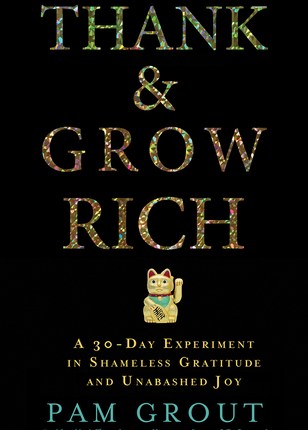
Thank & Grow Rich: A 30-Day Experiment in Shameless Gratitude and Unabashed Joy by Pam Grout

Thank & Grow Rich: A 30-Day Experiment in Shameless Gratitude and Unabashed Joy by Pam Grout

There is a disclaimer written in the description of this book on Goodreads that states it is not for everyone, but it was awesome in my opinion. I am going to admit that I am incredibly biased.
Photo by cottonbro on Pexels.com

I absolutely adored Pam’s other books on New Age thought and had some unbelievable experiences with the experiments recommended in them: E-Squared: Nine Do-It-Yourself Energy Experiments That Prove Your Thoughts Create Your Reality and E-Cubed: Nine More Energy Experiments That Prove Manifesting Magic and Miracles Is Your Full-Time Gig.

However, I couldn’t convince my public library to buy them because, I was told, they are “too fringe”.

Perhaps this book, which focuses on adopting an attitude of gratitude to improve your life, will be mainstream enough to make the cut.

Pam addresses the metaphorical elephant contained in her title early in the book: “No offense to Napoleon Hill, the author of the self help classic on which my title riffs, but the real power is in not thinking. If you want to override your brain’s unfortunate habit of leafing through your past and creating a present hologram to match, forget thinking. And start thanking.” Loc 108, ebook.

I read Think and Grow Rich last year and I could see how other people have beef with the classic. Napoleon Hill focuses on money, making connections, and doing the internal work to shoot yourself into the stratosphere of life success.

There’s very little in there about feeling your way to the same place.

Photo by fauxels on Pexels.com

Pam takes a different approach: “I should get this out on the table right now. This book won’t do a thing for your 401(k) or help you secure the McMansion you pasted onto your vision board. It’s not about getting rich in the traditional sense. … There’s nothing wrong with financial capital, but let me be very clear. It’s incapable of bringing any measure of real happiness.” Locs 324-337 ebook.

She gets to the heart of why seekers chase anything- because we believe that it will bring happiness. Pam suggests getting happy and then the success will come.

And, how does she say that we should “get happy”? By being thankful for what we already have.

“Be astonished by useless things. It’s easy to be thankful for the obvious- healthy kids, public libraries, strong marriages. But in this game we’re going to take it a step further. We’re going to build our gratitude muscle by also appreciating the insignificant and impractical…” Loc 856 ebook.

I had to include that passage for the library mention. Yay libraries!

Photo by Janko Ferlic on Pexels.com

Pam backs up her claims with scientific studies such as: “According to Richard Wiseman, psychology professor at the University of Hertfordshire in England and creator of Luck School, people who think they’re lucky actually are. After eight years of studying hundreds of self-identified exceptionally lucky and exceptionally unlucky people, he concluded that getting good breaks has nothing to do with karma or kismet and everything to do with how we see ourselves.” Loc 991 ebook.

I would like to state for the record that I am one of the luckiest people that I know. 🙂

She also includes a bunch of information from happiness researchers: “When it comes to success, research shows that while IQ, education, and training play cameo roles, the starring role, the headliner on the success stage, is “Do you have a vision? Do you believe it’s possible?” Shawn Achor, author of The Happiness Advantage: The Seven Principles of Positive Psychology That Fuel Success and Performance at Work… claims that predicting success using any other factor (say, your IQ or number of degrees) is about as effective as flipping a coin. What is effective, Achor and Frederickson and other happiness researchers have proven, is creating a happy brain that anticipates accomplishment, that knows success is just a matter of time.” Loc 1876 ebook.

I know that I have a pretty open mind when it comes to these types of books, but my thought is, what’s the harm in it? If it works for you, great! You’ve just discovered a new tool to use for living the best life for you.

If it doesn’t work, no harm done. At the very least, you would know for yourself.

Photo by Belle Co on Pexels.com

I recommend this book for readers of the Abraham Hicks materials because there are quite a few similarities in the philosophies contained within.

Some additional read-alikes for seekers like me who can’t get enough information about the law of attraction: The Power of the Heart: Finding Your True Purpose in Life, Happiness: A Guide to Developing Life’s Most Important Skill, or Dr. Quantum Presents: Meet the Real Creator–You!.

The opinions contained within this review are entirely my own. Thank you to NetGalley and Hay House for a free advance reader’s copy of this book for review purposes!  And, thank you for reading.

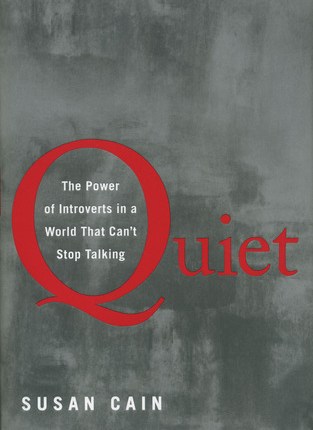
Quiet: the Power of Introverts in a World that Can’t Stop Talking by Susan Cain

Quiet: the Power of Introverts in a World that Can’t Stop Talking by Susan Cain

Quiet: The Power of Introverts in a World That Can’t Stop Talking entered my life at a particularly low moment.

Allow me to set the scene: I had been on vacation for a week and a half. We were in Colorado, visiting my husband’s family, some of whom I had met before, others whom I had not. I knew I wasn’t going to be entirely comfortable being around people the whole trip- I’m a huge introvert and I’m self aware enough to know that I need downtime, and quite a bit of it, to feel as if I’m functioning normally.

But I didn’t realize that my husband, who is just as introverted as I am and who I was counting on to help me through all of the introductions, dinners, conversations, etc, was going to immerse himself in Pokemon Go a majority of the time and essentially leave me to my own devices.

As Susan Cain would say, he found a “restorative niche” for himself in a digital world. It was hard on me as I didn’t have that escape.

Photo by ROMAN ODINTSOV on Pexels.com

So, here we are, visiting a friend’s home and my daughter, who strangely enough is a huge extrovert (the exact opposite of her parents), is struggling. She’s tired, out-of-sorts, and throwing a sulk every ten minutes.

I’m meeting yet more people, trying to hold trite conversations, and steer my child, all the while just wanting to retreat into a cave and not talk to anyone for a very long time. Honestly, I felt that way before we reached the party, but things seemed to get much, much worse the moment we arrived.

It had been building over the course of the vacation, but that day, my internal clamor reached a boiling point. My husband was oblivious to my growing discomfort as he’s catching Pokemon, again. (I don’t mean to sound bitter here, but I suppose that I am.)

I had forced myself for ten days to be social, keep the smile on my face, keep everything flowing smoothly. To my horror, I realize that I am about to have a panic attack in the middle of this crowd of people, more than half of whom I don’t even know. I grab my keys and leave.

I drive a couple blocks away, castigating myself for not being able to handle it and just pissed because, once again, like many times in my childhood, adolescence, and adulthood, I feel like I’m failing at life because I’m not a social butterfly.

Photo by Ryanniel Masucol on Pexels.com

I can’t stand to be around strangers for extended periods of time. I’ve always been this way- overly sensitive to others, noise, motion, events. I really dislike groups, parties, places where I have to circulate with a bunch of people who don’t know me or care about anything that I have to say.

The tears fell down my cheeks as I opened up my tablet and began reading this book. And I discovered that about half of all people are just like me.

Thank you, Susan Cain. Your book gave me the courage to drive back to my friend’s house and face the rest of the evening. I am not a pariah. I am an introvert and perhaps I can do a better job figuring out when I’ve reached my socializing limits before I meltdown.

Many of the positive attributes of introverts which Susan describes, I have, I’ve just never considered them as worth the trade-off of the extroverted personality.

I notice small details, have a great memory for conversations and events, long past the time when others forget such things. I think carefully about problems and people, devoting time to taking apart small nuances of books and movies, that other people don’t even consider, which makes me a good reviewer of media- perfect for my job as a librarian.

Susan nailed my general feeling about myself in the introduction: “Introverts living under the Extrovert Ideal are like women in a man’s world, discounted because of a trait that goes to the core of who they are. Extroversion is an enormously appealing personality style, but we’ve turned it into an oppressive standard to which most of us feel we must conform.” pg 34 ebook. Yes!

My role at the reference desk calls for an extroverted personality but I muddle through it, because I care about the job and helping others. Usually, I come home from work, totally worn out and in need of quiet time to unwind.

Susan helped me understand that sometimes “faking it” is worth it, if it for a cause that means something to you and that others do the exact same thing that I do.

Pull out the mask for the job, but then allow yourself the freedom to be who you really are at home: “According to Free Trait Theory, we are born and culturally endowed with certain personality traits- introversion, for example- but we can and do act out of character in the service of “core personal projects.” In other words, introverts are capable of acting like extroverts for the sake of work they consider important, people they love, or anything they value highly.” pg 391 ebook.

My favorite parts of the book were about sensitivity and social situations. Take this passage: “…maybe we didn’t choose … social accessories at random. Maybe we’ve adopted dark glasses, relaxed body language, and alcohol as signifiers precisely because they camouflage signs of a nervous system on overdrive. Sunglasses prevent others from seeing our eyes dilate with surprise or fear; we know from Kagan’s work that a relaxed torso is a hallmark of low reactivity; and alcohol removes our inhibitions and lowers our arousal levels. When you go to a football game and someone offers you a beer, says the personality psychologist Brian Little, “they’re really saying hi, have a glass of extroversion.” pg 277 ebook.

I may use that in my life. “Please hand me that glass of extroversion.”

I also really enjoyed learning the differences in thinking: “Introverts and extroverts also direct their attention differently: if you leave them to their own devices, the introverts tend to sit around wondering about things, imagining things, recalling events from their past, and making plans for the future. The extroverts are more likely to focus on what’s happening around them. It’s as if extroverts are seeing “what is” while their introverted peers are asking “what if.”pg 323 ebook. Yeah, I do that too.

I can’t recommend this book highly enough. It saved an evening for me, but more importantly, it changed the way that I view myself. There is power in knowing that you’re not alone. Again, thank you, Susan Cain. Some read-alikes: The Introvert’s Way: Living a Quiet Life in a Noisy World by Sophia Dembling (for introversion) or Furiously Happy: A Funny Book About Horrible Things by Jenny Lawson (for more instances of social anxiety).

Thank you for reading!

The Introvert’s Way by Sophia Dembling

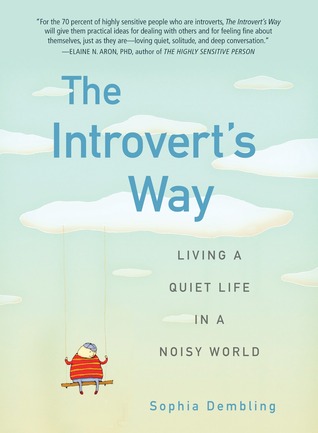
introvertThe Introvert’s Way: Living a Quiet Life in a Noisy World is a collection of Dembling’s blog posts about introversion. She talks about how introverts are different from extroverts, how we rub each other the wrong way, and how, with some understanding on both sides, we can all get along and thrive.  It’s engaging, but she writes as the royal “we” which I found distracting. No one has the authority to speak for introverts as a group. Right, introverts? *crickets*
I loved how she cleared up some rather major misunderstandings that I’ve been running into my entire adult life, like this one: “When we want to, not-shy introverts can nut up to the task of being charming and witty. We can meet new people. We can start conversations and keep them rolling, and even draw shy people out, since we’re good at not getting up in anyone’s face and we’re patient listeners… Introverts who are not shy are used to being told that they could not possibly be introverts. This can be irritating, but think of it as a teachable moment.” pg 16-17

Dembling gives some concrete ways in which introverts can improve their social skills: “If you’re misinterpreted more often than not, you might need to give some thought to what your quiet is telling people. When you are sitting quietly, try to parse what kind of quiet you’re feeling. “Leave me alone” quiet is different from “thinking hard” quiet, which is different from “enjoying watching the scene” quiet, which is different from “I’m totally overwhelmed, get me out of here” quiet. Once you have a sense of what you want to project, consider your body language. pg 37 My husband has expressed to me, many times, that he can’t read my “quiet”. This can be problematic because when I’m upset, I withdraw completely and, if he’s not paying attention, he misses the whole thing. Maybe I should make some signs…

“…with our deep listening habits and our hyperawareness and sensitivity, introverts are particularly susceptible to being sucked into the vortex of other people’s demands and expectations, which can cause us to keep going long after we are completely drained of energy.” pg 55 This is a legit problem. I’m from a large family of extroverts and I’ve learned that I have to draw very clear boundaries to preserve my space. There’s an assumption that if I’m home that I’m not doing anything “important” and I should be willing to go out and do whatever it is that they’re doing. Annoying. I know that they do it out of love and the desire to make me feel included, but sometimes, most times really, I just want to be left alone.

This, just this: “Nine out of ten introverts agree: the telephone is the tool of the devil.” pg 64 End of story. I can never think of anything to say while I’m on the phone, but after I hang up, I think of ten million things I could have said. It’s a vicious cycle of terror and then regret. I’m over it.

Dembling’s “Affirmations for Introverts” are excellent. Here’s my favorite: “I know what I need better than anyone else.” pg 179

It was encouraging to read about how some of my major personality quirks, which I have always viewed as flaws, are not really stumbling blocks at all. It’s just how I interact with the world. I’m very fortunate in that my friends and family have accepted me for who I am, for the most part, and not pushed me to be someone that I’m not. I just wish that I had been more aware of what makes me happy and not been so hard on myself for so many years because I wasn’t an extrovert. I wish I was good at parties, made small talk with ease, or lit up a room with my mere presence, but I don’t. And, at long last I realize: that’s ok.

If you’re looking for more books on this topic, try The Power of Personality: How Introverts and Extroverts Can Combine to Amazing Effect by Sylvia Loehken or The Life-Changing Magic of Not Giving a F*ck: How to Stop Spending Time You Don’t Have with People You Don’t Like Doing Things You Don’t Want to Do by Sarah Knight (not necessarily a book on personalities, but I found it useful as a technique to manage my energy).

Thanks for reading!

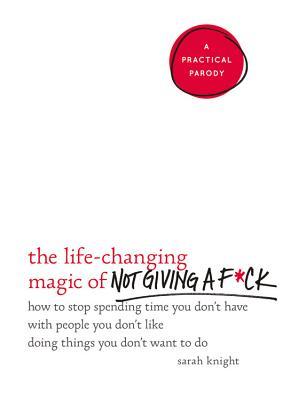
The Life Changing Magic of Not Giving a F*ck: How to Stop Spending Time You Don’t Have with People You Don’t Like Doing Things You Don’t Want to Do by Sarah Knight

The Life Changing Magic of Not Giving a F*ck: How to Stop Spending Time You Don’t Have with People You Don’t Like Doing Things You Don’t Want to Do by Sarah Knight

Since I just posted on Spark Joy, I thought that it was the appropriate time for a review of this one.

Full title, it’s a whopper and very descriptive of the book’s contents: The Life-Changing Magic of Not Giving a F*ck: How to Stop Spending Time You Don’t Have with People You Don’t Like Doing Things You Don’t Want to Do.

F-bombs aplenty in this parody of Marie Kondo’s international best seller about tidying. If you can look past the obvious language thing, Knight gives some fairly solid advice. She counsels readers to not care so much about what others think and give that mental energy to yourself. You’ll be surprised what you can accomplish.

“Please listen when I say that the shame and guilt you feel when you’re trying so hard to not give a f***? It’s usually not because you are wrong to not give that f***. It’s because you’re worried about what other people might think about your decision. And guess what? You have no control over what other people think.”pg 26

See? She reminded me of a more foul-mouthed Byron Katie.

Sometimes she manages to string together two whole sentences without the F-word. Check it out: “You can sidestep the prospect of hurt feelings entirely when you view your conflict through the lens of simple, emotionless opinion. NotSorry (Knight’s method) is all about simple, emotionless opinions.” pg 31.

Beyond managing your own mind, she branches out to give advice to parents: “One mother responded from the perspective of teaching her own kids what to give a f*** about: As someone who grew up in a household full of guilt, I think it’s important for our kids to know that they can make decisions about what to care about, and that they don’t need to pay attention to the approval or condescension of other people in deciding how to live their lives.”pg 92.

I can get behind that idea.

Then we move right along to shades of Eckhart Tolle and The Power of Now: A Guide to Spiritual Enlightenment with contemplating the meaning of existence and its temporariness: “The reality is, unless we’ve been given a ballpark figure by a reputable physician (and sometimes not even then), not a single one of us knows when we’re going to shuffle off this mortal coil. It’s morbid, but it’s true. Tomorrow you could get hit by a bus, or mauled by a pack of wolves, or be scared to death by a clown. When you think about it like that, don’t you want to make every second count? pg 184.

Sarah Knight’s book, in my opinion, doesn’t have the life-changing magic of the other book, but she’s got some interesting thoughts that I believe are true and, sometimes, rather funny. But make sure to bring your sense of humor with you when you pick this one up because the author doesn’t give a … well, you know.

Thanks for reading!