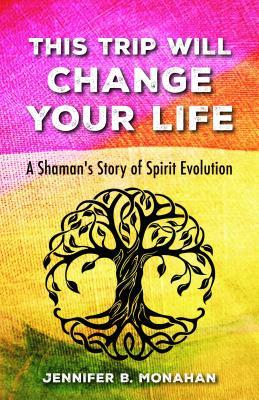
This Trip Will Change Your Life: A Shaman’s Story of Spirit Evolution by Jennifer Monahan

This Trip Will Change Your Life: A Shaman’s Story of Spirit Evolution by Jennifer Monahan
tripwillchangeyourlife

This is a firsthand account of Jennifer Monahan’s discovery of her spiritual path and budding abilities as she becomes a modern day shaman.

From the introduction: “Let me start off by saying that I’m nobody special- or at least not any more special than every other person on the planet. But I do believe in magic. And the power of the universe in our lives. This is a story about magic- everyday magic that exists in everyone’s life but that for many goes unnoticed and unappreciated.” loc 26, ebook.

I think that everyone has potential, but sometimes they don’t tap into it because they can’t see how or don’t realize that they can. Jennifer Monahan empowers the reader through her example.

Shamanism, though ancient, feels New Age.

Take this teaching about the mind: “The purpose of the mind, Antonio said, is to train it so that it focuses on those things that make the spirit sing and bring it joy- and to let everything else just slip on by without letting it get caught in the mind… Doing this enables people to live in a state of happiness, peace, and self-love.” loc 153, ebook.

That’s the message of Thank & Grow Rich: A 30-Day Experiment in Shameless Gratitude and Unabashed Joy, Ask and It Is Given: Learning to Manifest Your Desires, The Secret… I could go on. Perhaps the New Age teachers are on to something :).

My favorite parts of This Trip Will Change Your Life were the messages that Jennifer received during meditation and what she experienced during her vision walks. It is always positive, loving, supportive or healing wisdom that is shared.

Photo by Tobi on Pexels.com

Here’s the universe speaking to her while she breathes: “You don’t have to do anything. Just be. Radiate love out from your core. Focus on that and on being present. Be accepting of people- that is the first step. You’re doing that now; keep it up. Share your joy- find it! Tap into your life.” loc 503, ebook.

I can see this book not appealing to everyone: Jennifer has a few moments of “far out” behavior like talking to her crystals and receiving their wisdom, but if you believe that everything contains a spirit (the philosophy in The Life-Changing Magic of Tidying Up: The Japanese Art of Decluttering and Organizing comes to mind) then it is not such a stretch to entertain the idea that one could communicate with inanimate objects.

Western Qabalists have taught for centuries that everything has a guiding intelligence and that to tap into it, you just have to clear your thoughts, ask, and be ready for the response. But, if you don’t have a fairly open mind about such things, this might not be the book for you.

Overall, I loved the message of this book and the approachable way that Jennifer explains shamanism. “The realization that I’ve come to is that the basic human need is to be loved. And that love needs to come from within. When we feel love for ourselves, we are happy and feel good. We can then send our love unconditionally out into the world.” loc 751.

Highly recommended for those who are curious about shamanism or finding one’s spiritual calling- whatever that may be.

Recommended read alikes: the books I linked above as well as The Flying Witches of Veracruz: A Shaman’s True Story of Indigenous Witchcraft, Devil’s Weed, and Trance Healing in Aztec Brujeria by James Endredy (another modern shaman), The Way of the Shaman by Michael Harner(classic text, gives plenty of general knowledge and practices) or Active Dreaming: Journeying Beyond Self-Limitation to a Life of Wild Freedom by Robert Moss (incorporates the shamanistic practices of the Aborigines for a modern audience).

Thank you to NetGalley and She Writes Press for a free digital copy of this book! And, thank you for reading.

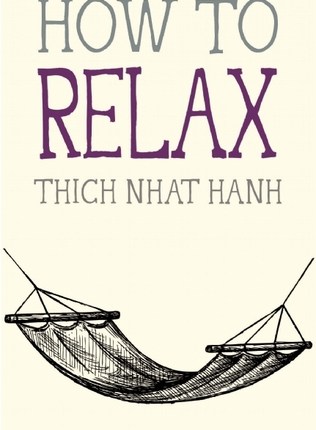
How to Relax by Thich Nhat Hanh

How to Relax by Thich Nhat Hanh

There are very few spiritual leaders who can communicate with the simplicity and succinctness of Thich Nhat Hanh.

As wise as the Dalai Lama is, I’ve only been able to really understand one of the books he’s written and I think that was because he had a co-author. It seems like he contemplates this stuff so much, you know, like it’s his job, that when he’s just trying to talk to a regular person about it, there’s a gap that can’t be crossed.

Photo by Mikhail Nilov on Pexels.com

That isn’t a problem in Thich’s Mindfulness Series.

Thich encourages the reader to find the quiet within. He says: “We already have calmness in us; we just need to know how to make it manifest.” pg 14, ebook.

How do we do this? Through focus, breathing, mindfulness, and relaxation.

One of Thich’s methods for connecting with inner peace that really resonated with me was that we should take “lazy days”: “A lazy day is a day for us to be without any scheduled activities. We just let the day unfold naturally, timelessly. … When we have unscheduled time, we tend to get bored, seek entertainment, or cast about for something to do. A lazy day is a chance to train ourselves not to be afraid of doing nothing. You might think that not doing anything is a waste of time. But that’s not true.” pg 32, ebook.

Not to brag, but I rather excel at “lazy days”.

Photo by Rachel Claire on Pexels.com

Anyone out there have a partner who snores? I do. Thich invites us to incorporate the snores into our relaxation practice.

“Sometimes you have to share a room with someone who snores. You may get irritated. But with mindfulness you can bring about compassion. You can lean on the sound of snoring in order to go to sleep. Listen and say that this brings you home to the here and now.” pg 42, ebook.

I think this could be a difficult exercise, but I’m willing to give it a try. 🙂

Ever tell yourself that relaxation/meditation is too hard? Thich addresses that concern too: “When you sit and watch television, you don’t make any effort. That’s why you can sit there for a long time. When you sit in meditation, if you struggle, you won’t be able to sit for very long. Please imitate the way you sit in your living room. Effortlessness is the key to success. pg 76 ebook.

If you can watch tv, you can meditate. It’s silly but it reminds me of that line from Dodgeball: “if you can dodge a wrench, you can dodge a ball”.

Highly recommended for anyone looking to introduce more relaxation into their lives and isn’t that everybody?

Some read alikes: Relax RX: A Self-Hypnosis Program for Health and Well-Being by Steven Gurgevich (very relaxing, all you have to do is listen), Guided Mindfulness Meditation by Jon Kabat-Zinn (simple and relaxing), or 10% Happier: How I Tamed the Voice in My Head, Reduced Stress Without Losing My Edge, and Found Self-Help That Actually Works by Dan Harris (a regular guy teaches himself to meditate- a light hearted memoir).

Thanks for reading!

The Way of the Shaman by Michael Harner

The Way of the Shaman by Michael Harner

The Way of the Shaman says the practice of shamanism isn’t a cultural thing- it’s a “human” thing.

Michael Harner gives a brief biography of his own beginner experiences, then a very short history of shamanism, what it is, and how the experiences during the shamanic vision walks compare to ordinary reality.

He goes on to give a few practices for beginners to experience those states of consciousness for themselves as well as methods for contacting your “power animal” and some basic healing techniques.

I valued this book most for its discussions of shamanistic consciousness rather than the practices, but I could see both being of value for the proper audience.

Photo by Abet Llacer on Pexels.com

On shamanism across cultural boundaries: Shamanism represents the most widespread and ancient methodological system of mind-body healing known to humanity. Archaeological and ethnological evidence suggests that shamanic methods are at least twenty or thirty thousand years old… One of the remarkable things about shamanic assumptions and methods is that they are very similar in widely separated and remote parts of the planet, including such regions as aboriginal Australia, native North and South American, Siberia and central Asia, eastern and northernmost Europe, and southern Africa.”pg 40-41

One of Harner’s reasons for writing this book is to encourage everyone to deeper self knowledge: “…truly significant shamanic knowledge is experienced, and cannot be obtained from me or any other shaman. Shamanism is, after all, basically a strategy for personal learning and acting on that learning.” pg xxiv of introduction.

The world could use more self knowledge.

Photo by Mikhail Nilov on Pexels.com

How Harner has experienced the ineffable nature of shamanic consciousness: “His experiences are like dreams, but waking ones that feel real and in which he can control his actions and direct his adventures. While in the shaman state of consciousness, he is often amazed by the reality of that which is presented.” pgs 21-22

I find it interesting how various religious practices and occult teachings mix, blend, and borrow from each other. Or perhaps, at their base, they’re all just the same thing- various ways of experiencing the non-ordinary consciousness from which all humanity springs.

I read a book by practicing shaman, James Endredy, called The Flying Witches of Veracruz back in December of 2014 and it seemed to be a total pipe dream. It was filled with amazing creatures and impossible actions, like flying, shape shifting, and jumping higher than humanly possible.

Photo by Rakicevic Nenad on Pexels.com

James talked about the magical in the same breath that he talked about what he ate for breakfast.

Harner explains in this book why it reads like that: “The emphasis I make here on drawing a distinction between the experiences one has in (ordinary consciousness) and the (shaman consciousness)…is not a distinction that is usually noted in the conversations of shamans among themselves or even with Westerners. Thus, if you were to listen to a Jivaro shaman talk, you might hear in his everyday conversation accounts of experiences and deeds which could seem to you, as a Westerner, to be patently absurd or impossible…” pg 47-48.

That whole book makes so much more sense to me now.

In the afterword, Harner closes with thoughts about why shamanism works: “Albert Schweitzer reportedly once observed, “The witch doctor succeeds for the same reason all of the rest of us (doctors) succeed. Each patient carries his own doctor inside him. They come to us not knowing this truth. We are at our best when we give the doctor who resides within each patient a chance to go to work.”

Be a healer by reminding people that they have the power to heal themselves.

If you’re looking for more books like The Way of the Shaman, try The Flying Witches of Veracruz: A Shaman’s True Story of Indigenous Witchcraft, Devil’s Weed, and Trance Healing in Aztec Brujeria by James Endredy or Active Dreaming: Journeying Beyond Self-Limitation to a Life of Wild Freedom by Robert Moss.

Thanks for reading!

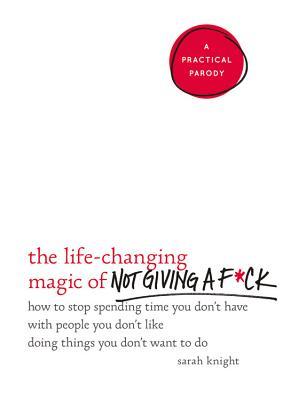
The Life Changing Magic of Not Giving a F*ck: How to Stop Spending Time You Don’t Have with People You Don’t Like Doing Things You Don’t Want to Do by Sarah Knight

The Life Changing Magic of Not Giving a F*ck: How to Stop Spending Time You Don’t Have with People You Don’t Like Doing Things You Don’t Want to Do by Sarah Knight

Since I just posted on Spark Joy, I thought that it was the appropriate time for a review of this one.

Full title, it’s a whopper and very descriptive of the book’s contents: The Life-Changing Magic of Not Giving a F*ck: How to Stop Spending Time You Don’t Have with People You Don’t Like Doing Things You Don’t Want to Do.

F-bombs aplenty in this parody of Marie Kondo’s international best seller about tidying. If you can look past the obvious language thing, Knight gives some fairly solid advice. She counsels readers to not care so much about what others think and give that mental energy to yourself. You’ll be surprised what you can accomplish.

“Please listen when I say that the shame and guilt you feel when you’re trying so hard to not give a f***? It’s usually not because you are wrong to not give that f***. It’s because you’re worried about what other people might think about your decision. And guess what? You have no control over what other people think.”pg 26

See? She reminded me of a more foul-mouthed Byron Katie.

Sometimes she manages to string together two whole sentences without the F-word. Check it out: “You can sidestep the prospect of hurt feelings entirely when you view your conflict through the lens of simple, emotionless opinion. NotSorry (Knight’s method) is all about simple, emotionless opinions.” pg 31.

Beyond managing your own mind, she branches out to give advice to parents: “One mother responded from the perspective of teaching her own kids what to give a f*** about: As someone who grew up in a household full of guilt, I think it’s important for our kids to know that they can make decisions about what to care about, and that they don’t need to pay attention to the approval or condescension of other people in deciding how to live their lives.”pg 92.

I can get behind that idea.

Then we move right along to shades of Eckhart Tolle and The Power of Now: A Guide to Spiritual Enlightenment with contemplating the meaning of existence and its temporariness: “The reality is, unless we’ve been given a ballpark figure by a reputable physician (and sometimes not even then), not a single one of us knows when we’re going to shuffle off this mortal coil. It’s morbid, but it’s true. Tomorrow you could get hit by a bus, or mauled by a pack of wolves, or be scared to death by a clown. When you think about it like that, don’t you want to make every second count? pg 184.

Sarah Knight’s book, in my opinion, doesn’t have the life-changing magic of the other book, but she’s got some interesting thoughts that I believe are true and, sometimes, rather funny. But make sure to bring your sense of humor with you when you pick this one up because the author doesn’t give a … well, you know.

Thanks for reading!