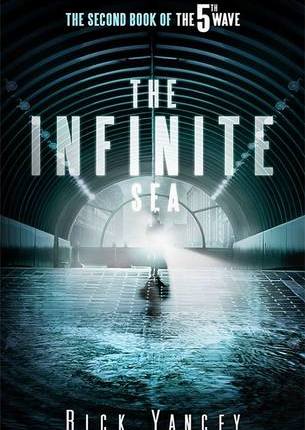
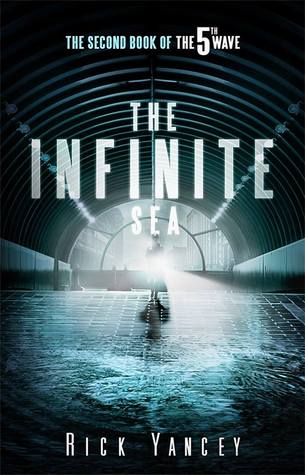
The Infinite Sea (The 5th Wave, #2) by Rick Yancey

The Infinite Sea (The 5th Wave, #2) by Rick Yancey
theinfinitesea

Gritter and more disturbing than The 5th Wave, Cassie, Ben, Ringer, et al are still trying to survive the end of the world. The mystery of the aliens increases. The manner in which the war against humanity is waged sinks to new lows. Yancey takes the story on some unexpected turns and I liked them.

The pace of this story is relentless and the lines are blurred between the “good guys” and the “bad guys.” It gives you a tension headache if you don’t take a break from it every couple of chapters. At least, it did for me. “Anyway, no debt is ever fully repaid, not really, not the ones that really matter. You saved me, he said, and back then I didn’t understand what I had saved him from. … Now I was thinking he didn’t mean I saved him from anything, but for something.” pg 128.

But for what! Yancey answers most of the questions he introduced the reader to in The 5th Wave. He also weaves in some complications. I won’t say anything about those… but they’re very serious and deadly. “No one can be trusted,” I said. “Not even a child.” The cold bored down to my bones and curled inside the marrow.” pg 148.

“I understand the game within the game now: There is nothing private, nothing sacred. There is no part of me hidden from him. My stomach churns with revulsion. He’s violated more than my memories. He’s molesting my soul.” pg 188. The aliens still seem to have the upper hand with the technology that can peer into people’s minds. With all of the creepy things in these books, that bit bothered me the most.

Will our intrepid teenage-survivalists solve the mystery of what the invaders want or what they are before everyone is dead? I don’t know… but I’m going to read the last book and find out. Recommended for young adults or the young-at-heart who enjoy dystopian/mystery thrill-rides.

Thanks for reading!

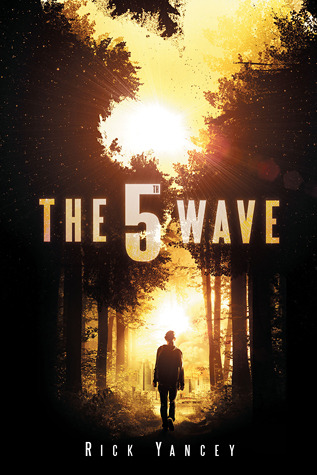
The 5th Wave (The 5th Wave, #1) by Rick Yancey

The 5th Wave (The 5th Wave, #1) by Rick Yancey
the5thwave

Major spoilers ahead. Please do not read if you haven’t read this book.

The 5th Wave is about the end of the world and aliens, yes, but it also explores why life is worth living.

Cassie didn’t know how good she had it until the alien spaceship appeared in the sky and life was never the same. First, there was chaos, but now it is clear that the aliens want to exterminate everyone. And, if they just want the planet for themselves, why are they waging war in such a sadistic manner? It is a mystery and Cassie is going to figure it out.

I was really into the narrative when Rick Yancey chose to change characters and continue the story from a different point of view. I felt that it was unnecessary and broke the flow.

Also, and this is another pet peeve of mine, must every young adult dystopian contain romance as a major part of the plot? The Hunger Games, Divergent, I could go on… and this. You’d think the teens would be far too busy staying alive to fall in love, but that’s clearly not the case from the literature.

I really liked the manner in which Yancey introduces his aliens. First, you get to see their results on humanity. Then, he drops breadcrumbs about how they got here. It’s creepy. “There will be no awakening. The sleeping woman will feel nothing the next morning, only a vague sense of unease and the unshakable feeling that someone is watching her. … And what the shadow has come for- the baby within the sleeping woman- will feel nothing. The intrusion breaks no skin, violates not a single cell of her or the baby’s body.” pg 17, ebook. So scary.

I read a few reviews in which this book was accused of being a copycat of The Host and I feel that it deserves a comment. They are similar in that they both contain aliens, both are dystopians and both have the alien consciousness inside human consciousness. But, those are very broad strokes. The details of the books are different enough and I feel that Yancey has his own plans for his story.

In The Host, the aliens feel more misunderstood and benevolent than the scary creatures in The 5th Wave. This book has a lot more action, The Host is more nuanced. To be fair, superficially, they seem too similar for that to be a coincidence. But in reality, they are as different as Star Wars and Dune. Wait a minute, bad comparison? 🙂

Here’s one of my favorite passages: “Forget about flying saucers and little green men and giant mechanical spiders spitting out death rays. Forget about epic battles with tanks and fighter jets and the final victory of us scrappy, unbroken, intrepid humans over the bug-eyed swarm. That’s about as far from the truth as their dying planet was from our living one. The truth is, once they found us, we were toast.” pg 19, ebook.

Also this one, for obvious reasons: “.. I have a thing about books. So did my father. … While the rest of us scrounged for potable water and food and stocked up on the weaponry for the last stand we were sure was coming, Daddy was out with my little brother’s Radio Flyer carting home books.” pg 33, ebook. Seriously. If the apocalypse ever comes, I’m going to camp out in the library, Station Eleven style. Who’s with me?

Recommended for people who like dystopians and intense survival scenes and aren’t annoyed by angst-y teen romance. The 5th Wave is one scary alien story. They’re here and they’re out to get you and everyone you know! And, so far, they’re doing a VERY good job.

Thanks for reading!

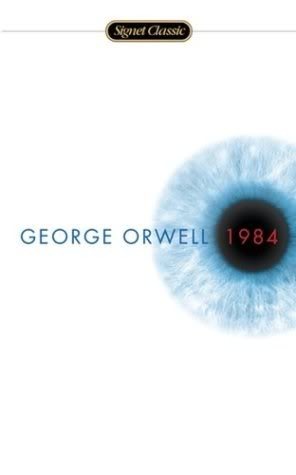
1984 by George Orwell

1984 by George Orwell
1984

Spoiler warning at the end of this review. Please do not read the last paragraphs if you haven’t had the chance to read this classic dystopian.

In 1984 or thereabouts, Winston Smith is a hard-working member of the Party. There is only one Party and it rules with an iron fist. It is divided into divisions that specialize in different areas on the surface, but actually occupy themselves with maintaining power.

The country, an amalgamation of the countries we know now, is always at war with one or another of the two other world powers.

Winston works in a literary branch of the government. He is responsible for making changes to printed literature to make the past in-line with current party sentiment. “As soon as all the corrections which happened to be necessary in any particular number of the Times had been assembled and collated, that number would be reprinted, the original copy destroyed, and the corrected copy placed on the files in its stead.” pg 39.

In the course of his job, he notices things changing. For instance, he knows that at one time, they were at war with someone different than the enemy they fight now. “Nothing exists except an endless present in which the Party is always right. I know, of course, that the past is falsified, but it would never be possible for me to prove it, even when I did the falsification myself. After the thing is done, no evidence ever remains.” pg 155.

But this is not knowledge that he can share. The Party exerts control over everyone at all times through screens built into the wall of every home. You can see the state-sponsored programs like a regular television but they can look out through the screen and see you too.“The two aims of the Party are to conquer the whole surface of the earth and to extinguish once and for all the possibility of independent thought. There are therefore two great problems which the Party is concerned to solve. One is how to discover, against his will, what another human being is thinking, and the other is how to kill several hundred million people in a few seconds without giving warning beforehand.” pg 193.

The Thought Police drag away any trouble makers or those whose thoughts aren’t acceptable to the Party. That could be anyone. Winston knows that one day it will be him. But not just yet.

“There was of course no way of knowing whether you were being watched at any given moment. How often, or on what system, the Thought Police plugged in on any individual wire was guesswork. It was even conceivable that they watched everybody all the time. … You had to live- did live, from habit that became instinct- in the assumption that every sound you made was overheard, and, except in darkness, every movement scrutinized.” pg 3.

The absolute powerlessness of Winston’s situation is terrifying. And then, he falls in love with a girl named Julia who works in his building. “He wondered vaguely how many others like her there might be in the younger generation- people who had grown up in the world of the Revolution, knowing nothing else, accepting the Party as something unalterable, like the sky, not rebelling against its authority but simply evading it, as a rabbit dodges a dog.” pg 131.

This was the first time I ever read 1984. I was still convinced, until a few pages before the end, that it was going to have a happy ending. The rat-mask part had me doubting but then, I still considered the possibility that Winston was faking his conversation. But, after he spoke to Julia one last time, I finally abandoned that theory too.

He lived through his ordeal, but at what cost? He lost everything- even his ability to think. I found it to be incredibly bleak, but worth the time, if only for the warnings that it contains.

Thanks for reading!

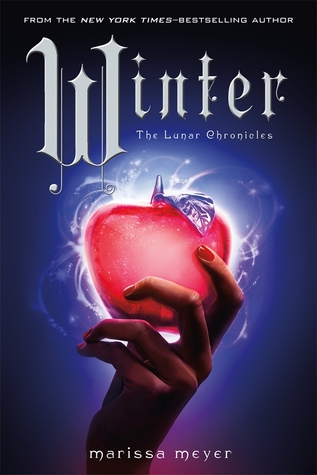
Winter (The Lunar Chronicles, #4) by Marissa Meyer

Winter (The Lunar Chronicles, #4) by Marissa Meyer

winterWarning: There are spoilers in this review. Please do not read further if you have not read this book.
Winter is the disappointing final installment of the promising Lunar Chronicles. Coming in at over 800 pages, I thought that this was going to be an epic conclusion. Sadly, I found it to be uninspired and far too repetitive.

Cress was my favorite of this series. In it, Meyer is at her best. Her fairy tale re-telling of Rapunzel was brilliant. She took the elements of the classic tale and gave it a science fiction twist. There’s adventure, danger and an inspiring heroine.

Winter reaches for that mix with the re-telling of Snow White, but it never makes it.

I started going through the stages of mourning with the ending of this series.

First, I was in denial. This couldn’t be the last of it. That’s not how the story ends… it can’t be!

Then, I was angry. These were characters I cared about. They deserved inventive and unique endings and not necessarily all perfectly happy ones wrapped in a bow. I know this isn’t a popular opinion but, sometimes there isn’t a happily ever after. Every single one of the protagonists ends up together. How predictable and trite.

On to bargaining. I thought that maybe if I waited to write my review, that I’d like it more. Perhaps time passing would blunt the edges of my disappointment. Perhaps I needed to accept that this book was written for the young adult audience and look at it from that point of view.

Then depression. So many readers loved this series, maybe my opinion was just wrong. Maybe I wouldn’t know what a good story was if it punched me in the face. Maybe I disliked this series just to be contrary to popular opinion.

Finally, acceptance. I did not like Winter. I didn’t like its emphasis on physical appearance and connecting that to internal characteristics. How many times did we have to hear how ugly Levana was under her glamour? And don’t we find out in this book that it wasn’t her fault? That she was physically abused and then taunted because of her appearance? So, yeah, let’s talk more about how repulsive she is.

I didn’t like how the worst thing that Meyer could think to write of her antagonists was “He/she was INSANE.” We get it.

I didn’t like how the characters would turn to each other and talk through obvious motivations. Do you think she/he did that/this because she knows we’re coming/going/trying to escape? Yeah, I do! Now stop talking and go face your destiny. We could have saved almost 200 pages if the characters would have acted instead of talked endlessly about acting.

And Iko’s happy ending was that she got a bunch of dresses and color-changing eyes? That was the final straw for me. She was my favorite character and she deserved an ending that matched her unflagging spirit, loyalty and optimism.

I listened to this entire series on audiobook. Was it worth the hours of my time? I guess that depends on what which book we’re talking about. If this series had ended on a book the quality of Cress, this would be a very different review.

My apologies if this is your favorite series. No book appeals to every reader. Winter just wasn’t for me.

Thanks for reading!

Zeroboxer by Fonda Lee

Zeroboxer by Fonda Lee

zeroboxerAt first, I thought that Zeroboxer was just Rocky in space, but as the story developed, I realized that it was more than that. Zeroboxer is also an examination of genetic ethics and, like most science fiction, poses some serious ‘what if’s. What if humanity begins to settle the universe- will they divide themselves into different races depending upon their planet of origins? What if the settlers develop their own system of government- how will humankind negotiate the potentially choppy waters of intergalactic politics? What if humanity could use gene therapy not just to eliminate disease but also to create a sort of super human? Fonda Lee has imagined a future filled with flawed but well-meaning people that feels very similar to our own and is, perhaps, not as far into the future as one may imagine.
The style of boxing in this story incorporates mixed martial arts with the added hiccup of no gravity: “To inflict any bare-handed damage to a person in zero gravity, you had to establish a brace or a point of leverage- preferably a vulnerable part of your opponent’s body- to keep them from floating away while you hurt them. Or you had to treat space itself as a weapon, using the infinite angles of movement to strike and rebound, strike and rebound, faster and harder than the other guy.” pg 13, ebook. Fans of MMA may enjoy this story more than I did- I don’t particularly care for violence but it was never too graphic or more than I could handle.

The colonists who settled on Mars (the Martians) embraced zero gravity sports while the people who stayed behind on Earth (the Terrans) didn’t. Luka, the main character in this story, is from Earth and he’s part of a group that is trying to popularize the sport on Earth- with mixed success: “I left Mars twenty-five year ago, saying I was going to grow the sport with the Terrans. I was practically laughed off the Red Planet. All the best zeroboxers in the Martian system… you know what they said to me? ‘Everyone on the old planet is a planet rat. The most daring and inventive Terrans left generations ago to build Mars and the other settlements. Why would a place with countless gravity-dependent sports want anything different?” pg 27, ebook.

The story becomes even more complicated because the Martians have accepted gene therapy as a way to improve and expand their race, while the Terrans only use it to keep children from developing poor eye sight or asthma. The Martian fighters are so dominant at the sport because not only were they born into a world that encouraged zero gravity sports, but also they were partially engineered to be that way. When the boxers from Earth face the boxers from Mars, it is more than planet vs planet- it is also a match up of nature vs science.

Luka doesn’t want to consider the complexities of it all and just wants to fight: “Two guys go into a Cube. They fight. One of them beats the other. How much simpler can it be? People don’t have to make it more than it is.” pg 176, ebook. Will Luka get his wish?

This book should appeal to fans of Ender’s Game or Red Rising (which is a much more adult examination of these themes). Thanks for reading!

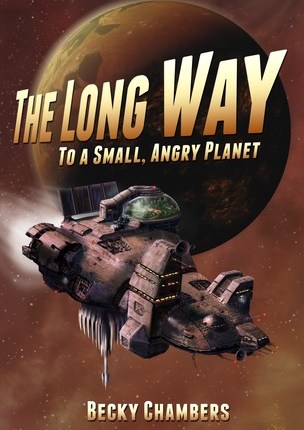
The Long Way to a Small, Angry Planet by Becky Chambers

The Long Way to a Small, Angry Planet by Becky Chambers

I recently finished The Long Way to a Small, Angry Planet for a second time and was again impressed by the author’s character building.

A small criticism I have is the lack of adventure in the tale. Becky Chambers does such a great job creating characters the reader cares about, but then does so little with them.

Still recommended for readers who enjoy light-hearted science fiction.

Photo by Pixabay on Pexels.com

Review from first read-through:
This is a charming, character driven, space opera-ish, science fiction novel about a crew, made of a bunch of different species, who man a ship that drills holes in space.

The focus of this story is on the relationships of the crew, their histories, and a big job that is going to take them to a distant part of space where very few have gone.

At first, I was concerned this book was going to be too heavy on the technology or psychics, but, have no fear readers, very little technical thinking is required in The Long Way to a Small, Angry Planet, which, after a few I’ve read lately, was just what I was looking for.

I loved the different species that Chambers imagined for this universe. From lizard-type aliens to a giant caterpillar with an otter head to a simian creature who shaves his blue fur into concentric shapes, there’s a lot of characters to keep track of but they’re so different that it’s not confusing. It is just plain fun.

Photo by David Selbert on Pexels.com

Even the AI of the ship, the Wayfarer, is a character named Lovelace: “There were other Lovelaces out there, of course. Her core software platform could be purchased through any AI dealer. There were probably dozens of versions of her traveling through the galaxy- maybe hundreds, who knew. But they weren’t her.” pg 58. Indeed.

The reader gets to learn about space travel and the various ports of call through the eyes of Rosemary, the newest member of the crew, who is carrying a dark secret about her past:

“Rosemary hurried after her crewmates, anxious to not get lost. … Getting lost wasn’t what scared her, exactly. It was more the prospect of getting mugged. Or harassed. Or stabbed. She’d seen a few people that definitely looked stabby.” pgs 109-110. “Looked stabby” made me giggle.

This bit had me laughing too. I had never taken the time to consider what might happen if a cold-blooded creature ate something that was freezing cold: “We’re grown-ups, we can have ice cream for lunch if we want.” “Let’s not,” Sissix said. “Right. I forgot,” Kizzy said, and laughed. “Ice cream makes her mouth go slack.” pg 140

Photo by Somben Chea on Pexels.com

There are a few bits of life advice hidden in this story: “All you can do, Rosemary- all any of us can do- is work to be something positive instead. That is a choice that every sapient must make every day of their life. The universe is what we make of it. It’s up to you to decide what part you will play.” pg 232.

This last section contains my favorite line from the entire book: “She lived up there, in that vast expanse of color. Every day, she saw planets and comets and stellar nurseries right up close, plain as weather. Yes, there was something about being planetside that made it feel different. Perhaps stars were supposed to be viewed from the ground. pg 291-292.

“Perhaps stars were supposed to be viewed from the ground” is it. I have never traveled in space and may never get the chance to, but The Long Way to a Small, Angry Planet transports you, if just for a short time, into worlds far beyond ours.

I highly recommend it for folks who enjoy light, character-driven science fiction as there is nothing too heavy or disturbing to be found here.

Thanks for reading!

Forest of Memory by Mary Robinette Kowal

Forest of Memory by Mary Robinette Kowal

Katya lives in a futuristic world where everyone and everything is linked to the web. Her AI speaks in her ear and fills her vision telling her about the people around her, their histories, past business deals, and anything that could be of interest to her in her job as an “Authenticities” (basically antiques) dealer. One day, on her way back from a purchase, she sees a man shoot a deer (very illegal) and realizes that her connection to the web has crashed, leaving her marooned in the real world with a potential maniac. What’s he doing and is she going to survive?

I see where Kowal was trying to take this novella, but it didn’t really work for me. She wrote as her narrator, trying to recount a story without the use of computers, which, in this world is particularly difficult as everyone in the future uses computers to remember anything, and shows her discomfort at her disconnected state by inserting misspellings and typos. But, she didn’t do this consistently… it was just random enough for me to forget that she was using this device and say to myself, “Typo!” and then remember that it was supposed to be there. So, it turned into this annoying distraction.

I was most interested in Katya’s job as an Authenticities dealer, but, when Kowal moved the story off the grid, that essentially removed that element. In this passage, Katya’s analyzing a typewriter: “It looked to be from the mid-twentieth century, though without picking it up or using my loupe, I couldn’t confirm that. The fine dust caked into the grooves around the base seemed real enough, though. Most people who print fakes know enough to add dust to make it seem older, but they usually put it on too thickly and without regard for the use patterns of everyday objects.” pg 7, ebook. The parts that I loved the most read like a futuristic Antiques Road Show, which would have been awesome if the story had continued along that vein.

The novella reached for depths that it never really explored, but this passage caught my attention: “It feels like he wanted me there to bear witness, but maybe it was just an opportunity that presented itself because I stopped. If I hadn’t, if I had biked on through, would I have known that this was a cusp point in my life? Probably not. It makes you wonder, doesn’t it, how many other cusp points you sail through in life without any awareness.” pg 11 ebook. I do wonder about that. Life seems to be a series of stumblings and fortunate events but is it really as random as it seems? If you take one road, instead of another, does it even matter? Aware or not, life unfolds… I don’t know. What do you think?

What ruined this short read for me was that I didn’t get the ending at all. I essentially had to go back and read it all again, but then I still had a moment of “Huh?” Katya describes my over-arching feelings well: “There were so few things that made sense about the whole experience; I’m not sure why I expected events to suddenly appear orderly and rational now.” pg 25, ebook

I do not recommend Forest of Memory unless you’re looking for a puzzling sci fi read that raises the question of reliance on AI at the expense of everything else. And, if you find deeper meaning in it than I did, please do explain it to me. Thanks for reading!

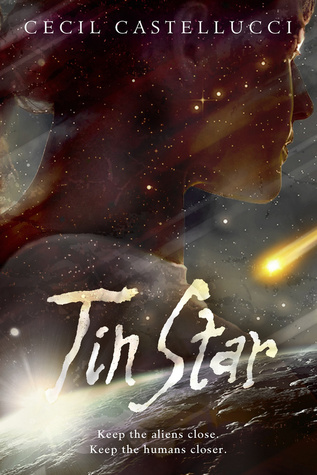
Tin Star by Cecil Castellucci

Tin Star by Cecil Castellucci

tinstarTin Star is the story of Tula Bane, a teenager who joined a space colonizing cult from Earth. She is abandoned on a way station near the edge of the known universe on the way to her new home.
How will Tula Bane survive among aliens who think human beings are the worst? Will she ever be able to go home to Earth or the colony’s planet? How will she manage to put bread on the table?

I love a good space opera and I thought that I would enjoy Tin Star more than I did.

The promise of books set in space, in my opinion, is the opportunity for unique interstellar exploration and worlds created entirely from the author’s imagination. Because of Tula’s unique plight- being stuck in what is essentially a space gas station- the author left herself very little room to write a creative story.

Mainly, Tin Star deals with character development and social struggles, not adventuring in new places.

The villain of the tale was charismatic and creepy. Take this description: “He had his hand on my shoulder in a way that he had a million times before. Only before it was comforting, encouraging, affectionate. Now it was menacing. He was looking at me and his face was smiling. To anyone looking from afar, he seemed to be pleased with me, but it was just a mask. His attitude shifted from concerned leader to unknowable monster.” pg 4

Tula manages to befriend a shady, insect-like alien named Heckleck. He’s my favorite character.

In this passage, Heckleck explains the problems Tula will face in trying to leave the station: “I know about you,” Heckleck said. “Everyone does. And you will never get off this station. You are nobody. And worse, you’re a Human. Even if you did not get on a ship that would take one of your kind, you’d have nowhere to go but to roam like the others of your kind do.” pg 35.

Keeping it real: with Heckleck.

I thought Cecil Castellucci could have done more with the cultural differences between Tula and the others on the station.

One of the most interesting exchanges in the book was between Tula and Tournour, the head of the outpost. She’s trying to figure out how old he is and, because they’re from different planets/species, it’s a surreal conversation. More of that would have been nice.

But Castellucci wrote cultural and language barriers out of the story by introducing nanites into Tula’s bloodstream to translate alien languages for her.

Something that Castellucci did well was writing profound silences between characters into her story. For much of this story, Tula finds herself standing around with Heckleck and Tournour and having nothing to say. But, somehow, it works.

I liked how Castellucci wrote the thoughts spinning through Tula’s mind at these moments. It reminded me of myself when I can’t think of anything to say: “It was a silent agreement between us that if we spoke too much then we would have to talk about the practical things. … If we ever spoke of the things that truly pressed up against us, our very real worries, our seemingly impossibly plans for escape, our divergent hopes for the future, our bubble would blow apart.” pg 184

This book in three lines: “In the end, good must win over evil. The trouble is trying to figure out which is which. Sometimes they look so much alike.” pg 204

Read this book if you enjoy light, young adult drama in space. If you’re looking for a meaty, space adventure, you’ll need to find another title.

Some read-alikes are: The Knife of Never Letting Go (teen trying to survive on an alien planet) or Gated (teen trying to leave a cult).

Thank you to Roaring Brook Press for sending an advance reader copy of this book. And, thank you for reading!

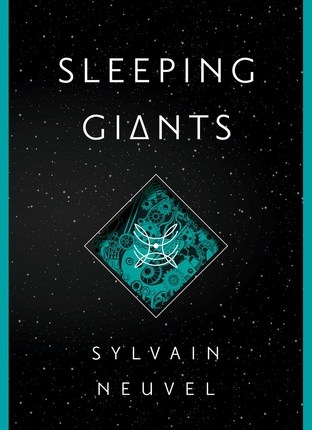
Sleeping Giants by Sylvain Neuvel

Sleeping Giants by Sylvain Neuvel

In Sleeping Giants, a large, metal object shaped like a gigantic hand is found in South Dakota. It glows with its own light and scientists have no idea what it is made of or what it can do. And so, the mystery and adventure begins.

Photo by Mayur Rawte on Pexels.com

I enjoyed the story a lot but not how it was written. Neuvel tells Sleeping Giants through a series of “case files” or question and answer sessions between the main characters and a mysterious, all-powerful figure who is manipulating the scenario from behind the scenes.

This method of storytelling seemed especially ridiculous during some of the action scenes, when Neuvel had the characters talking to each other on the phone, describing what was happening to them as it occurred.

But, otherwise, the Q & A setup gave readers a behind-the-scenes look at what was going on in the character’s minds and allowed for a lot of personality development.

I wish that Neuvel had switched back and forth between traditional storytelling and the “case file” thing, so that he could both tell the story and have the in-depth character portions. Maybe he could do something like that in the next book.

I was nervous that Sleeping Giants was going to be more science fiction than fantasy, but it wasn’t. There are only a few mind-boggling moments when the scientists are trying to figure out mathematics with a base of 8 rather than a base of 10.

Mostly, The Sleeping Giants asks the questions: what would happen to humanity if something very strange and not of our civilization was discovered on earth? What would that mean for world politics? And how, on an individual level, would everyone involved handle it?

Photo by Pixabay on Pexels.com

Kara Resnik, a pilot, was my favorite character in this story. She’s impulsive, passionate, and honest.

In this passage, she’s talking about the possibility of leaving the project before it’s completed: What would I do anyway? Go about my business as if nothing ever happened? I couldn’t even talk about it to anyone. This is gonna sound incredibly selfish, but I’d get bored to death unless someone started World War III or something.” pg 54

The moral dilemma for the scientists involved in the project is interesting.

In this passage, lead scientist Rose Franklin talks about the fact that the technology discovered could be used for good or ill, depending on who controls it and how that makes her complicit in their actions, because she’s the one figuring out how it works: “What I’ve been trying so hard to deny is that I’m loving every minute of it. … I’m a scientist, and this is what I breathe for. If I had learn to live with that, I might be able to sleep again.” pg 167

Photo by Pixabay on Pexels.com

If you enjoyed Sleeping Giants, you may want to pick up The Many Selves of Katherine North by Emma Geen (in which, advanced technology raises moral questions) or The Interminables by Paige Orwen (in a dystopian world, humanity tries to save itself from inter-dimensional creatures, but maybe some solutions aren’t worth the cost).

Big thanks to the Goodreads First Reads Program for a free copy of this book. And, thank you for reading!