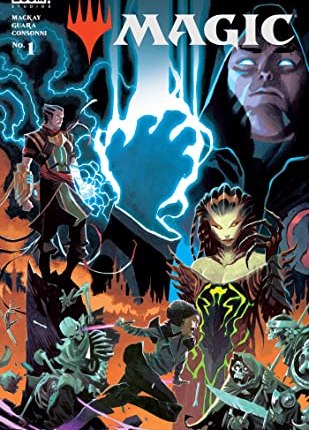
Magic Vol. 1 is a beautiful beginning to a fantasy series based on the card game, “Magic the Gathering.”
The story is quite busy for a first volume, bringing together a number of characters and introducing a fairly complex system of magic.
At least, it seemed like a lot to me as I’ve never played Magic the Gathering and have no idea how it goes. To those who are familiar with the game, this might be less of an issue.
The artwork is gorgeous. I love when talented artists team up with great writers to produce graphic novels. I believe that is the case with this book.
I’m interested to see where this goes. Recommended for fantasy readers ages 14 plus because of some violence.
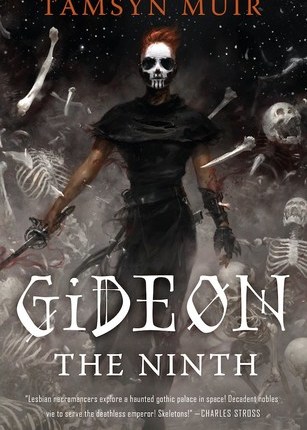
Gideon wants to escape from her dreary life on a dead end planet but when her plans are hijacked by the head of her household, she ends up having to become a cavalier for her nemesis. Snarky humor, profanity, and gothic themes follow.
“Gideon marveled that someone could live in the universe only seventeen years and yet wear black and sneer with such ancient self-assurance.” pg 24
I was unprepared for the violence and blood-soaked pages of this book. (Maybe I should have read some of the reviews first!)
I also had trouble keeping track of character’s titles. Each character could be referred to in three or four different ways, and the author used the titles interchangeably.
It made it hard for me to enjoy the story. The pacing was slow in the middle, which didn’t help matters.
One positive thing I have to say about Gideon the Ninth is the story is quite unique. I’ve never read a story about necromancers in space – until now.
Also, the humor was note-worthy. Tamsyn Muir, the author, uses modern language to build sparkling dialogue and funny interactions. If readers are fond of Deadpool, they may enjoy this story too.
I wish I had enjoyed it more. Only recommended for readers who like their humor dark, their bloody wounds flowing and their character lists massive.
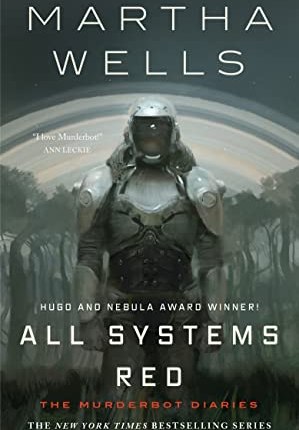
In All Systems Red a sentient android, who calls herself, Murderbot, is with a group of scientists on a mission to survey a planet. She (though technically not a she, but I think of her as a she) is responsible for the security of the group.
When things begin going horribly wrong, Murderbot’s job becomes infinitely more complex. She doesn’t experience emotions but is thrust into situation after situation where the humans around her are dealing with emotions.
At least she has hours of videos in storage to keep her busy- watching films is her favorite pastime.
It’s not an easy job. But someone has to do it.
From the first pages of this story, I was hooked. Author Martha Wells pulled me in and my attention never wavered throughout this novella. It’s easy to see why this one is an award winner – both Hugo and Nebula Awards.
The characters are delightful. The action is both intense and entertaining.
Throughout the story, I was mentally comparing Murderbot’s interactions with other people with the plight of real soldiers who are returning from war. In many ways, she feels like she doesn’t belong. Her special skillsets and very existence forever separates her from the people around her.
She has no emotions; mimicking the numbness that some soldiers feel with post-traumatic stress disorder.
I realize soldiers are not actually robots, but the allegories drawn from this book could make for interesting book club conversations.
Even though it’s science fiction, it’s not the “hard” variety which leads to appeal far beyond the typical group of science fiction readers.
This is a stand-alone novel as well as the first in a series. Readers who are completionists, like me, may like that, especially if they’re reading outside of their typical genre.
Highly recommended for fiction readers and book clubs.
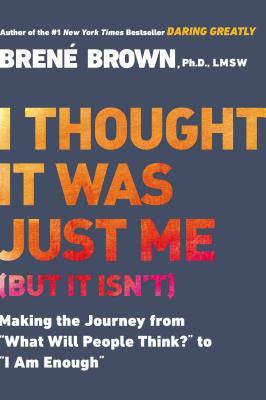
Researcher Brené Brown gives readers another self help title on how to handle the difficult emotion called shame.
“This book offers information, insight and specific strategies for understanding shame and building “shame resilience.” We can never become completely resistant to shame; however, we can develop the resilience we need to recognize shame, move through it constructively and grow from our experiences.” pg xiv
It’s not easy to handle shame. In fact, it’s not that easy to read about it.
But Brown says the way through is sharing those uncomfortable feelings with others. One of the solutions to shame is empathy and another is self awareness.
Other attributes shared by those with high shame resilience are:
“The ability to recognize and understand their shame triggers. High levels of critical awareness about their shame web. The willingness to reach out to others. The ability to speak shame.” pg 67
Part of her work in psychology has been to define what shame is. Brown writes everyone has different triggers based on unique childhood and adult experiences. Therefore, it is impossible to name universal shame triggers which can make it difficult to study shame.
Her studies have led her to believe the opposite of shame is self esteem, which was an interesting aspect I had never considered. Other aspects of shame include: feeling like you’re not good enough or don’t belong.
Brown has discovered another hurdle in her research- it can be difficult to speak about shame as words sometimes fail us when we experience visceral feelings.
“Sharing our shame with someone is painful, and just sitting with someone who is sharing his or her shame story with us can be equally painful.” pg 147
On a more positive note, Brown writes everyone has experienced this at some point or another. She uses this universality of experience to issue a clarion call for change. To foster shame resilience, we should build networks of support and be kind to each other by showing our own vulnerability. We’re all in this together.
And I couldn’t agree more.
Recommended for anyone who has ever felt shame. That’s everybody.
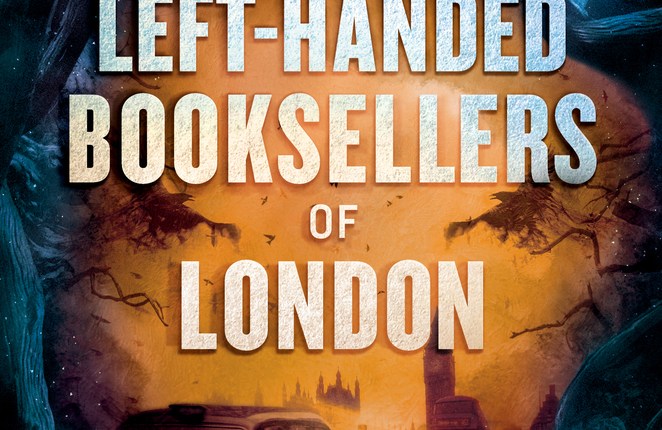
Her search takes her to London where, after a night of violence and supernatural scares, she discovers a whole other world existing alongside the every day one.
This is a world of magic and legend, and mysterious, ultra-cool booksellers.
“Susan hesitated and looked back. The monstrous bug was still writhing, but something else was happening now. A dark fog was flowing up the stairs.”
“Children’s writers,” said Merlin. “Dangerous bunch. They cause us a lot of trouble. … They don’t do it on purpose… But quite often they discover the key to raise some ancient myth, or release something that should have stayed imprisoned, and they share that knowledge via their writing. Stories aren’t always stories, you know.” pg 59, book
The characters and their sparkling dialogue are the high points in this fantasy tale for young adults.
I was also fond of the heroes being a bunch of booksellers. The only change that would have raised that, in my opinion, was if author Garth Nix had made them librarians. But that’s just me. 🙂
The world Nix has imagined, though intriguing, never moves beyond the entirely predictable. I suppose I wasn’t the intended audience for the story, but I believe a great book entertains all ages.
“I never knew anything about the Old World or any of this stuff before I met Merlin.” pg 67, ebook.
Although, now that the world is created, I could see this being the first entry in a fun, light-hearted series. We shall see.
Only recommended for young adults who are looking for fantasy reads. Adults readers may find themselves longing for more complexity.
The title, Big Book of Family Games: 101 Original Family Group Games that Don’t Need Charging, pretty much says it all.
The games are divided into different categories: predictions, discovery, creativity, performance, deception, strategy, speed, memory, puzzle solving, and athletic. So, you can pick the game that the group is feeling like playing or is appropriate for your work, classroom, etc.
Others have gone on about the disconnected scourge of modern living, especially since the advent of this pesky virus. These games build bridges and help players get to know each other and themselves, if he or she is really honest about it.
“What you have in your possession is a book of games that accomplishes three of my main goals when bringing people together: disconnection from technology… convenience… adaptability.” pg 6, ebook.
I’d like to add – this book of games only works if others are really into it. Otherwise, you just ask the question, which is most of these games, and get met with a blank stare.
I think one of the next challenges facing society after the pandemic will be reestablishing social conventions. Or perhaps we will all be forever changed. Here’s hoping it’s for the better.
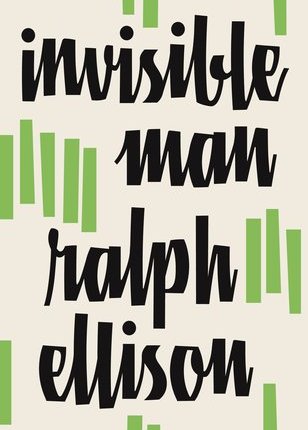
In Invisible Man, an unnamed narrator moves through a series of events that highlight racism and inequality both in the society and in the people within the system.
This is a book that is difficult to describe and may need to be experienced.
The writing is powerful and builds like a punch in sections. I listened to the audiobook while on a walk through the woods so maybe that’s why I was so sensitive to the rhythms.
I’m not a black man and I’ve never walked a mile in his shoes, but this book gives a short sojourn into another person’s life.
The material is sobering and shocking, at times, lyrical and beautiful in others. Rather like life.
At the end of the book, I found myself hopeful for the narrator. Hopeful that he would move forward from all of the challenges that he faced into a new dawn of understanding and racial equality.
I’m always hopeful for improvement. Always.
I think society sometimes uses aspects of our lives (like gender, race, social status, level of education, sexual orientation) to place people into tidy boxes or make them invisible like the narrator in Ellison’s novel.
One way to combat this evil is to know that we’re not alone as we travel through life. We’re all in this together. We see each other and acknowledge each other’s strengths and weaknesses.
We are seen and appreciated for our uniqueness by the communities we create. It’s a big responsibility.
I read this classic because it is painted on the staircase of the library where I work. I’m trying to read all of the classics recorded there in an effort to become “classically” well-read.
What do I mean by classics? The most-tagged classics on Goodreads.com include such notable books as “1984” by George Orwell, “The Catcher in the Rye” by J.D. Salinger, and “Of Mice and Men” by John Steinbeck.
So, the next problem with this aspiration of mine is — Where do I start? Who is the definitive voice when it comes to choosing classics?
Who better than a library, I thought, literally.
I had the privilege of working at O’Fallon Public Library during the Great Renovation of 2015 to 2016. One of my favorite pieces of improved library space (other than the bubble wall!) are the book spines that were painted on our stairs.
I’d like to invite everyone to read along with me as I “climb the stairs” by reading the classics listed there. The goal is to share the books our community deemed important enough to preserve in our library space for all time.
The next title on the steps is Watership Down, another classic that I have not had the pleasure of reading. (Portions of this review first appeared on the O’Fallon Public Library’s blog.)
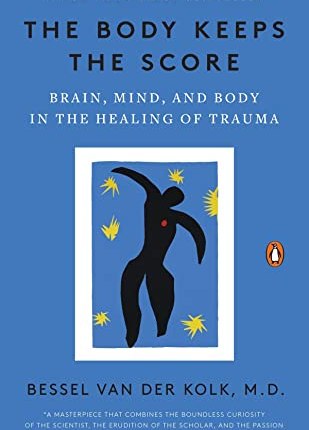
The Body Keeps the Score is a non-fiction book about how the body stores trauma and what you can do about it.
My most distressing take-away from this book was how common trauma is. Author Bessel van der Kolk discusses how people from all walks of life suffer from trauma.
People suffering from these kinds of afflictions believe they’re the only ones. They try to numb the pain with drugs or alcohol and are easily triggered which brings back the pain of the traumatic events again and again.
This affects their lives, relationships and ability to trust others.
Kolk details how traumatic memories can be triggered by smells, touch and taste. He explains how powerful emotions remain behind, even after the logical mind has processed the event.
He suggests you can’t think your way out of strong emotions.
What do we do about this?
Form a strong community around yourself with supportive relationships. Practice mindfulness and yoga- exercises that explore the mind and body connection.
Also, find a therapist who practices eye movement desensitization and reprocessing (EMDR). The author records amazing recoveries by sufferers who utilized this therapy.
Personally, I’ve practiced EMDR with a therapist and the results were astounding. I left the session feeling lighter than I have in years, having released trauma I didn’t realize I was carrying.
But, like others, I still struggle with powerful emotions stored in my body. It is a process, not a cure. And I’ve learned to take life one day at a time.
Highly recommended for readers looking for scientifically-proven ways to handle trauma.
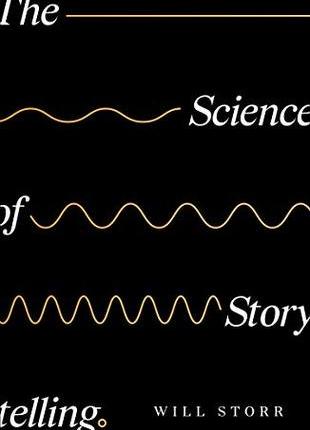
In The Science of Storytelling, Will Storr reminds readers our brains are hard-wired for stories and how best to utilize this in our own writing endeavors.
Through the use of various writing tools based on scientific research, Storr demonstrates how to appeal to an audience, keep them hooked and connected to the characters.
For example, Storr writes the use of change in storytelling grabs readers’ attention because human beings are always on the look out for it. Change can be good or bad- it’s life itself. Our brains look for change as a survival mechanism and this trait can be used to entice readers so they come back for more story.
“This is what storytellers do. They create moments of unexpected change that seize the attention of their protagonists and, by extension, their readers and viewers.” pg 13, ebook
Change is also something that people try to control (they can’t but they try). This universal pattern is called, ‘the theory of control’. When readers see traits they share with characters in stories, they become invested in the outcome which keeps them reading. Or when readers see traits they don’t believe they have, but do, they’re hooked.
There’s a lot of hooking going on, which is a good thing when you’re writing a story. 🙂
“A character in fiction, like a character in life, inhabits their own unique hallucinated world in which everything they see and touch comes with its own unique personal meaning.” pg 41, ebook
Storr suggests creating complex characters and writes that the story almost creates itself with a properly drawn character. A complex character has flaws, a personality, misunderstandings with others in the story.
Also, going back to the ‘change’ theme, complex characters are generally passing through a ‘change of status’ of some kind. This ignites curiosity in the reader. It makes readers ask themselves, ‘What’s going to happen next?!’
“The place of maximum curiosity- the zone in which storytellers play- is when people think they have some idea but aren’t quite sure.” pg 18, ebook




















 The Help Desk Book Blog