Into the Magic Shop: A Neurosurgeon’s Quest to Discover the Mysteries of the Brain and the Secrets of the Heart by James R. Doty

Into the Magic Shop: A Neurosurgeon’s Quest to Discover the Mysteries of the Brain and the Secrets of the Heart by James R. Doty

This book is James Doty’s memoir. He had a tragic childhood with parents who, for various reasons, were not present for him. Then, after an encounter with a total stranger, James was taught meditation, creative visualization, and positive thought practices that changed his life.

As he comes of age, he dismisses the compassion related portions of his childhood training and focuses instead upon the money and prestige that it brings as he pursues a career as a neurosurgeon. It’s a fascinating and educational account.

Photo by Vidal Balielo Jr. on Pexels.com

I was particularly taken with the near-death experience portion of the book. James approached that experience as an atheist so I felt that made his opinion on it rather different than other accounts I’ve read.

Some of the bits that I want to remember (advance reader’s copy cited so the final published book may contain slightly different wording):
“Some of the wisest patients and people I have ever met have been children. The heart of a child is wide-open. Children will tell you what scares them, what makes them happy, what they like about you and what they don’t. There is no hidden agenda and you never have to guess how they really feel.” pg 3

Photo by Juan Pablo Serrano Arenas on Pexels.com

“Everyone has a story, and I have learned that, at the core of it, most of our stories are more similar than not.” pg 60  But not everyone tells their story.  Thank you, Dr. Doty, for telling yours.

“When our brain changes, we change. That is a truth proven by science. But an even greater truth is that when our heart changes, everything changes. And that change is not only in how we see the world but how the world sees us. And how the world responds to us.” pg 151  I think that this is one of the great mysteries of life.

About his near death experience: “At the time I felt the warmth of a light and a sense of oneness with the universe. I was enveloped in love, and while it didn’t transform my religious beliefs, it informed my absolute belief that who we are today doesn’t have to be who we are tomorrow and that we are connected to everything and everyone.” pg 203

Photo by Pixabay on Pexels.com

“There’s a reason stock traders are using meditation techniques; these techniques help them become not only more focused but, sadly in some cases, more callous. This is what Ruth warned me about before she taught me to visualize. Yes, we can create anything we want, but it is only the intelligence of the heart that can tell us what’s worth creating.” pg 231 A powerful lesson, but one, I think, that can only be learned through personal experience.

If you enjoyed this book, try Proof of Heaven: A Neurosurgeon’s Journey into the Afterlife by Eben Alexander or The Power of the Heart: Finding Your True Purpose in Life by Baptist de Pape.

Thank you to the Goodreads First Reads program for an advance reader copy of this book.  And, thank you for reading!

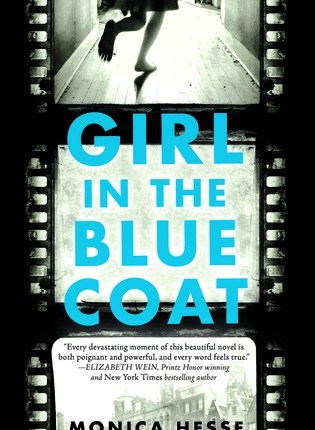
Girl in the Blue Coat by Monica Hesse

Girl in the Blue Coat by Monica Hesse

Girl in the Blue Coat is a beautifully written, young adult book about a terrible moment in history- the German occupation of the Netherlands. Hanneke is a young woman who runs black market goods to people in her town not only so that her family can eat, but also to thumb her nose at the Nazis who have taken so much from her and her people. The mystery portion of the book begins when one of Hanneke’s clients asks her to find a Jewish girl who disappeared from the safe house where she had been hiding.

I found myself drawn into this story for many reasons. First, Hanneke is a strong, female protagonist who doesn’t wait for other people to solve her problems- I liked that. Also, Girl in the Blue Coat does an excellent job of keeping the reader guessing. Just when I thought I had things figured out, Hesse changed it up. In addition, I cared about the characters in the story and I wanted them to succeed. It reminded me a lot of The Book Thief by Markus Zusak- same time period, different country.

The strength of Hanneke: “I can feel myself getting sucked into this mystery… Maybe because it’s another way to flout the rules. But maybe because, in a country that has come to make no sense, in a world I cannot solve, this is a small piece that I can. pg 45-46

The complexity of Hanneke’s emotions in a world divided by war: “Here is the thing about my grief: It’s like a very messy room in a house where the electricity has gone out. My grief over Bas (young man she lost to the war) is the darkness. It’s the thing that’s most immediately wrong in the house. It’s the thing that you notice straight off. It covers everything else up. But if you could turn the lights back on, you would see there are lots of other things still wrong in the room. The dishes are dirty. There is mold in the sink. The rug is askew. Elsbeth (former best friend) is my askew rug. Elsbeth is my messy room. Elsbeth is the grief I would allow myself to feel, if my emotions weren’t so covered in darkness.” pg 104

Hanneke’s growing self awareness because of her struggles: “I watched a whole afternoon unfold under my nose, and I misread everything that was happening, from start to finish. All the clues were in front of me, but I still didn’t see them.” pg 125

How Hanneke’s country has changed because of the occupation: “The prisoners follow, carrying suitcases, disheveled and tired like they haven’t slept in days. The crowd is big, maybe seventy people, and the soldiers march them down the middle of the street. It’s a lovely winter day in Amsterdam, and though there are other people on the street, couples like me and Willem, nobody acts like the forced parade of people is out of the ordinary. Our sense of ordinary has become horrifying.” pg 212

If you enjoyed Girl in the Blue Coat, you may want to pick up The Book Thief by Markus Zusak or The Bishop’s Wife (Linda Wallheim Mystery, #1) by Mette Ivie Harrison.  Thanks to Little, Brown Books for Young Readers for the advance reader copy of this book.  And, thank you for reading!

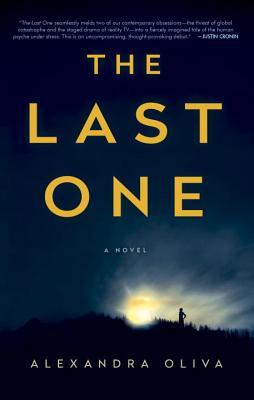
The Last One by Alexandra Oliva

The Last One by Alexandra Oliva

Twelve contestants go on a survival reality show.  It’s a brutal competition and the only way off the show is to say the safe word.  While the filming is taking place, something terrible happens in the real world… and no one tells the contestants.  Will any of them survive?  And, if they somehow survive, will they have a home to go back to?

In the book blurb, The Last One is compared to Station Eleven and The Passage neither of which I liked very much. I thought Station Eleven was boring and The Passage is the Game of Thrones of dystopian literature, it goes on and on and on… Unlike the other two titles, I think that The Last One got the mix of action to number of characters just right. If I had to pick the book that I think it’s most like, I would compare it to Oryx and Crake by Margaret Atwood but with far more like-able characters and a much more optimistic world view.

The Last One is told through a first person, present narrative and a third person flashback, alternating viewpoints between chapters. I was a bit frustrated with that set up until the timelines began to converge towards the end of the book, because Oliva kept putting in foreshadowing, but then not delivering on it until a couple chapters later- just long enough for me to completely forget about it. I’m much more of an instant gratification kind of reader, but I managed to push through it and really started to enjoy the novel despite the style of storytelling.

Mixing reality television with the end of the world was brilliant because the mind set of the people in the reality shows is already in survival of the fittest/game mode. I completely believed the mental breakdown that Zoo suffered when she tried to figure out where the game ended and reality began. She was put in a situation where she wasn’t supposed to know what was going on and then, she didn’t even know when exactly, no one knew what was going on. This type of world ending felt much more believable than the descent into chaos in World War Z or Station Eleven because of that slow transition to a different world provided by the reality tv show setting.

Also, anyone who’s ever watched reality tv will immediately grasp the archtypical roles that Oliva uses to label her characters and it makes it simple to keep a rather large group of people straight in your mind. Fans of Big Brother, Top Chef, The Jersey Shore, and any of the countless other offerings of that genre will eat this up.

What I loved most about this book is that it was so easy to put myself in Zoo’s shoes. In this passage, she’s talking about her reluctance to go on the show: “It didn’t used to be so difficult to leave, but it was different before I met my husband. Before- leaving Stowe for college, that summer hiking hostel to hostel across western Europe, six months in Australia after graduating from Columbia- my fear was always tempered by excitement enough to tip the scales. Leaving was always scary, but it was never hard. But this time I not only left familiarity behind, I left happiness. There’s a difference, the magnitude of which I didn’t anticipate.”advance reader, pg 24-25

Cooper, aka Tracker, was also so relatable. He reminded me of various people that I have known in my real life: “Cooper was kind of like that at first. Standoffish. I don’t know what drew me to him so strongly from the start. No- I do. His air of almost freakish competence. The way he scanned each of us, assessing without looking for allies, because from the moment he leapt into that tree it was clear he didn’t need anyone but himself. I bet his entire adult life has been like that: needing no one, being needed by no one- existing without apology and accomplishing wonders. I’d never been around someone so supremely independent before and was fascinated.” advance reader, pg 38

The reality show mentality begins: “Waitress’s animosity doesn’t surprise Exorcist, but Rancher’s agreement does, as do the many nodding heads around the campfire. Briefly, he looks into a camera lens, as though accusing the device of having put the others up to this. Indeed, that’s exactly what he’s doing; he thinks they’re performing- like he is. But the truth is most of the contestants have in this moment forgotten that they’re being recorded. An ancient instinct is kicking in, not so much a survival-of-the-fittest mentality as an unwillingness to carry an able but lazy individual.” advance reader, pg 174

Zoo’s confusion between reality and reality television makes for some really intense, introspective moments: “I wonder how I’m being portrayed now. I know what my role was when we started. I was the earnest animal lover, always cheerful and up for a Challenge. But now? Will they cast me as off my rocker? Probably not; that’s Randy’s role, with his stupid gold cross and his tales of possessed toddlers. But whoever I am now, I’m no longer who I was. I wonder if I can even do that anymore, be that person grinning until her cheeks ache. It was exhausting, as exhausting as this endless trekking, in its own way.” advance reader, pg 185 After awhile, I started to wonder if Zoo would ever accept what was really happening to her or choose to keep soldiering on and never come back from the world that she was building in her head. I liked her enough though, that I was cheering for her sanity, every step of the way. That’s the sign of a good book, I think.

Finally, I loved this moment, when Zoo’s happy mask begins to crack on the television show and how she’s received: “Waitress is shocked, as are Rancher and the camerman. The producers will be shocked too, and the editor, who will work so hard to explain away this moment. But there is at least one viewer who won’t be shocked: Zoo’s husband. He knows this secret competitive side of her, her impatience for wallowing and delay. He also knows how fear can turn her mean.” advance reader, pg 221. Ah marriage, the ultimate reality show.

There’s a lot more to The Last One that I’m not going to talk about here because I don’t want to spoil anything for anyone. It’s a great book. I recommend it for readers who enjoy dystopians, for television watchers who enjoy reality shows, and for anyone who has ever wondered about their capacity to survive the end of the world. Could you be as strong as Zoo? Could I? I wonder…

Thank you to the Goodreads First Reads and NetGalley for advance reading copies of this book.  And, thank you for reading! The full text of this review has also appeared on my public library’s blog : ofplblog.info
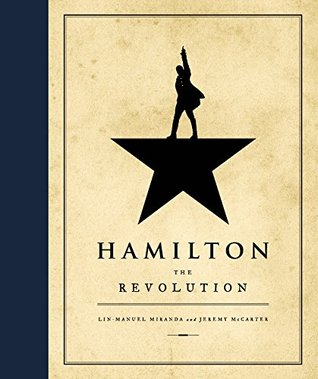
Hamilton: The Revolution by Lin-Manuel Miranda

Hamilton: The Revolution by Lin-Manuel Miranda

Hamilton: The Revolution is a musical that uses hip-hop to tell the story of Alexander Hamilton, one of the founders of the United States.  This book is not just the libretto, but also the story behind the musical.

Photo by Karolina Grabowska on Pexels.com

I have not heard this libretto performed, yet, so the part of Hamilton that stuck out the most for me was not the music (which might change after I hear it live) but the enormous amount of research that Miranda put into the creation of it.

I also enjoyed the copious details of his creative process. Every artist takes a different route to produce a masterpiece. Miranda credits the love for his wife as the foundation of this work, even calling Hamilton: The Revolution a “love letter” to her.

Love seems to be the driving force behind most creative endeavors, doesn’t it?

Photo by Nataliya Vaitkevich on Pexels.com

Back to the history behind Hamilton: I loved that Miranda included photographs of the actual documents and direct quotations from the figures of the period. This isn’t just a fun musical that uses hip hop to tell its story. This is history being retold in a way that appeals to modern sensibilities.

About Hamilton’s ambition that is highlighted in the song My Shot, Miranda says: “A character needs to want something pretty badly to sing about it for two and half hours… Alexander Hamilton lived hard, wrote fast, and hustled his a** off. “For to confess my weakness, Ned,” he wrote to a friend at age 14, “my Ambition is prevalent.” This man was born to perform an “I want” song. pg 21

I don’t know that I knew what the word ‘ambition’ meant at 14… a sign of things to come perhaps.

I loved all of the information about the set construction and having New York itself as the background: “The founders tended to be country boys. Washington, Jefferson, Adams, and many other key figures of the revolution hailed from, and frequently returned to, estates and farms out of town… It’s no wonder that John Adams, who despised Hamilton, also despised the town and its citizens: “They talk very loud, very fast, and all together,” he complained…” pg 38

Still rather true today, yes? I tease… 🙂

Photo by TheUknownPhotographer on Pexels.com

I didn’t know about Hamilton’s actual love poem to Eliza about which, Miranda says, “(she) wore it in a necklace for the rest of her life”:

“Before no mortal ever knew, A love like mine so tender, true, Completely wretched- you away, And but half blessed e’en while you stay. If present love (illegible) face, Deny you to my fond embrace, No joy unmixed my bosom warms, But when my angel’s in my arms.” pg 69

He wooed her with poetry- smart man.

I enjoyed the introduction to Angelica Schuyler, an incredibly bright woman in a time when she couldn’t really use that intellect in a constructive way.

In this passage, Miranda talks about how difficult her brilliant character is to portray and how hard her lines are to say: “Renee was the first one who came in and made us say, ‘Oh, she thinks exactly that fast,” he recalls. Her whirring brain made Angelica come alive in a new way… Renee acknowledges that she does indeed think pretty fast- “too fast to have good handwriting.”pg 79

That must be why I have bad handwriting too. 🙂

Photo by Daria Shevtsova on Pexels.com

I loved the empowering message of Hamilton: “There are plenty of debatable lessons to be drawn from Alexander Hamilton’s life, but that one is clear. The poor bastard orphan from the islands ought to have died a dozen times but somehow lived to help to found the nation…”There are strong minds in every walk of life that will rise superior to the disadvantages of situation and will command the tribute due to their merit,” Hamilton wrote in The Federalist No. 36. Look no further than his own life for proof of that statement.” pg 149

One of the rules of fostering creativity is to not be afraid to make mistakes. They were very brave in the development of Hamilton: “Lin, Tommy, and their collaborators shared an eagerness to try things- to try everything- to find what worked best. “New discoveries, new mistakes” was the daily goal that Tommy had announced for the company at their first rehearsal the previous November.” pg 206

The pages of this book are packed with the stories, anecdotes, and behind-the-scenes hijinks of the creators, actors/actresses, and historical figures behind Hamilton: The Revolution. Pick it up and treat yourself to the newest Broadway sensation- winner of the 2016 Pulitzer Prize for Drama. It’s amazing and well worth the time.

Thanks for reading!

Awakening from the Daydream: Reimagining the Buddha’s Wheel of Life by David Nichtern

Awakening from the Daydream: Reimagining the Buddha’s Wheel of Life by David Nichtern

Awakening from the Daydream: Reimagining the Buddha’s Wheel of Life is an accessible and modern reworking of the Buddhist Wheel of Life.

I took a course on Buddhism in college (seems like a million years ago now) and I remember being deeply affected by the Wheel of Life then- the original version.

For thousands of years, Buddhist practitioners have been studying the mind, how it perceives the world, and how it creates a perpetual cycle of suffering. The original Wheel captures this in extraordinary detail. David Nichtern’s re-imagining of it is brilliant.

Photo by carol wd on Pexels.com

I think that this could be very helpful for many people. It’s similar to artists updating and customizing Tarot decks. Sometimes, new images spark new ways of looking at situations and new solutions arise.

Nichtern is clearly an expert on this topic but he never ventures beyond the basics of the teaching into spaces that beginners can’t grasp. His philosophic writing is understandable and relatable. I appreciated that because not all Buddhists texts are simple reads- Stages of Meditation by the Dalai Lama comes to mind.

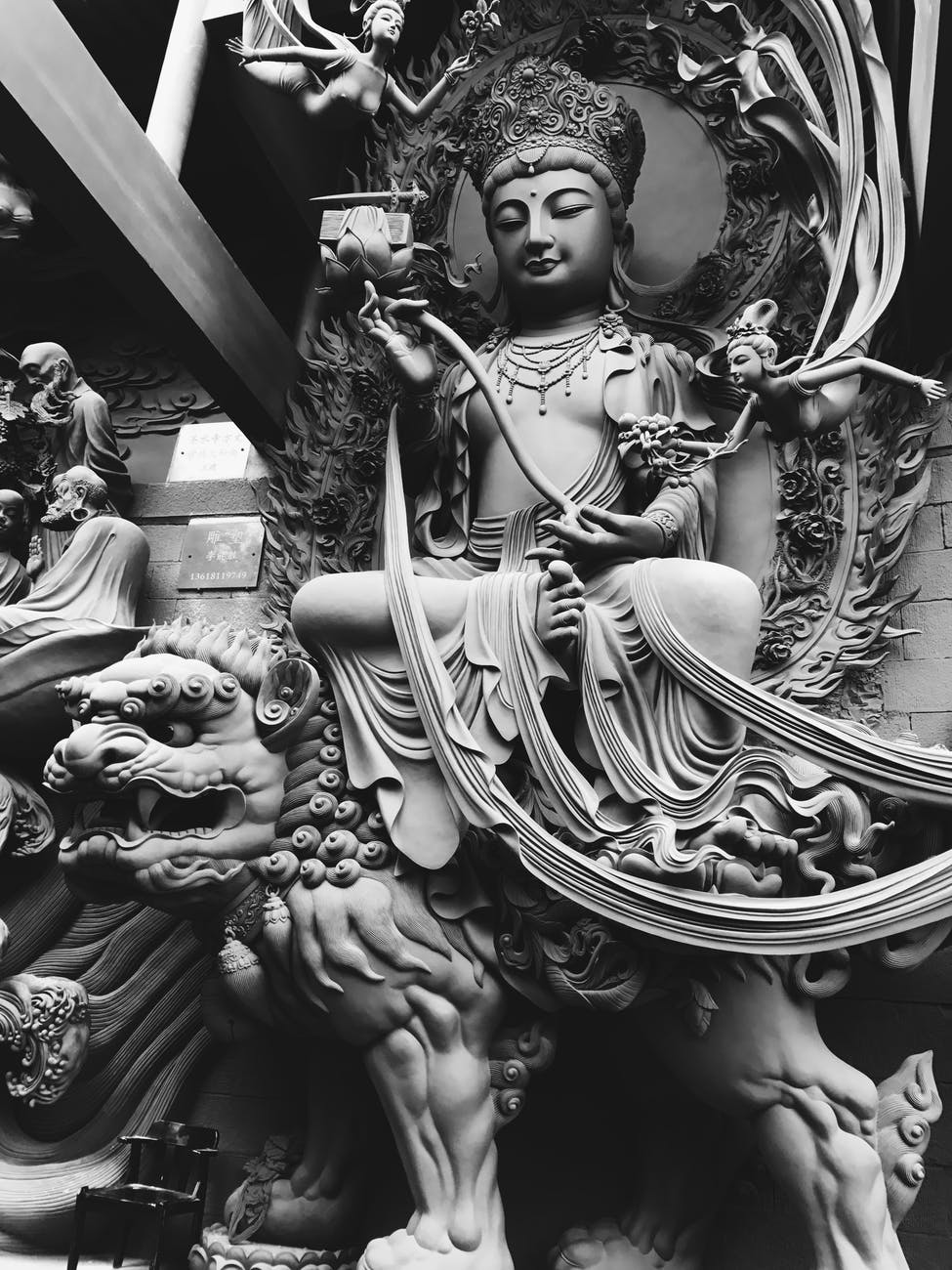
“Tradition says that the Buddha directed the creation of the original Wheel painting, which he commissioned as a gift to teach Dharma to an Indian king. When the king who received the painting contemplated it and fully understood its meaning, he attained enlightenment- he brought the suffering caused by unconscious habitual patterns to an end… The image of the Wheel survives not just because it sustains tradition, but because the message it conveys is powerful and timelessly relevant.”

Nichtern reminds us in this book that Buddha gave the painting to a king not a monk. This shows that we can live in the world and also transcend it. These teachings are for everyone.

Photo by RODNAE Productions on Pexels.com

Nichtern discusses the Buddhas contained in each part of the picture- in the suffering areas and outside of it: “There is also usually a Buddha standing outside of the Wheel, representing transcending the six realms altogether. Such people are said to be free from imprisonment in the six realms- free of karma- and only appear in the six realms in order to teach and liberate the beings within the realms out of compassion. Sometimes we are fortunate enough to meet people who remind us of this kind of possibility.” People, I would say, like Nichtern himself.

How to find opportunity in the midst of suffering: “The abject misery that we experience in the hell realm mindset offers us the opportunity to relate to the suffering of others… This isn’t to say that we simply forgive the harmful behavior of others. Instead, we can use our own intense experiences of hatred or depression to realize a deeper truth about all of us living beings in general: none of us are immune from this.” None of us.

Nichtern offers meditation practices for beginners or more experienced folks. Here is a snippet of his advice: “…it is good to help manage people’s expectations. Meditation can include boredom, irritation, discomfort, frustration, grasping, aggression, a discursive waterfall of thoughts and emotions coming and going, and perhaps occasionally a sense of peace and acceptance of things as they are. In a nutshell, it can and will include all the aspects of who we are and of what our lives are actually made.” He also offers concrete suggestions on how to find instructors.

I recommend Awakening from the Daydream for anyone interested in Buddhism, at all levels of knowledge, but this would probably be most helpful for beginners to intermediate practitioners.

Some books that cover similar topics that you may want to check out: You Are Here: Discovering the Magic of the Present Moment by Thích Nhất Hạnh, Happiness: A Guide to Developing Life’s Most Important Skill by Matthieu Ricardo, or The Buddha Walks into the Office: A Guide to Livelihood for a New Generation by Lodro Rinzler.

Thank you to NetGalley and Wisdom Publications for a free digital copy of this book and thank you for reading!

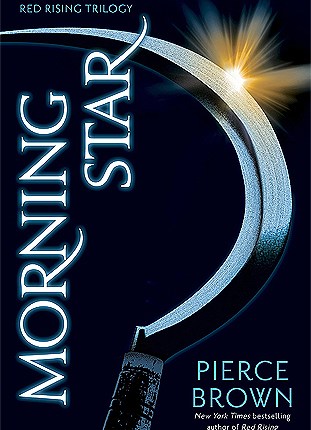
Morning Star by Pierce Brown

Morning Star by Pierce Brown

The Red Rising trilogy, of which Morning Star is the third book, is a gritty space opera in a futuristic universe.  Mankind has genetically engineered themselves into classes based on colors.  Each color has a specific function, which individuals can’t refuse to fulfill, in society.  The Golds are at the top and the Reds are at the bottom.  Everyone inbetween these two polarities suffers as well…

One word to describe this whole trilogy: INTENSE. It draws you in. It makes you keep reading when you should be going to sleep. It transports you to another world. My husband was laughing at me: sitting in my favorite chair, gasping in surprise or groaning in despair at the incredible turns in this story. I had to keep putting my hand over the page so that my eyes wouldn’t skip ahead and spoil it. Seriously. This book is that good. Its predecessors are also enjoyable, but this one absolutely brought the thunder. I loved it. Sci fi/fantasy fans, read them. Right now!

Brown waxes on a bit in Morning Star but I loved it. His style is reminiscent of Dan Simmons- meandering, bordering on repetitive, but I forgive him. It’s worth it. I’m going to share a couple of my favorite passages now, to give you a taste of the poetry of Brown’s story. No spoilers, I promise.

Darrow, throughout the course of the story, has become a severely damaged hero: “He wants pity. My pity was lost in the darkness. The heroes of Red songs have mercy, honor. They let men live, as I let the Jackal live, so they can remain untarnished by sin. Let the villain be the evil one. Let him wear black and try to stab me as I turn my back, so I can wheel about and kill him, giving satisfaction without guilt. But this is no song. This is war.” pg 35 That’s part of the larger question that Morning Star seeks to answer. Has Darrow’s spirit been crushed by the cruelty of the Golds? Read it and see.

Darrow describing desperation at living in a world that is not free, where your birth determines not only your place in society, but your ultimate destiny: “I feel like a prisoner who spent his whole life digging through the wall, only to break through and find he’s dug into another cell. Except there will always be another cell. And another. And another. These people are not living. They’re all just trying to postpone the end.” pg 71

Man’s insignificant place in nature: “Mars is over our heads, consuming and omnipotent. …I wonder… if the planet does not mind that we wound her surface or pillage her bounty, because she knows we silly warm things are not even a breath in her cosmic life. We have grown and spread, and will rage and die. And when all that remains of us is our steel monuments and plastic idols, her winds will whisper, her sands will shift, and she will spin on and on, forgetting about the bold, hairless apes who thought they deserved immortality.” pgs 145-146

One last passage, about love, because I am a romantic sap: “I was going to say something important. Something memorable. But I’ve forgotten it in her eyes. That gulf that divided us is still there, filled with questions and recrimination and guilt, but that’s only part of love, part of being human. Everything is cracked, everything is stained except the fragile moments that hang crystalline in time and make life worth living. pg 443

If you enjoyed Morning Star, you may want to try Gemsigns by Stephanie Saulter or The Lies of Locke Lamora by Scott Lynch.  Thanks for reading!

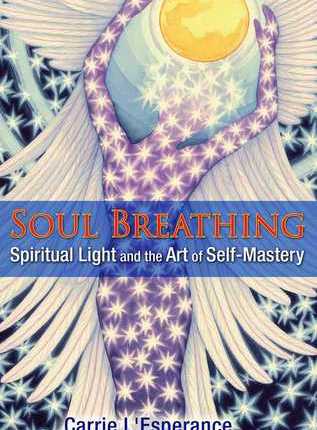
Soul Breathing: Spiritual Light and the Art of Self-Mastery by Carrie L’Esperance

Soul Breathing: Spiritual Light and the Art of Self-Mastery by Carrie L’Esperance

An incredibly ambitious book, Soul Breathing: Spiritual Light and the Art of Self-Mastery covers most major spiritual topics- from chakras to meditations and the evolution of the soul to aliens.

With this very diverse amount of material, readers are certain to find at least one chapter or section that resonates with them.

Photo by Egor Kamelev on Pexels.com

Unfortunately, he or she will probably also discover something that doesn’t, which is just fine, because as Carrie points out in this book, everyone experiences the “Universal Mind” in a different way.

What is enlightenment? In the author’s own words: “Enlightenment is a way of freeing oneself from ignorance in order to act, operate, and contribute as a Light in the world. It is through the balanced integration of body, mind, and spirit that a deeper and more profound Intelligence is expressed.”

The vocabulary in Soul Breathing is definitely New Age, but the reader doesn’t have to have any background in that to understand what Carrie is talking about. She starts out with a bit of her personal history and then jumps into general teachings about the soul and transcendence, which I found to be very reminiscent of Eckhart Tolle’s A New Earth.

After that, Soul Breathing goes in a bunch of different directions, which I didn’t enjoy nearly as much as the opening few chapters.

Photo by Jill Wellington on Pexels.com

What is Soul Breathing anyway? “Soul Breathing is the ability to create a balanced life on Earth through a conscious connection to Spirit. It is a state of grace achieved through action and experience.”

Carrie L’Esperance is at her strongest when she’s relating personal stories or giving concrete instructions- like specific affirmations or methods of meditating to support positive spiritual change.

I felt that Soul Breathing stumbled in the parts where Carrie talks about what is wrong with the world or how things have gone so badly. (The rampant energy pollution and government-alien conspiracy sections come to mind.)

All personal stories of spiritual or the otherworldly have value as Carrie reminds us: “There have always been the unbelievers and the hyperrational scientific intellectuals who attempt to devalue what for some people are the most powerful, transformative, and sacred experiences of their lives. In truth, there is really no one who can denigrate the authentic spiritual experiences of the individual.” I would add, except his or herself.

I thought that this book with its myriad of suggestions and prohibitions would be impossible for anyone to ever implement in their lives in a manageable way.

Photo by Chermiti Mohamed on Pexels.com

Carrie says: “We don’t have to dissect every aspect of how and why we exist in order to appreciate the miracle of life. We can experience all that is needed in the natural stages and steps that we take along the way. Ultimately we are to choose what capacities we will develop within the laws of existence.”

Despite that passage, Carrie seems to be a very demanding teacher.

It is clear that Carrie is passionate about spiritual, physical, earthly, and even galactic health and well-being.

Don’t read this book if you are unwilling to have an open mind about all manner of spiritual topics. Do read this book if you’re looking for more information about sensing, managing, and healing with subtle energy in the body, mind, and soul.

Photo by Magicbowls on Pexels.com

Her beliefs about aliens and a grand government conspiracy to control and manipulate the population were a bridge too far for me, but I’m certain that there are some readers out there who will resonate with her teachings.

Perhaps fans of Whitley Strieber or John Keel will enjoy Soul Breathing.

A big thank you to Netgalley and Bear & Company for a free digital Advance Reader copy of this book for review purposes!  And, thank you for reading.

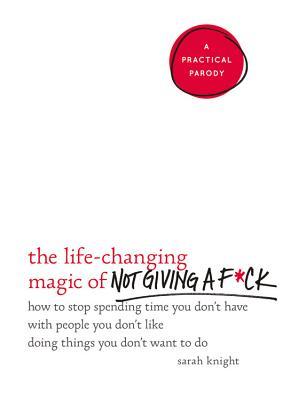
The Life Changing Magic of Not Giving a F*ck: How to Stop Spending Time You Don’t Have with People You Don’t Like Doing Things You Don’t Want to Do by Sarah Knight

The Life Changing Magic of Not Giving a F*ck: How to Stop Spending Time You Don’t Have with People You Don’t Like Doing Things You Don’t Want to Do by Sarah Knight

Since I just posted on Spark Joy, I thought that it was the appropriate time for a review of this one.

Full title, it’s a whopper and very descriptive of the book’s contents: The Life-Changing Magic of Not Giving a F*ck: How to Stop Spending Time You Don’t Have with People You Don’t Like Doing Things You Don’t Want to Do.

F-bombs aplenty in this parody of Marie Kondo’s international best seller about tidying. If you can look past the obvious language thing, Knight gives some fairly solid advice. She counsels readers to not care so much about what others think and give that mental energy to yourself. You’ll be surprised what you can accomplish.

“Please listen when I say that the shame and guilt you feel when you’re trying so hard to not give a f***? It’s usually not because you are wrong to not give that f***. It’s because you’re worried about what other people might think about your decision. And guess what? You have no control over what other people think.”pg 26

See? She reminded me of a more foul-mouthed Byron Katie.

Sometimes she manages to string together two whole sentences without the F-word. Check it out: “You can sidestep the prospect of hurt feelings entirely when you view your conflict through the lens of simple, emotionless opinion. NotSorry (Knight’s method) is all about simple, emotionless opinions.” pg 31.

Beyond managing your own mind, she branches out to give advice to parents: “One mother responded from the perspective of teaching her own kids what to give a f*** about: As someone who grew up in a household full of guilt, I think it’s important for our kids to know that they can make decisions about what to care about, and that they don’t need to pay attention to the approval or condescension of other people in deciding how to live their lives.”pg 92.

I can get behind that idea.

Then we move right along to shades of Eckhart Tolle and The Power of Now: A Guide to Spiritual Enlightenment with contemplating the meaning of existence and its temporariness: “The reality is, unless we’ve been given a ballpark figure by a reputable physician (and sometimes not even then), not a single one of us knows when we’re going to shuffle off this mortal coil. It’s morbid, but it’s true. Tomorrow you could get hit by a bus, or mauled by a pack of wolves, or be scared to death by a clown. When you think about it like that, don’t you want to make every second count? pg 184.

Sarah Knight’s book, in my opinion, doesn’t have the life-changing magic of the other book, but she’s got some interesting thoughts that I believe are true and, sometimes, rather funny. But make sure to bring your sense of humor with you when you pick this one up because the author doesn’t give a … well, you know.

Thanks for reading!

Spark Joy: an illustrated master class on the art of organizing and tidying up by Marie Kondo

Spark Joy: an illustrated master class on the art of organizing and tidying up by Marie Kondo

Spark Joy is author Marie Kondō’s follow up to her internationally best-selling title, The Life-Changing Magic of Tidying Up: The Japanese Art of Decluttering and Organizing.

Kondo’s not for everyone — some of her ideas are very different like treating your possessions as if they have spirits of their own and sorting items by smell — but I like her.

I think it’s because she is obviously very passionate about what she teaches. Her excitement seems to seek from the pages of her book.

This companion novel is an excellent book by itself, but, in my opinion, you won’t be able to fully appreciate it unless you’ve read Kondō’s first title. She doesn’t as completely explain her tidying methods in this book as she took the time to in the last. But there was still so much to enjoy here.

She encourages individuals to embrace what they love, even if society doesn’t love it too, like in this section called Save Your Cosplay for Indoors“…a surprisingly high percentage of my clients have costume-like clothes. To name just a few, I have encountered a Chinese dress, a maid’s outfit, and a belly-dancing costume. … If it brings you joy, but you can’t see yourself wearing it outside, there’s no reason you shouldn’t wear it inside.” pg 25-26

Kondo has a pretty philosophy of living: “I’m convinced that things that have been loved and cherished acquire elegance and character. When we surround ourselves only with things that spark joy and shower them with love, we can transform our home into a space filled with precious artifacts, our very own art museum.” pg 47

One of my favorite parts of both books is Kondo’s theory about socks. It makes me smile: “The socks you wear at home are particularly important because they are the contact point between you and your house, so choose ones that will make the time you spend there even more enjoyable. Balling your socks and stockings, or tying them into knots, is cruel. Please put an end to this practice today.” pg 98 🙂

As much as I enjoy Kondo’s quirkiness, I don’t embrace all of her theories.

For example, I’m still trying to talk myself out of the mountains of books that I have around the house. I have this dream that one day, I’ll have an enormous library with shelves so high that I’ll need a ladder with rollers to climb up and reach the books at the top.

Here’s what Kondo has to say about tidying up the books: “When you’re left with only those books that you love, you’ll discover that the quality of information you receive changes noticeably. The room you make by discarding books seems to create space for an equivalent volume of new information. You’ll soon see that the information you need comes just when you need it, and when it does, you’ll find that you respond to it immediately in a new pattern of behavior that wasn’t possible when you were hoarding books and neglecting the information they contained.”pg 126

Sigh.

Here’s a helpful tip for sorting piles of stuffed animals: “Energy resides in the eyes, which is why it’s best to cover them when discarding something. Once their eyes are hidden, stuffed toys and dolls look much more like objects, and that makes it far easier to part with them. The simplest solution is to place a cloth or piece of paper over their faces.” pg 164-165

Consider some of the most used items in your life for the royal treatment: “…my criterion for deciding which items require royal treatment… is this: the item’s proximity to your body. Items such as forks or undergarments, which come in direct contact with delicate parts of our bodies, should be treated as a rank above the rest whenever possible.” pg 183

Good to know.

And finally: “Tidying is a special event. If you give storage your best effort, experimenting with different ideas and enjoying the whole process, you’ll find that it goes very smoothly. Treat it like a game. Each idea you try will bring immediate results, and you can readjust anytime you like.” pg 206

If only I had that sort of passion for tidying…

Marie Kondo is inspiring but I don’t know if I will ever achieve the emotional highs that she seems to find from it. The best part of this book is: she makes me willing to try.

Other tidying (or anti-tidying) books I’ve reviewed can be read here:

Remodelista: The Organized Home by Julie Carlson

The Joy of Leaving Your Sh*t All Over the Place by Jennifer McCartney

Thanks for reading!