Dying to Wake Up: A Doctor’s Voyage into the Afterlife and the Wisdom He Brought Back by Rajiv Parti

Dying to Wake Up: A Doctor’s Voyage into the Afterlife and the Wisdom He Brought Back by Rajiv Parti

Rajiv Parti was living a materialistic dream with the house, car, and beautiful wife to prove it. But, the many things in his life didn’t bring him comfort when he developed prostate cancer and a bunch of unfortunate side effects from the surgery to remove it.

Photo by PixaSquare on Pexels.com

Addicted to pain pills and disconnected from the people around him, Dr. Parti underwent emergency surgery and experienced something so incredible, that when he woke up, he completely changed his life, developed a new form of holistic health treatment, and gave up many of the possessions that were weighing him down.

This is the memoir about that experience and Dr. Parti shares it in the hopes that it will change the reader’s life or at least bring comfort to those who are struggling in their current life experience.

Like many of the other memoirs I’ve read by medical professionals, Dr. Parti talks about the completely scientific view he had of the soul, which is to say, if you couldn’t see it and measure it, then it doesn’t exist.

Also, working on the technological edge of medical breakthroughs in the treatment of various diseases, had given him an invincible feeling.

This experience blew that attitude away: “Feeling like a master of the universe is easy in the world of modern medicine. … Maybe it’s a sense of cheating death for others that gives us cardiac surgical teams the vague feeling that we can overcome our own death. Of course that isn’t true. … Reality popped that myth for me.” pg 10

Photo by Kevin Menajang on Pexels.com

In his near death experience, Dr. Parti not only encountered his father, but also a huge crowd of his ancestors.

They shared messages of forgiveness and love: “Love is the most important thing there is, my grandfather communicated to me. I am glad to let you know that simple truth while you can still make change in your earthly life.” pg 44

But his time on the other side wasn’t all light and love, Dr. Parti also had the (fairly rare) experience of seeing hell and the suffering souls within it.

This is entirely my opinion, but I think that the detached manner in which Dr. Parti was living his life brought forth a major wake-up call from the spirit world. He saw hell first and then heaven and, in a way, that could be a metaphor for his life experience.

Photo by Skitterphoto on Pexels.com

I don’t believe in “hell” myself other than the nightmare that people can create in their own minds and lives, but, I didn’t experience it like Dr. Parti did. This memoir does not focus on the hell portion of the narrative, but, with the rarity of that experience, it could have. That, in itself, says something.

When Dr. Parti “comes back”, he knows that he wants to start a new life and a new focus, but he doesn’t know how.

The information for developing a new type of medicine comes to him slowly during meditation: “What is (the new mode of healing) anyway?” “…It is how nonpharmacological treatments in combination with drugs can heal things like depression and addiction and other diseases. It’s about searching one’s own soul to fight back against the hollowness that pharmaceuticals alone or alcohol and illegal drugs create or don’t really fill.”pg 91.

He eventually develops meditations and lifestyle changes as well as a manifesto for treatment.

To me, the most fascinating part of this memoir was the communication between himself and the spirit world once he was back.

For readers who are unfamiliar with near death experiences, Dr. Parti provides a broad background with some of the major historical figures who went through it.

Like Jung: “(Carl) Jung’s NDE led to a split with Sigmund Freud, who believed that spiritual experiences were fantasies. Jung, however, considered spirituality an important part of our well-being saying that life has purpose beyond material goals and that our main task, the path we should all be on, is the one that leads to our own connection with the universe.” pg 124

Photo by Cliford Mervil on Pexels.com

Ultimately uplifting and empowering, Dying to Wake Up is another excellent entry into the literature about near death experiences.

Recommended for anyone who questions why we are here or what comes after. Some further reading: Into the Magic Shop: A Neurosurgeon’s Quest to Discover the Mysteries of the Brain and the Secrets of the Heart, Dying to Be Me: My Journey from Cancer, to Near Death, to True Healing, or Wisdom of Near-Death Experiences

Thanks for reading!

The Space Within: Finding Your Way Back Home by Michael Neill

The Space Within: Finding Your Way Back Home by Michael Neill
thespacewithin

No matter how many books I read on meditation, I always seem to learn something new when I pick another one up.

The Space Within is one of the more excellent books that I’ve discovered- not pushing any particular way of being, just quietly encouraging the reader to go within and embrace what’s there.

On separating our consciousness from the universal energy that surrounds it, Neill compares the mind to a book and I’m sure most Goodreads users, like me, could easily connect with the metaphor:“Think of ‘quiet’ not as an absence of thought but as the space inside which the noise of your thinking arises. What makes this tricky, at least to begin with, is that at first glimpse the noise is more interesting than the quiet …look at the white background of this page. Chances are you can still see the words, and even read them, but without noticing it, at some point you will once again become absorbed in the words and stop seeing the white of the page.” loc 192, ebook.

Why bother to meditate? : “There is a space within you where you are already perfect, whole, and complete. It is a space of pure Consciousness- the space inside which all thoughts come and go. When you rest in the feeling of this space, the warmth of it heals your mind and body. When you operate from the infinite creative potential of this space, you produce high levels of performance and creative flow.” loc 207

And more, promises Neill. I’ve meditated for many years and I’ve experienced some extraordinary things. It wasn’t always easy and it didn’t happen all at once, but I can say, from personal experience, that this particular claim is absolutely true.

Photo by Samuel Theo Manat Silitonga on Pexels.com

Thoughts are incredibly powerful things. I think we forget just how life changing your personal perspective can be: “… we live in a world of unrecognized thought. Thought is the architect of both hope and despair, the source of every color in the emotional rainbow. … But unrecognized thought demands our attention and fills our consciousness. And when we get caught up in thought, we lose our way.” loc 324, ebook.

And also: “We live in a world of thought, but we think we live in a world of external experience. The mind is not a camera, it’s a projector. We can’t tell the difference between an imagined experience ‘in here’ and what’s going on ‘out there’- and that confusion creates a lot of confusion.” loc 375, ebook.

You create your own reality- but it’s easy to forget that and blame other people for your circumstances.

When I read this next passage, I thought of How The Secret Changed My Life and the incredible importance that people placed on feeling good.

Neill points out that it isn’t anything to get wound up about: “There’s no such thing as a solution to a feeling. Because we don’t recognize this fact, we spend huge chunks of our time and energy trying to ‘solve’ our feelings by changing them to ‘better’ ones or eliminating them altogether. … When it’s okay to feel good when you feel good and bad when you feel bad, recognizing that as thoughts change, the feelings change with them, there’s no need to prefer one feeling over another, let alone attempt to fix it. And when you really see that for yourself, you being to experience more of the deeper feelings that make life worth living.” loc 457, ebook.

This is a great place to start if you’re just learning about meditation/mindfulness but it’s also appropriate for more experienced practitioners- if you breathe or think, you could probably learn something from this book. Some suggestions for further reading: Buddha’s Brain: The Practical Neuroscience of Happiness, Love, and Wisdom, Meditations for Breaking the Habit of Being Yourself, or Happiness: A Guide to Developing Life’s Most Important Skill.

Thank you to NetGalley and Hay House Publishing for a digital copy of this book! And, thank you for reading.

Zeroboxer by Fonda Lee

Zeroboxer by Fonda Lee

zeroboxerAt first, I thought that Zeroboxer was just Rocky in space, but as the story developed, I realized that it was more than that. Zeroboxer is also an examination of genetic ethics and, like most science fiction, poses some serious ‘what if’s. What if humanity begins to settle the universe- will they divide themselves into different races depending upon their planet of origins? What if the settlers develop their own system of government- how will humankind negotiate the potentially choppy waters of intergalactic politics? What if humanity could use gene therapy not just to eliminate disease but also to create a sort of super human? Fonda Lee has imagined a future filled with flawed but well-meaning people that feels very similar to our own and is, perhaps, not as far into the future as one may imagine.
The style of boxing in this story incorporates mixed martial arts with the added hiccup of no gravity: “To inflict any bare-handed damage to a person in zero gravity, you had to establish a brace or a point of leverage- preferably a vulnerable part of your opponent’s body- to keep them from floating away while you hurt them. Or you had to treat space itself as a weapon, using the infinite angles of movement to strike and rebound, strike and rebound, faster and harder than the other guy.” pg 13, ebook. Fans of MMA may enjoy this story more than I did- I don’t particularly care for violence but it was never too graphic or more than I could handle.

The colonists who settled on Mars (the Martians) embraced zero gravity sports while the people who stayed behind on Earth (the Terrans) didn’t. Luka, the main character in this story, is from Earth and he’s part of a group that is trying to popularize the sport on Earth- with mixed success: “I left Mars twenty-five year ago, saying I was going to grow the sport with the Terrans. I was practically laughed off the Red Planet. All the best zeroboxers in the Martian system… you know what they said to me? ‘Everyone on the old planet is a planet rat. The most daring and inventive Terrans left generations ago to build Mars and the other settlements. Why would a place with countless gravity-dependent sports want anything different?” pg 27, ebook.

The story becomes even more complicated because the Martians have accepted gene therapy as a way to improve and expand their race, while the Terrans only use it to keep children from developing poor eye sight or asthma. The Martian fighters are so dominant at the sport because not only were they born into a world that encouraged zero gravity sports, but also they were partially engineered to be that way. When the boxers from Earth face the boxers from Mars, it is more than planet vs planet- it is also a match up of nature vs science.

Luka doesn’t want to consider the complexities of it all and just wants to fight: “Two guys go into a Cube. They fight. One of them beats the other. How much simpler can it be? People don’t have to make it more than it is.” pg 176, ebook. Will Luka get his wish?

This book should appeal to fans of Ender’s Game or Red Rising (which is a much more adult examination of these themes). Thanks for reading!

Five Good Minutes: 100 Morning Practices to Help You Stay Calm and Focused All Day Long by Jeffrey Brantley, Wendy-O Matik, Wendy Millstine

Five Good Minutes: 100 Morning Practices to Help You Stay Calm and Focused All Day Long by Jeffrey Brantley, Wendy-O Matik, Wendy Millstine
fivegoodminutes

Things have been stressful in my neck of the woods, so I picked up Five Good Minutes to help me cope.

I’m in the fourth month of having my house on the market and my husband has been looking for employment for over a year. Yeah, I’m feeling it…

Five Good Minutes is simple enough for beginners to the mindfulness/meditation practice and filled to the brim with suggestions for ways to focus in the morning and get your day off on the right foot.

The best part of this book is that there is something for everyone- it is that broad. The techniques that it uses varies from visualizations to mindfully drinking your morning cuppa.

The worst part of the book is that, because it covers so much, that it doesn’t really talk about anything in depth. If you’re looking for detailed methods of meditation and relaxation, this is not the book for you.

Why the focus on early in the day?: “The morning is the best time to break away from old habits of thinking and feeling and to set a new direction for yourself and how you will be in your day. Any exercise in this book- done in the morning- has the power to impact greatly on your experience throughout the day, if you allow it!

Photo by Felipe Borges on Pexels.com

Personally, I’ve found that I’m at my best in the mornings- well, once I blink the sleep out of my eyes. My mind is clearer and I can focus for longer periods of time.

But, if you’re more an afternoon/evening type person, don’t let the title of this book stop you. I think that these practices could be beneficial at any time of the day.

My favorites were- the Five-Fingered Peace pg 32: In which you use your hands almost as a rosary and remember awesome things that have happened to you.

Freedom from Tension pg 58: In which you scan your body and focus your relaxation on the stressed out bits.

Photo by Alexandr Podvalny on Pexels.com

Your First Sip of Tea pg 94: or coffee, for me. Take your time and mindfully drink your morning pick-me-up.

A Shot of Faith pg 186: You use visualization to picture a problem turning out perfectly.

And finally, Cultivate Gratitude pg 206: “This practice invites you to turn toward the good in your life and to express gratitude as recognition grows.”.

If none of those spoke to you, there are 95 others for you to choose from.

Recommended for stressed out people everywhere and those who are interested in bringing a bit of mindfulness or meditation to their day but don’t know where to start. Some further reading: Thank & Grow Rich: A 30-Day Experiment in Shameless Gratitude and Unabashed Joy, Meditations for Breaking the Habit of Being Yourself, or 10% Happier: How I Tamed the Voice in My Head, Reduced Stress Without Losing My Edge, and Found Self-Help That Actually Works. Peace and thanks for reading!

Into the Wild by Jon Krakauer

into-the-wild

“Not all those who wander are lost” seems to be the focus of this non-fiction biography by Krakauer about a young man named Chris McCandless who went into the Alaskan wilderness, but never came out again.

Jon Krakauer examines McCandless’ history, friendships, and probable motivations while also comparing his case to other young men who died or disappeared in the wilderness.

He also gets very personal and recounts a solo mountain climbing adventure of his own that nearly went south, but didn’t- crediting his survival to luck rather than skill.

Into the Wild paints McCandless as a man with a brilliant mind and the soul of an artist, who didn’t fit in to the modern world’s or his family’s view of how he was supposed to be.

“In April 1992, a young man from a well-to-do East Coast family hitchhiked to Alaska and walked alone into the wilderness north of Mt. McKinley. Four months later his decomposed body was found by a party of moose hunters.” pg 10, ebook.

For much of the book, Krakauer tries to figure out what ultimately ended McCandless’s life. In the edition I read, he had a new afterword that he penned in April 2015, talking about his definitive theory for why McCandless died.

Photo by eberhard grossgasteiger on Pexels.com

If you haven’t read the book since it was published, I really recommend picking up a new edition if only to read that.

Krakauer includes actual journal entries from McCandless’s wanderings, which I thought gave us a pretty clear window into the man’s mind: “It is the experiences, the memories, the great triumphant joy of living to the fullest extent in which real meaning is found. God it’s great to be alive! Thank you. Thank you.” pg 37, ebook.

We saw a man who cared about life, about the way he was living, and about the way he interacted with others.

Photo by Pixabay on Pexels.com

It is curious to me that his relationship with his parents wasn’t better, but I’ll let Krakauer tell you all about it: “McCandless’s personality was puzzling in its complexity. He was intensely private but could be convivial and gregarious in the extreme. And despite his overdeveloped social conscience, he was no tight-lipped, perpetually grim do-gooder who frowned on fun. To the contrary, he enjoyed tipping a glass now and then and was an incorrigible ham.” pg 95

As interesting as McCandless’s story is, my favorite part of this book was Krakauer’s experience solo climbing the Devil’s Thumb in Alaska.

“By and by your attention becomes so intensely focused that you no longer notice the raw knuckles, the cramping thighs, the strain of maintaining nonstop concentration. A trancelike state settles over your efforts; the climb becomes a clear-eyed dream. Hours slide by like minutes. The accumulated clutter of day-to-day existence- the lapses of conscience, the unpaid bills, the bungled opportunities, the dust under the couch, the inescapable prison of your genes- all of it is temporarily forgotten, crowded from your thoughts by an overpowering clarity of purpose and by the seriousness of the task at hand.” pg 115, ebook.

That passage made me wonder- what sorts of things do I like to do in my life as much as Krakauer loves climbing? It seems to me, that the state of flow he’s describing there, would be a place that I would like to dwell in as much as possible.

Recommended for folks who like to read about people with unconventional life styles or if you’re looking for a book about the human spirit. Into the Wild is a book about why people wander, what they may find, and, sadly, the loved ones they leave behind. Some further reading: Naked and Marooned: One Man. One Island., Man’s Search for Meaning, or A Death on Diamond Mountain: A True Story of Obsession, Madness, and the Path to Enlightenment.

Thanks for reading!

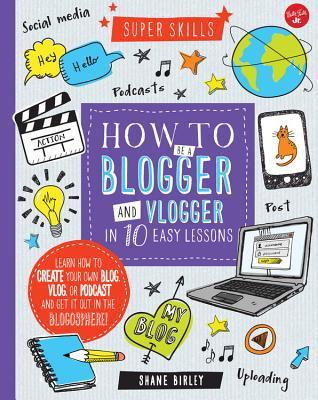
How to be a Blogger and Vlogger in 10 Easy Lessons: Learn how to create your own blog, vlog, or podcast and get it out in the blogosphere! by Shane Birley

How to be a Blogger and Vlogger in 10 Easy Lessons: Learn how to create your own blog, vlog, or podcast and get it out in the blogosphere! by Shane Birley
howtobeablogger

This is a good resource for kids who are looking to start their own online presence on a variety of platforms.

From podcasts to video blogs, Birley gives basic to expert tips and safety suggestions.

As a parent, I was particularly interested in his Super Skill Section 8 (begins on page 50) in which he talks about online etiquette and how to appropriately handle unruly website visitors.

(Getting on my soapbox) I think that there aren’t enough books that teach kids how to behave online.

With episodes of cyber bullying and trolling on the increase, as a professional educator, I am always on the lookout for books that give effective coping mechanisms for dealing with the issues that arise.

How to Be a Blogger and Vlogger in 10 Easy Lessons is a great place to start and we need more books just like it. (Getting off soapbox)

My only complaint is that this doesn’t include “Parent Tips” or any sections about how the adults in the kids’ lives can support the effort.

Birley doesn’t leave parents entirely out of the loop: “Speak to a trusted adult about any comments on your blog that make you feel uncomfortable or upset.” pg 53. But, I wish that there had been more.

The recommendation on the cover of this book is for ages 12+ but my 9-year-old devoured this text. So, I’d give this to any child who is interested in digital media, no matter their age.

Thanks for reading!

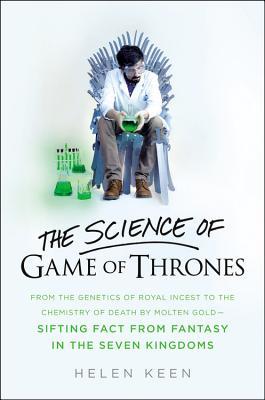
The Science of Game of Thrones: From the genetics of royal incest to the chemistry of death by molten gold – sifting fact from fantasy in the Seven Kingdoms by Helen Keen

The Science of Game of Thrones: From the genetics of royal incest to the chemistry of death by molten gold – sifting fact from fantasy in the Seven Kingdoms by Helen Keen
thescienceofgameofthrones

Readers beware: there are major spoilers contained within the pages of The Science of Game of Thrones. Do not read it (or this review) unless you’ve read all of the books that are currently out or have watched all of the seasons of the HBO show!

That being said: if you are a fan of the Game of Thrones, in any format, you simply must read this book.

From dragons to the effectiveness of female body armor, poisoning to the real possibilities of our world ending in ice or fire, Keen takes us on a scientific examination of all things related to George R.R. Martin’s epic series and what a trip it is.

My favorite part was a discussion about how dragons would breathe fire in real life and how that relates to the explosive capabilities of cows: “A cow can produce between 250 and 500 litres of highly flammable methane a day… In 2013 it was reported that a build-up of methane from a particularly afflicted dairy herd, coupled with an accidental spark of static electricity, ‘nearly blew the roof off [the] barn’ in Rasdorf, Germany… After a lot of genetic tinkering, a Danearys Targaryen in our world will be able to ride valiantly into battle to claim what’s hers on the back of a genetically modified fire-breathing heifer.” loc 235, ebook.

Can you picture it? I can!

Photo by Pixabay on Pexels.com

The potential positive effects of inbreeding: “… there’s evidence that, over time, inbreeding can actually purge a population of the effects of harmful recessive gene variants. These ‘bad’ genes are way more likely to show their effects, so, ultimately, the lines of the carriers are more likely to die off. Thus while the results of successive generations inbreeding is generally bad for the particular individual, it’s often good for the population as a whole.” loc 328, ebook.

So, the Lannisters can continue paying their debts as long as they’re not carrying harmful recessive gene variants. Good to know.

The Hodor question: “For a long time we were wondering what happened to Wyllis to cause his ‘hodoring’ behaviour. Perhaps he suffered a stroke or a tumour, or even a blow to the head. … Extensive damage to Broca’s area is also sometimes caused by malnutrition, but that seems unlikely in Wyllis’s case, given his enormous girth. Whatever the story, one thing is clear: Wyllis is clearly exhibiting a severe type of ‘expressive aphasia’. He can understand what other people are saying and respond, but he struggles to produce more than a single word.” loc 882-895, ebook. Hodor, hodor… hodor! Hodor.

Prior to a wonderful examination of the actual existence of dire wolves, Keen has this to say about the Starks and their pets: “The Stark children.. find a litter of orphaned dire wolf puppies and are desperate to keep them- like all children everywhere when confronted with the cute, mewling faces of slavering ferocious death beasts in their juvenile form. Their father Ned gives them a lecture worthy of any parent in Pets R Us along the lines of ‘Ok then but you’ll have to walk them yourselves even if it’s raining’.” loc 1160, ebook. Ha!

Photo by Brenda Timmermans on Pexels.com

And, finally, I enjoyed learning about crows. Apparently, they’re actually extremely smart and have very good memories: “Previous research has shown that crows not only remember a threatening face, they share that knowledge within their community, so that the individual is remembered and scolded by the crows, even after a gap of several years. Young crows, it seems, are even taught to recognise and scold the ‘villain’ by their parents.” loc 1357, ebook. Yikes. Don’t bully crows, friends.

There’s a bit of language in The Science of Game of Thrones and some juvenile humor, but, overall, it is much tamer than the source material. Recommended for ages 14+. Some further reading: What If?: Serious Scientific Answers to Absurd Hypothetical Questions by Randall Munroe or Loch Ness Monsters and Raining Frogs: The World’s Most Puzzling Mysteries Solved by Albert Jack.

Thank you to NetGalley and Little, Brown and Company for a free digital copy of this book! And, thank you for reading.

Medicine, Miracles, and Manifestations: A Doctor’s Journey Through the Worlds of Divine Intervention, Near-death Experiences, and Universal Energy by John L. Turner

Medicine, Miracles, and Manifestations: A Doctor’s Journey Through the Worlds of Divine Intervention, Near-death Experiences, and Universal Energy by John L. Turner
johnturner

I felt like this memoir was all over the place- from remote viewing to Johrei, prophetic dreams to explanations of brain functions.

Dr. John Turner has an incredibly open mind when it comes to integrating traditional Western and holistic medicinal techniques. That was refreshing, but, because he was covering so much material, I felt like he didn’t spend enough time going into detail about the different modalities.

I wanted more depth and less breadth.

There were some interesting bits in here though.

Dr. Turner experienced, first hand, a case of spontaneous healing. His patient had a large brain tumor and, through the intercession of some monks and some radiation therapy, her tumor completely disappeared: “Here was a case of emotional disarray that when corrected, allowed healing to take place. Was it the patient’s realization or belief in karmic cause of her disease that allowed her brain to join with radiation to expel the foreign invader?… Were surgery and radiation necessary at all? I paced back and forth in my office, pondering the matter.” pg 60

Photo by Oles kanebckuu on Pexels.com

Dr. Turner practiced daimoku (intense chanting of a certain set of words, like a prayer) for two hours a day for a year.

Here is what he had to say of the experience: “I believe that chanting sets up resonant circuits in the brain that activate usually quiescent neural pathways. I came to know this feeling of attonement quite well, and after the promised 12 months I discarded the incense sticks, the gong, and the chanting. I could recreate the feeling through meditation… However, I saw no practical way in which to use this complex and time-consuming process for the benefit of my patients.” pg 89-90

Dr. Turner practicing Johrei (a light healing technique) in his surgery: “After placing the last suture, I gave him 20 minutes of intraoperative Johrei, letting Okada’s light flow through a spiritual cord to me, and then to the patient. This was a first for Hawaii and perhaps for any medical center (and surely for any neurosurgical operating room) outside of Japan. (My patient’s) recovery was spectacular…” pg 134

Photo by Pixabay on Pexels.com

The technique seems strange to me, but if it works, I say use it!

One of the first accounts I have read of remote viewing being used for medical diagnosis and treatment: “…it occurred to me that I should run the cause of this patient’s pain as a remote viewing target and see what Ed Dames could do to arrive at the answer. Not only would this be a confirmation of the power of remote viewing as a method of medical diagnosis, I would also have a chance to witness an expert at work. The results, as you will see, were everything I had hoped for; the patient fared well, much better than if I had tried to wait for the condition to become obvious on examination.” pg 194

If you are looking for more books about neurosurgeons who are considering non-traditional therapies in their practice, try Into the Magic Shop: A Neurosurgeon’s Quest to Discover the Mysteries of the Brain and the Secrets of the Heart by James Doty or Proof of Heaven: A Neurosurgeon’s Journey into the Afterlife by Eben Alexander.

Thanks for reading!

Templar by Jordan Mechner

Templar by Jordan Mechner

templarTemplar: a graphic novel about the dissolution of that famous order and the struggle for the legendary treasure that they left behind. A couple of weeks ago, I read the first book in this series and I enjoyed it more than this complete volume. It was the ending that diminished my enjoyment of it the most, which I won’t get into because I don’t want to ruin it for anyone, but that was really my issue. Mechner ties up the major plot points, but I didn’t like how he did it- at all.

Like the other book, this contains adventure, daring rescues, and amusing “heist movie” type moments. We’ve also got a strong female lead in Madame De Chalancon (love interest) who is actually very hard core for a 12th century woman. She’s sneaking out at night and running around with the guys, stealing horses, manipulating the powerful men around her, kissing people- I mean, that kind of stuff could have gotten her burned as a heretic or witch back then. So, that was good and the other characterizations are solid. The illustrations aren’t gorgeous (compared to Monstress #1 or Saga, Volume 1) but those are considered adult graphic novels while this one is marketed for the teen set.

Which reminds me, there’s a whole scene that takes place in a Turkish steam bath that some parents may find objectionable. I’d let my kid read it, but she’s a girl and has the parts that are revealed through the steam and also, I’m a librarian, and I don’t censor stuff. But yeah, there’s some (very tasteful) nude females, torture scenes, hand to hand combat, men being burned at the stake, arrows through limbs… I honestly think that this may have been better as a mature book than a watered down PG13, but it is what it is.

Still, it is a fun story and semi-educational in that some of the people featured in this book were actual historical figures. Mechner includes his sources in the back and also some recommended reading. I think I’m going to look into Foucault’s Pendulum, which I’ve never read, but Mechner gives high praise.

Some more graphic novels that teens may enjoy are The Guild (ties in to the show of the same name) or the surprisingly fun, Nimona.

Thanks for reading!