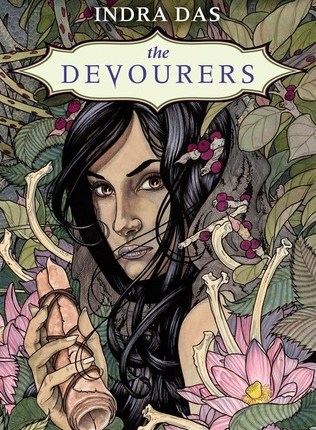
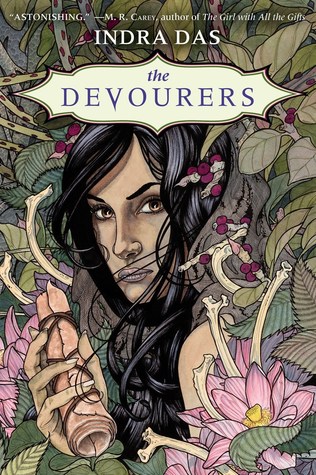
 A wholly original shape-shifter tale that also delves into identity, gender roles, and love. Alok is a college professor who is approached one night by a person who claims to be more than a man. Alok doesn’t believe the stranger until an unbelievable vision, caused by the man’s hypnotic words, appears in Alok’s mind. Suddenly, the stranger’s claims that he’s a werewolf don’t seem so far fetched. The stranger, who won’t reveal his name, has a job for Alok, the transcription of an ancient narrative that was written by a shape-shifter, a creature of magic and blood that consumes humans like prey. Through his work on the story, Alok comes to know the stranger and a world that is beyond anything he ever dreamed.
If rape, gore, or graphic sex bother you- you may want to pass on The Devourers as it contains much of all of those things. The heart of the story, about what makes a man, a man and a monster, a monster, are worth the read, but I can see how this book may not be for everyone. “Listen,” he repeats. He is not looking at me. “I am going to tell you a story, and it is true.” pg 8. Personally, I thought that The Devourers was magical, but repetitive. I understand why the author took us in loops and it did lend a beautiful symmetry to the work, but I thought, in a couple different places, that yet another gory kill or another description of blood or urine running down someone’s leg wasn’t needed. “And here where we stand, long before India, before its empires and kingdoms, there were human tribes who identified with dogs and wolves, with wild animals. And there were, and still are, tribes who are not human, who identify with humans in similar ways. Who take the shape of humans, just as humans took the shape of animals by wearing skins.” pg 16.
Indra Das’ vision of shape-shifters as different from each other as people from different cultures was fascinating. By presenting his magical creatures in the manner that they were remembered by the humans they fed upon, he fit the mythologies of a myriad of different countries into one story and it was a perfect fit- the shape-shifters in deserts became the djinn, the ones from Europe were werewolves or vampires, the ones in India were tigers or demons. “To me, to my kind. You are prey. … Something to kill, and sustain us.” “You are cannibals then.” “No, we do not eat our own kind. We eat you, little Cyrah. You keep forgetting-we are not human.” We are the devouring, not the creative.” pg 126
It was in the “devouring, not the creative” mindset of the shape-shifters that Indra explores the traditional roles and balance of power between men and women: “Women create. Men inflict violence on you, envious and fearful, desperate to share in that ability. And it is this hateful battle that keeps your kind extant. You have taught me that your race’s love is just a beautifully woven veil, to make pretty shadows out of a brutal war.” pg 213. One of the main points of this story is that this particular view is not true, but you can see how a creature that only continues to exist through constant violence, could interpret the relationship between the sexes like that. Love and hate are opposite sides to the same coin after all. “I’ve never loved a man in my life, but I’m not fool enough to think that there are no men and women in this world who truly love each other, and love their children together, and did not conceive them through violence and pain.” pg 225.
I haven’t begun to plumb the depths of what The Devourers is about, but I don’t want to ruin this complex fantasy for anyone who’s interested in experiencing it for him or herself. Recommended for readers who like their fantasies to have an adult edge and a grittiness to them. Some similar reads: In the Night Garden, The Last Werewolf, or Hyde.
Thanks for reading.
 Warning: minor spoilers ahead! Read with caution.
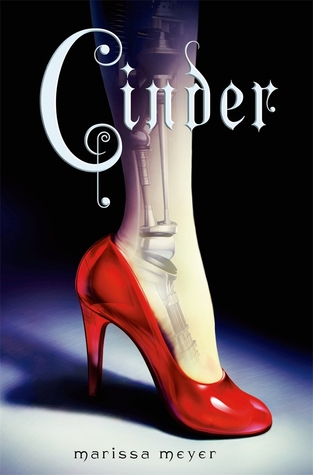 Typical young adult fantasy in that the ‘big twist’ was obvious from the start, but this story still has some charm. Cinder is a cyborg mechanic who wants to go to the ball, but she doesn’t have the time or money to do so. She lives in a world where cyborgs are despised, but tolerated. Humankind is suffering from a plague, one which strikes without warning and leaves the affected dead within days. There’s a draft for cyborgs to be tested upon in order to find a cure for this disease but Cinder is lucky in that her number hasn’t been drawn yet.
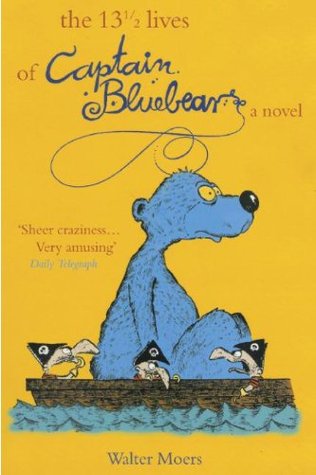 This book was very strange. It reminded me of Charlie and the Great Glass Elevator by Roald Dahl. Moers writes page after page of strange creatures, worlds, and circumstances that are only connected because Bluebear passes through them. And, like in Dahl’s book, I felt like the author was always hinting about a greater truth behind the story, as if The 13 1/2 Lives of Captain Bluebear was more a gigantic allegory than a children’s book. I enjoyed the fantastic nature of it but I didn’t like the long lists of creatures that read more like crazy encyclopedic entries than an actual story with characters.
 Sometimes life kills you before you die. It’s not a death of the body but a slow wearing away of the spirit that you carried from your birth through your childhood until wherever it is that time finds you now. That flickering flame of beliefs and dreams that you somehow knew was a true vision of reality but you had no real reason to believe so, except that inner feeling in your chest that would incline its head in quiet acknowledgment when you consult it. I thought that life had devoured my romantic streak but then this little book of poetry made me cry and I realized that my flame still burns. Some things can never be lost. That’s what this collection made me feel. I suppose all good poetry should make you feel like that.


 The Help Desk Book Blog