Amy Gunn’s trailer is swept up in a tornado and she finds herself in Oz, but something has gone horribly wrong. The characters from the story that Amy knows are all twisted and changed. She has to get back home, but she also has to save Oz.
The trouble with this book is not the premise, which is excellent, but it’s in the execution of it and in the decision of the author to place this poorly written story in one of the most beloved worlds of fantasy literature. Not a similar world or parallel, the girl in this story is plopped right down in the magical land of Oz. No matter what came next, everything that was written was going to be held up and compared in the light of Baum’s masterpiece. And, this story is found wanting.
The horror twist is interesting but because this is a YA piece, I feel that the author holds back or dumbs down the material. One only needs to read Gaiman to discover that a world can be completely appropriate for a YA audience (Coraline comes to mind) and also be absolutely terrifying. The strange variations that are presented of the beloved characters from the story of Oz are repulsive but not earth shattering. I was so disappointed.
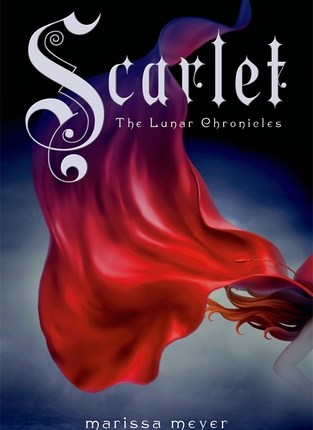
Scarlet the second book in The Lunar Chronicles is better than the first. The introduction of Scarlet and Wolf is a clever and breaks up the the Cinder story line. I don’t like to read reviews of books before I read/listen to them, so I had no idea that Meyer wove more than one fairy tale together. I liked that a lot.
This book, like the previous one, is still plagued by cringe-worthy teen romance scenes and angst. But, it’s easier to ignore those bits because of the crazy stuff that begins to happen with the Lunar Queen and the intense chase scenes.
Iko is by far my favorite character. Team Iko!
Recommended for ages 13+ because of some disturbing, non-graphic torture descriptions. The audiobook is pretty good and may work out well for road trips. You don’t need to have read the first book to appreciate this one because the author does a good job of outlining the backstory. Personally, I prefer to read books in a series in order, but it’s not required here to understand what’s going on.
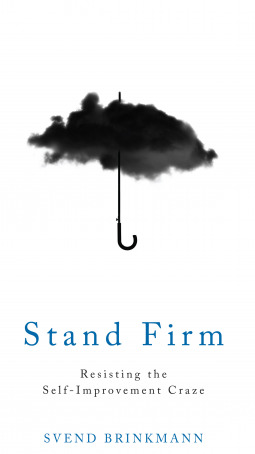
Brinkmann provides seven steps that outline his plan to apply Stoicism to your life and free yourself from the (as he sees it) needless, endless introspection and self improvement that plagues modern society. “In spheres like diet, health and exercise, a veritable religion has emerged that constantly churns out new edicts to follow and regimes to live by. … It seems that we- and I’m not afraid to count myself among the collective ‘we’- lack purpose and direction, and run around looking for the latest recipe for happiness, progress and success. From a psychological perspective, this resemble a collective state of dependency.” loc 118, ebook.
I disagree. I think that the myriad of different approaches are only of benefit to society. No one solution is going to fit everyone. The variety appeals to the varying needs.
Brinkmann also talks about using ‘negative visualization’ to build a sense of appreciation and gratitude: “Think about losing something (or someone) you care for and note how this enhances the pleasure you derive from it/them. Psychologists speak of the concept of ‘hedonic adaptation,’ i.e. that we very quickly get used to the good life. Negative visualization can counteract hedonic adaptation and make you more grateful.” loc 497, ebook.
He explains why suppressing emotion is a good thing and should be practiced: “… the worship of authenticity in the pursuit of true feelings infantilises us. … As an adult, you should admire those who are capable of controlling- even suppressing- negative emotions. You should also be careful not to casually hurl around positive emotions. When repeated too many times, ‘Wow, that’s megafantastic!’ quickly loses its meaning.” loc 759, ebook. Again, I just can’t agree. It doesn’t feel right to me. That’s kind of the point of this book, that I shouldn’t trust those quickly passing ‘feelings’, but I do.
“Self-help literature is part of the problem, and should be ignored. However, since reading is generally a good thing, I recommend you throw yourself into a different type of literature instead- namely novels.” loc 983.
Eh, read whatever you want, whenever you want, as much as you want- that’s my recommendation.
I guess I figured out that I’m not a Stoic. Not a huge surprise there, but if you think that you may be or you’re just generally interested in Stoic philosophy- you should read this book. As for me, I’m going to go back to my navel-gazing, infantilising feeling releasing, self help inspired life. Stand Squishy, that’s me.
Thank you to NetGalley and Polity Publishing for a free digital copy of this book. And, thank you for reading!
I think we’ve all, at one time or another, worked with one of “those” people- the ones who are rude, who take all the credit, who won’t look up from their phones during meetings, send an email when they should call, or make you do work that they find boring or unimportant.
Before I read Mastering Civility, I assumed that this was behavior I had to endure until the perpetrator got another job or experienced a spontaneous personality overhaul.
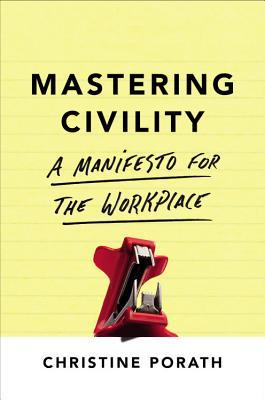
Author Christine Porath asserts that tolerating incivility in the workplace is a bad idea because it spreads like a virus. Once rudeness or intolerance enters the scene, it effects everyone it touches and can sink the ship causing everything from profit loss to poor job performance.
Throughout the book, Porath teaches the reader how to recognize incivility in oneself, how to assist coworkers in reforming poor behavior, and how to end working relationships with employees who either can’t or won’t toe the line. Sounding a clarion call for employers and employees alike, Porath rallies readers everywhere to join her in making the workplace civil again.
“Incivility usually arises not from malice but from ignorance. I started my research thinking that jerks out there were intentionally ruining workplaces; I now see that most bad behavior reflects a lack of self-awareness. We don’t want to hurt others, but we do.” pg 12. Until I read this book, I thought that too.
“…incivility has a way of pulling people off track and preventing them from doing their best. I’ve found this to be true in every study I’ve conducted. Even witnesses working around incivility take a hit.” pg 24.
I thought that was especially chilling because Porath ran a bunch of studies. “Many people think of rudeness as a self-contained experience, limited to one person or interaction. In truth, incivility is a virus that spreads, making the lives of everyone exposed to it more difficult. … Left unchecked, incivility can drag down an entire organization, making everyone less kind, less patient, less energetic, less fun- simply less.” pg 39.
Those are the don’ts. Here are a few do’s: “If you want to connect with your employee or team, lead with warmth. Most of us are in a hurry to prove our competence, but warmth contributes significantly more to other’s evaluations. .. It facilitates trust, information, and idea sharing.” pg 71
“… the single biggest complaint I hear from employees about their bosses is that they fail to tune in. Do yourself and others a favor: When you speak or meet with someone, put away your smartphone. Make others the priority.” pg 114. Amen.
I laughed when Porath suggested eating well, exercising, and getting enough sleep to help foster a civil atmosphere in the workplace. Common sense stuff, yes, but how many of us have lashed out because we’re “hangry”? Change starts with you so: eat breakfast, people.
The Optimistic Workplace is a complex but useful manual on how to shift the environment at work. Shawn Murphy talks about all aspects of business from the individual to management to all the levels in-between. There weren’t many surprises in these pages, but the advice was solid.
I knew that leadership was important to the overall vibe in the work space and Murphy does say that it’s important: “…your leadership style impacts climate by up to 70 percent. Think about that 70 percent. It’s mostly how you show up and interact with others that shapes the climate that influences your team’s performance.” pg 9 But, it isn’t the only thing that matters.
There are also ways in which the individual can change the work space. It all starts with greater self knowledge: “Workplace optimism thrives when people understand why they show up to work. Not only is the purpose and meaning of work important, but so, too, are the personal implications. … Personal expression through work is a major contributor to your employees’ well-being. Doing work that matters facilitates the expression of one’s talents.” pg 19 Makes sense. Know thyself does seem to be the foundation of most major life-changing movements.
“..the benefit to positively shaping the climate for your team is getting to know yourself better and discovering how to fulfill your own potential. You position yourself to love your work. In doing so, you set the tone and lead the way to help your employees realize their own potential and find greater meaning in their work and life.” pg 48 Sort of a trickle-down effect of optimistic workplace awesomeness.
Of all of the myriad of studies included in this book, my favorite was the study of “ikigai” : “Your health is linked to a sense of purpose in life, or, as the Japanese all it, ikigai. … A 2008 study in Japan by Toshimasa Sone and his colleagues sought to understand how, if at all, ikigai contributed to longevity in life. … Mortality risks were higher in those who did not have a sense of being and of joy. Those lacking clarity in intentional living had a higher incidence of cardiovascular disease and other life-threatening illnesses.” pg 89 Purpose or death.
The only critical thing I have to say about The Optimistic Workplace is that it’s so broad. Towards the end, I despaired of ever having the time to implement all of the changes suggested, even though they seem like good ones. My boss suggested that I take my favorites and start there. I think I will.
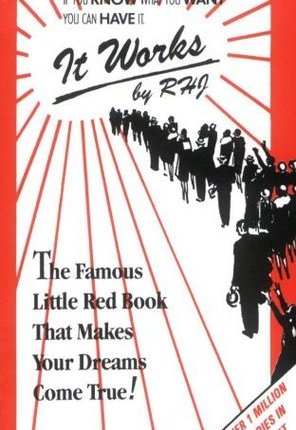
It Works by RHJ is a short book, pamphlet really, on the Law of Attraction. I was fortunate enough to pick up the deluxe version that not only had the text of the original work, but also a PDF of the way it appeared in its first printing.
A short chapter was also included that discussed the nearly-anonymous author.
I’ve read a lot of New Age/New Thought material, but I focused on this one because a certain loved one of mine is struggling. I won’t mention him by name because he says that I talk about him too much in my reviews, but suffice to say, I see him every day. Over a year and a half ago, he was laid off from a job that he enjoyed, had worked at for more than a decade, and he hasn’t found anything else yet to occupy his time. Part of the trouble, I think, is that he doesn’t know what he wants in a new occupation. It Works addresses that directly.
The mechanics of it are simple. Make a list of what you want, think about it every day, don’t tell anybody that you’re doing it. The assumption is that there is a force beyond our comprehension that responds to our thoughts and directs our lives based on what we choose to turn our thoughts towards.
The Abraham Hicks materials cover this in depth, but It Works was published in 1926, long before Abraham and The Secret burst into popular consciousness. This was, in fact, one of the first published books of its kind and even influenced the writings of that titan of new age thought, Napolean Hill.
To get what you want is no more mysterious or uncertain than the radio waves all around you. Tune in correctly and you get a perfect result…” pg 14.
“(Write down exactly what you want and the date you want it.) This may seem very foolish at first, but you can never realize your desires if you do not know positively and in detail what you want and when you want it. If you cannot decide this, you are not in earnest. You must be definite, and when you are, results will be surprising and almost unbelievable.” pg 20.
In a not too distant future, owning books is against the law. Firemen burn property instead of protect it and everyone is dialed in to their televisions, subsisting on a steady stream of sensational media stories and vapid entertainment to numb their quickly congealing brains. The nation is always at war, but you would never guess it from the populace’s empty conversations and emptier dreams. Guy Montag longs for something different, but what exactly, he can’t even say, until he meets a girl who wanders outside for fun and sees faces in the moon. He becomes convinced that what society has labeled as wrong and anti-social is more real than anything he’s experienced in a long time. However, these are dangerous thoughts. And, being a fireman, Guy knows, more than anyone, the price that is demanded of people who dare to think, read, and entertain original thoughts.
Fahrenheit 451 was shocking to me. Ray Bradbury predicted internet/social media addiction long before such things existed. He also called society’s horrifically shortened attention spans. Where once, we would have read through a novel or a long article, now we spend less than thirty seconds absorbing information before scrolling onwards to the next thing, then the next, and the next. (Goodreads friends excepted from the majority, of course.)
I listened to the audiobook version where Tim Robbins performed the narration. It was brilliant. He is a natural fit for this material and I highly recommend it.
The only annoying thing about listening to the audiobook is Bradbury’s use of repetition to build the tension and pound his ideas home. You’ll particularly notice it when the war planes fly overhead or when Guy gets into a big fight with his wife and she won’t turn off the television. It’s headache inducing but Bradbury certainly knows how to make a point.
This is one of those classics that I never got the chance to read in school, but I wish I had. I would have enjoyed this much more than Hard Times, which I managed to yawn my way through. Recommended for those who are disturbed by the shallowness of modern life and long for real connections with the people and world around them. The lessons that Bradbury teaches are still very applicable today and, as I said, shocking in their implications.
“Audrey Niffenegger’s dazzling debut is the story of Clare, a beautiful, strong-minded art student, and Henry, an adventuresome librarian, who have known each other since Clare was six and Henry was thirty-six, and were married when Clare was twenty-three and Henry thirty-one. Impossible but true, because Henry is one of the first people diagnosed with Chrono-Displacement Disorder: his genetic clock randomly resets and he finds himself misplaced in time, pulled to moments of emotional gravity from his life, past and future.”
Unpopular opinion time: I found the story to be quite different from that and have to say a big no thank you to The Time Traveler’s Wife.
To the legions of fans of this book, I’d like to know what you enjoyed about it. What did I miss? I see that it’s won a pile of awards and I just don’t get it.
I thought I was in for a sweet romance but all I got was a time traveler who cheated at the lottery, beat people up for clothes, and engaged in sexual hijinks with time traveling versions of himself.
I was completely creeped out by the fact that Henry is Clare’s best friend from the time that she was 6. She was groomed from that young age to be his wife, no matter that it wasn’t consummated until later. How awful is that.
When she is essentially date raped, she doesn’t go to the police, Clare goes to Henry who engages in some vigilante justice. It was horrible what happened to her, but she should have reported it to the authorities.
The yuck factor from a bunch of places absolutely ruined the book for me not to mention that fact that Clare never really had a childhood or life at all without Henry in it. That’s not romantic, it’s sad.
Anyway, my apologies if you loved it. Like I said, I am willing to consider other opinions on this book, I just really can’t recommend it.
Time for the hippie librarian to get a little New Age-y!
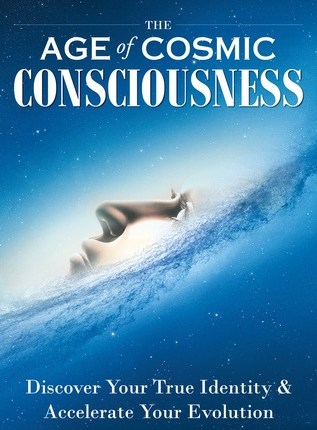
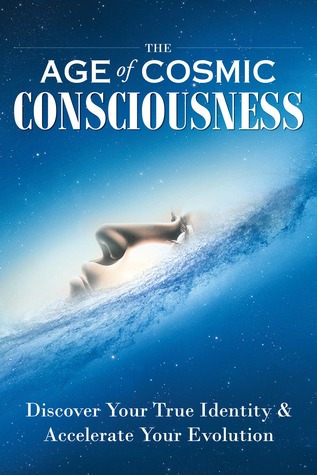
The Age of Cosmic Consciousness is a bunch of different metaphysical concepts strung together sort of like Ram Dass’ Be Here Now but written on regular paper instead of- I don’t know what that stuff is- let’s say brown paper bags.
The first thing to know about this book is that it is written in a flow of consciousness style. I found it very difficult to get into, but then hypnotic once I got reading, and thus it became difficult to put dow
. I found it similar to Kelly Howell’s Secret of the Universal Mind Meditation in that one idea leads to the next idea in a very natural and linear fashion.
A lot of the concepts in here have been covered by The Secret and various other authors. There’s a good bit about the Law of Attraction, but there’s so much more than that.
What I loved about this book can be summed up in this quote: “Do not overly focus on the inaccessible gurus and unapproachable enlightened people. Recognize and accept that a higher consciousness can be attained by anyone who proactively pursues its realization.” pg 136 I truly believe that enlightenment is for everyone and possible for everyone. This book really puts that idea forward.
That being said, I don’t know that I was prepared for the “other beings of light consciousness” mentioned in this book or the section that purports to have information directly from them but not “channeled”. Or the other section about aliens tampering with human DNA in the dawn of time. My inner self doesn’t necessarily “resonate” with those ideas yet, but some readers out there may feel it and understand it.







 In a not too distant future, owning books is against the law. Firemen burn property instead of protect it and everyone is dialed in to their televisions, subsisting on a steady stream of sensational media stories and vapid entertainment to numb their quickly congealing brains. The nation is always at war, but you would never guess it from the populace’s empty conversations and emptier dreams. Guy Montag longs for something different, but what exactly, he can’t even say, until he meets a girl who wanders outside for fun and sees faces in the moon. He becomes convinced that what society has labeled as wrong and anti-social is more real than anything he’s experienced in a long time. However, these are dangerous thoughts. And, being a fireman, Guy knows, more than anyone, the price that is demanded of people who dare to think, read, and entertain original thoughts.



 The Help Desk Book Blog