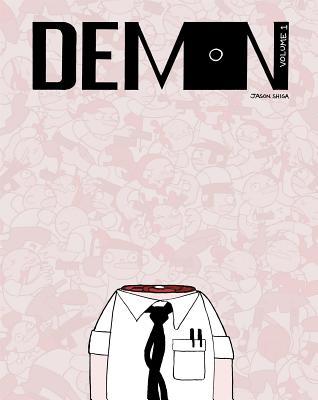
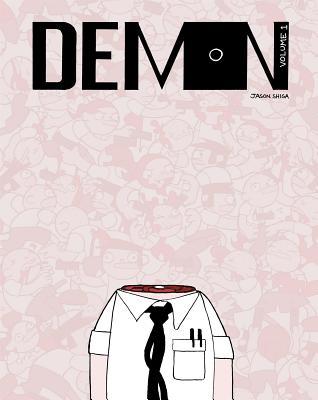
An edgy, simply-drawn comic about a man who tries to commit suicide, but keeps waking up alive. There’s an unexpected twist and lots of blood.
In the author’s own words: “From the suicide depicted on the first page of the story to the climactic bloodbath three volumes later, Demon is my gleeful homage to the lurid and pulpy entertainment rags that make up the detritus of our childhoods.” From the foreword.
I see what he was trying to do. It just wasn’t for me.
For Jason Shiga, this was a very personal work: “Ultimately, Jimmy is me. When he leaps in front of a semi-trailer, it’s really me who secretly wants to do that. When he acts in a deliberately amoral and antisocial manner, that’s me, too.” From the foreword.
Shiga warns readers from the start that Demon is crass and graphically violent. And, it is.
Secrets of Meditation is one of the clearest and beginner friendly meditation manuals that I’ve ever read.
Davidji breaks practices down not only into type and step-by-step instructions with examples, but also by lineage and development over time and place.
Davidji provides enough background on himself to establish his bona fides but not so much as to overpower the instruction with meaningless chatter about himself.
He intersperses the text with helpful advice, additional authors to explore, and a myriad of ways to connect with him online for some meditation freebies.
Though it’s clear that he’s immersed himself in Eastern culture and practices (having traveled extensively in the East and studied under various gurus), Davidji hasn’t adopted an insider’s way of talking about meditation.
Sometimes, and maybe this is just me, it feels like meditation instructors go so far out into the “oneness” that they never come back fully into the real world. That’s not Davidji at all. I loved this text mainly because of how he could keep one foot “over there” and the other firmly planted “back here”.
Admittedly, my daily meditation practice has lately fallen somewhat on my priority list. This book makes me want to head back to the mat.
And also, Seeking Heaven. Eben Alexander is a neurosurgeon who had a near death experience turned it into guided meditations. I think they’re easy enough for beginners to use.
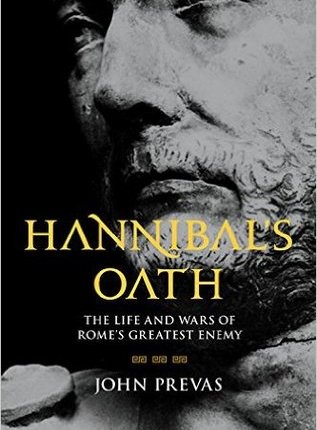
A fascinating and true study of Hannibal, one of ancient Rome’s greatest enemies, a brilliant general and, according to John Prevas, a “larger-than-life action hero from the past.”
Prevas did the translations from period and later documents, historical research and traveled to the places where Hannibal went, to create one of the most insightful, non-fiction examinations of Hannibal that I’ve ever read.
It all started with Hannibal’s father, Hamilcar. “Hamilcar was furious at what he saw as Roman bad faith, but powerless to intervene at the moment, he chose to bide his time and find another way to even the score.” loc 290, ebook.
Spoiler alert (if you don’t know ancient history): Hamilcar had a bunch of kids and made them swear to destroy Rome. The boys, he groomed as warriors; the girls, he married off advantageously to help his sons.
“As the rituals neared completion, Hamilcar called for Hannibal, then only nine years of age, to join him at the altar. There, the young boy begged his father to take him to Spain, and Hamilcar consented on the condition that Hannibal pledge to the god he would always be an enemy to Rome and to anyone who stood with Rome.” loc 323, ebook. No pressure or anything.
The Barcas, Hamilcar’s family, create a foothold in Spain. It is from there, that Hannibal will eventually attack the Romans by, famously, crossing the Alps- with elephants in tow.
Anything to do with Hannibal’s elephants were my favorite parts of this book. “The elephants were often plied with wine before battle to stimulate their aggression, and while the wine might have done that to some degree, it also seems to have contributed to their tendency to panic and then rampage during the mayhem of the fighting.” loc 713, ebook.
Drunk, rampaging elephants! It doesn’t get much more dramatic than that.
Though written more like a textbook than a historical fiction (which is my favorite way to learn about history), I still learned a lot from Hannibal’s Oath and enjoyed it.
Recommended for classic majors, elephant lovers and fans of ancient history.
Reminder: the short quotations I cited in this review may change in the final printed version. Thank you to NetGalley and Da Capo Press for a free advance reader’s copy of this book.
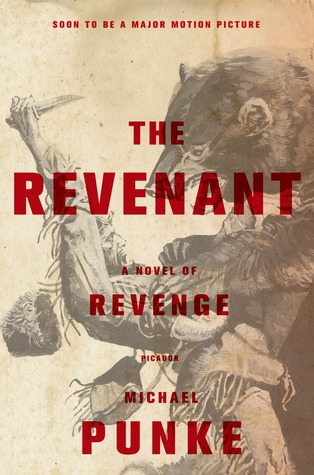
The Revenant is a fictional tale based on the real life account of Hugh Glass, a trapper who was attacked by a grizzly bear and then left for dead by the men who had been left to care for him.
This story is so gripping. From the explosive opening moments until the very last page, the reader is practically swept up into the action.
Not only are the men in The Revenant struggling with each other, but Nature herself has a huge role in this survival tale. If the characters aren’t freezing, they’re starving or looking for a safe place to sleep.
This is a particularly excellent read for a cold winter night with a cup of something hot to drink near your elbow.
This would have been a five star read except for the ridiculously unsatisfying conclusion.
It felt like The Revenant suddenly turned from a survival/adventure/revenge story into a tame morality play.
I realize that it is a morality play the whole time, but with all the action and nail-biting tension, it doesn’t “feel” like one until the ending- which I won’t ruin for you, except to say that it was very lame.
My husband read a version of this story called Lord Grizzly when he was in college so, while I was into this one, we were comparing notes on the differences between the two works.
Although varying in small details, the major arcs were the same. I felt as if The Revenant did a better job of building the tension than Lord Grizzly but we both agreed that the ending to the story (in both books) was a let-down.
If you enjoyed reading The Revenant, you may enjoy The Knife of Never Letting Go. Though not based on a true story, it shares the traveling-through-the-wilderness feel and tension of this book.
I received a free copy of this book through Goodreads First Reads. FTC guidelines: check!
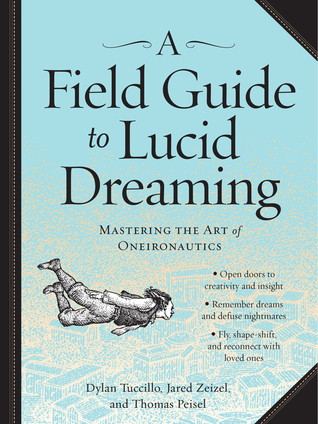
An excellent guide to experiencing or deepening lucid dreams, A Field Guide to Lucid Dreaming is filled with tips, tricks and advice to explore your dream world.
My husband and daughter experience lucid dreams all the time and I don’t or, at least, haven’t yet. It’s embarrassing.
It’s as if they have access to worlds that I can only dream about, literally. I picked this book up because I wanted to develop this skill too.
So far, with the advice contained within this Field Guide, I’ve realized that I was dreaming once, became lucid and immediately woke up. But, that’s progress.
I’m encouraged actually. If I can go lucid once, I can do it again.
“Lucid dreaming is the ability to know you’re dreaming while you’re dreaming. A lucid dreamer is able to go to sleep at night and wake up within his or her dream. With this unique awareness, you can generally behave like someone who is awake, exercising the free will, imagination, and memory of waking life.” introduction. How fun would that be?
Ever wanted to fly? Face your nightmares? Talk to a deceased loved one? The authors of this book claim that it is all possible.
They addressed some of my problems directly: “Quite often, the amateur lucid dreamer’s early exploits in lucidity last only a few moments. If you’ve become lucid already but lost your awareness very quickly, don’t worry. This is common. In the next chapter we’ll look at ways in which you can stabilize the dream and stay lucid for long stretches of time.” pg 106.
Practice makes perfect, it seems.
The shamanistic beliefs about the dream world are intriguing:“…shamans of indigenous cultures understood that in order for something to be created in the physical world (such as that kitchen you’ve been meaning to remodel, or this book), it must first be constructed in the “imaginal realm.” In other words, lucid dreaming might be a tool in creating our physical reality.”pg 151.
Life is like a dream and we are the dreamers, whether asleep or awake:“This world can be a nightmare or a nice dream. It’s full of friends or enemies, success or failure, meaning or nihilism. We’re headed toward destruction or we’re headed toward rebirth. There are many viewpoints on Earth as there are people. And just like the dream, we shape our experience with our thoughts, emotions, and expectations. pg 246.
Recommended for anyone who, like me, wants to master lucid dreaming. I think that this book will help you find your way.
Memoirs can drag on and become self-indulgent and ridiculous. I feel like that was a problem with The Art of Asking.
The tipping point for me was when she formed The Dresden Dolls with her friend and said (I’m quoting from memory here since I was listening to the audiobook): “I finally had the strongly emoting band I’d always dreamed of” or something like that.
I realized, I was strongly emoting on this book, but not in a good way.
I understand her internal struggles in forming a relationship with Neil Gaiman must have been difficult for her, but her “should I date him, he’s older and richer and more famous than me” just came off as silly and very first-world problems.
I get that she loves her fans, her art, her lifestyle- but it just come together to make a read that I enjoyed.
My apologies to her fans. If it helps, my favorite parts of the audiobook were the songs she put between some of the tracks. Those were actually pretty awesome.
And the over-arching theme of The Art of Asking was good too.
Society isn’t comfortable with asking. We don’t know how to do it, don’t feel comfortable with it and it prevents people from making the art that they were born to make.
You can get that part of this book by watching Palmer’s TED talk. Maybe you should do that instead of reading this.
The Woman I Wanted to Be is the life story of the incomparable Diane Von Furstenberg.
She starts with her parents’ harrowing early life in war-torn Europe and continues through her own tumultuous love affairs and child-rearing years.
After a personal first half, the second half of her book is dedicated to how she entered and eventually became a living icon in the world of fashion.
I really enjoyed this book.
In an era where the media glorifies women who show off their bodies, cling to powerful men, and descend into drug addictions, Diane personifies the empowered woman who shows what she can do and build rather than living on how she looks or scandal.
That’s not to say that Diane hasn’t had a wild life, she has, but she owns it, has evolved from it and built it into an empire.
There are many moments in The Woman I Wanted to Be where Diane failed to be that woman. But instead of becoming mired in failure (she had to sell her business two separate times to avoid bankruptcy), she persevered to become a household name.
At another point, she gave up her identity and her business to spend time with a man who wanted her to be a blank slate. He ended up leaving her for someone else.
Diane didn’t crawl into a hole and wilt then either. With grace and dignity, she re-entered life and the fashion world. Diane went on to experience an even greater level of success than she had before her exit.
Diane provides some great general advice for life such as: when bad things happen, they can actually be good things.
Also, never play the victim- take responsibility for your life.
These philosophies have enabled Diane to rise above any obstacles that have appeared in her path. She is an excellent role model and it was such fun to read about her incredibly exciting and almost unbelievably successful life.
It’s far more glamorous than either of those two selections, but the underlying themes of female empowerment and reaching for the life of your dreams despite all the odds, are the same.
I received a free copy of this book through Goodreads First Reads. FTC guidelines: check! Thanks for reading!
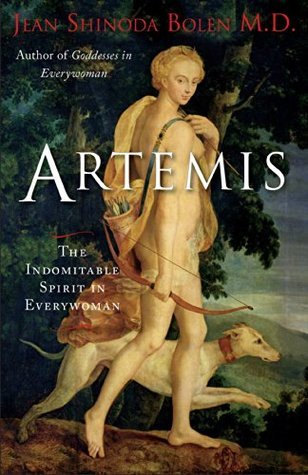
In Artemis, Jean Bolen discusses the importance of archetypes and mythological stories. She asserts that we don’t just enjoy the stories for their entertainment value- we respond to the psychological truths contained between the lines.
I’ve always enjoyed academic discussions of mythological tales. I never really knew why though until I read this book.
The meanings of mythology are so layered that our conscious minds may not even know that our subconscious minds are latching onto the veiled truths. We love them without realizing their importance.
Artemis: The Indomitable Spirit in Everywoman contains an intricate dissection of the tale of Atalanta, a mortal whose life paralleled the goddess, Artemis, in many ways.
I think I had been exposed to this tale in a classical mythology course in college, but the complex Jungian psychology that goes along with it wasn’t explained to this extent. Bolen’s explanation of the myth is masterful.
One archetype in particular that I enjoyed learning about was Selene/Endymion. Sometimes, in the frantic growth to adulthood, one can feel alone in their struggles and inner landscape.
I’ve known so many girls (myself included) who were living that pattern but they didn’t even know it. Bolen’s explanation of the motivations and the potential growth that can accompany this life pattern was enlightening as well as encouraging.
Bolen ties humanity together through shared experiences and mythologies. She makes the reader feel that, no matter what they have gone through, they are not and have never been alone. It’s a very empowering message.
My minor in classics covered much that was discussed in this book but the feminist lens that was applied to the mythologies was very unique and different from what I have learned in the past.
In addition to the myths, Bolen includes contemporary fictional heroines as well as real life figures who embody the archetypes. I liked that she traveled beyond the boundary of the tales to apply the energies to real life.
Young women who aspire to embody the vision of Artemis in all of her variations in their own life will find many examples to emulate within these pages.
I enjoyed this quite a lot. I haven’t read Bolen’s Goddesses in Everywoman but this book makes me want to dive into it.
I’d recommend this book to anyone who’s interested in Jungian psychology, mythology or the elevation of the human spirit.
I received a free copy of this book through Goodreads First Reads. FTC guidelines: check!
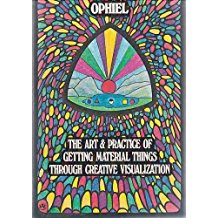
Originally published in 1967, the Art and Practice of Getting Material Things Through Creative Visualization arrived nearly three decades before The Secret.
With more of an occult than a New Age twist, the one-name author, Ophiel, talks readers through what is essentially the Law of Attraction, but he never calls it that.
Ophiel tends to write portions of the book that he thinks are most important in all caps. LIKE THIS. It can be annoying.
Another interesting quirk, Ophiel talks about him/herself in the third person, at all times.
In this passage, he’s talking about why he wrote this book, and you get to see the author’s style in action: “Ophiel’s defect consists of not being about to accept self-styled prophets’ sayings, and teachings, without raising the following awkward question- and making the following embarrassing test. The question is IS WHAT THEY SAY TRUE? and the test is DOES WHAT THEY SAY WORK, AND PRODUCE RESULTS? And if what they SAY DOES NOT WORK THEN IT IS NOT TRUE, and into the garbage can with it!!” pg iii
Ophiel claims that creative visualization techniques don’t always work for a variety of reasons. He gives the reader exercises and suggestions for improving their results.
“In Creative Visualization work all the planes involved in our cosmic existence are used, the Etheric, the Lower Astral, The Higher Astral, the Mental Plane, and the Causal Plane, AND ALL THESE PLANES HAVE DEFINITE RULES AND LAWS FROM WHICH THEY WILL NOT DEVIATE ONE IOTA.” pg 5.
He also has interesting ideas about reasons why beginners fail out of the gate.
He cites something called “the sphere of availability”: “The new student then proceeds to visualize for LARGE THINGS. BIG THINGS. VALUABLE THINGS. Things that are far beyond his ability- not to visualize-imagine-desire, BUT FAR BEYOND HIS PRESENT ABILITY TO DEMONSTRATE-VISUALIZE.” pg 31.
Ophiel uses different words, but essentially he says, start small, celebrate the small victories and increase your “sphere of availability” in that manner. He also gives practices to improve your visualization skills.
Honestly, if asked to recommend a teacher for creative visualization, I’d say skip Ophiel and read Abraham Hicks. They’re a lot more fun.
 An edgy, simply-drawn comic about a man who tries to commit suicide, but keeps waking up alive. There’s an unexpected twist and lots of blood.
















 The Help Desk Book Blog