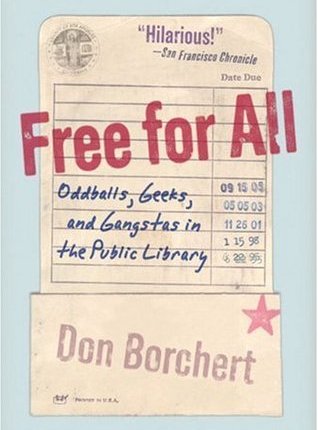
Free for All: Oddballs, Geeks, and Gangstas in the Public Library by Don Borchert

Free for All: Oddballs, Geeks, and Gangstas in the Public Library by Don Borchert

Free for All is an accurate depiction of life as a librarian in a public library.

Sometimes, the job is funny. Other times, it’s incredibly sad. If you’ve never worked in a library system, this book will reveal some of the secrets of a librarian’s day-to-day life.

Photo by Pixabay on Pexels.com

Before I worked at a public library, I thought it was a quiet, organized mecca for students and bookworms. Now, that I’ve spent some time on the librarian-side of the desk, I know better. My idea of a library was far too simple.

It is a study hall, archive, playroom, home for the homeless, kitchen, bank, movie theater, video game store, newspaper kiosk and so much more. I guess the appropriate question is: what doesn’t a library do?

And a public librarian is so much more than just a librarian. She is a counselor, a computer wizard, a curator of excellent and free entertainment.

She talks to the lonely, uplifts the lost and helps the public navigate the dangerous waters of the internet.

Librarians are my heroes.

Photo by Element5 Digital on Pexels.com

If I ever cease writing for a living, look for me at the library. Odds are, I’ll end up back there.

Perhaps some of the policies at Don Borchert’s library have changed, but at the time that he wrote this book, they charged 50 cents to put a hold in for a patron. This policy shocked me, as my library always offered that service for free.

Borchert cheerfully documents the difficulties with summer reading people vs the school year regulars. It’s a real problem.

If Borchert’s book is too edgy for you- he uses rough language and doesn’t hold back on some of his opinions- read Gina Sheridan’s I Work at a Public Library: A Collection of Crazy Stories from the Stacks.

Both are excellent and realistic non-fiction books about the trials, tribulations, and, sometimes, life-enhancing satisfaction of working at the library.

Thanks for reading!

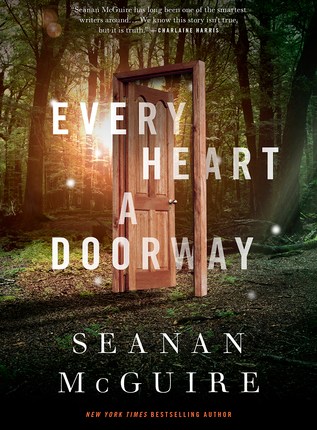
Every Heart a Doorway (Wayward Children #1) by Seanan McGuire

Every Heart a Doorway (Wayward Children #1) by Seanan McGuire

everyheartWhat if children actually fell into other worlds, like Alice in Wonderland or the Pevensies into Narnia, far more often than anyone realized? What if those worlds were superior in every way to the normal, mundane world- not in that they were in heaven, but the child felt finally at home?

And what if those worlds cast the children out, to live in the “real world” again? It might not be a pretty picture.

That is why Eleanor West started a home for children who went away, came back and didn’t belong anymore. All of those reasons, but also, because she went away once too.

“Eleanor West spent her days giving them what she had never had, and hoped that someday, it would be enough to pay her passage back to the place where she belonged.” pg 13.

I loved the basic premise of this story. All of the worlds the children went to were so different, but the fact that the worlds were “other,” tied them altogether.

“‘Real’ is a four-letter world, and I’ll thank you to use it as little as possible while you live under my roof.” pg 20

This story has the drama of a bunch of misfit children all trying to get along, but also the mystery of these other worlds. There’s also a deeper mystery that develops when one of the children seems determined to find a way home- at any cost.

“You will not all find your doors again. Some doors really do appear only once, the consequence of some strange convergence that we can’t predict or re-create. They’re drawn by need and by sympathy. Not the emotion- the resonance of one thing to another. There’s a reason you were all pulled into the worlds that suited you so well.” pg 97

I was concerned when I started this book that it would be too much like Miss Peregrine’s Home for Peculiar Children. That was a needless concern.

They are similar in that both contain orphanages for extraordinary children and fantasy has a large part in the story. But that was where I felt the similarities ended.

I also found myself wishing that Every Heart a Doorway was written for adults rather than young adults. This was a fairytale that could have used some darker twists to it.

Seanan McGuire didn’t make this story all rainbows and gumdrops, but I would have liked it to be edgier.

I loved the “longing to belong” feeling McGuire wove into the book. It seems to me to be a quintessential teenage feeling, but I suppose everyone wants to feel completely at home- whatever that might mean.

For some people, that longing is attached to a place, another person, or to the drug addict, it’s the next hit. Other people crave a moment in time, or a particular period in their life.

I would say, on second consideration, “longing to belong” is perhaps the human condition itself.

Recommended for fans of Miss Peregrine’s Home for Peculiar Children. If you’re looking for a darker, more adult fairytale, I’d recommend The Magicians by Lev Grossman.

Thanks for reading!

The Book of Speculation by Erika Swyler

The Book of Speculation by Erika Swyler

Simon works in the reference section at a struggling library in Maine, whose biggest draw is a whaling archive. He’s hard up for money and his historic home on the coast is in such disrepair that it’s about to fall into the ocean.

One day, Simon receives a very old book in the mail. Strangely, it has some of his family member’s names in it.

Photo by Suzy Hazelwood on Pexels.com

The text describes a circus, a boy who can’t speak, and a girl who can hold her breath so long that they call her a mermaid.

But, what does this have to do with his family? And why do so many of the people in the book die on the same day?

In addition to the mystery, The Book of Speculation includes one or two love stories: “Redheaded and pretty, Alice has her father’s smile and a way with kids. She’s better with people than I am, which is why she handles programming and I’m in reference.”pg 9, ebook.

Photo by Maycon Marmo on Pexels.com

I did not like how the reference section was stereotypically depicted as the “bad with people” part of the library. I have a soft spot in my heart for those reference types, having been one myself in my previous job. 🙂

Also, for being a librarian, Simon doesn’t act very librarian-y.

Take this part when he receives the mysterious book: “The box contains a good-sized book, carefully wrapped. .. A small shock runs through me. It’s very old, not a book to be handled with naked fingers, but seeing as it’s already ruined, I give in to the quiet thrill of touching something with history.” pg 15.

Photo by cottonbro on Pexels.com

No self-respecting archivist would do that. “Already ruined” so who cares? I don’t think so.

The fantasy/magic portions of this book are subtle and written so that one could almost believe that it was real.

Take Amos’ (one of the characters from the old book) ability to disappear: “People may live for a century without discovering the secret of vanishing. The boy found it because he was free to listen to the ground humming, the subtle moving of soil, and the breathing of water- a whisper barely discernible over the sound of a heartbeat. Water was the key.” pg 18 ebook.

Photo by Jess Vide on Pexels.com

The history recorded in the old book is revealed to the reader through a series of flashbacks. That bothered some of my friends on Goodreads but the circus folk stories are my favorite parts of this book.

The characterizations are ok, nothing extraordinary.

My favorite minor character, Benno, could have used more fleshing out: “After a time Benno climbed down from the wagon. “You are my friend and you are kind,” he said quietly. “More than is good. I was taught to watch for gentle souls, as they’ve not the wit to look after themselves.” pg 124, ebook.

Some similar reads (perhaps a bit more magical than this): The Golem and the JinniMagonia or The Mermaid’s Sister.

Thanks for reading!

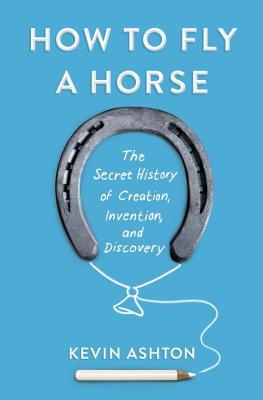
How to Fly a Horse: The Secret History of Creation, Invention, and Discovery by Kevin Ashton

How to Fly a Horse: The Secret History of Creation, Invention, and Discovery by Kevin Ashton

How to Fly a Horse takes many of the myths that I believed about creativity or the creative process and methodically takes them apart. Any perceived blocks are revealed for the fallacies that they are.

It is one of those great non-fiction books that educates the reader while simultaneously encouraging her to improve herself.

From the creation of a South Park episode to Coca-Cola, Kevin Ashton covers all sorts of ways the average person can, does, and should contribute to mankind through her own, innate creativity.

My biggest take-aways from this are Ashton’s descriptions and appropriateness of creativity (or lack of) within organizations. He writes about humanity’s need for the new while simultaneously pushing against it.

Here’s a quote about organizations that could be applied to any work place: “Organizations are made of rituals- millions of small, moments-long transactions between individuals within groups- and it is these rituals that determine how much an organization creates.” pg 225

Photo by Marc Mueller on Pexels.com

Be aware of these rituals and harness them to be more creative.

And, on humanity’s propensity to reject innovation, Ashton explains this is not unusual but is actually the normal response to expect when introducing new ideas into your work environment.

Don’t be discouraged; be prepared. Create anyway.

Photo by Pixabay on Pexels.com

I liked that he encouraged creation while also illuminating the many pitfalls, both internal and external, that one may encounter along the creative path.

Folks who enjoy How to Fly a Horse may also like Leonardo’s Brain: Understanding da Vinci’s Creative Genius or any of Malcolm Gladwell’s books. If you’re looking for another book about how to be more productive or creative in the workplace, I suggest Linchpin: Are You Indispensable?.

I received a free copy of this book through Goodreads First Reads. FTC guidelines: check!

Thanks for reading.

You Do You: How to Be Who You Are and Use What You’ve Got to Get What You Want by Sarah Knight

You Do You: How to Be Who You Are and Use What You’ve Got to Get What You Want by Sarah Knight

The self-styled “anti-guru” Sarah Knight adds another volume to her quirky, profanity-laden self-help series with You Do You.

The focus, as you can guess from the title, is the art of allowing your authentic self to shine through without feeling guilt or being so far out of the social norms that you border on “psychopath.”

You Do You is about accepting your strengths and your flaws, whether those flaws are self-identified, or just things that you’re perfectly happy about but that other people seem to have a problem with. Or, should I say, that you WOULD be happy about, if you felt a little more confident in yourself…” loc 146, ebook.

Photo by Kat Jayne on Pexels.com

And, like the previous books, Knight doesn’t stint on the bad words. She admits she kept the title clean so a certain publication *cough* New York Times *cough* would print the all the words of the title in their sought after Best Seller list.

Which Knight has made before… but had her titles censored for their content.

“The advice in this book boils down to one simple mantra: Stand up for who you are and what you want. How do you do that? Stop letting other people tell you what to do, how to do it, or why it can’t be done.” loc 188, ebook.

I enjoyed You Do You, but I felt it wasn’t as strong as Knight’s other titles because she spends so much time rehashing material she has already covered elsewhere.

That being said, I like Knight’s style, her famous diagrams and her illuminating stories. This is an author who has been there, done that and cussed about it.

Photo by Anna Nekrashevich on Pexels.com

My favorite diagram in You Do You is Knight’s “ouroboros” or symbolic, conjoined serpent of wisdom picture. The text with the cute doodle says: “Is it right or wrong? You won’t know unless you have the confidence to take a risk and find out. If you regret your decision, then accept the consequences, swallow the lesson, and start over. With confidence.” loc 1995, ebook.

Verges on mystic Eastern wisdom, doesn’t it?

She encourages all readers everywhere to let the strange sides of yourself out- within certain boundaries. Don’t hurt anybody. Don’t take advantage of people. Be reasonable within your freakishness.

“Now, with those ground rules established, I do declare that we, as a society, should celebrate weirdness in all its forms- and that the right to be weird should be inalienable- just like the right to life, liberty, and the pursuit of happiness.” loc 2130, ebook.

Photo by Gratisography on Pexels.com

“You do you” and let everybody else do them. It’s that simple. It’s that hard.

Sarah Knight may be a bit of an acquired taste. Please don’t read unless you have a high tolerance for bad words and, dare I say, mild snark.

But, if you are someone in need of encouragement to let your freak flag fly, look no further.

Thank you to NetGalley and Little Brown and Company for a free digital copy of this book. And thank you for reading!

Read my reviews of Sarah Knight’s other titles:

The Life Changing Magic of Not Giving a F*ck by Sarah Knight

Get Your Sh*t Together by Sarah Knight

Kraken by China Miéville

Kraken by China Miéville

A book review of Kraken by China Miéville.

Kraken is a complex urban fantasy about a missing squid, an astonishing large cast of characters and the end of the world – in no particular order.

Photo by Anni Roenkae on Pexels.com

China Miéville is an incredibly imaginative author. In this story, he has created a half dozen separate religions with their own gods and customs. (Hundreds more are hinted at.) Not content with that, he also created magic of all kinds, a strike by familiars, protective London-based angels and a supernatural police force.

And that’s just the tip of the storytelling iceberg.

I would put forth the argument that he is one of the most inventive authors I’ve ever read.

That being said, I wanted more story and less world building.

Miéville has a cadence to his storytelling. Just when I thought the next important point in the plot would be revealed, he’d unveil a new character. It started to become annoying rather than astonishing.

Photo by Yura Forrat on Pexels.com

The pace of Kraken is slow, so slow. But, for readers who enjoy a complex setup and completely unexpected reveal, this may be the read for you.

Personally, I like my stories to move at a faster clip.

There’s also a good bit of coarse language in Kraken. I’m not the most sensitive person in the world, but it did grate my ears at times. Consider yourself warned.

My absolute favorite character, out of the legions to choose from, is Wati. It’s not just for his unique premise either, which is incredibly inventive. (Another tip of the hat to Miéville.)

Photo by Allan Mas on Pexels.com

Wati has so much heart. He fearlessly goes where others can’t or won’t, putting himself in danger for his friends.

And Miéville certainly takes the time to build his characters. That is his absolute strength – world and character building.

Recommended for readers who enjoy complexity and stunningly fantastical worlds, and who have the patience to thoroughly savor all of it.

Thanks for reading!

Life Is Like a Musical: How Broadway Can Help You Live Your Best Life by Tim Federle

Life Is Like a Musical: How Broadway Can Help You Live Your Best Life by Tim Federle

Life is Like a Musical is a cute, self-helpish book, full of the wisdom Tim Federle gleaned from years of experience on the stage.

“Basically, think of this book as ‘Don’t Sweat the Small Stuff’ with jazz hands.” Introduction.

Photo by Anastasiya Gepp on Pexels.com

Tim’s advice is common sense, but I appreciated it anyway. Make your weaknesses your strengths. Be nice to everybody. Pay attention. Don’t try to be a perfectionist, and so on.

He pairs these nuggets with his life stories. So, it’s part-memoir, part-self help.

“When Bob Fosse had a bald spot, he put on a stylish hat. Where’s your bald spot? Or blind spot? Or thing that you can barely accept about yourself? Go put a hat on it, and make it something wonderful.” pg 23. There’s nothing wrong with advice like that.

Photo by cottonbro on Pexels.com

First off, the key to approximately 90 percent of adulthood is appearing more interested in something than you actually are. Seriously.” pg 31.

Truth bombs, people.

Don’t give your power away. Remember who you are: “Please, never forget you’re the leading character in your own life. Read that sentence again: You aren’t the supporting cast. You’re it, baby.” pg 48.

And most importantly of all, have a sense of humor about the whole thing.

“Forgive yourself when you screw up. Develop a sense of humor that allows you to snort-giggle before anyone else can.” pg 139.

Photo by Tim Mossholder on Pexels.com

None of us are getting out of this thing called life alive. We may as well make the most of it.

I enjoyed this book. I was also a huge fan of his drink recipe book mixed with classic book titles: Tequila Mockingbird: Cocktails with a Literary Twist.

Recommended for people who are looking for a peppy voice to get them back on track and singing throughout the soundtrack of their own lives. This read will do the trick.

Thanks for reading!

I See You by Clare Mackintosh

I See You by Clare Mackintosh

I See You is a tense thriller with fairly good execution that stumbles on its ending.

It takes place in London. The scary parts mainly take place on the public transport system.

“…I don’t know how you do this every day.” “You get used to it,” I say, although you don’t so much get used to it as simply put up with it. Standing up on a cramped, malodorous train is part and parcel of working in London.” pg 42.

Photo by Jean-Paul Wright from Pexels

Zoe Walker sees her photo, or what she believes is her photo, in the papers on her way to work. It’s weird and scary because she didn’t submit her photo to the press.

“Routine is comforting to you. It’s familiar, reassuring. Routine makes you feel safe. Routine will kill you.” pg 51.

Kelly is a member of the police. She has secrets in her past and reasons to prove herself.

“Kelly thought of all the crime prevention initiatives she’d seen rolled out over her nine years in the job. Poster campaigns, leaflet drops, attack alarms, education programs… Yet it was far simpler than that; they just had to listen to victims. Believe them.” pg 83.

Photo by sum+it from Pexels

When Zoe comes to Kelly with her concerns and her photo in the paper, she sounds crazy. But she finds a sympathetic ear with Kelly.

Can they figure out what is going on before its too late?

I read this title for book club. And even though I was disappointed in the ending, this story scared me. It also scared some members of the club.

I was frightened partly because I don’t usually read this type of book. But, it also felt so real to me.

Photo by Lennart Wittstock from Pexels

We are creatures of habit, after all. It certainly made me consider taking a different route to work. You never know who could be watching…

Recommended for brave readers who don’t shy away from unsatisfying endings. Thanks for reading!

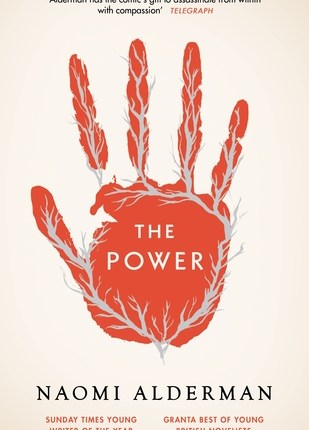
The Power by Naomi Alderman

The Power by Naomi Alderman

In The Power, young women have developed the ability to control electricity. It shifts the balance of power between the sexes and the world begins to come apart at the seams.

It is told from the point of view of a few women and a man. They each have different stories and experiences that Naomi Alderman blends together to create a powerful statement about how we live.

Photo by Sora Shimazaki on Pexels.com

This is one of the most disturbing books I’ve ever read, but also, most brilliant. It made me think about all of the internal biases I have when it comes to gender, cultural expectations and roles.

Who was it who said: “Absolute power corrupts absolutely.” This book is an examination of power and how it has shaped the world, not always for the better.

The monumental societal shift starts out small enough. A man named Tunde captures a moment between a young woman and a man who was hitting on her at the grocery store: “Tunde is recording when she turns around. … There she is, bringing her hand to his arm when he smiles and thinks she is performing mock-fury for his amusement. If you pause the video for a moment at this point, you can see the charge jump.” loc 261, ebook.

Those who have been abused are more likely to become abusers. And there are many, many abused women in the world.

“A strange new kind of fighting which leaves boys- mostly boys, sometimes girls- breathless and twitching, with scars like unfurling leaves winding up their arms or legs or across the soft flesh of their middles. Their first thought after disease is a new weapon, something these kids are bringing into school, but as the first week trickles into the second they know that’s not it.” loc 316, ebook.

Photo by Pixabay on Pexels.com

Entire governments crumble to powerful women. Women who have been locked up their entire lives roam the streets, free. Soon enough, they’re locking up and abusing the men, because they can.

Religions change. Sexual predilections change. New politicians are elected. New soldiers are trained.

“Allie thinks, God is telling the world that there is to be a new order. That the old way is overturned. The old centuries are done.”loc 681, ebook.

The new scourge of third world countries are powerful, uncontrolled women.

“He wounds three of the women in the leg or arm and the others are on him like a tide. There is a sound like eggs frying. When Tunde gets close enough to show what has been done, he is perfectly still, the twisted-vine marks across his face and neck so thick that his features are barely discernible.” loc 884, ebook.

Photo by tugay aydu0131n on Pexels.com

I think book clubs may find plenty to talk about in this book- if they can make it through. There are some very disturbing scenes.

“Gender is a shell game. What is a man? Whatever a woman isn’t. What is a woman? Whatever a man is not. Tap on it and it’s hollow. Look under the shells: it’s not there.” loc 4780, ebook.

In a time when so many women may feel powerless or voiceless, The Power may speak directly to them. It is, as I’ve said, a disturbing book, but also a conversation starter.

To quote Victor Hugo: Nothing is as powerful as an idea whose time has come. And, in my mind, it was the perfect time for this book to be written.

Thank you to NetGalley for a free digital copy of this book and thanks for reading.