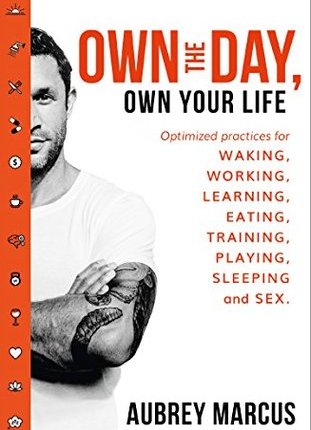
Own the Day, Own Your Life: Optimised practices for waking, working, learning, eating, training, playing, sleeping and sex by Aubrey Marcus

Own the Day, Own Your Life: Optimised practices for waking, working, learning, eating, training, playing, sleeping and sex by Aubrey Marcus

Aubrey Marcus shares different life hacks in an effort to improve your day. Because, as he reminds us: “To live one day well is the same as to live ten thousand days well. To master twenty-four hours is to master your life.” pg 7, ebook

There’s not a lot of new information here, especially not for aficionados of the self help genre. But there are some interesting strategies to try that I enjoyed.

One is to use your commute time to listen to a book or a podcast. As Aubrey points out, if you’re going to be spending the time anyway, you may as well use it to invest in yourself.

“These minutes are precious things. They are the only currency we spend every day whose value fluctuates wildly. Spend your minutes investing in your future self, filling your emotional coffers, and building value and enjoyment, or spend minutes depleting your emotional bank account.” pg 82, ebook

Photo by Stas Knop on Pexels.com

Nothing new, as I said, and also it doesn’t take too much encouragement to get me to read. 🙂 But for anybody who hasn’t tried it yet, I highly recommend incorporating this into your morning commute.

Another strategy suggested in Own the Day, Own Your Life that I attempted to hilarious, yet effective, results was a method for waking yourself up. Basically, you practice deep breathing and then stand under cold water in your shower.

The basic principle behind it, if I understand it correctly, is that our bodies have evolved to handle stress in ways that are completely outdated in the modern world. We react to an emotional email or digital comment as if a tiger was running at us. But it’s not.

All of those chemicals go into us and have no where to go, leading to chronic stress and all of the symptoms that go along with that. The deep breathing and cold water cause a stress reaction too, but it’s one that you control and can switch off at will. The exposure teaches your body how to handle it when you can’t switch it off.

Photo by Gratisography on Pexels.com

In addition to these other supposed benefits, it wakes you the heck up. I can vouch for that. Come on, Heidi, I can hear you say. You really needed a book to tell you to take a cold shower? Well, apparently I did. And that part really works as promised.

If you’ve already got your diet and exercise routines locked down, you’re already well on your way to living your best life and probably don’t need this book. But, for anybody looking for a few pointers or are willing to try new things, this could be the book you’re looking for.

The Song of Achilles by Madeline Miller

The Song of Achilles by Madeline Miller

Madeline Miller brings her incomparable talent for rewriting ancient myths for the modern audience to the tale of the Greek hero, Achilles, and his lover, Patroclus.

“For many years now, Achilles, I have urged companions on you and you have turned them away. Why this boy?” … “He is surprising.” pg 26, ebook

Photo by Bakr Magrabi on Pexels.com

Readers don’t have to be familiar with the mythology behind the story to enjoy it. In addition, Miller includes a helpful guide of figures from classical myth at the back of the book in case you are in need of a refresher course.

Here’s a brief summary: Helen, the most beautiful woman in the world, is kidnapped (or leaves of her own accord, it’s unclear) and taken to Troy. Warriors around the globe gather to fight on one side or another because of this inciting incident, and the gods do as well.

As told in The Illiad, it is a struggle between mortals, immortals, and those who stand inbetween those two- the demi-gods, children of both worlds.

Among this special group, there is the son of Thetis, a sea nymph, and Peleus, the king of a small Grecian country. His name is Achilles. There is a prophecy, a couple in fact, about Achilles and that plays a large part in the story that follows.

Photo by GEORGE DESIPRIS on Pexels.com

The part of the story that has not been told before, and that Miller illustrates with such brilliance, is the life of Patroclus, the man whose death is so central in the myth but who is rather ancillary to the other heroes in the original telling.

“This was more of the gods than I had ever seen in my life. He made it look beautiful, this sweating, hacking art of ours.” pg 32, ebook

Miller also brings attention to the shadowy figure of Thetis, Achilles’ mother. Her role in the story was marginalized as well, but in The Song of Achilles she comes to the forefront.

Like parents throughout history, she wants her son to succeed to the best of his ability. In this particular case, she thinks he should shed his mortality take his place among the gods.

To do so, he has to achieve godlike status on earth. Falling in love with a mortal does not fit into Thetis’ plan for Achilles’ future.

Photo by Hernan Pauccara on Pexels.com

“There is no law that gods must be fair, Achilles,” Chiron said. pg 55

I read Miller’s Circe prior to this story and so wasn’t surprised that I enjoyed this tale as much as I did. As I mentioned before, she excels at taking old themes and making them feel new again.

This cultural development is important for humanity, as I recently read in Antigone Rising: The Subversive Power of the Ancient Myths. There is power in the stories we tell and the manner in which we tell them. It helps to shape the future.

Highly recommended for readers who enjoy mythology or a simply well-told tale.

Thanks for reading!

The Art of Comforting: What to Say and Do for People in Distress by Val Walker

The Art of Comforting: What to Say and Do for People in Distress by Val Walker

“Qualities like gentleness, patience, warmth, and empathy can be so undervalued in this day and age that when we need to sit down with someone devastated by a loss or turbulent change in their lives, we often feel unsure about what to say or do.” pg 7, ebook.

Author Val Walker discovered first-hand that there is a lack of knowledge about offering comfort in the modern age. She was going through a divorce and relocation, and had no one to confide in. She said her friends and family members were either too busy to give her some of their time or they gave her a type of attention she didn’t desire- like mouthing platitudes or giving unwelcome advice.

Photo by Nikita Khandelwal on Pexels.com

Walker realized that society has lost its ability to do something as simple as listen and be present. She wrote this book to help others offer this gift to those around them.

“Presence. Unshakable, steady, tender, and empathic presence. Soft strength. That was comfort.” pg 10, ebook

She dispels many myths about what comforting may look like, including my concern that I never know what to say when someone shares their inner turmoil with me.

“Myth: Comforters always know what to say. We don’t have to know the right thing to say. Sometimes there is really nothing that can be said.” pg 21, ebook

Photo by cottonbro on Pexels.com

After that, Walker interviews mental health professionals from many different modalities, offering different ways that these comforters approach and soothe those around them. From creating art to writing to simply watching television together, there are so many opportunities to spend time and connect with someone in need.

“The language of comforting is a language like any other- it can be learned but, once mastered, can become as effortless as breathing. And if our words and gestures are warm, empathic, and respectful, they will help to create a safe space for the comforter and the one being comforted to inhabit.” pg 81

Photo by Jonathan Borba on Pexels.com

The past year has been devastating for so many. I picked up this book because I never know what to say when someone comes to me with pain or disappointment or heartbreak.

Walker has reassured me that sometimes the best help anyone can give another is to say nothing at all but to offer the gift of your presence and attention. Because at the end of the day, another word for ‘comfort’ is ‘love’. And we all know how to do that already, right?

Thanks for reading!

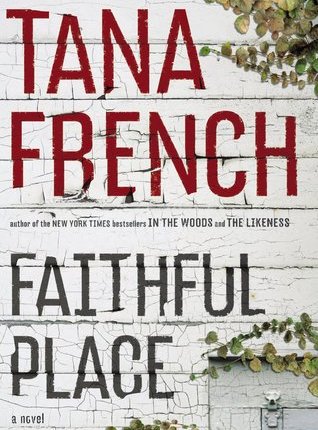
Faithful Place (Dublin Murder Squad #3) by Tana French

Faithful Place (Dublin Murder Squad #3) by Tana French

Faithful Place is a mystery and the backstory of Frank Mackey, the undercover agent readers first met in The Likeness.

Honestly, I didn’t like him, as a character, very much in the last book. This installment gave me understanding about why he’s so gruff and generally unkind. A difficult and abusive childhood has taken its toll on him.

There’s also the small matter of a broken heart over his teenage sweetheart, who never showed up the night they were going to run away together.

Photo by James Wheeler on Pexels.com

“The night faded to a thin sad gray and round the corner a milk cart clattered over cobblestones towards the dairy, and I was still waiting for Rosie Daly at the top of Faithful Place.” pg 13, ebook

But it turns out, Frank’s past isn’t as straight forward as all that. And that’s what he discovers in this book.

“No matter how good you are, this world is always going to be better at this game. It’s more cunning than you are, it’s faster and it’s a whole lot more ruthless. All you can do is try to keep up, know your weak spots and never stop expecting the sucker punch.” pg 14, ebook

The Dublin Murder Squad series continues to surprise me with how much I enjoy it. Tana French is a master at building suspense throughout the stories. Her world doesn’t get stale because you (at least so far) follow a different character in each tale, learning a bit more about them, and then moving on to the next character.

Photo by Javon Swaby on Pexels.com

“I was right to enjoy the normal world while I had it. Deep down, even while I was shaking my fist at the sky and vowing never to darken the cobbles of that hellhole again, I must have known the Place was going to take that as a challenge.” pg 141, ebook

French manages to convey visceral and surprising emotions in her stories, which I love. It makes the hair raise on my arms and gives me goosebumps. I find myself thinking about key plot points when I wake up in the middle of the night, wondering what’s going to happen next. Not many books have that effect on me.

Her characters are complex. They’re not angels, but they’re not demons. They’re something in between, very human, and they feel completely real.

Photo by Pavel Danilyuk on Pexels.com

“If you don’t know this by now, mate, you’d better write it down and learn it by heart: the right thing is not always the same as what’s in your pretty little rule book.” pg 158, ebook

And there’s always a moment in her novels, or sometimes two moments, that flips the story on its head. In this one, when that moment came, I had to read the passage twice and I even said aloud, “You’re kidding, right?”

Now, you don’t know this about me, but I am a completely silent reader. I never talk to the books. French has made me into one of “those” readers — a talking reader. That’s a pretty big deal.

Recommended for readers who like their mysteries to be thrilling and books that draw you in so much that you forget the real world for a time.

Thanks for reading!

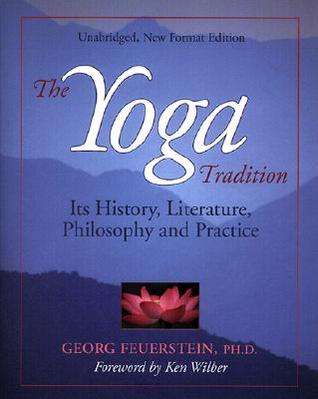
The Yoga Tradition: Its History, Literature, Philosophy and Practice by Georg Feuerstein

The Yoga Tradition: Its History, Literature, Philosophy and Practice by Georg Feuerstein

The Yoga Tradition is a reference book for the history and practical methods of yoga in its myriad forms throughout time and different religious traditions.

“In its oldest known form, Yoga appears to have been the practice of disciplined introspection, or meditative focusing, in conjunction with sacrificial rituals.” pg 27

Photo by Lucas Pezeta on Pexels.com

From these ancient beginnings, author Georg Feuerstein takes readers on a fantastical and spiritual journey through the various branches of yoga including Raja, Hatha, Bhakti, Jnana and more. He’s printed original texts, along with analysis of them, throughout the book to provide context and origin materials for each tradition.

What emerges in The Yoga Tradition is stunning in its complexity as well as sheer variety of methods, beliefs and practices.

“Long before the word yoga acquired its customary meaning of ‘spirituality’ or ‘spiritual discipline,’ the sages of India had developed a body of knowledge and techniques that aimed at the transformation and transcendence of ordinary consciousness. This stock of ideas and practices formed the matrix out of which grew the complex historical phenomenon that later came to be called Yoga.” pg 65

Photo by Karolina Grabowska on Pexels.com

Beyond sharing the history, philosophy, and practice of yoga, Feuerstein encourages modern scientists to look closely at the traditions in these pages to see what benefits could be gained from the ancient knowledge.

“Gradually, modern medicine and psychology, aided by advanced scientific concepts, methods, and instrumentation, are rediscovering some of the amazing facts that yogins have talked about and demonstrated for centuries.” pg 400

In my mind, that is one of the most exciting aspects of this book- what humanity could possibly learn about the enduring mystery of consciousness itself through the application of modern methods of study to ancient techniques.

Highly recommended for anyone interested in yoga and looking for a scholar’s thorough dissection of its history and forms. Your search can begin and end with this title.

Thanks for reading!

Machine (White Space, #2) by Elizabeth Bear

Machine (White Space, #2) by Elizabeth Bear

Dr. Jens, a rescue specialist for a medical group composed of different species from across the galaxy, is on a mission to save the lives of thousands of humans on an ancient ship, stranded among the stars. Something has gone terribly wrong with their computer system.

In addition, there’s a strange, and dangerous looking, machine in the hold of another, far more modern ship, that is attached to the archaic ship. Could it be the genesis of everything that went wrong or something more sinister?

“There could be people alive in there. We had to proceed as if there were, until we had proven otherwise.”

Photo by Pixabay on Pexels.com

Elizabeth Bear has created a fantastical, possible future in Machine where humanity has learned to manage some of our more troublesome brain chemistry through the use of sophisticated machines implanted in our heads.

I loved her imagining of what aliens (she calls them ‘systers’) may look like and how thousands of different people from worlds separated by both time and space would be able to come together and create something resembling a community.

It leads to some particularly interesting questions in this story as Dr. Jens is concerned primarily with the physical, and occasionally emotional, health of the beings, both flesh-bound and digital, whom she encounters.

“An AI couldn’t suffer a psychotic break, exactly. But they had their own varieties of sophipathology, and dissociation of their various subroutines into disparate personalities was definitely one that had been well-testified in the literature.”

I liked those aspects of the story- the exploration of a universe so far removed from my own.

Photo by Felix Mittermeier on Pexels.com

Unfortunately, I felt that this exploration was bogged down by long and meandering self reflection at key moments in the story. I realize that much of the development of the plot is an emotional journey for the characters, but it’s not fun to read about and occasionally comes off as a little preachy.

“We had to learn that there were more important things than being ‘right.’ Brilliant people are sometimes terrible at being people.”

And, as I said, it slowed the story down to a painful crawl through neurosis and the perpetual struggle Dr. Jens has between allowing her emotions or handling them through her technologically advanced and chemically-altering brain tech.

All that being said, Machine was an enjoyable sci-fi adventure and mystery, and I look forward to reading more from Elizabeth Bear in the future.

Thank you to NetGalley and the publisher for a free digital copy of this book for review purposes.

Patriarch Reliance (I Shall Seal the Heavens, #1) by Er Gen

Patriarch Reliance (I Shall Seal the Heavens, #1) by Er Gen

Meng Hao, an ambitious yet ultimately unsuccessful scholar, is kidnapped by a magically powerful woman and catapulted into a world of “cultivators”, mortals who grow their spiritual power in a never ending quest to become immortal. It is a dangerous world and Meng decides that the only way to stay alive is to become as powerful as he possibly can, as quickly as he can.

Photo by carol wd on Pexels.com

Patriarch Reliance was my first foray into the written world of the fascinating genre known as “wuxia”. I say ‘written’ because I this past summer I watched a show of the same genre on Netflix and thought it might be interesting to read a book. I Shall Seal the Heavens was one of the highest rated wuxia series available that has been translated into English.

What is wuxia? The definition from Google is: “a genre of Chinese fiction or cinema featuring itinerant warriors of ancient China, often depicted as capable of superhuman feats of martial arts.”

Patriarch Reliance is an adventure fantasy that uses many components of traditional Chinese medicine in its magic system or spiritual cultivation. Traditional Chinese medicine was a subject I’d never studied until I found myself looking up the topic to understand how the magic works in this book. It seems quite complex to me, but perhaps this is because I’m a newcomer to it.

Photo by Pietro Jeng on Pexels.com

The cultivators use a dizzying array of magical items with different abilities from a rain of swords to flying fans that turn into rays of light to almost anything imaginable. They are gathered and ordered by ability into sects with different legacies and secret attacks. The higher ups among the different groups fight as viciously as the newbies- perhaps more so because they have their reputations to maintain.

Despite the huge array of items and abilities, this book does become repetitious after two dozen chapters or so as Meng goes from one life threatening situation to another.

A curious aspect of the story was its deviation from my own expectations of what someone of higher spiritual power should act like. When I think of someone ‘spiritual’, I picture people like Mother Theresa, Dalai Lama, and Buddha.

Photo by Alexandr Podvalny on Pexels.com

The cultivators in Patriarch Reliance are nothing like that. They are, for the most part, violent, careless of life, and power-hungry. And they have to be. Or the people studying and meditating beside them will kill them!

I’m not sure what to make of the whole thing except that I’m going to continue on to the next book in the series. Because, despite my bewilderment, it is compulsively readable.

Recommended for fantasy readers who enjoy forays into completely unfamiliar worlds.

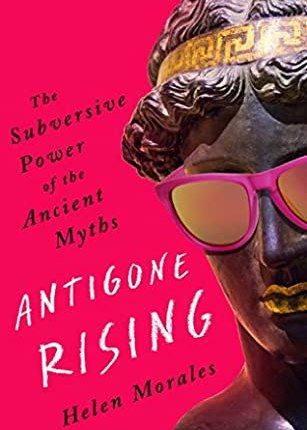
Antigone Rising: The Subversive Power of the Ancient Myths by Helen Morales

Antigone Rising: The Subversive Power of the Ancient Myths by Helen Morales

Helen Morales highlights troubling aspects of Greek and Roman mythology in a call-to-action to analyze and reimagine those myths for modern times.

As a classicist, I was familiar with most of the myths Morales examined. However, I was unaware of some of the toxic sub-context contained within them.

“My hope is that by tracing patterns and connections between ancient and modern beliefs and practices it will become easier to understand how misogyny operates and the ways in which classical antiquity plays a role (although it is not the only player and this is not its only role) in legitimating how misogyny operates today.” pg 14

Photo by Miggy Rivera on Pexels.com

The stories we tell ourselves are powerful. It shapes our expectations for our communities and the roles we occupy within them. Joseph Campbell pointed this out for the last generation. Perhaps Helen Morales will be the one to point it out for this one.

“The problem is that misogynist myths are more strongly culturally entrenched in our societies than myths that subvert them.” pg 148

But all hope is not lost. Creators from books to film to music videos are taking these myths and making them their own. With time, new interpretations will take hold.

Antigone is rising. Antigones (and Ismenes and Haemons) are rising.” pg 150

Photo by cottonbro on Pexels.com

Lest we forget, Morales reminds readers that ancient myths have been the inspiration for, among other things, “the Declaration of Independence and the US Constitution, trades union movements, Marxism, and the gay rights movement.”

It is all about how we interpret and tell the myths with each passing generation. Let’s choose carefully.

Thanks for reading!

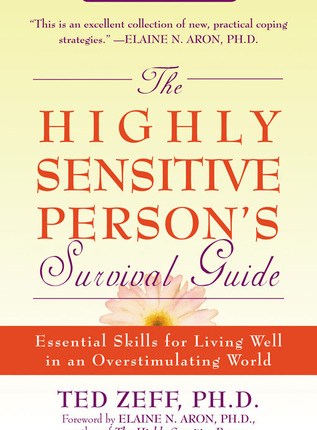
The Highly Sensitive Person’s Survival Guide: Essential Skills for Living Well in an Overstimulating World by Ted Zeff

The Highly Sensitive Person’s Survival Guide: Essential Skills for Living Well in an Overstimulating World by Ted Zeff

“Approximately 15 to 20 percent of the population have trouble screening out stimuli and can be easily overwhelmed by noise, crowds, and time pressure.” pg 10, ebook

Ted Zeff, a self professed highly sensitive person or HSP, shares coping mechanisms he’s cultivated throughout his life-long struggle with the unique way he responds to every day life. Topics range from improving work environments, personal relationships with non-highly sensitive people, getting a good night’s sleep and more.

While you can’t live your life totally removed from the world’s jolts, you can create an environment that minimizes stimuli. If you can anchor yourself to a ship of tranquility, you won’t be tossed about by the waves of stimulation.” pg 22

Photo by Anna Shvets on Pexels.com

I am a highly sensitive person too. Most of the tips and habits Zeff suggests in this book are common sense and were not all that helpful to me. The material also becomes somewhat repetitive as the book goes on. But, if you’ve just discovered this about yourself, I could see this book being eye-opening.

“Since our aggressive society values non-HSP behavior, HSPs must learn to create boundaries and speak up. Unfortunately, many HSPs are shy and feel embarrassed to state what they want.” pg 63

Something I did learn about in this book is the highly sensitive person issue of “time pressure”. I know deadlines and meet up times stress me out, but I didn’t realize that was fairly typical of highly sensitive people.

Photo by David Bartus on Pexels.com

“Combined with your high sense of responsibility, functioning under time constraints can be one of the most difficult aspects of being a highly sensitive person. In this section you will learn specific techniques to successfully deal with the daily pressures of our fast-paced modern society.” pg 32

If you only have time to read one book about highly sensitive people, the author himself recommends The Highly Sensitive Person: How to Thrive When the World Overwhelms You multiple times throughout this text. You may want to pick that one up and give this a pass.

Thanks for reading!