“I gradually understood the truth of my situation: I was a secret.” pg 14, ebook.
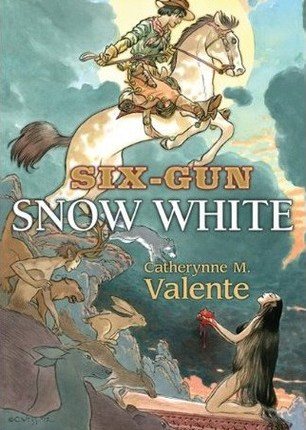
Catherynne Valente has penned a bewildering and ultimately disappointing western-tinged fairy tale retelling in Six-Gun Snow White. Her reimagining of the classic story has Snow White as an unloved daughter of a mine speculator and an abused, indigenous mother. When her mother ends her own life, Snow White’s father marries a mysterious woman from back East, the evil stepmother of fairytale infamy, whom the narrator calls Mrs. H.
“She named me a thing I could aspire to but never become, the one thing I was not and could never be: Snow White.” pg 27, ebook
The disappointing part of the story is not the set up or general idea of Snow White as a western, both of which I thought were excellent. The trouble arrives in the magical portions of the story which are, in my opinion, not well written. They felt disjointed and tacked on.
It’s curious to me that I didn’t like this story because Valente is one of my favorite authors. There is no one like her when it comes to an interwoven story or mysterious magic. Maybe my issue with this tale is that it’s so short Valente didn’t have a chance to work her usual story telling magic? Perhaps.
“Since the dawn of humanity, in all cultures and religions across the globe, trees have been revered not only as a life-sustaining source of food and medicine but also as a place where spirits dwelt, awaiting to reveal great mysteries to those who sought their wisdom, knowledge, and magick.” pg 2
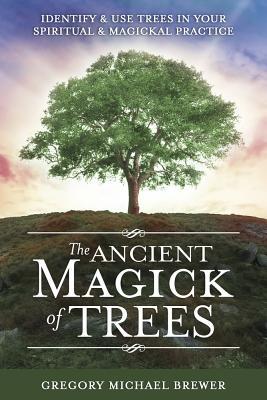
Author Gregory Brewer examines the wonder and mystery that are trees from the pagan perspective in this book which is part informational, tree-related ritual/meditation suggestions, and reference.
Understanding the symbolism of trees throughout countless cultures of human history is an enlightening study, but equally important is learning to form a personal connection with them in order to better comprehend the interaction of how the divine reveals itself to us through nature.” pg 243
The majority of the book is dedicated to descriptions and occult associations for different types of trees.
I read The Ancient Magick of Trees in order to learn more ways to invite nature into my life. The book has that but I found Forest Bathing: How Trees Can Help You Find Health and Happiness to be more immediately practical. I also connected more with the information in the forest bathing book.
“The third time she was reborn, Gullveig fled, though she left something behind: her speared heart, still smoking on the pyre.” pg 4
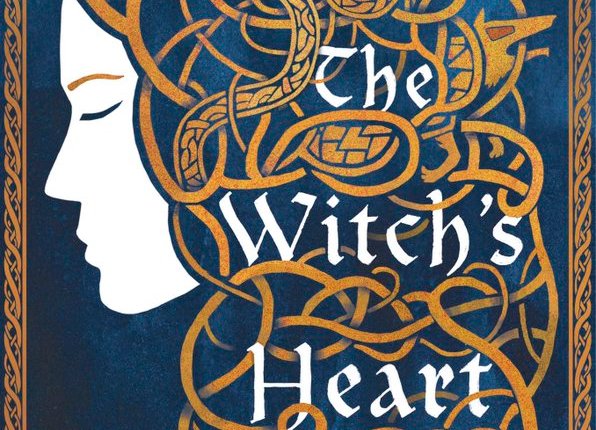
Angrboda, the Norse witch formerly known as ‘Gullveig’, is hiding from the Aesir when the trickster god Loki finds her. And changes her life (or in her case: lives) forever.
“Although her memories as Gullveig were vague enough, she recalled feeling like she didn’t belong – and the moment they’d turned on her, burned her, she’d felt a lot of things. But the emotion she could recall most distinctly was not fear or anger, but the feeling of being used.” pg 43
The gods kill Angrboda because of her refusal to share the secret of her scrying power, called ‘seid’. She will not look into the future and give Odin the mysteries that reside at the end of all things.
Odin does not take no for an answer.
Genevieve Gornichec reimagines the shadowy character of Angrboda in this Norse myth-filled retelling. Maybe it’s because I’m a classics major and gravitate towards mythology, but it seems to me that it has become somewhat popular to do so – think The Song of Achilles or Circe.
In this case, I feel like Gornichec didn’t go far enough in her imagining. She gave Angrboda a voice, a rare talent, and a fierce love for her children, but, beyond that, the witch remains a fairly passive character.
Part of this could be due to the fact that the Aesir are such powerhouses in the old myths. They hog the spotlight and the action. But still, I believe there’s enough room around the stories to give a figure whose mythology has been largely forgotten a new legacy.
I think the biggest missed opportunity for this is in Angrboda’s relationship with Loki.
“She would do anything for him, she realized then… And for some reason, this scared her, as if the thought itself were a promise she knew that she couldn’t hope to keep.” pg 74
Like the other major players in the mythology, readers will be familiar with many of Loki’s hijinks. He is constantly in action, tricking people or becoming the victim of his own cleverness. What readers have never really gotten to see is his interior world. What is he thinking when he pulls his legendary stunts? What are his secret motivations?
One would think this is something he might share with a lover. But the storytelling never quite got there and I found The Witch’s Heart to be rather a disappointment in that way.
That being said, if you’re a reader who enjoys mythological retellings, there is still much to enjoy in this story. It is well-written if fairly limited in scope.
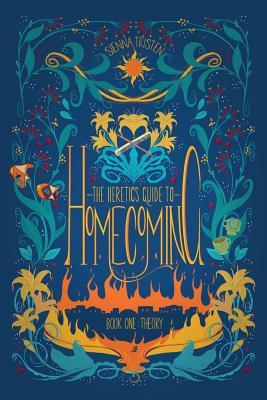
The Heretic’s Guide to Homecoming is a fantasy journey in which Ronoah, an introverted and anxious main character, discovers a strength inside himself that he didn’t know he had and, along the way, learns about the world outside of the regimented and ill-fitting expectations of his hometown.
It is not a simple adventure because Ronoah, with all of his hang ups, is a very unlikely hero.
“… Ronoah was not one tenth the rebel she needed him to be. Inertia had him by the throat, and its consequence was a keen pain squatting ugly at the bottom of his soul, rotting it from the roots up.” pg 9
Like other readers, I found author Sienne Tristen‘s depiction of Ronoah’s crippling anxiety and panic attacks to be one of the most insightful and sensitive pieces of writing I’ve ever had the privilege to read. Unlike most works of fantasy in which the action takes place in an external world, Ronoah’s greatest battles are in his own mind.
The anxiety speaks with its own voice and becomes a main character throughout the story.
“What were you thinking, it sneered, acting like you’re so important, so worldly, making it out like you’re some big intellectual champion when all you really are is a petulant runaway with a few bits of trivia stuck in your useless head? Talking and talking like you’re an authority on anything- who do you think you are?” pg 53
Ronoah’s interactions with the other characters from the book take on a secondary importance to the all-encompassing relationship that he has with his inner world. But they are still beautiful connections.
“… He had this way of grabbing life by the horns and refusing to let go, no matter how it tried to shake him off. You know those people you sometimes find, the ones who…” “Who shine.” pg 154
Sienna Tristen’s writing brings to light foibles of anxious people that might otherwise remain shrouded in the sufferer’s inability to vocalize their feelings. Anybody who has ever spent a sleepless night stuck in the agony of fear and indecision will understand exactly what Tristen is spelling out in this story.
On the other hand, I found the first two-thirds of the book to be extremely triggering because of this gigantic magnifying glass that is held up to anxiety. The pacing didn’t do me any favors either. As Ronoah slowly twisted in the unending spirals of panic in his own head, I hung on the hook right along with him.
It was helpful to see Ronoah’s thinking process which Tristen writes so beautifully. Almost every time, readers can feel the moment he tips from functional person with some worries to frozen anxious mess. In my own life, I’ve started to watch for those tipping points- the moments I go from concerned about the future to paralyzed by anxiety. It has actually been quite illuminating.
But all of that new found self knowledge doesn’t make for a fun read. Fiction is one of my escapes from reality. In this book, I found quite a lot of reality and it wasn’t an escape after all.
“How far do you have to push your boundaries before you can feel them stretch? How high do you have to climb before your horizon expands? Is it possible to notice your own growing, or is improvement like an eyeball- visible to everything but itself?” pg 193
Recommended for readers who don’t mind very slow pacing in exchange for gorgeous writing about anxiety. Mind the triggers.
“All too late it is beginning to be realized, slowly indeed but no less surely, that the historic evolution of dress and personal ornament offers a wide field for methodical study; that it is in fact a science and can be made to subserve worthier ends than those of mere amusement.” pg 11, ebook
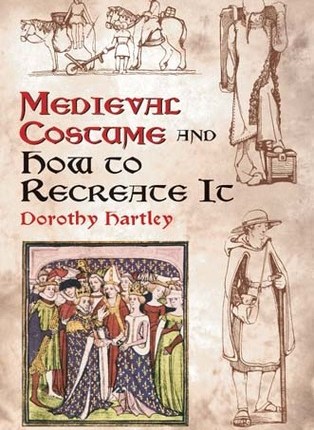
Medieval Costume and How to Recreate It by Dorothy Hartley is more of a history book than practical manual for dressing as a historical figure, unless the reader happens to have a very highly developed tailoring ability.
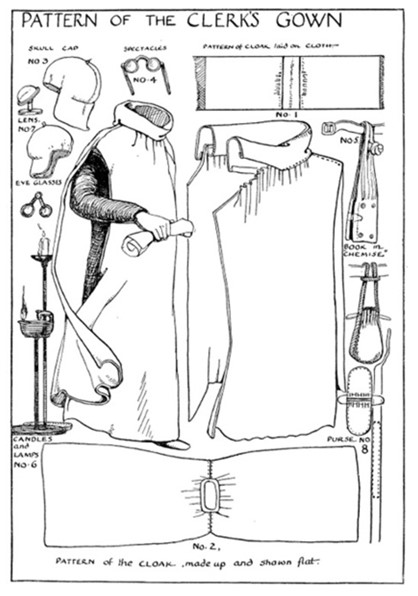
From the book.
At least, more than I currently have.
That being said, the divisions of different types of historical costumes into profession is inspired. As author Dorothy Hartley explains, at the beginning of the book, professions had a huge affect on how medieval persons looked. Think doctor compared to butcher compared to musician or priest.
“After the careful restrictions of religion and royalty, musicians are refreshingly loose, and may wear anything. Since there is no definite costume for musicians we have concentrated on robes and sleeves that give free play to the arms.” pg 74, ebook
In addition to the visible clothing, this book delves into the garments worn under historical clothing, which was a topic I hadn’t considered before. But, as Hartley writes, dressing as a historical figure gives the roleplayer the opportunity to both entertain and educate through the details of the costume.
For example, the thickness and type of the fabrics that go into hose have an obvious function as well as a proper place on timeline of historical costumes.
“To the casual enquirer it will no doubt seem a curious anomaly: it is none the less a fact that in the majority of costume-books no portions of man’s apparel are slurred over in so haphazard a fashion as those under the above heading.” (hose and breeches) pg 80
This book is a learning experience but, as I mentioned, also a practical one if you already know how to construct a shirt or are curious about how to make a cloak hang correctly.
“The idea of Less Doing is to reclaim your time and- more important- your mind, so you can do the things you want to do.” pg xv
Ari Meisel, a self-professed “achievement architect”, outlines ways to streamline your chores, finances, and more in order to free up time for the activities, and people, that are most important to you.
“I don’t want you to run errands, ever ever ever again. They’re not efficient, and there’s no way to make them efficient.” pg 69
Many of his suggestions are common now, like setting up an automatic delivery from Amazon for your regularly needed household items like toilet paper and paper towels. But when I considered that this book was published in 2014, then it seemed like a stroke of genius.
However, that won’t necessarily be useful to readers who are looking for more updated suggestions to make their lives that much more efficient- except for a few of his timeless strategies. For example, measure and monitor how much time it takes you to do things so then you can figure out where your time is going to.
Not rocket science, but helpful.
The one suggestion of his that I found most intriguing was his idea of creating an ‘external brain’. Basically, you write notes, diary entries, clip electronic articles and organize it in a program (he likes Evernote) so that you can access it again quickly if you would like.
“… you can create an ‘external brain’ that stores everything reliably, offers instant access, and frees your mind for more interesting work.” pg 18
I thought this approach could be very helpful for someone like me who reads and researches different topics all the time, for the fun of it, but also for professional content creators who are looking for their next blog post or YouTube video, etc.
How much easier would it be to be able to access all of your previous research rather than having to start over from scratch each time?
On the other hand, there is a massive amount of time required to both create this external brain and keep it updated. I suppose the investment only makes sense depending on what you’re eventually going to use the database for.
Recommended with reservations for readers who are looking for ways to streamline their lives.
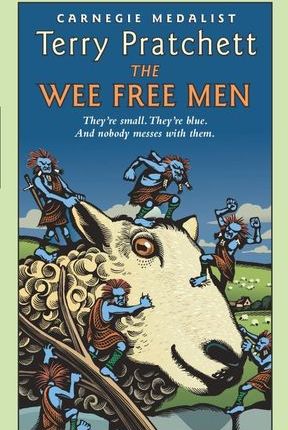
With those three sentences, Terry Pratchett introduces readers to one of the most beloved characters from his Discworld series, Tiffany Aching.
Young Tiffany lives in sheep raising country, where chalk from an ancient sea lies beneath the ground. When an otherworldly creature bursts out of a creek and tries to pull her and her little brother Wentworth beneath its waters, Tiffany fights back.
It is the beginning of a life or death struggle with monsters from worlds beyond Discworld, though Tiffany does not know it at the time.
But luckily for her, there are allies who will join her in this fight- the Wee Free Men.
“In the reeds, quite low down, small voices whispered: “Crivens, Wee Bobby, did yer no’ see that?” “Aye, we’d better offski an’ tell the Big Man we’ve found the hag.” pg 10
Pratchett weaves this coming of age story with humor and magic. He utilizes the best themes of the Witches Discworld subseries to do so.
Tiffany discovers headology, the importance of belief and appearances, and her own mysterious connection to a witch legacy that was hiding in plain sight in the hills.
The pacing of the tale is quick, racing from one danger to the next, and perfect for young adults or reluctant readers who enjoy fantasy.
In addition, Pratchett uses a real life painting in the story which adds another layer of ‘fairy magic’ to the telling. The artwork is “The Fairy Feller’s Master-Stroke” by Richard Dadd and you can see it here: https://bit.ly/3tW58bb
Detail of “The Fairy Feller’s Master-Stroke”
The surreal painting captures the unsettling feel of the creatures and worlds Pratchett so deftly describes. It is also whimsical, but hints at the danger lurking in the shadows.
For the past few weeks, I have been doing a read-through of the Discworld Witches series and really disliked the last one, Maskerade. I felt like the witches’ character flaws were beginning to dominate the story, which was draining its humor and heart away.
The Wee Free Men brings magic and heart back into the equation. In Tiffany, readers discover a brave young girl who wants to do the right thing but doesn’t have any one to show her the way. We know her mentors will show up eventually, but until then, she and the wee free men need to figure things out on their own.
And how they do that is a very good story. Highly recommended.
The First 100 Chinese Characters, Simplified Character Edition: The Quick and Easy Way to Learn Basic Chinese Characters delivers on everything it promises in the title except the part that mentions “easy”.
I didn’t find it easy at all.
“You’ll be learning a writing system which is one of the oldest in the world and which is now used by more than a billion people around the globe every day.” pg 4
After a brief introduction in which the author Alison Matthews outlines the book (there is a pronunciation guide, explanation about the construction of the language, techniques and more), it hops right in to the basic characters, beginning with numbers.
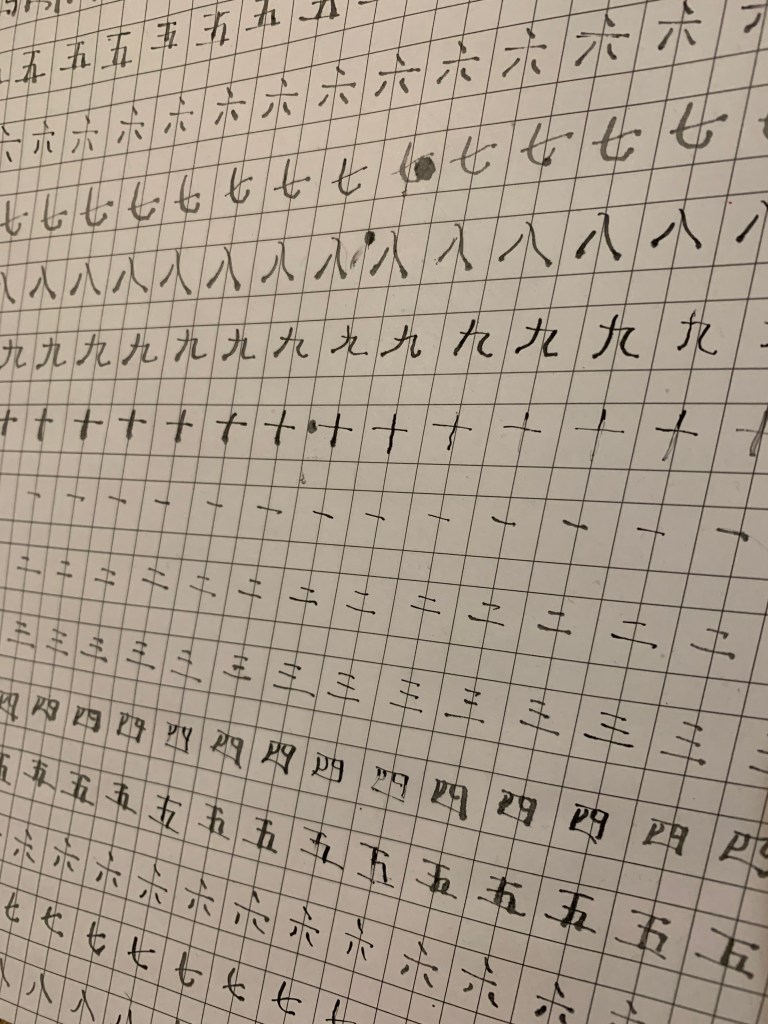
The book provides plenty of space for practice, but I utilized calligraphy paper because I’m not allowed to write in a library book. 🙂
That being said, I am going to acquire a copy of this just for me, because not only is it fun, but also it’s going to take me longer than a few weeks to master the basics.
I had some warning going in to this project that it wasn’t going to be a cakewalk. One of my nephews took Chinese as his foreign language option in the lower grades and, though he’s a smart little dude, he said it was very difficult.
It is. But it is also beautiful. I love how the characters sometimes resemble the words they stand for, a dimension English lacks with our boring Roman alphabet.
My efforts at writing Chinese numbers!
And like calligraphy, there is an art to creating the characters. I suppose the same could be said of cursive, but it doesn’t have the same feel at all. When I finish a practice page of Chinese characters, I feel like I’m looking at a painting rather than an essay.
In addition, being a left-hander is a benefit in writing Chinese rather than the hindrance that I feel it has been for me in English. The characters are traditionally written top to bottom, right to left. I don’t smear the ink across my hand and wrist! It’s been quite novel.
Highly recommended for anybody interested in learning how to write Chinese characters.
“Orhan.” Nobody called me that. “You’re a clever man and you use your brain, which makes you unique in this man’s town, but you’ve got to do something about your attitude.” “Attitude? Me?” pg 16
Through a series of unfortunate events, Orhan, the leader of a group of military engineers, finds himself in charge of the defense of “the City”, the capital of the Robur empire. The Robur empire seems to have been loosely based on the Roman empire, which, in its conquering of the world, took diverse sets of people and organized them into useful groups under its overarching control.
Orhan is one of these conquered peoples. But he has a unique set of skills, all of which will be put into use during the siege that is to come.
“My meteoric rise, from illiterate barbarian serf to commander of an Imperial regiment, is due to the Hus, the Sherden, the Echmen and, last but not least, the Robur, who are proud of the fact that over the last hundred years they’ve slaughtered in excess of a million of my people.” pg 5
The story is told entirely from Orhan’s point of view in first-person narrative. This invites the reader to step into Orhan’s shoes and makes the tale quite exciting and immediate.
On the other hand, Orhan is emotionally bereft and runs his life through merciless logic, which doesn’t always serve him, or the people around him, very well.
“That’s one thing about human beings I don’t see the point in: love. It does nobody any good. You love someone, and either they let you down or they die. Either way, you end up crucified.” pg 55
He is an impatient and, occasionally, violent character, who literally punches people when they don’t conform to his view of the world fast enough.
In other words, wearing Orhan’s shoes for the length of the story is an uncomfortable ride for anyone who uses a modicum of emotional intelligence in their lives.
Photo by Miquel Rossellu00f3 Calafell on Pexels.com
That being said, K.J. Parker (pen name for Tom Holt) has done a brilliant job of creating an unforgettable, if unpleasant, narrator. By the end of the book, even though I didn’t like him, I found myself rooting for Orhan anyway because that’s the kind of reader I am.
But if you have trouble connecting with stories where you don’t like the characters, this might not be the book for you.
The one moment where I did connect with the narrator was when he discovers his importance in the siege that is to come.
“If, as I was horribly afraid, I was the senior military officer in the City, I needed confirmation or a warrant or something. If there was someone higher up than me, I desperately wanted to hear about him and ask him for orders.” pg 78
I used to have similar feelings when I first started working as a reference librarian at the library. Prior to that, as a circulation assistant, if I had any question about anything having to do with the library or technology or research, I’d call up whoever was sitting at the reference desk and they’d supply me with the answer.
It was my own version of chain-of-command. There was an unspoken faith that I carried- if I didn’t know the answer, the reference librarian would so there was never any reason to worry.
The day that my training was done, my supervisor went home, and I was left alone at the reference desk, that was my Orhan moment. If I didn’t know or couldn’t find the answer, there was no one else for me to turn to.
It is humbling to realize that it all rests on your shoulders, but it is also a character making moment. How you respond to the pressure says so much about you. And that is the strength of this story, the slow revelation of Orhan’s character under pressure.
Recommended for readers who enjoy historical fiction. Though this is classified as a fantasy too, I feel like it veers more into a parallel universe than a true fantasy world where magic is real and otherworldly creatures are running around. I’d be curious to know what other readers think about its genre.

















 The Help Desk Book Blog